


If you work in an office, study business communication, or manage a team, you have probably written or received a memo. Memos are one of the simplest and fastest ways to share information across departments. Yet, many people still struggle to write a good one.
So today, let’s fix that. By the end of this guide, you’ll know exactly how to write a memo that is professional, clear, and easy to understand. You’ll also get practical templates and examples you can use right away.
What Is a Memo?
A memo, short for memorandum, is a short internal document used to share information, make requests, give updates or issue reminders within an organization. Unlike a business letter, which usually goes to outside parties, a memo circulates inside the company between departments, managers and employees.
Preparation Before Writing a Memo
Before typing a single word, it’s smart to pause for a moment. Ask yourself, “What do I want to communicate, and who needs to read it?”
Here’s how to prepare effectively:
- Identify the purpose: Decide whether your memo will inform, request, or remind.
- Know your audience: Write differently for a manager than for a colleague.
- Choose the right tone: Most memos use a formal or neutral tone.
- Decide the format: Will it be a printed memo or an internal email-style memo?
Remember, preparation saves time. When you are clear about your purpose, the writing becomes ten times easier.
For deeper insights on communication preparation, you can check out When Written Communication Becomes More Effective.
Memo Writing Format (Standard Layout)
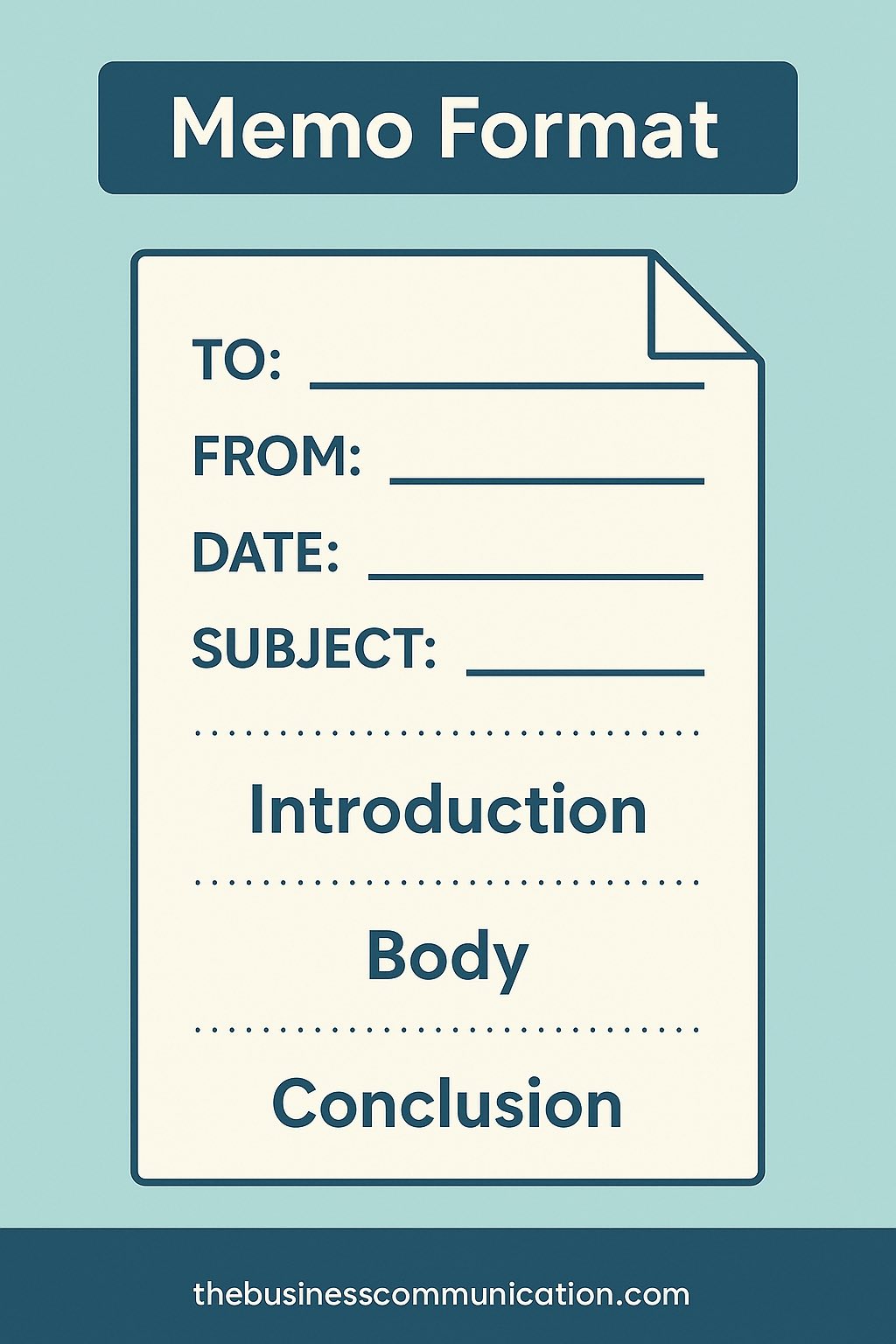
Every memo follows a fixed structure. Think of it as the “skeleton” that holds everything together.
A standard memo usually includes:
Heading Section
- To: Person or department receiving the memo
- From: Your name or department
- Date: The date the memo is written
- Subject: Short and direct topic
Body Section
- Opening paragraph: State the purpose clearly.
- Middle paragraph(s): Explain details or background.
- Closing paragraph: Summarize or request specific actions.
Formatting rules are simple. Use single spacing, left alignment, and a professional font. Avoid fancy colors or emojis (save those for chat messages).
- Use a standard font such as Arial or Times New Roman in 12 pt.
- Keep 1-inch margins on all sides.
- Many organizations print “MEMORANDUM” or “MEMO” at the top of the page.
- Separate the header, body and any attachments with spacing or bold headings.
- If your company has a branded memo template, follow it.
Step-by-Step Guide: How to Write a Memo
Let’s now move through each step to create a professional memo.
Step 1: Start with the Header
At the top, include the four essential lines: To, From, Date, and Subject.
For example:
To: All Employees
From: HR Department
Date: November 2, 2025
Subject: Updated Work-from-Home Policy
This makes the memo clear and formal right from the start.
Step 2: Write a Clear Subject Line
Your subject line should be short and focused.
Bad: “Some Important Things About Work”
Good: “Guidelines for Remote Work Policy Update”
A good subject tells the reader exactly what the memo is about before they even start reading.
Step 3: Write an Engaging Opening Line
The opening paragraph should immediately tell readers why they are reading the memo.
For example:
“This memo provides updated details about the company’s new remote work policy starting next month.”
Avoid unnecessary greetings or long introductions. Get to the point quickly but politely.
Step 4: Provide Key Details in the Body
Now explain your message clearly and logically. Use short sentences and bullet points if necessary.
For instance:
“Employees working remotely must log in between 9 AM and 5 PM. Team meetings will be held every Monday at 10 AM through Zoom. Performance reviews will include virtual attendance records.”
See? Direct, simple, and easy to follow.
Step 5: End with a Call to Action or Summary
A strong closing makes the memo complete. End by telling the reader what to do next.
Example:
“Please review the attached guidelines before November 10 and contact HR if you have any questions.”
That one sentence turns the memo into a clear action plan.
Step 6: Review and Edit
Before you send or print your memo, review it carefully. Check for grammar, tone, and formatting errors. Make sure your memo looks clean and professional.
If you’d like, you can also refer to Qualities of Good Communication to understand what makes written messages effective.
How to Write a Memo Subject Line
A memo subject line should name the topic and, if needed, the action or deadline in a few specific words. It sits in the header after To, From and Date, and it helps readers decide what to read first and find the memo again later. Avoid one-word subjects such as “Update” or “Meeting.”
To: All Department Heads
From: Finance Department
Date: [Month, Day, Year]
Subject: Q1 Budget Report - Approval Needed by Friday
5 Formulas for Memo Subject Lines
- Topic + action required: Employee Survey – Please Complete by Friday
- Urgency + specific event: URGENT: Server Maintenance Downtime
- Benefit + topic: Flexible Work Schedule Now Available
- Date + meeting name: Nov 5 – Weekly Staff Meeting Agenda
- Policy name + status: Travel Expense Guidelines – New Procedure
Memo Subject Line Examples
- Action Required: Q1 Marketing Budget Approval
- Signature Needed: Vendor Contract Renewal
- Please Review: Draft Proposal for Project X
- Welcome to the Team: [Name], New Head of Sales
- Update: New Remote Work Policy Effective [Date]
- Reminder: Office Closure for Public Holiday
- Mandatory Training: Cybersecurity Awareness Workshop
- Security Alert: Phishing Emails Detected
- Correction: Update to Previous Sales Figures
- Progress Update: Warehouse Expansion
Good vs. Bad Memo Subject Lines
| Weak subject | Better subject | Why it works |
|---|---|---|
| Meeting | Planning Meeting: Q4 Goals (Oct 12) | Adds the topic and date |
| Question | Clarification Needed on Expense Policy | States the actual question |
| Read This | Important: New Security Protocols | Explains why it matters instead of giving an order |
| Update | Project X: Status Update – Phase 1 Complete | Shows what changed |
| Hello | Welcome: John Doe, New IT Manager | Says what the memo is about |
A memo subject is usually more formal than an email subject because the memo becomes a record. For an email you might write “Quick q about the budget?”; for a memo, write “Inquiry Regarding Q3 Budget Allocation.” Use tags such as [URGENT], [CONFIDENTIAL] or [ACTION REQUIRED] only when they are true. If every memo is marked urgent, readers stop taking the tag seriously. For ready-made formats, see these business memo templates.
Effective Writing Tips for Memos
Here are some simple yet powerful tips for writing great memos:
- Keep it short, ideally one page.
- Use clear, active voice sentences.
- Stick to one topic per memo.
- Avoid long background stories.
- Use bullet points for clarity.
- Maintain a polite, respectful tone.
- Always proofread before sending.
- Be specific about deadlines and the action you expect.
For example, instead of “It is requested that reports be submitted by Friday,” write “Please submit your reports by Friday.”
If you master these basics, your memos will be both professional and pleasant to read.
Memo Template (Ready-to-Use Format)
Here’s a ready-to-use template that you can copy and fill in with your details:
To: [Recipient’s Name / Department]
From: [Your Name / Department]
Date: [Month, Day, Year]
Subject: [Memo Subject Here]

[Opening paragraph: State the reason for writing the memo clearly. Be brief and direct.]

[Middle paragraph(s): Provide relevant details, explanations, or background information. Use bullet points if needed for clarity.]

[Closing paragraph: Summarize the main idea or give instructions on what to do next.]
This is the standard format used in most organizations. Keep it simple and professional, and you’re good to go.
Common Types of Memos
The format stays the same, but the purpose changes the content. Common types of memos include:
- Informational memo: shares updates or general news, such as a new company policy.
- Request memo: asks for approval, data or resources, such as a training budget.
- Confirmation memo: records decisions or agreements made in a meeting.
- Policy memo: sets out organizational policies and procedures.
- Proposal memo: introduces a new idea, plan or strategy.
A short memo covers one topic in a few paragraphs. A longer memo may need section headings and tables.
Practical Examples of Memos
Here are a few real-life examples you can adapt to your own workplace.
1. Office Announcement Memo
To: All Staff
From: Administration Department
Date: November 2, 2025
Subject: Change in Office Working Hours

This memo informs all employees that our office hours will change starting from November 15. The new working hours will be from 9:00 AM to 5:30 PM, Monday to Friday.

The change has been made to align with client availability across different time zones. Kindly adjust your schedules accordingly.

Thank you for your understanding and cooperation.
2. Meeting Reminder Memo
To: Marketing Team
From: Project Coordinator
Date: November 2, 2025
Subject: Reminder: Monthly Marketing Strategy Meeting

This is a reminder for our upcoming marketing meeting scheduled for Tuesday, November 5, at 10:00 AM in Conference Room B.

The agenda includes campaign performance updates, new ad strategies, and upcoming promotional activities. Please come prepared with your department’s progress report.

See you all at the meeting.
3. Policy Update Memo
To: All Employees
From: Human Resources Department
Date: November 2, 2025
Subject: Update on Leave Policy

We have revised the annual leave policy to provide better flexibility for employees. The updated policy now allows you to carry forward up to 10 unused leave days to the next calendar year.

Please review the detailed policy attached and contact the HR team if you have any questions.

Your cooperation is appreciated.
4. Appreciation Memo
To: Sales Department
From: Managing Director
Date: November 2, 2025
Subject: Appreciation for Achieving Sales Target

I am pleased to congratulate the entire Sales Department for exceeding the quarterly target by 15%. Your dedication and teamwork are truly commendable.

Keep up the excellent work, and continue setting an example for other departments. Lunch will be arranged this Friday in your honor.
5. Deadline Reminder Memo
MEMORANDUM

To: All Department Heads
From: HR Director
Date: October 30, 2025
Subject: Reminder: Annual Performance Review Deadline

This memo is a reminder about the upcoming deadline for submitting annual performance reviews.

Please complete all evaluations and submit them to HR by November 15, 2025. Late submissions may delay the appraisal process. If you need any clarification, contact the HR office before November 10.

Thank you for your cooperation in keeping submissions on time.
Memo vs. Other Business Documents
| Document | Purpose | Audience |
|---|---|---|
| Memo | Internal communication, kept as a record | Employees or departments |
| Letter | External, formal communication | Clients and other outside parties |
| Quick, often conversational messages | Internal or external readers | |
| Report | Analysis or detailed information | Management or stakeholders |
| Notice | Public announcement | Employees or the public |
For a closer comparison, read circular letter vs memo vs notice and memo vs email.
Sending a Memo Digitally (Email, Slack, Teams)
Many memos are now shared by email or through internal tools such as Slack, Microsoft Teams or Google Workspace. To adapt the format:
- Keep the header simple: To, From, Date and Subject.
- Use bold headings to separate sections.
- Add links or attachments instead of pasting long background material.
- Keep a polite, professional tone, even in informal channels.
Common Mistakes to Avoid
Even experienced professionals make mistakes when writing memos. Here are a few to watch out for:
- Using vague subject lines like “Important Information.”
- Writing long, confusing paragraphs.
- Forgetting to include a date or sender.
- Being overly casual or emotional.
- Ignoring proofreading before sending.
Avoiding these will make your memo more credible and professional.
Final Thoughts
Writing a memo isn’t difficult once you understand the process. The goal is simple: communicate clearly, briefly, and effectively. Always remember that people in workplaces are busy, so respect their time by being direct and organized.
A well-written memo reflects your professionalism and attention to detail. So next time you prepare one, use these steps, follow the format, and apply the examples provided here. You’ll notice how smoothly your office communication improves.
Frequently asked questions
Should I send a memo as email or print it out?
Use email for routine updates and quick announcements. Print memos for formal policies, legal records, or when you need physical documentation. Email is faster and more common today, but printed memos work better for official company records that employees need to sign or file. Choose based on your organization’s culture and the memo’s importance.
What if my memo needs to go to multiple departments with different needs?
Write separate memos for each audience. A single memo addressing different departments often confuses readers about what applies to them. If the core message is identical, use one memo but clearly label sections by department. For example: “For Sales Team:” and “For HR Team:” with distinct action items for each group.
Can I use a memo format for sensitive or confidential information?
Yes, memos work for sensitive topics, but add a “Confidential” or “For Internal Use Only” line in the header. Keep the tone professional and factual. Avoid emotional language or unnecessary details. Consider whether email or a printed memo is more secure for your situation. Sensitive memos should be reviewed by management before distribution.
How long should a memo be if the topic requires detailed explanation?
Keep the memo itself to one page. If you need more space, attach supporting documents or appendices instead. Reference them in the memo body: “See attached guidelines for full details.” This keeps your memo scannable while providing depth where needed. Readers appreciate concise memos that direct them to detailed resources.
What if no one responds to my memo or takes the requested action?
Your memo may lack clarity or urgency. Review your call to action—is it specific and time-bound? Did you explain the “why” behind the request? Consider following up with a brief email or meeting if the deadline passes. Also check that the memo reached the right people and that your tone wasn’t too casual or unclear.
What are the four headings of a memo?
The four headings are To, From, Date and Subject. They appear at the top of the memo, before the opening paragraph.
Can I use a memo to deliver bad news or criticism?
Yes, but keep a professional, neutral tone. State the facts without emotion, explain the issue clearly and end with next steps. For sensitive feedback, talk to the person privately first, then send a memo to document what was discussed and agreed.
Should I include my name in the memo subject line?
No. The From line already shows who sent the memo. Use the subject line for what the memo is about and what the reader needs to do.