


Feedback is what transforms a one-sided announcement into a genuine exchange. Understanding why feedback matters helps you close communication gaps, improve team coordination, and make better decisions based on real input rather than assumptions. This article explains the essential role feedback plays in completing the communication process, driving employee engagement, and preventing costly organizational missteps.
What is feedback in communication?
Feedback is the receiver’s response to the sender’s message. It can take many forms: a verbal acknowledgment, a written reply, a facial expression, or even silence that signals confusion or disagreement. Feedback is active, not passive. When your colleague nods during your presentation, when a team member emails clarifying questions, or when an employee’s body language shows hesitation, you’re receiving feedback.

This response completes the two-way communication loop. Without feedback, communication remains one-directional, a broadcast with no confirmation that the message landed as intended. The sender transmits information but has no way to verify understanding, adjust the message, or address misinterpretations. Feedback converts a monologue into a dialogue.
Most people think feedback only happens in formal settings like performance reviews. You give and receive feedback constantly throughout your workday, often unconsciously. A quick “Got it, thanks” after a meeting, a thumbs-up emoji on Slack, or a puzzled look during a presentation all constitute feedback that shapes how the conversation continues.
Why feedback is essential to complete the communication process
Communication is not complete when you hit send on an email or finish delivering a presentation. It’s complete when the receiver responds and the sender knows the message was received and understood. Feedback closes the sender-receiver cycle, confirming that your intended meaning matches the receiver’s interpretation.
Consider a project manager who sends a 1,200-word email outlining new deliverable deadlines to a remote team. Without feedback, she has no idea whether team members read the email, understood the new timeline, or flagged potential conflicts with existing commitments. When three team members reply with clarifying questions and one flags a scheduling conflict, the manager now has confirmation. She can adjust her approach, provide additional context, or revise the timeline before problems escalate. This adjustment mechanism prevents miscommunication and costly organizational errors. A manufacturing supervisor who receives immediate feedback that safety instructions were unclear can re-explain the procedure before an accident occurs. A sales director who hears from regional managers that a new pricing strategy confuses customers can revise the approach before revenue drops. Feedback acts as an early-warning system, catching problems when they’re still manageable.
How feedback measures communication effectiveness
Feedback validates that the receiver understood your message as you intended it. When you explain a new policy and your team accurately summarizes the key points back to you, you have evidence that your communication succeeded. When they misstate critical details or ask questions that suggest fundamental confusion, you know the message failed to land.
This validation reveals gaps between intended and perceived meaning. You might think your project brief was crystal-clear, but feedback showing that half your team misunderstood the scope tells you otherwise. These gaps often stem from barriers to effective communication like jargon, cultural differences, or information overload. Feedback exposes these barriers so you can address them.
Feedback also enables you to assess whether your chosen communication medium was appropriate. A complex technical change might require a live meeting with Q&A rather than a dense email. If you send a 2,000-word policy memo and receive zero questions or acknowledgments, the silence itself is feedback. Your audience either didn’t read it, didn’t understand it, or didn’t care. That tells you to try a different channel next time: perhaps a brief video walkthrough or a team meeting with discussion time.
According to research from Gallup, employees whose managers provide regular feedback are three times more likely to be engaged at work. This isn’t just about frequency, it’s about creating a feedback-rich environment where communication effectiveness is constantly measured and improved.
Feedback’s role in decision-making and information gathering
The receiver’s feedback communicates opinions, concerns, and insights that inform your next decisions. When a finance director proposes budget cuts and department heads provide feedback on how those cuts would impact operations, that input shapes the final decision. Without it, the director operates on incomplete information.
One-way communication only transmits information outward. If you want to gather intelligence, understand ground-level realities, or test ideas before committing resources, you must seek feedback. A CEO who announces a new strategic direction and then asks regional managers for feedback on implementation challenges will make better decisions than one who simply expects compliance.
This dialogue is particularly valuable for gathering information across departments. When marketing shares campaign plans and receives feedback from sales about customer objections they’re hearing, both teams benefit. Marketing adjusts messaging to address real concerns, and sales gains clarity on how to position new offerings. The upward communication that feedback enables brings frontline insights to decision-makers who would otherwise remain isolated from operational realities.
In cross-functional projects, feedback prevents teams from working at cross-purposes. If IT implements a new system without gathering feedback from the departments that will use it, they risk building something that solves the wrong problem or creates more work than it eliminates. Feedback during the planning phase surfaces these issues early, when changes are still inexpensive.
Feedback as a driver of employee engagement and retention
Employees who receive regular, meaningful feedback show significantly higher engagement levels than those who don’t. This isn’t about annual performance reviews, it’s about ongoing dialogue that makes people feel heard. When your manager asks for your input on a process change and then acts on your suggestion, you see evidence that your perspective matters.
Feedback demonstrates that management values employee input. A team member who proposes an efficiency improvement and receives thoughtful feedback, whether the idea is adopted, modified, or respectfully declined with explanation, feels more invested in organizational success than one whose ideas disappear into a void.
The absence of feedback creates disengagement.
Employees who never know whether their work meets expectations, whose suggestions go unacknowledged, or who receive only negative feedback during crises often start looking for new jobs. According to SHRM research, lack of feedback and recognition is a leading driver of voluntary turnover, particularly among high performers who have options elsewhere.
Feedback also builds psychological safety. When managers regularly ask for feedback and respond constructively to criticism, they signal that dissenting views won’t be punished. This openness encourages the honest dialogue that prevents small problems from becoming crises. A software team that feels safe giving feedback about unrealistic deadlines can negotiate better timelines before burnout sets in.
Constructive vs. destructive feedback: impact on workplace culture
Not all feedback improves performance or morale. The distinction between constructive and destructive feedback determines whether your communication strengthens or damages workplace culture. Constructive feedback is specific, behavior-focused, timely, and actionable. It tells someone exactly what they did, how it affected outcomes, and what to do differently next time.
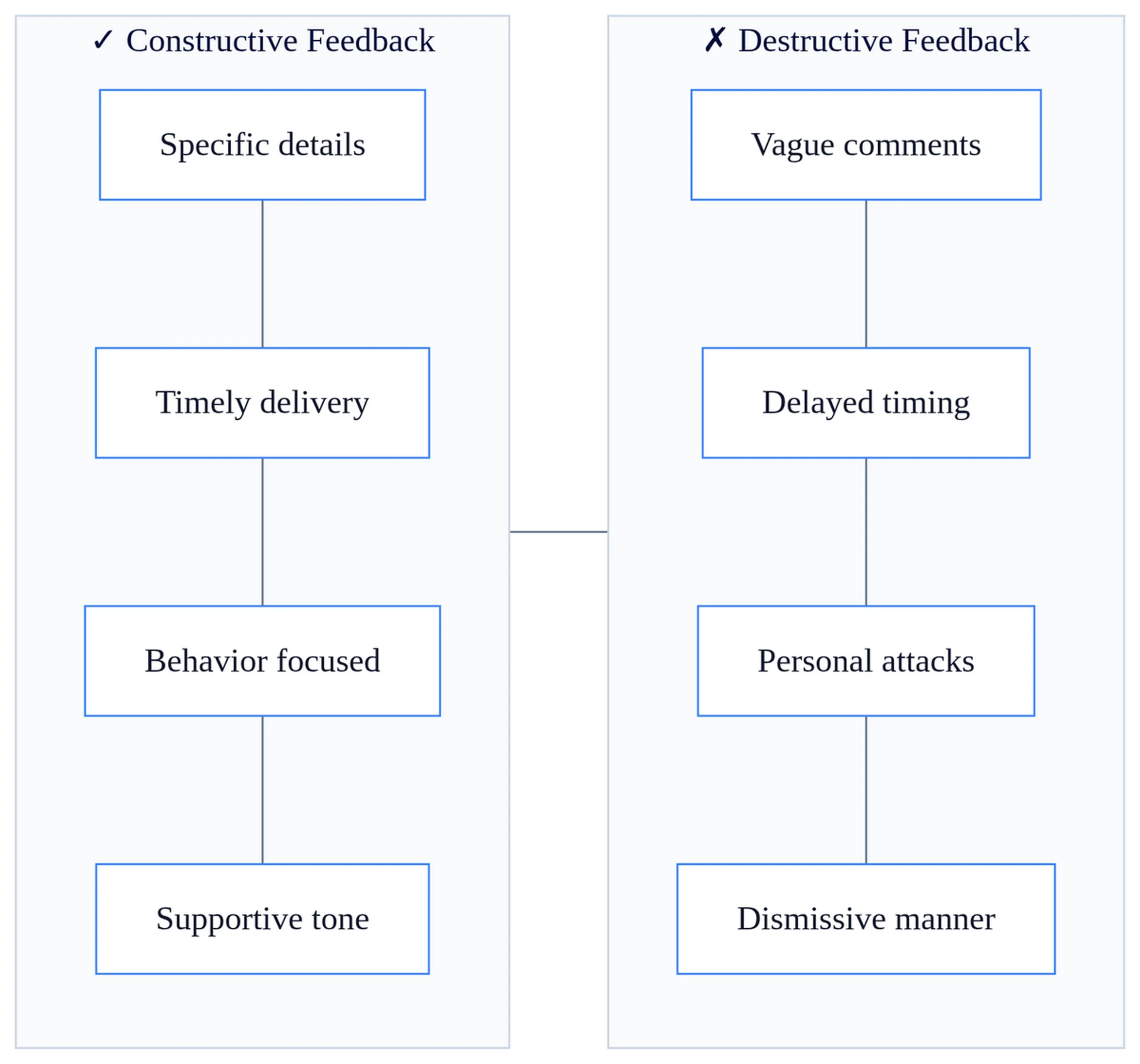
Destructive feedback is vague, personal, delayed, or dismissive. Telling someone “Your presentation was terrible” offers no actionable guidance and attacks the person rather than the behavior. By the time you deliver feedback three weeks after the event, the recipient has forgotten the context and can’t apply the lesson to future work. Dismissive feedback like “That’s just not how we do things here” shuts down dialogue rather than opening it.
| Constructive Feedback | Destructive Feedback |
|---|---|
| Specific: “The budget section lacked supporting data for the projections” | Vague: “The report wasn’t good enough” |
| Behavior-focused: “When you interrupted during the client call…” | Personal: “You’re always so aggressive” |
| Timely: Given within 24-48 hours while details are fresh | Delayed: Brought up weeks later during performance review |
| Actionable: “Next time, include a summary slide upfront” | Dismissive: “You need to do better” (no guidance on how) |
| Supportive tone: Framed as development opportunity | Punitive tone: Framed as criticism or blame |
Managers must learn to frame feedback as developmental rather than punitive. The goal is improving future performance, not punishing past mistakes. When a team member misses a deadline, constructive feedback explores what obstacles prevented timely completion and how to prevent similar issues. Destructive feedback simply assigns blame and creates defensiveness that blocks learning.
What most managers get wrong is waiting until problems become serious before giving feedback. By that point, frustration has built up and the feedback comes out harsh or personal. Regular, small-dose feedback prevents this accumulation and normalizes the practice as part of effective communication rather than a sign that someone is in trouble.
Feedback channels and delivery methods
The channel you choose for delivering feedback shapes how it’s received and whether it achieves your intended outcome. Verbal feedback delivered in person, by phone, or via video call allows immediate clarification and captures tone nuances that text can’t convey. When you need to discuss sensitive performance issues or complex situations with multiple factors, verbal channels let you read reactions and adjust your approach in real time.
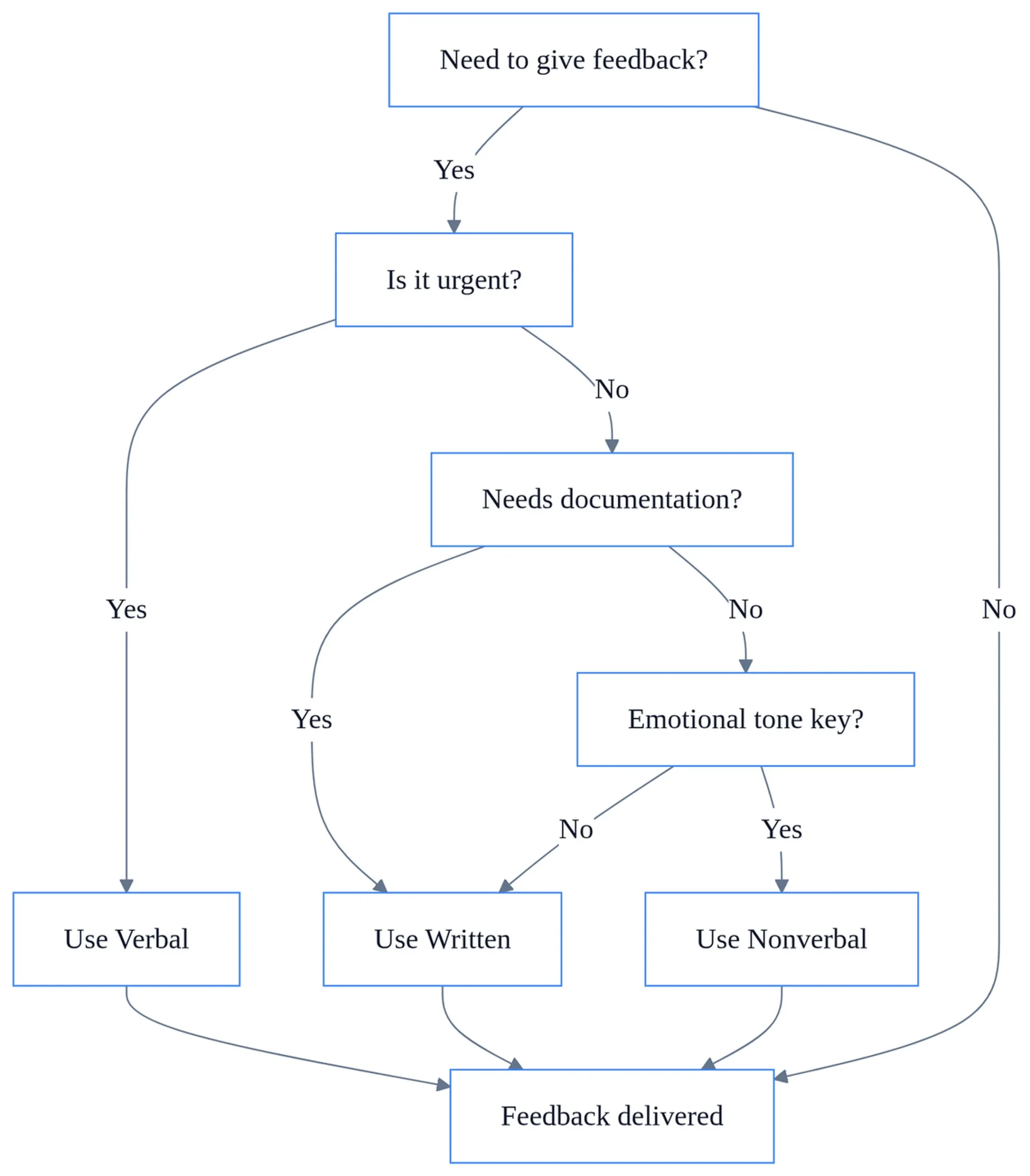
Written feedback through email, surveys, or formal reviews creates documentation and allows reflection. An employee receiving written feedback on a project can revisit the comments while revising their work, ensuring they address each point. Written channels work well for detailed technical feedback, positive recognition that employees can save and reference, or situations where you want a permanent record of what was communicated.
Nonverbal cues like facial expressions, body language, and tone of voice reinforce or contradict your verbal message. Saying “Good job” while frowning and avoiding eye contact sends a mixed signal that undermines the positive words. The interplay between verbal and non-verbal communication determines whether your feedback feels genuine or forced, supportive or threatening.
Choose your channel based on urgency, complexity, and need for documentation. Urgent safety feedback requires immediate verbal communication, not a follow-up email. Complex feedback on a major project benefits from a face-to-face conversation followed by written summary. Routine positive feedback works well as a quick message or public recognition in a team meeting. Remote and hybrid work environments complicate feedback delivery. Video calls capture more nonverbal information than phone calls or chat, making them preferable for substantive feedback conversations. However, don’t let perfect be the enemy of good. Brief, frequent feedback via messaging apps often works better than waiting for scheduled video calls. A quick “Great work on that client response, your solution addressed exactly what they needed” delivered immediately has more impact than the same praise delivered two weeks later in a formal meeting.
Feedback in organizational coordination and cross-departmental alignment
Interdepartmental feedback ensures that activities across different teams align with organizational goals rather than working at cross-purposes. When product development shares prototypes and receives feedback from sales about customer needs, from operations about manufacturing constraints, and from finance about cost targets, the final product reflects organizational priorities rather than just one department’s perspective.
Top management uses feedback loops to monitor coordination effectiveness and catch misalignment early. A retail chain’s regional managers providing feedback on inventory distribution problems alerts headquarters to supply chain issues before they result in lost sales. Without these feedback mechanisms, headquarters operates on lagging indicators like revenue reports that show problems only after significant damage occurs.
Feedback prevents silos and ensures shared understanding of strategy. When departments operate independently without feedback exchanges, they develop different interpretations of organizational goals and make decisions that seem rational locally but conflict with broader strategy. Marketing might launch a premium positioning campaign while sales offers aggressive discounts, creating customer confusion. Regular feedback between departments surfaces these conflicts and enables resolution before they damage the brand.
A practical example: a Dhaka-based software company with development teams in Bangladesh and client-facing teams in the US struggled with missed deadlines and scope creep. The core issue was one-way communication. US teams sent requirements to Bangladesh developers but rarely asked for feedback on feasibility or timeline. When the company implemented weekly feedback sessions where developers could flag unrealistic requests and suggest alternative approaches, project completion rates improved by 40% within three months. The feedback loop transformed the relationship from order-taking to collaborative problem-solving.
Cross-departmental feedback also helps replicate successes across the organization. When one team discovers an efficient process and shares it, feedback from other teams on how they adapted it to their context creates organizational learning. Without feedback channels, successful innovations remain isolated and the organization loses opportunities for improvement.
Start by seeking feedback on one decision this week. Ask a specific question about feasibility, impact, or alternatives. Notice how that simple act changes the quality of information you receive and the buy-in you generate.
Frequently asked questions
What if someone gives no response at all—is silence actually feedback?
Yes. Silence is feedback. If you send a message and receive no acknowledgment, reply, or reaction, that absence tells you something went wrong. The recipient either didn’t read it, didn’t understand it, or didn’t feel compelled to respond. Silence signals a communication breakdown and should prompt you to follow up or try a different channel.
How do I know if I’m asking for feedback in the right way?
Ask specific questions rather than open-ended ones. Instead of “Any thoughts?” try “Does this timeline work for your team?” or “What concerns do you have about this approach?” Specific questions get actionable feedback. Also create psychological safety—people won’t give honest feedback if they fear negative consequences. Show you genuinely want input, not just agreement.
Should I wait for feedback before moving forward, or proceed and adjust later?
It depends on the stakes and timeline. High-risk decisions (safety, major budget, strategy) warrant waiting for feedback upfront. Lower-stakes updates can move forward with a feedback window built in for adjustments. Remote or async teams often need this built-in feedback loop since real-time response isn’t possible. Always clarify your deadline for feedback so people know when to respond.
What if feedback contradicts what I intended to communicate?
That’s valuable data. It means your message didn’t land as planned. Don’t dismiss the feedback as “wrong.” Instead, investigate why the gap exists. Was your language unclear? Did you miss context the receiver needed? Use the contradiction to improve your next communication. The receiver’s interpretation is real, even if unintended.
Can too much feedback slow down decision-making?
Yes, if you seek feedback from everyone on everything. Set clear boundaries: decide which decisions warrant input and from whom. A quick decision might need feedback from two stakeholders; a major strategic shift might need broader input. Also set feedback deadlines. Asking for input without a deadline creates endless delays. Balance thoroughness with speed.