


A few spoken words can seal a million-dollar deal, but a slip of the tongue can destroy a reputation. Speaking is often described as a double-edged sword. We do it every day, yet we rarely stop to think about its power.
In today’s digital age, we are obsessed with emails and instant messages. However, the oldest form of human interaction remains the most widely used in business. Whether it is a quick chat by the coffee machine or a formal board meeting, talking gets things done.
But is it always the best choice? Not necessarily.
To be a successful manager or leader, you need to know when to speak and when to type. Understanding the specific strengths and weaknesses of verbal interaction is essential. In this post, we will explore the top 10 advantages and disadvantages of oral communication. We will break down exactly why it is effective and where it might fail you.
If you are new to this topic, you might want to start with our comprehensive oral communication guide to understand the basics first.
The Top 10 Advantages of Oral Communication
Why do we prefer to call someone when there is an emergency? Why do salespeople insist on meeting clients in person? Here are the ten biggest benefits of choosing speech over text.
1. High Speed and Time-Saving
The most obvious benefit is speed. Talking is significantly faster than typing. Imagine you need to give a quick instruction to your team. You can say it in ten seconds. If you were to type it, you would need to open your email, draft the message, check for typos, and hit send.
In emergency situations, oral communication is unbeatable. When a decision needs to be made right now, you cannot afford the delay of written correspondence.
2. Immediate Feedback and Clarification
When you send an email, you play the waiting game. You have no idea if the receiver understood your message until they reply. This could take hours or even days.
With oral communication, the feedback loop is instant. You can see the listener’s reaction. If they look confused, you can explain it again differently. If they have a question, they can ask it immediately. This dynamic exchange ensures that everyone is on the same page without delay.
3. Personal Touch and Relationship Building
Business is ultimately about people. Written text can often feel cold and impersonal. A voice, however, carries warmth. It conveys emotion and sincerity in a way that fonts never can.
Speaking to someone allows you to build a bond. It creates a sense of friendliness and cooperation. This is why face-to-face interaction is so critical for networking and team building. It humanizes the professional relationship.
4. Flexibility and Adaptability
When you write a report, it is rigid. Once you send it, you cannot change it based on how the reader feels. Oral communication, however, is highly flexible.
As a speaker, you can adapt your message in real-time. If you notice your audience is getting bored, you can speed up or tell a joke. If you see they are upset, you can soften your tone. This ability to pivot makes speaking a powerful tool for leadership.
5. High Persuasion Power
Have you ever tried to negotiate a salary raise via email? It rarely works as well as a face-to-face meeting. Voice allows you to use pitch, pauses, and emphasis to persuade others.
Sales professionals know this well. They prefer calls or meetings because they can use their charm and vocal skills to influence the client’s decision. The emotional weight of a spoken argument is almost always heavier than a written one.
6. Confidentiality (Off the Record)
Sometimes, you need to discuss sensitive matters. You might want to brainstorm a risky idea or discuss a personnel issue without creating a paper trail.
Emails and messages leave a permanent digital footprint. They can be forwarded, printed, or subpoenaed. Oral communication, unless recorded, is temporary. It allows for “off the record” conversations where people can speak freely without fear of future scrutiny.
7. Conflict Resolution
Misunderstandings happen constantly in business. Resolving a conflict over text usually makes it worse. Without hearing a tone of voice, people often assume the worst.
A simple phone call or meeting can de-escalate anger quickly. Hearing a calm, empathetic voice reassures the other party. It shows that you care enough to talk it through. This is why oral communication is the preferred method for dispute resolution.
8. Cost-Effectiveness (Short Term)
For simple, daily interactions, speaking is free. It saves money on stationery and, more importantly, it saves administrative time. There is no need to file a memo or draft a formal letter for every small update.
While travel for meetings can be expensive, the act of speaking itself requires no tools other than your voice.
9. Incorporates Non-Verbal Cues
Words are only half the story. A huge part of human communication is visual. When you speak to someone, especially in person, you use body language, facial expressions, and hand gestures.
These cues help clarify your message. A smile can soften a criticism. A firm handshake can seal a deal. Understanding the significance of non-verbal cues helps you communicate deeper meanings that text simply cannot capture.
10. Boosts Team Morale
A leader cannot inspire a team solely through memos. Motivation is emotional. A spirited speech from a CEO can energize employees in a way a newsletter cannot.
Oral communication fosters a sense of solidarity. It makes employees feel heard and valued. Regular verbal praise and open group discussions create a healthy, positive work culture.
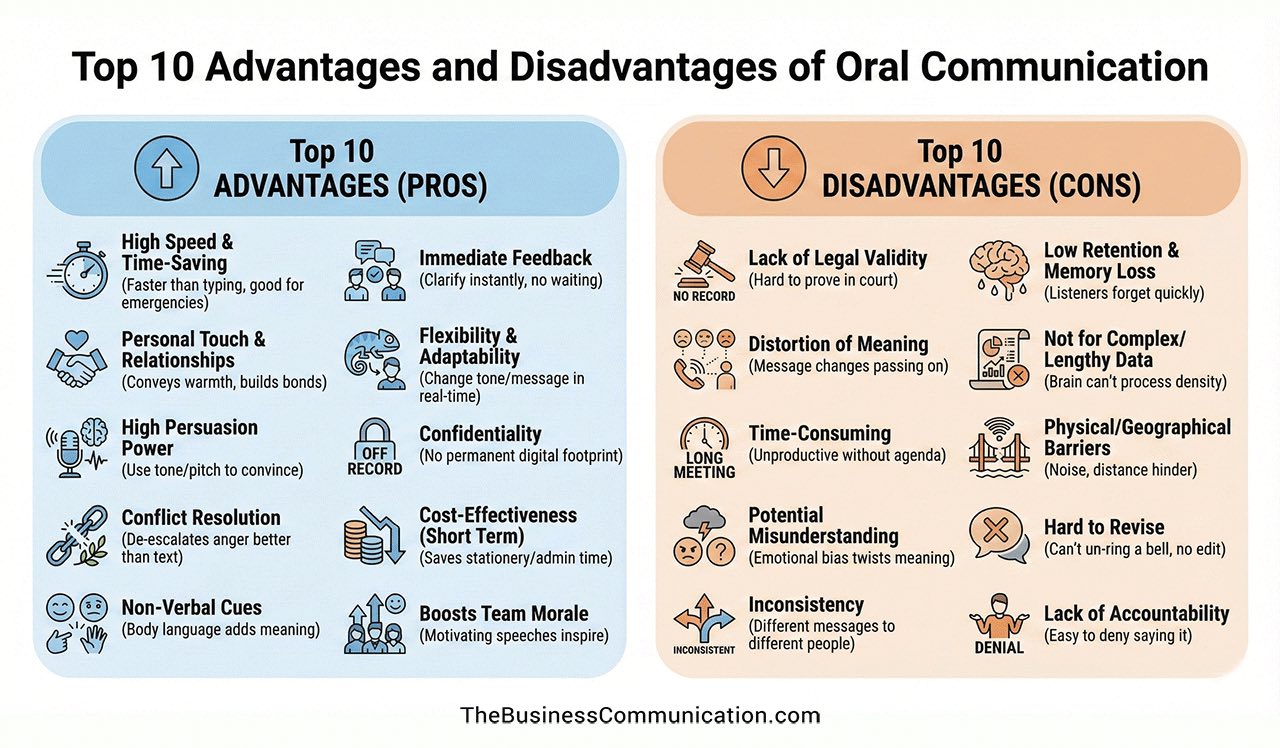
The Top 10 Disadvantages of Oral Communication
Despite its power, oral communication is not perfect. In fact, relying on it too much can be dangerous for a business. Here are the major limitations you must be aware of.
1. Lack of Legal Validity (No Record)
There is an old Latin saying: Verba volant, scripta manent. It means “spoken words fly away, written words remain.”
The biggest disadvantage of oral communication is the lack of proof. In a court of law, oral agreements are notoriously hard to prove. It often becomes a case of “he said, she said.” If you need to protect your business legally, you should always opt for the benefits of written documentation.
2. Low Retention and Memory Loss
Human memory is flawed. We forget things incredibly fast. Studies suggest that listeners forget about 50% of what they hear within 24 hours.
If you give a long list of instructions verbally, your team will likely forget half of them. Unlike a document, they cannot “re-read” your voice unless it was recorded. This leads to mistakes and missed deadlines.
3. Distortion of Meaning
Have you ever played the “Telephone Game”? You whisper a message to one person, they whisper it to the next, and by the end, the message is completely different.
In a large organization, oral messages get distorted as they pass from one manager to another. Important details get lost or changed. This creates rumors and misinformation that can harm the company.
4. Not Suitable for Lengthy or Complex Data
Try reading a complex financial spreadsheet aloud to a colleague. They will likely be confused within seconds.
Oral communication is terrible for dense data. The human brain cannot process long lists of numbers or complicated statistics through hearing alone. For technical details, policies, or financial reports, written communication is the only viable option.
5. Time-Consuming (The “Long Meeting” Syndrome)
We have all sat through meetings that dragged on for hours with no result. While speaking is fast, conversations can wander.
Without a strict agenda, oral communication can waste enormous amounts of time. People go off-topic, tell stories, or argue in circles. This loss of productivity is a major cost for businesses.
6. Physical and Geographical Barriers
Oral communication requires a channel. If there is loud construction noise outside, you cannot hear the speaker. If the internet connection is bad, the video call freezes.
These physical barriers can completely ruin the message. Furthermore, if your team is spread across different time zones, finding a time to talk is difficult. You can learn more about these obstacles in our post on the reasons for communication failure.
7. Potential for Misunderstanding (Emotional Bias)
While emotion is a strength, it is also a weakness. If a speaker is angry, their message might sound aggressive even if they don’t mean it to be.
Similarly, if the listener is stressed or prejudiced against the speaker, they might misinterpret what is being said. They might hear an insult where there was none. Oral communication is heavily influenced by the mood of the participants.
8. Hard to Revise
You cannot hit the “backspace” key when you are talking. Once a word leaves your mouth, it is out there. You cannot edit it.
If you slip up and say something offensive or incorrect, the damage is done immediately. You can apologize, but you cannot erase the memory. Written documents, conversely, can be drafted, edited, and perfected before anyone sees them.
9. Inconsistency
When you speak to different people separately, you might inadvertently use different words. You might tell one employee, “finish this soon,” and another, “finish this by Friday.”
This creates inconsistency. Employees get confused about what the actual rule or deadline is. Written communication ensures that every single person receives the exact same message.
10. Lack of Accountability
Because there is no record, it is easy for people to deny their words. A manager might promise a raise verbally and then later claim, “I never said that.”
This lack of accountability can breed mistrust in an organization. Dishonest individuals can use the temporary nature of speech to manipulate situations without leaving evidence.
Comparative Summary Table (Pros vs. Cons)
To help you visualize this, here is a quick summary of the top 5 points from each side.
| Advantages (Pros) | Disadvantages (Cons) |
| Speed: Instant transmission of ideas. | No Record: No legal validity or proof. |
| Feedback: Immediate clarification possible. | Retention: Listeners forget quickly. |
| Emotion: Builds trust and relationships. | Distortion: Message changes when passed on. |
| Persuasion: Easier to convince others. | Complexity: Bad for detailed data. |
| Correction: Flexible and adaptable. | Accountability: Easy to deny later. |
How to Overcome the Disadvantages
Does this mean you should stop talking and only write emails? Absolutely not. The trick is to mitigate the risks. Here are three strategies to get the best of both worlds.
Tip 1: Follow Up in Writing
This is the “Hybrid Approach.” Have the meeting or the phone call to get the benefit of speed and connection. Then, immediately send an email summarizing what was discussed.
If you had a formal meeting, ensure someone takes notes. You can check our meeting minutes samples to see how to document spoken decisions professionally.
Tip 2: Use Active Listening
To fight the problem of low retention and misunderstanding, practice active listening. This means fully concentrating on the speaker.
Ask the listener to repeat the message back to you. This confirms they understood it correctly. If you want to sharpen this skill, there are specific techniques to improve listening that every manager should know.
Tip 3: Record Important Calls
With the rise of video conferencing tools like Zoom and Teams, it is easier than ever to record conversations. If you are discussing complex details or training, hit the record button (with permission, of course). This gives you a reference point later.
Conclusion
Oral communication is the heart of human interaction. It allows us to inspire, persuade, and connect with one another. However, written communication is the backbone of business organization. It provides the structure, proof, and detail we need to operate.
The most successful professionals understand the Top 10 Advantages and Disadvantages of Oral Communication. They know that speaking is great for people, but writing is better for data. They do not rely on one method blindly. Instead, they switch between them based on the situation.
So, the next time you have a message to deliver, pause. Ask yourself: Is this urgent? Is it emotional? Or does it need to be legally binding? Your answer will tell you whether to open your mouth or open your laptop.
Frequently Asked Questions (FAQ)
What is the main advantage of oral communication?
The main advantage is the immediate feedback loop. It allows for instant clarification and faster decision-making compared to written methods.
Why is oral communication considered less authentic in business?
It is considered less authentic in a legal sense because it lacks a permanent record. Without documentation, it is difficult to prove what was agreed upon.
How does oral communication save time?
It eliminates the time spent drafting, proofreading, and waiting for replies. A complex issue that might take 20 emails to resolve can often be fixed in a 5-minute phone call.
Frequently asked questions
When should I use email instead of calling someone?
Use email when you need a permanent record, are communicating complex technical details, or the recipient may need time to process. Also choose email if the person is in a different time zone, you’re documenting a decision, or the matter is non-urgent. Calls work best for quick clarifications, sensitive discussions, or when immediate feedback matters.
How do I avoid miscommunication in a phone call without written confirmation?
Always summarize key points at the end of the call and ask the listener to confirm understanding. For important decisions or instructions, follow up with a brief email recap. This creates a paper trail while preserving the speed and personal connection of oral communication. Use phrases like, “Just to confirm, we agreed that…”
Is it unprofessional to call instead of emailing a formal request?
Not if the situation warrants it. Calls are appropriate for urgent matters, complex negotiations, or relationship-building. However, always follow up with written documentation for formal requests, contracts, or decisions that affect multiple people. The combination of both methods is often the strongest approach.
What if someone claims they never received my verbal instruction?
This is a real risk of oral-only communication. Protect yourself by having witnesses present when possible, or immediately send a written summary. For critical instructions, ask the person to repeat back what you said. In high-stakes situations, always document verbal agreements in writing within 24 hours.
Can I use oral communication for negative feedback or disciplinary action?
Yes, but carefully. Deliver the feedback verbally to show respect and allow dialogue, but document it in writing afterward. This approach maintains the personal touch while protecting both parties legally. Never rely solely on verbal discipline for serious issues—HR typically requires written records.
54 Comments
Very good analysis
who is the author of this information? and when and where was it published? in need of de answers, quick response plz
This article was published on Oct 10, 2013 at https://thebusinesscommunication.com site. And the author name is Masudur Rashid & Ornov Chowdhury Bappi.
Thanks
thank you for this.
It has been of great importance to me. Thanks a lot
thanks for such information
It so helpful to me..so be blessed
thanks a lot
Thank you very much. It really help me
Thanks for enlightened me on oral communication indeed my time was not wasted here.
God bless you 🙌
T I understand easily thnks
thank you the writter and all the congeration that surport you in written this wonderful books rightup thanks once more, its help me alot in my research.
Thanks so much it was very helpful to me
Thanks u Soo much
thanks for this information
Thanks … It has been very useful to me
Thanks for the information it has helped me a lot
actual
my respondent has no cause of alerm but alot of thanks
It’s good for the student and very helpfull to find the answer..
Wonderful information
what is the tittle of the book plz help me
Thanks.God bless u for that wonderful article.
So helpful to me thanks
Please provide references.
Thanks so much
Thank you very much, keep on giving us such information.
Thanks so much I’m interested about yourey information of communucation.
Big thanks to you
thanks
am impressed in your good works. Kudos! !!
Thanks for information
nice point
Really helpful
am grateful for this piece of work….its very educative to me.
Very nice work
great
Thanks alot
Thanks for the answers becouse it was so intresting
So how about the effect of Putting oral literature into written literature
thanks so much for this artical guys
it has been great to me…thanks
Thank. This been very good. Information easy to understrand and take in the eye. Keep the good work skywards.
am one beneficiary of your information,, thanks!
am always you with you together to learn more and more
Thanks a lot for the helpful information, but what is the book title?
it has really helped…. Thenks
So helpful to me thanks
I can’t see the references
This article has been of great importance to me. Thanks a lot.
really interesting
Thenks for good information .God bless you
Hello
When we talk about disadvantages of oral communication you mentioned expensive. You talk about T. A and D. A please give me their meaning.
Thanks
Thanks a lot for such abrilliant information
This will help the student and organization to grow and communicate efficieny and effectively