


The Greek philosopher Epictetus once said something profound. He said we have two ears and one mouth so that we can listen twice as much as we speak.
It sounds simple enough. Yet, in the modern business world, we seem to have forgotten this math. We are often too busy trying to get our own point across. We focus entirely on what we are going to say next.
Let’s be honest for a moment. How many times have you been in a meeting where you were just waiting for your turn to talk? You were not really hearing the other person. You were just preparing your rebuttal.
This is the biggest trap in communication. Most people listen with the intent to reply, rather than the intent to understand.
Today, we are going to flip the script. While we previously discussed how to master articulate speaking techniques, this guide focuses on the other half of the equation. We are going to dive deep into the power of active listening.
This is not just about staying silent. It is a conscious decision to focus, understand, respond, and remember.
Hearing vs. Listening: What’s the Difference?
First, we need to clear up a common misconception. Hearing and listening are not the same thing.
Hearing is physiological. It happens when sound waves hit your eardrums. It is passive. If a car honks outside your window, you hear it. You do not have to try. It just happens.
Listening, on the other hand, is cognitive. It is a mental process. It requires your brain to decode the meaning of the sounds. It is active.
Think of it like this. You can hear music playing in a grocery store while you shop. However, you are not really listening to the lyrics. You are just acknowledging the noise.
Active listening skills involve taking that cognitive process a step further. It means you are fully engaged. You are not just downloading data. You are processing the emotion and intent behind the words. You are providing feedback to prove you are with them.
The 4 Key Elements of Active Listening Skills
So, how do you actually do it? Active listening is not a magical talent. It is a skill built on four specific pillars.
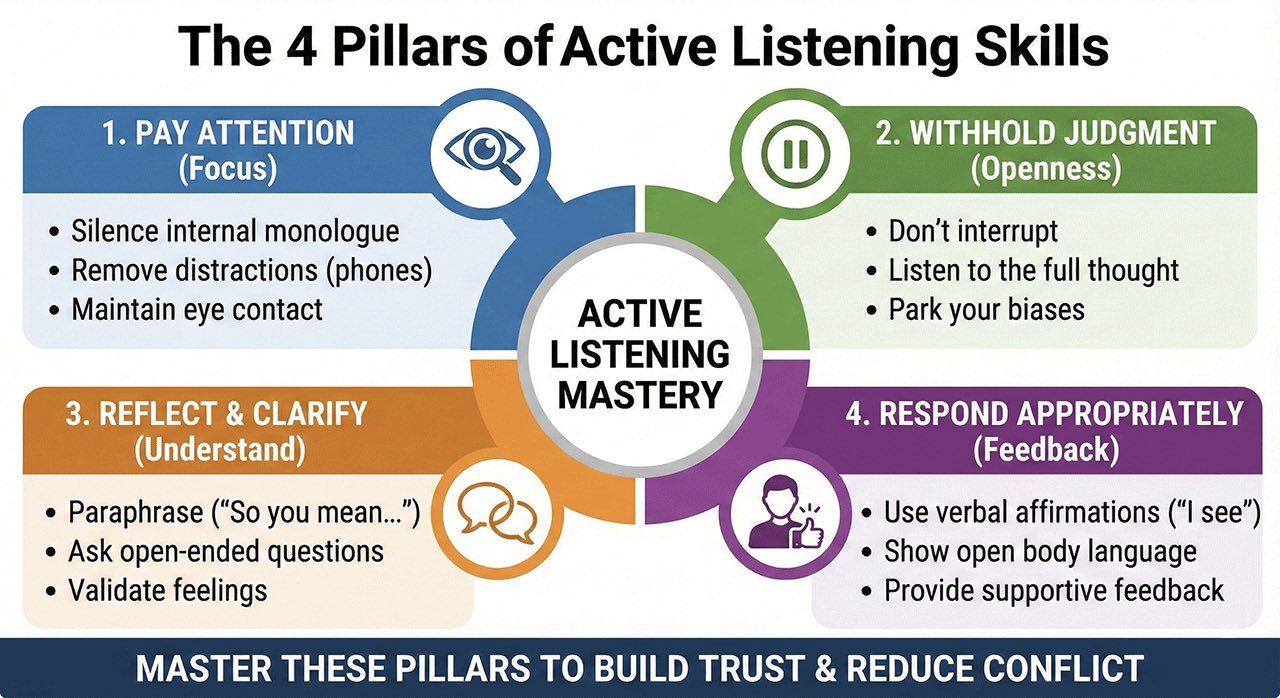
1. Pay Attention (Undivided Focus)
In our distracted world, attention is a currency. When you give someone your full attention, you are paying them a high compliment.
To practice this, look at the speaker directly. Put your phone away. Close your laptop if you can. Do not let your eyes wander around the room.
You also need to silence your internal dialogue. Stop planning your grocery list. Stop rehearsing your argument. Just be present.
This applies to all types of verbal interaction. Whether you are in a face-to-face meeting or on a video call, your focus must be absolute. On a video call, this means looking at the camera, not checking your email in another tab.
2. Withhold Judgment (Open-Mindedness)
This is the hardest part for many leaders. We like to solve problems. As soon as we hear a complaint, we want to jump in with a solution.
Active listening requires you to hit the pause button on your judgment. Do not interrupt. Do not finish their sentences for them.
Allow the speaker to finish their entire thought process. Sometimes, the real issue comes out at the very end of the sentence. If you interrupt, you miss the gold.
3. Reflect and Clarify (Paraphrasing)
How do you prove you understood? You reflect it back.
This is the art of paraphrasing. You can use phrases like, “So, what I am hearing is…” or “Do you mean that…?”
For example, an employee might vent for five minutes about a project. You can say, “It sounds like you are frustrated because the deadlines keep changing. Is that right?”
This does two things. First, it validates their feelings. Second, it clears up any confusion immediately. It prevents simple misunderstandings from turning into major conflicts.
4. Respond Appropriately (Feedback)
Communication is a loop. You need to close that loop with feedback.
This involves verbal affirmations. Small words like “I see,” “Go on,” or “That makes sense” keep the momentum going. They tell the speaker that you are still connected.
However, be careful not to overdo it. You do not want to sound like a bobblehead. Your responses should be genuine and timed correctly.
The Role of Non-Verbal Communication in Listening
We often think listening is done with the ears. Surprisingly, a lot of it is done with the eyes.
You need to “listen” to what is not being said. Is the speaker’s voice shaking? Are their arms crossed? Is their tone sarcastic or sincere?
To truly master this, you need to understand non-verbal signals. If a client says, “I am happy with the deal,” but they are frowning and looking at the floor, you know something is wrong.
Conversely, you need to use your own body to show you are listening. Lean forward slightly. Nod your head occasionally. Mirror their facial expressions. If they look sad, look concerned. If they smile, smile back.
This physical engagement creates a subconscious bond. It makes the speaker feel safe to open up.
Why Active Listening is a Superpower in Business
You might be thinking, “This sounds like a lot of work.” You are right. It is work. However, the return on investment is massive.
Builds Trust and Rapport
People trust leaders who make them feel heard. It is that simple. When an employee feels that you truly understand their perspective, they become loyal. They feel valued as human beings, not just cogs in a machine.
This is crucial in both formal versus informal settings. Whether you are in a boardroom or at a casual lunch, listening builds the relationship capital you need to lead effectively.
Solves Conflicts Faster
Most workplace arguments are not about facts. They are about feelings. They happen because someone feels ignored or misunderstood.
Active listening gets to the root cause. By allowing the other party to vent and then validating their point, you take the heat out of the argument. You can move from “me vs. you” to “us vs. the problem.”
Improves Productivity
How much time is wasted fixing mistakes? Often, these mistakes happen because someone didn’t listen to the instructions.
When you listen actively, you get the details right the first time. You understand the nuances of the assignment. This reduces the need for rework and endless follow-up emails.
Enhances Sales and Negotiation
You cannot sell a solution if you don’t understand the problem. The best salespeople are not the ones with the smoothest pitch. They are the ones who listen to the client’s pain points.
By listening, you can tailor your offer to fit their exact needs. This makes it much harder for them to say no.
Common Barriers to Active Listening
If listening is so great, why are we so bad at it? Several barriers get in the way.
Environmental Distractions: It is hard to listen in a loud coffee shop. Open offices with constant chatter are also improved killers of focus.
Psychological Barriers: We all have biases. If you don’t like the person speaking, you are likely to tune them out. If you are stressed or angry, your brain shuts down its listening centers.
Selective Listening: This is when we only hear what we want to hear. We filter out anything that contradicts our existing beliefs.
These barriers are common reasons for communication failure. Identifying them is the first step to removing them.
5 Exercises to Improve Your Active Listening Skills
Like any muscle, your listening skills can be strengthened with exercise. Here are five practical ways to train yourself.
Exercise 1: The “No Interrupting” Rule
Challenge yourself in your next meeting. Make a pact that you will not interrupt anyone.
Even if you have the perfect answer, wait. Wait until they stop talking completely. Count to two in your head before you respond. This forces you to focus on their words rather than your rebuttal.
Exercise 2: The Summary Technique
Practice the reflection skill we discussed earlier. Before you state your own opinion, summarize the other person’s point.
Start your sentence with, “Before I answer, I want to make sure I understood you correctly. You said…” If they agree, proceed. If they correct you, listen again.
Exercise 3: Listen for the “Unsaid”
Try to be a detective. In your next conversation, try to identify the emotion behind the words.
Ask yourself: Is this person anxious? Are they excited? Are they holding something back? Focusing on the emotional subtext keeps your brain engaged.
For more specific drills, you can check our dedicated resource on techniques for improving listening ability.
Exercise 4: Body Language Audit
During a conversation, check your own body. Are your arms crossed? Are you turned away?
Consciously adopt an “open” posture. Uncross your arms. Face the speaker. Lean in. You will be surprised at how this physical shift changes your mental focus.
Exercise 5: The Eye Contact Challenge
Try to notice the eye color of the person speaking to you. You don’t have to stare them down creepily. Just try to hold eye contact for 60-70% of the time.
This forces you to look at them, which naturally reduces the urge to look at distractions.
Conclusion
Active listening is the bridge between confusion and clarity. It is the difference between a boss and a leader.
It requires patience. It requires humility. It requires you to put your own ego aside for a moment to truly understand another person.
However, the rewards are worth it. You will have fewer conflicts. You will have deeper relationships. You will make fewer mistakes.
Remember, communication is a two-way street. Now that you know how to listen, ensure that when you do speak, your own message is clear. A great way to check this is by reviewing the 7 Cs of communication.
Start today. In your next conversation, listen twice as much as you speak. You might be amazed at what you hear.
Frequently Asked Questions (FAQ)
What are the 3 A’s of active listening?
The 3 A’s are often described as Attitude, Attention, and Adjustment. You need a positive attitude, focused attention, and the ability to adjust your perspective based on what you hear.
How does active listening improve workplace culture?
It creates an environment of psychological safety. When employees feel heard, they are more likely to share innovative ideas and raise concerns before they become disasters.
Can active listening be learned?
Absolutely. It is a soft skill that can be developed through practice and self-awareness, just like public speaking or negotiation.
Frequently asked questions
What if I disagree with what the speaker is saying?
Withhold judgment doesn’t mean you agree. It means you let them finish without interrupting or dismissing their point. Once they’ve fully expressed themselves, you can respectfully share your perspective. This approach often reveals the real issue beneath the surface disagreement, making resolution faster and more collaborative.
How do I avoid looking like I’m just pretending to listen?
Genuine engagement comes through specific actions: maintain eye contact, nod occasionally, and paraphrase what you heard. Avoid overdoing verbal affirmations like “uh-huh” repeatedly, which sounds robotic. Your body language and paraphrasing should feel natural and timed to the conversation’s rhythm.
Should I take notes while someone is talking to me?
Yes, but strategically. Brief notes show you value their input, but constant writing breaks eye contact and suggests distraction. Take notes after key points or during pauses. On video calls, note-taking is less visible, so it’s more acceptable. Always ask permission if it’s a sensitive conversation.
What if the speaker keeps rambling and never gets to the point?
Resist the urge to interrupt. Let them finish their thought. If they truly lose direction, use a gentle clarifying question: “Can you help me understand how this connects to the main issue?” This keeps them on track without shutting them down, and they’ll feel heard rather than rushed.
How do I balance active listening with moving a meeting forward?
Active listening actually saves time by preventing misunderstandings and conflicts later. Set clear time boundaries upfront if needed. Use paraphrasing to confirm understanding quickly, then move to next steps. Quality listening in the first five minutes often eliminates the need for follow-up conversations.
Can active listening work in high-pressure situations like negotiations?
Absolutely. In negotiations, listening reveals what the other party truly needs, not just what they’re asking for. This uncovers win-win solutions you’d miss if you were only preparing rebuttals. Active listening is actually your competitive advantage in high-stakes conversations.