


Have you ever sat through a long meeting that could have easily been an email? Or perhaps you sent a joke over a text message that was completely misunderstood? We have all been there. These awkward moments happen when we choose the wrong channel for our message.
In the fast-paced world of business, communication is everything. However, knowing how to communicate is not enough. You also need to know how to deliver that message. Should you pick up the phone? Or should you draft a formal report?
Choosing between oral and written communication is a daily dilemma for professionals. While they both aim to transfer information, they function very differently. Making the wrong choice can lead to confusion, wasted time, and even legal issues.
In this post, we will dive deep into the 7 key differences between these two modes. We will explore when to use which and how to avoid common pitfalls. Let’s ensure your message always lands exactly as you intended.
Defining the Two Modes
Before we jump into the differences, let’s briefly define what we are dealing with. It is important to have a clear baseline.
Oral Communication involves words spoken by mouth. It is the oldest form of human interaction. This includes face-to-face conversations, telephone calls, video conferences, and speeches. It is dynamic, immediate, and personal. If you want to master this specific area, you should check out our comprehensive guide on oral communication.
Written Communication, on the other hand, involves any message that uses written words or symbols. This includes emails, reports, memos, letters, and instant messages. It is structured, permanent, and often delayed. To understand the full scope of this mode, it helps to know the characteristics of written messages.
Now that we are on the same page, let’s look at what sets them apart.
1. Speed and The Feedback Loop
The most obvious difference is speed.
Oral communication is synchronous. This means it happens in real-time. When you speak to someone, they hear you instantly. The feedback loop is immediate. You can see their facial expressions. You can hear their tone of voice. If they look confused, you can explain your point again right away. This makes it incredibly efficient for brainstorming or resolving misunderstandings.
Written communication is usually asynchronous. You send an email, and then you wait. The receiver might read it in five minutes, or they might read it in five days. The feedback is delayed. If they misunderstand your email, they have to write back to ask for clarification. Then, you have to write back to explain. This back-and-forth can take days.
Key Takeaway: If you need an answer now, stop typing and start talking.
2. Legal Validity and The “Paper Trail”
In the business world, proof matters. This is where written communication shines.
Spoken words are fleeting. Once you say them, they vanish into the air. Unless you are recording the conversation, there is no permanent record. In a legal dispute, oral agreements are notoriously difficult to prove. It often turns into a case of “he said, she said.”
Conversely, written communication creates a permanent record. An email chain, a signed contract, or a formal letter serves as tangible proof. It can be archived and retrieved years later. This is essential for compliance, legal defense, and historical reference.
If you are dealing with contracts, employment offers, or financial transactions, you need the benefits of written documentation. It protects you and your business.
Key Takeaway: If it isn’t written down, in the eyes of the law, it often didn’t happen.
3. Non-Verbal Cues and Emotion
Have you ever tried to be sarcastic in an email? It usually fails.
Oral communication is rich in context. It is not just about the words you use. It is about how you say them. Your pitch, volume, tone, and pacing add layers of meaning to your message. If you are speaking face-to-face, your body language plays a huge role. Eye contact, hand gestures, and posture can signal confidence, empathy, or aggression.
These elements are known as non-verbal communication. They help build rapport and trust. Understanding the significance of non-verbal cues is crucial for leadership.
Written communication strips away these layers. The reader cannot see your smile. They cannot hear the concern in your voice. They only see text on a screen. This makes written messages prone to misinterpretation. A neutral sentence can easily be read as rude or demanding depending on the reader’s mood.
Key Takeaway: For emotional topics or sensitive feedback, use your voice.
4. Complexity of Information
Imagine trying to explain a complex financial spreadsheet over the phone. You would probably get frustrated very quickly.
Oral communication is best for simple, direct concepts. It is also great for high-level overviews and emotional appeals. However, the human brain can only retain a certain amount of spoken information at once. If you rattle off twenty statistics in a meeting, your audience will likely forget eighteen of them.
Written communication is superior for complex data. When information is written down, the reader can study it. They can read it at their own pace. They can re-read difficult sections. They can look at charts, graphs, and tables. This is why detailed policies, technical manuals, and financial reports are always written.
If you have a lot of data to share, rely on the structure of written formats rather than facing the drawbacks of spoken interaction.
Key Takeaway: Use writing for data and details. Use speaking for ideas and emotions.
5. Revision and Accuracy
We have all said things we immediately regretted.
In oral communication, once the words leave your mouth, they are out there. You cannot hit the backspace key. You can apologize or try to clarify, but the initial impact has already happened. Speaking requires the ability to think on your feet. It is spontaneous and often less structured.
Written communication allows for precision. You can draft an email and leave it in your drafts folder for an hour. You can edit it. You can rearrange sentences. You can check your grammar and spelling. You can ensure that every word creates exactly the impression you want.
This level of control allows for higher accuracy. It reduces the chance of impulsive mistakes. Following the 7 Cs of communication is often easier when you have the time to sit and write.
Key Takeaway: If accuracy is more important than speed, put it in writing.
6. Audience Reach
How many people can you talk to at once?
Oral communication is often limited by proximity. In a conversation, you are talking to one person. In a meeting, you might be talking to ten. Even in a public speech, your audience is limited to the capacity of the room (unless it is broadcasted).
Written communication scales effortlessly. You can write a single company-wide email and send it to ten thousand employees with one click. You can publish a press release that is read by millions. The effort required to communicate with one person is almost the same as communicating with thousands.
This makes written communication a powerful tool for mass communication. It ensures consistency. Everyone receives the exact same message in the exact same words.
Key Takeaway: For mass distribution and consistency, writing is king.
7. Cost and Time Consumption
Finally, let’s talk about resources.
Oral communication can be expensive. Think about a business meeting. You have ten high-paid managers sitting in a room for an hour. That is ten hours of salary cost for one meeting. If travel is involved to meet a client face-to-face, the costs skyrocket.
Written communication is generally more cost-effective. Sending an email costs practically nothing. It respects the receiver’s time because they can read it when it suits them. They do not have to stop their work to listen to you.
However, writing takes time to compose. Crafting a perfect proposal might take hours. Speaking is usually faster for the sender but can be more time-consuming for the receiver if the message is rambling.
Key Takeaway: Meetings are an investment. Emails are a utility.
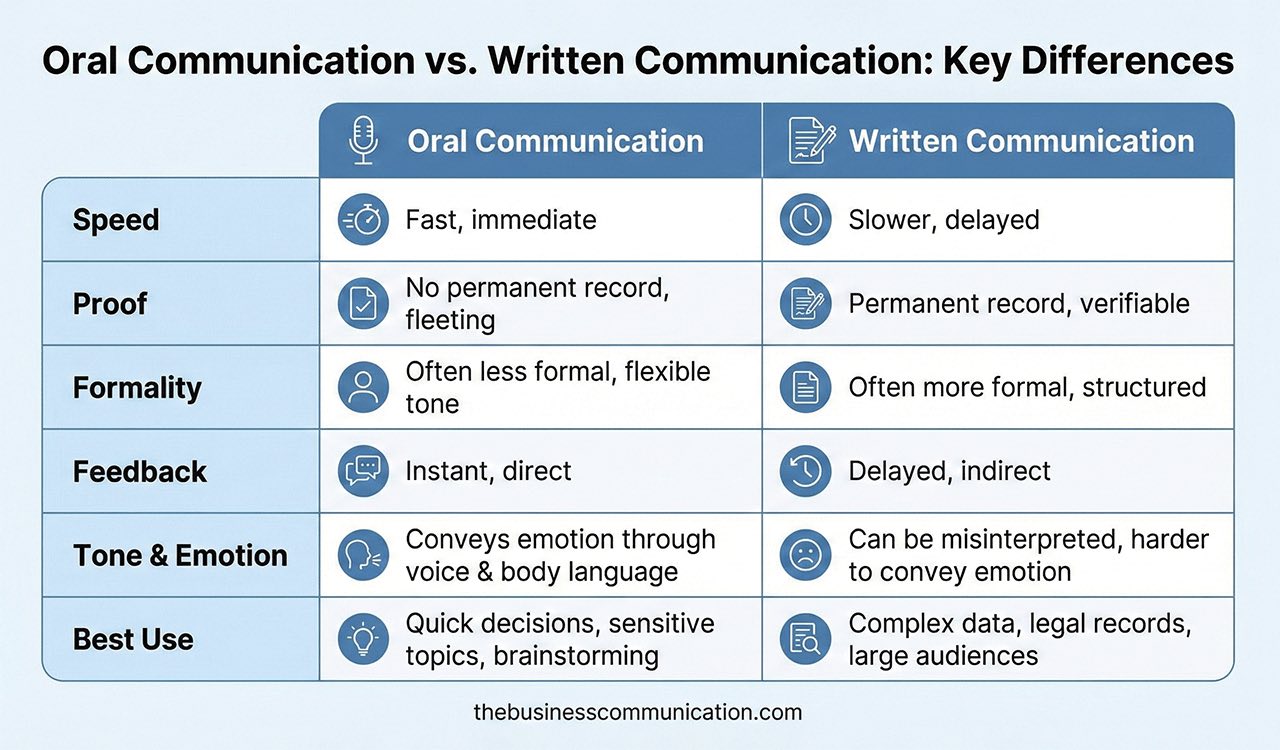
Comparison Table: At a Glance
To make this easier to digest, here is a quick comparison of the two modes.
| Feature | Oral Communication | Written Communication |
| Speed | Instant transmission and feedback. | Delayed transmission and feedback. |
| Proof | No permanent record (usually). | Permanent legal record. |
| Emotion | High (Voice, Tone, Body Language). | Low (Risk of misinterpretation). |
| Complexity | Best for simple ideas. | Best for complex data. |
| Revision | Impossible (Spontaneous). | Possible (Editable). |
| Cost | High (Time/Travel). | Low (Digital/Paper). |
| Formality | Often informal (flexible). | Often formal (structured). |
When to Use Which? (The Decision Matrix)
Now that you know the differences, how do you choose? Here is a simple guide to help you decide.
Choose Oral Communication When:
- You need to resolve a conflict. The personal touch helps de-escalate tension.
- The news is bad. Firing someone or cancelling a project should always be done in person out of respect.
- You need to brainstorm. The immediate feedback loop sparks creativity.
- The matter is confidential. If you don’t want it forwarded, don’t write it down.
Choose Written Communication When:
- You are giving detailed instructions. People need to refer back to steps.
- You are interacting with a remote team. Time zones make real-time talking difficult.
- You need a record. Use this for agreements, follow-ups, and policies.
- You are sending data. Charts and figures belong in a document.
The Hybrid Approach: The “Follow-Up” Method
The best communicators do not strictly stick to one method. Instead, they combine them. This is often called the hybrid approach.
For example, you might have a phone call with a client to discuss a new project. This builds rapport and allows you to answer their questions quickly. Immediately after the call, you send an email summarizing what was discussed.
This gives you the best of both worlds. You get the emotional connection of the oral interaction. You also get the clarity and permanent record of the written interaction.
In business, this is often done through meeting minutes. After a discussion, someone documents the key decisions. You can see examples of this in our guide on meeting minutes samples.
Conclusion
Understanding the difference between oral and written communication is not just academic. It is a practical skill that affects your daily productivity.
Oral communication is your tool for connection, speed, and persuasion. Written communication is your tool for precision, record-keeping, and complexity. Neither is better than the other. They are simply different tools in your toolkit.
The most successful professionals are those who know which tool to pick up. They know when to walk over to a desk and when to draft a memo. They know when to pick up the phone and when to send a PDF.
Next time you have a message to send, pause for a second. Ask yourself: Do I need a record of this? Is this emotional? Is it complex? Your answer will tell you exactly what to do.
Frequently Asked Questions (FAQ)
Which form of communication is more formal?
Generally, written communication is considered more formal. Business letters, reports, and contracts follow strict structures. Oral communication tends to be more fluid and casual, although speeches and interviews can be very formal.
Why is written communication better for business records?
Written communication provides a physical or digital trail. It can be stored, searched, and verified. This is essential for accountability and legal protection.
Can oral communication be used for legal contracts?
Verbal contracts can be valid in some situations, but they are incredibly risky. Without written proof, it is your word against theirs. It is always safer to have agreements in writing.
What is the biggest risk of written communication?
The biggest risk is misinterpretation of tone. Without vocal cues, a reader might think you are angry when you are just being brief. Using emojis (informally) or careful word choice helps mitigate this.
Frequently asked questions
Should I follow up a phone call with an email summary?
Yes, especially for decisions or action items. A phone call builds rapport and clarifies nuance, but an email creates the legal record. Send a brief summary within hours: what was discussed, what was agreed, and next steps. This protects both parties and prevents misunderstandings later.
What if I need to deliver bad news—call or email?
Call first if the person is a direct report or close colleague. A voice conveys empathy and allows them to ask questions immediately. Follow with a written summary for clarity. For less personal relationships, email is acceptable, but avoid hiding behind text for major announcements that deserve real-time dialogue.
Can I use instant messages for formal business agreements?
Avoid it. Instant messages are written but often treated as casual and temporary. For any binding agreement—contracts, offers, or policy changes—use formal email or signed documents. Instant messages can be deleted, edited, or misremembered. Written communication only counts legally if it’s documented and preserved.
How do I know if my written message will be misunderstood?
Read it aloud before sending. If it could be interpreted two ways, rewrite it. Avoid sarcasm, humor, and emotional language in email. If the topic is sensitive or complex, pick up the phone instead. When in doubt, a quick call prevents days of back-and-forth clarification.
Should I present data in a meeting or send a written report?
Do both. Present key findings verbally to engage the audience and answer live questions. Provide a written report so people can study details, share it with others, and reference it later. Oral delivery captures attention; written format ensures retention and creates accountability.
3 Comments
To Argue for Lyon’s claim that; “in the literate of modern industrialized and and bureaucratic societies,the spoken language is used for a wider range of purpose than the written,and writing serves as a functional substitute for speech only in situation which makes vocal-auditory communication impossible,unreliable or inefficient.”
Also written communication does not use words for communicating while oral communication use words for may be meeting, group discussion, seminars, lectures atc
writing is a much slower medium of communication than the oral medium.
Written communication also conveys a psychological climate. The word will convey either a helpful, problem-solving attitude towards the reader or a defensive, judgmental attitude.