


You might be standing in front of a room saying, “I am fully confident in this plan.” However, your arms are crossed tightly across your chest. You are looking at the floor. You are shuffling your feet.
What is your audience going to believe?
They will not believe your words. They will believe your body. Your verbal message says “confidence,” but your non-verbal message screams “fear.”
In the world of business, we often obsess over finding the perfect words. We write scripts. We memorize stats. Yet, we forget that our body is broadcasting a signal 24/7.
Research by Professor Albert Mehrabian suggests a fascinating breakdown of communication. He found that in face-to-face interactions, words account for only 7% of the message. Tone of voice accounts for 38%. Body language accounts for a massive 55%.
This is known as the 55-38-7 rule. Whether you are negotiating a salary or pitching a client, your body speaks louder than your voice.
In this guide, we will explore the hidden language of non-verbal cues. We will break down the different types, how they alter your message, and how you can master them to become a magnetic communicator.
If you are just starting to explore this topic, you should first read our complete oral communication guide to understand the foundational principles.
What is Non-Verbal Communication?
Non-verbal communication is the transmission of messages or signals through a non-verbal platform. This includes eye contact, facial expressions, gestures, posture, and the distance between two individuals.
Think of it as a “second channel.”
When you speak, you are broadcasting on two channels simultaneously. Channel One is the audio (your words). Channel Two is the video (your body).
If these two channels are out of sync, the viewer gets confused. They instinctively trust the video over the audio.
Understanding this dynamic is crucial for professionals. It is often the missing key for those trying to overcome glossophobia or fear of public speaking. When you learn to control your body, your mind often follows suit.
The 7 Types of Non-Verbal Cues in Business
To master body language, you need to know what to look for. Experts categorize these cues into seven distinct types. Let’s break them down.
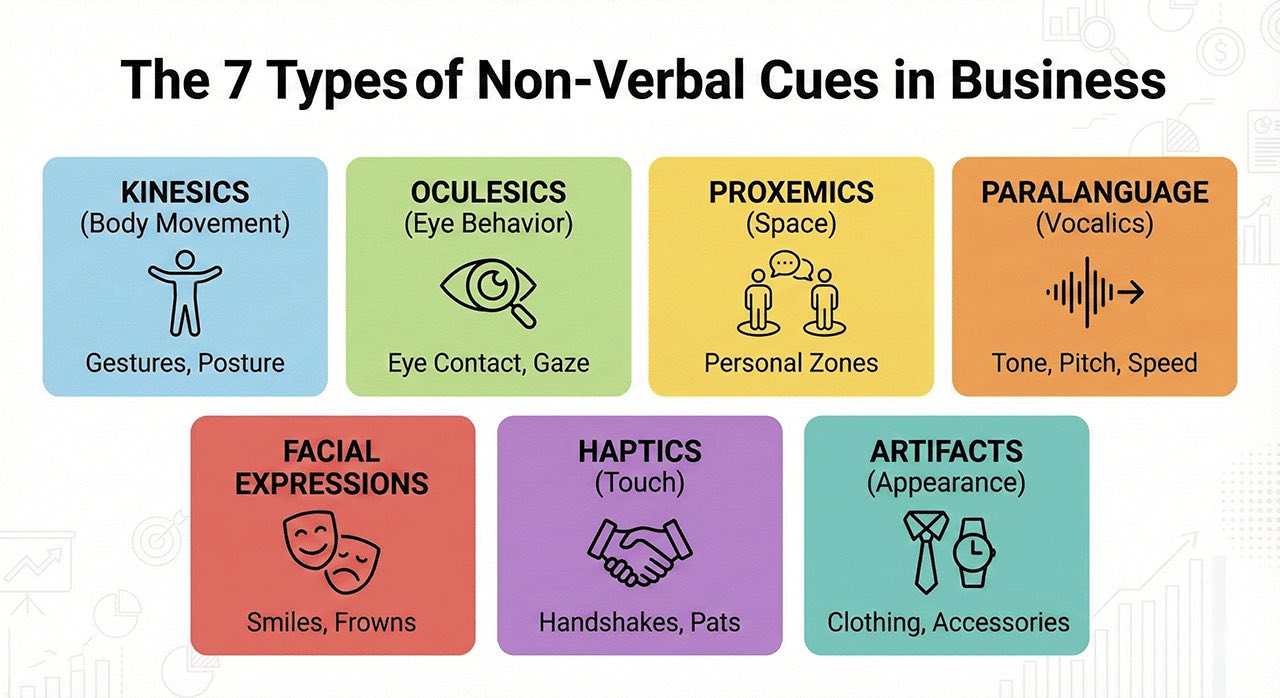
1. Kinesics (Body Movements)
Kinesics refers to the movement of your body. This is what we typically think of when we hear “body language.”
Gestures: These are movements of the hands and arms. Using open palms signals honesty and openness. Pointing a finger, conversely, can be seen as aggressive or accusatory.
Posture: How you stand or sit tells a story about your confidence. Slouching signals boredom or low energy. Standing tall signals authority.
Your posture often dictates the tone of the conversation. In formal vs informal communication, your physical stance sets the rules. A rigid posture suits a formal boardroom, while a relaxed lean suits a casual coffee chat.
2. Oculesics (Eye Contact)
The eyes are often called the windows to the soul. In business, they are the windows to trust.
Oculesics is the study of eye behavior. Maintaining steady eye contact shows that you are interested and confident. It builds rapport.
However, there is a balance. Staring without blinking can seem aggressive. Avoiding eye contact entirely makes you look dishonest or nervous.
3. Proxemics (Space and Distance)
Have you ever felt uncomfortable because someone stood too close to you? That is a violation of proxemics.
Proxemics is the study of personal space. In a business context, respecting these zones is vital.
- Intimate Zone: For family and close friends.
- Personal Zone: For one-on-one conversations with colleagues.
- Social Zone: For meetings and new acquaintances.
- Public Zone: For speeches and presentations.
Understanding these zones helps you navigate different types of oral communication in business. You wouldn’t stand in the “public zone” distance during a private performance review.
4. Paralanguage (Vocalics)
This is not what you say, but how you say it.
Paralanguage includes your pitch, volume, speed, and tone. If you say “I am so excited” in a flat, monotone voice, nobody will believe you.
You can learn specific exercises to master this in our post on how to improve oral communication skills. Vocal modulation is a tool that turns boring data into a compelling story.
5. Facial Expressions
The human face is incredibly expressive. It can convey countless emotions without saying a word.
Unlike some gestures, facial expressions are largely universal. A smile means happiness in New York and Tokyo. A frown means sadness everywhere.
In a meeting, your face is always visible. If you are checking your email while someone is presenting, your face will likely show disinterest. This can damage relationships without you realizing it.
6. Haptics (Touch)
Haptics refers to communication through touch. In the workplace, this is the most sensitive category.
The most common business haptic is the handshake. A firm handshake signals confidence and professionalism. A limp handshake signals weakness.
Beyond the handshake, you must be very careful. A pat on the back might be encouraging to some, but offensive to others. Always be aware of cultural and personal boundaries.
7. Artifacts (Appearance)
Believe it or not, your clothes are communicating for you.
Artifacts refer to the objects and images you use to represent yourself. This includes your clothing, accessories, hairstyle, and even your Zoom background.
If you show up to a client meeting in wrinkled clothes, you are signaling that you do not care about details. If you dress sharply, you signal professionalism and respect.
How Body Language Affects the Message
Non-verbal cues do not just exist in a vacuum. They interact with your spoken words in five specific ways.
Repetition: This happens when your body repeats what your lips are saying. For example, nodding your head while saying “Yes.” This strengthens the message.
Contradiction: This is dangerous. It happens when your body tells a different story than your words. For instance, looking at your watch while saying, “I have plenty of time.” The listener will always trust the watch-glance over the words.
Substitution: Sometimes, body language replaces words entirely. A “thumbs up” or a shrug of the shoulders conveys a full message without a single sound.
Complementing: This adds nuance to the message. Smiling warmly while telling a success story adds an emotional layer that the words alone cannot carry.
Accenting: This is like using a highlighter pen. Pounding the table to emphasize a deadline accents the importance of the verbal message.
Reading the Room: Decoding Others’ Signals
Communication is a two-way street. You need to control your own signals, but you also need to read the signals of others.
This is a core component of active listening skills. Listening is not just about hearing words; it is about seeing feelings.
Signs of Boredom:
- Slouching in the chair.
- Looking at phones or watches repeatedly.
- Feet pointing towards the door (a subconscious desire to leave).
- Blank stares.
Signs of Defensiveness:
- Crossed arms or legs (creating a physical barrier).
- Touching the neck or rubbing eyes.
- Turning the body slightly away from you.
Signs of Engagement:
- Leaning forward.
- Nodding while you speak.
- Mirroring your posture.
- Maintained eye contact.
If you spot signs of boredom or defensiveness, stop. Do not keep pushing your agenda. Change your approach. Ask a question to re-engage them.
How to Improve Your Own Non-Verbal Communication
Now that you know the theory, how do you practice it? Here are four actionable tips to improve your non-verbal impact today.
Tip 1: The Power of the Open Stance
When you are nervous, you instinctively want to make yourself smaller. You hunch your shoulders and cross your arms.
Fight this instinct. Keep your torso open. Uncross your arms. Expose your heart area. This signals vulnerability and honesty. It makes you look trustworthy and confident.
Tip 2: Mirroring
Mirroring is a psychological technique where you subtly copy the body language of the person you are talking to.
If they lean forward, you lean forward. If they speak softly, you lower your voice.
Do not mimic them like a cartoon. Be subtle. This creates a subconscious bond. It tells their brain, “I am like you.” It is a powerful tool for building rapport.
Tip 3: The “Eyebrow Flash”
This is a tiny movement with a huge impact. When you first make eye contact with someone, raise your eyebrows slightly for a split second.
This is a universal signal of recognition and friendliness. It instantly disarms the other person and sets a positive tone for the interaction.
Tip 4: Watch Your Hands
Nervous energy often escapes through the hands. You might fidget with a pen, play with your hair, or hide your hands in your pockets.
Keep your hands visible. Use them to gesture naturally. Research shows that speakers who use hand gestures are perceived as more competent and charismatic.
Conclusion
Oral communication is complex. It is not just about vocabulary and grammar. Words are the content, but body language is the context.
You can have the best script in the world, but if your body is signaling fear or arrogance, your message will fail. Conversely, a simple message delivered with open, confident body language can move mountains.
To be a master communicator, you must align your audio with your video. You need to ensure that your non-verbal cues are reinforcing your words, not sabotaging them.
Start observing these cues today. In your next meeting, look around the table. What are your colleagues really saying? The answers might surprise you.
If you want to ensure your spoken message is just as polished as your body language, take a moment to review the 7 Cs of communication. When you combine clear words with powerful body language, you become unstoppable.
Frequently Asked Questions (FAQ)
What is the 7-38-55 rule in communication?
This rule, developed by Albert Mehrabian, states that 7% of meaning is communicated through spoken words, 38% through tone of voice, and 55% through body language during face-to-face interactions regarding feelings and attitudes.
Can body language be faked?
You can practice positive body language, but micro-expressions often reveal true feelings. However, “faking” confidence through power posing can actually help you feel more confident over time.
How does culture affect non-verbal communication?
It has a huge impact. For example, direct eye contact is a sign of respect in Western cultures but can be seen as rude or aggressive in some Asian cultures. Always research cultural norms before traveling for business.
Frequently asked questions
What should I do if my body language contradicts what I’m saying?
Your audience will believe your body over your words. If you say you’re confident but cross your arms and avoid eye contact, they’ll perceive fear or doubt. Align your non-verbal cues with your message. Practice your delivery in front of a mirror or record yourself to catch mismatches. When verbal and non-verbal channels sync, your message becomes credible and persuasive.
How close should I stand to someone during a business conversation?
Use the personal zone for one-on-one conversations with colleagues—typically 1.5 to 4 feet apart. The social zone (4 to 12 feet) works for meetings and new acquaintances. Standing too close feels invasive and damages trust. Too far creates distance. Adjust based on the setting and relationship, and always watch for discomfort signals from the other person.
Is it possible to maintain too much eye contact?
Yes. Steady eye contact builds trust, but unblinking staring appears aggressive or uncomfortable. Aim for natural eye contact—look at the person for 3-5 seconds, then briefly look away. In group settings, shift your gaze among listeners. This balance shows confidence and interest without intimidating your audience.
How can I appear more confident when I’m actually nervous?
Control your posture first. Stand tall with shoulders back—this physical shift often calms your mind. Use open hand gestures instead of crossing your arms. Maintain steady eye contact. Slow your speech and lower your pitch slightly. These adjustments signal confidence to your audience and can actually reduce your internal anxiety through physical feedback.
Does what I wear really affect how people perceive my message?
Absolutely. Clothing is non-verbal communication. Wrinkled or casual attire in a formal setting signals carelessness. Sharp, appropriate dress reinforces professionalism and credibility. Your appearance sets expectations before you speak. Match your clothing to the context and audience. Even on video calls, dress appropriately—your background and appearance shape how your message is received.
What’s the best way to shake hands in a business setting?
A firm handshake signals confidence and professionalism. Grip should be strong but not crushing—match the other person’s pressure. Make eye contact, smile, and shake for 2-3 seconds. Avoid limp or overly aggressive handshakes. Be mindful of cultural differences and personal boundaries. If someone prefers not to shake hands, respect that without making it awkward.