


In the world of business and education, communication plays a key role. Every message, whether written or verbal, has its purpose. Among the many types of written communication used in organizations, the interview letter holds an important place.
It is more than just a piece of paper or an email — it represents professionalism, clarity, and respect between an employer and a candidate. In this article, we’ll explore what an interview letter is, its structure, examples, and the right way to write one so that you never go wrong in formal communication again.
Introduction
When an organization shortlists a candidate for a job, they usually inform them officially through an interview letter. This letter serves as a formal invitation for the candidate to attend an interview at a specific date, time, and place.
An interview letter is often the next step after submitting a job application. It helps both parties — the employer and the applicant — stay clear about expectations.
If you’re not sure how interview communication fits into the professional world, you can read What Is Job Interview – Employment Interview. It gives you a clear idea of how the hiring process works from start to finish.
Meaning of Interview Letter
An interview letter is a formal business letter sent by an employer to a candidate to invite them for an interview. It confirms that the candidate’s application has been considered and shortlisted.
The letter mentions details like:
- The date and time of the interview.
- The venue or platform (for online interviews).
- The position for which the interview is being held.
- Any documents the candidate needs to bring.
In simple words, it acts as an official bridge between application and selection.
Unlike casual or personal letters, an interview letter follows strict business letter writing principles — clarity, politeness, and structure. To understand this better, check out Job Application – Types, Format, Example. It shows how applications naturally lead to interview communications.
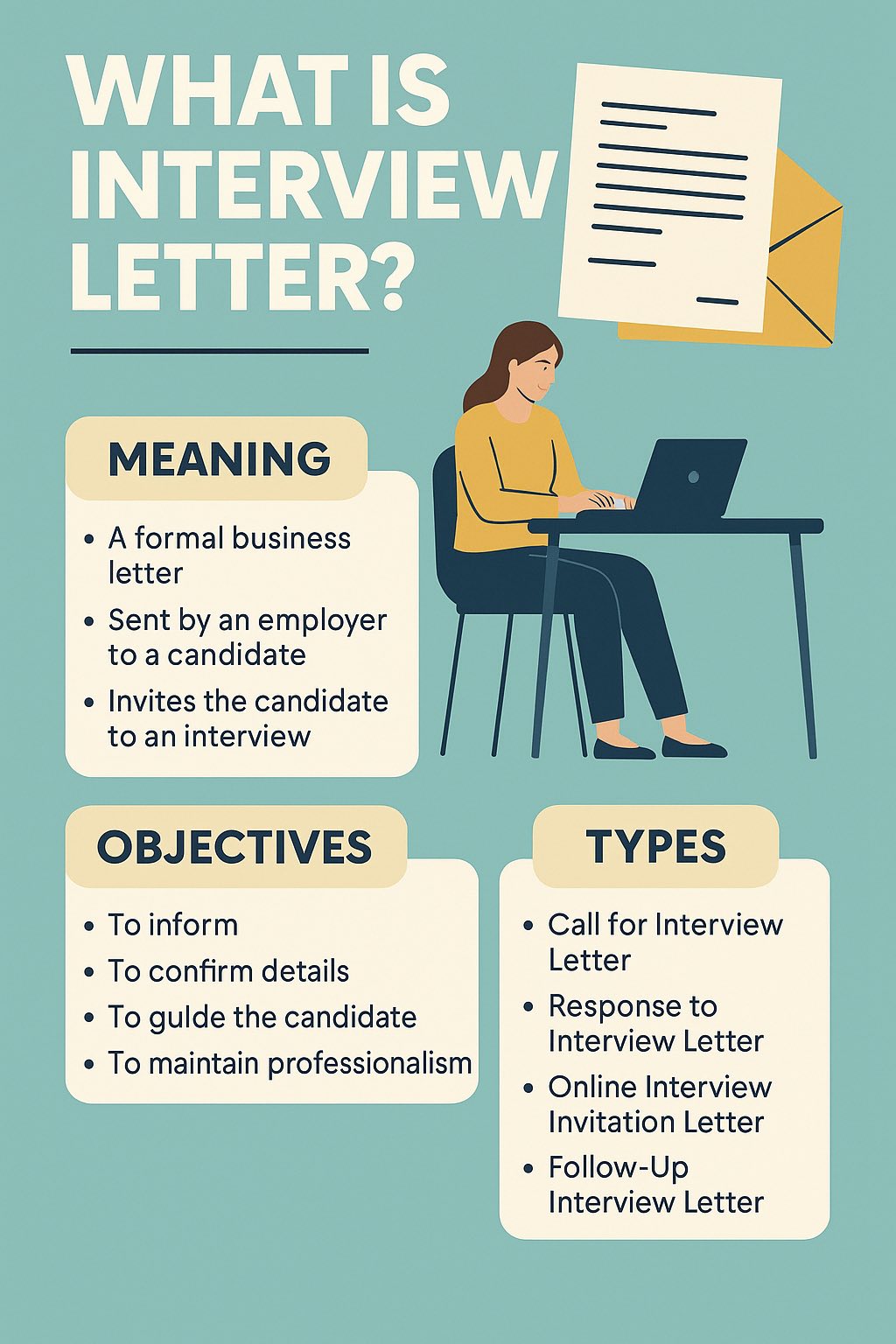
Objectives of an Interview Letter
Every professional letter has a purpose, and the interview letter is no exception. It performs several essential functions in the hiring and communication process.
Here are the main objectives of an interview letter:
- To Inform:
It notifies the candidate that they have been shortlisted for an interview. - To Confirm Details:
The letter provides information about the time, date, and venue so the candidate can prepare accordingly. - To Guide the Candidate:
It includes any instructions, such as bringing specific documents or attending a virtual meeting link. - To Maintain Professionalism:
Sending an interview letter demonstrates good communication etiquette and builds a professional image for the organization. - To Serve as a Record:
It acts as official documentation that an invitation was issued, maintaining transparency in the recruitment process.
Above all, it strengthens business communication by keeping interactions formal and error-free.
Types of Interview Letters
Though the purpose of all interview letters is to invite or confirm participation, the tone and content can differ based on who sends it and why. Let’s look at the four main types.
A. Call for Interview Letter
This is the most common type. It is sent by the employer to invite a shortlisted candidate for an interview.
It usually mentions:
- The job title or position.
- The interview date, time, and place.
- The documents required.
- The name or designation of the interviewer.
This kind of letter is usually polite and professional, written in a positive tone that motivates the candidate.
B. Response to Interview Letter
This letter is sent by the candidate to acknowledge and confirm the invitation. It expresses gratitude and confirms attendance at the scheduled time.
Such a letter reflects good manners and effective communication skills, both of which matter in professional life.
C. Online or Virtual Interview Invitation Letter
In today’s digital world, many organizations conduct interviews via Zoom, Google Meet, or Microsoft Teams.
This letter contains:
- The meeting link.
- Platform details.
- Login or meeting code.
- Technical instructions or time zone clarifications.
It’s concise and ensures the candidate can join smoothly.
D. Follow-Up or Reminder Interview Letter
This type of letter is sent when an interview is approaching or if the schedule has changed.
It helps avoid confusion and ensures attendance.
You can find more examples of letter variations in Features of Business Letter, which explains tone, structure, and professional balance.
Structure of an Interview Letter
The structure of an interview letter is what gives it professionalism and clarity. Without proper format, even a well-written message can look disorganized.
Here’s a breakdown of the standard format:
- Sender’s Information:
Include the name, title, company, and address. - Date:
Mention the date the letter is being sent. - Receiver’s Information:
Candidate’s name, address, and contact details. - Subject Line:
Example: Interview Call for the Position of Marketing Executive. - Salutation:
“Dear Mr./Ms.” followed by the candidate’s name. - Body Paragraphs:
- Opening: Congratulate and invite.
- Middle: Provide details of time, date, and documents.
- Closing: Encourage attendance and provide contact info.
- Complimentary Close:
“Yours sincerely” or “Yours faithfully.” - Signature and Designation:
End with your full name and position.
For more on letter formatting and parts, visit Parts of Business Letter – Header, Salutation, Body, Closing.
Example of an Interview Letter (Employer to Candidate)
Here’s a simple and professional example of how to write an interview letter.
ABC Corporation Ltd.
Dhaka, Bangladesh
Date: 10 January 2025

Mr. Rahim Uddin
Uttara, Dhaka

Subject: Interview Call for the Position of Marketing Executive

Dear Mr. Rahim,

We are pleased to inform you that you have been shortlisted for an interview for the position of Marketing Executive at our company.

The interview will be held on 15 January 2025, at 10:00 AM, at our head office located at House #22, Road #3, Dhanmondi, Dhaka.

Please bring your updated resume, educational certificates, and a recent passport-size photograph.

We look forward to meeting you soon.

Yours sincerely,
[Signature]
HR Manager
ABC Corporation Ltd.
Example of a Reply to an Interview Letter (Candidate to Employer)
Now, let’s look at how a candidate should respond politely.
Mr. Rahim Uddin
Uttara, Dhaka
Date: 11 January 2025

The HR Manager
ABC Corporation Ltd.
Dhaka

Subject: Confirmation of Interview Attendance

Dear Sir/Madam,

Thank you for inviting me to attend the interview for the position of Marketing Executive.

I confirm that I will be attending the interview on 15 January 2025, at 10:00 AM, as scheduled.

Yours faithfully,
Rahim Uddin
For more examples of professional communication, see Acknowledgement Letter – Business Format & Samples.
Tips for Writing an Effective Interview Letter
A well-written interview letter reflects your attention to detail and professionalism.
Here are some essential tips:
- Be Clear and Concise:
Mention only what’s necessary, such as date, time, and venue. - Use Positive Language:
Make the tone inviting and respectful. - Avoid Complex Sentences:
Use short, clear sentences that are easy to read. - Follow Business Letter Etiquette:
Keep the tone formal but friendly. - Double-Check Details:
Ensure dates, times, and names are correct before sending. - Proofread Before Sending:
Spelling or grammar errors can damage your credibility.
For more practical guidance, visit How to Write Business Letter – Step-by-Step Guide.
Importance of Interview Letter in Business Communication
The interview letter might seem small, but it holds great importance in business communication. It helps create a professional image and builds trust.
A. Strengthens Professional Relationships
Sending a well-structured interview letter shows respect and professionalism. It assures the candidate that the company values clear communication.
B. Promotes Transparency
When all details are clearly mentioned, misunderstandings are minimized. Transparency builds confidence between both parties.
C. Acts as Formal Record
An interview letter serves as proof that the candidate was invited, protecting the organization from miscommunication.
D. Reflects Corporate Culture
The tone and clarity of the letter mirror the organization’s communication standards and values.
You can read Importance of Business Letter for a deeper understanding of how such correspondence enhances professional relationships.
Common Mistakes to Avoid
Even small errors can make a professional letter look unprofessional. Avoid these common mistakes:
- Forgetting to include the subject line.
- Using informal or casual language.
- Missing crucial details like date or venue.
- Forgetting to proofread before sending.
- Not addressing the recipient correctly.
- Sending the letter too late.
Attention to these details shows good communication discipline and leaves a lasting positive impression.
Difference Between Interview Letter and Appointment Letter
Many students confuse an interview letter with an appointment letter, but the two are quite different. Here’s a quick comparison:
| Aspect | Interview Letter | Appointment Letter |
|---|---|---|
| Purpose | Invitation for interview | Confirmation of job |
| Sender | Employer | Employer |
| Receiver | Candidate | Selected candidate |
| Timing | Before selection | After selection |
| Tone | Formal and neutral | Formal and congratulatory |
| Content | Interview details | Salary, joining date, terms |
If you’re curious about the next step after selection, check What Is Joining Letter – Specimen of Joining Letter.
Conclusion
In summary, an interview letter is a vital component of professional communication. It ensures that both employer and candidate stay informed and prepared. Whether it’s an email or a printed letter, what matters most is clarity, politeness, and structure.
Remember, in the business world, the way you communicate represents who you are. A well-written interview letter not only invites someone to an interview but also reflects the professional image of your organization.
So next time you need to send one, take a few extra minutes to plan, review, and write thoughtfully — because your letter might just set the tone for a successful professional relationship.
Frequently asked questions
Should I send an interview letter via email or printed mail?
Email is standard for most organizations today—it’s faster and easier to track. Use printed mail only if the employer specifically requested it or your industry traditionally uses formal post (law, government). Email allows the candidate to respond quickly and keeps a clear digital record for both parties.
What if I don’t know the candidate’s preferred title (Mr., Ms., Dr.)?
Use the full name without a title if unsure: “Dear Sarah Chen” instead of guessing. If you must use a title, “Ms.” is safer than “Mrs.” since it doesn’t assume marital status. When in doubt, check the job application or LinkedIn profile for clues about how they present themselves professionally.
Can I include additional company information in the interview letter body?
Keep it minimal. The interview letter’s job is to confirm logistics, not sell the company. If you want to share company details, attach a separate document or direct them to your careers page. Too much information clutters the letter and dilutes its core purpose.
What should I do if a candidate doesn’t respond to my interview letter?
Wait 2-3 business days, then send a polite follow-up reminder via the same channel. Include the original details and ask for confirmation. If still no response after another 3 days, move to your next candidate. Non-response often signals lack of interest.
Is it unprofessional to send an interview letter template to multiple candidates?
No, using a template is standard and efficient. However, personalize key details: the candidate’s name, position applied for, and interview specifics. Generic templates are fine; generic execution (wrong name, vague position) damages your credibility and the candidate’s confidence.
Should the interview letter mention salary or benefits information?
No. The interview letter invites and confirms logistics only. Salary and benefits discussions happen during or after the interview. Mentioning compensation prematurely can create confusion or set wrong expectations before you’ve assessed the candidate.
1 Comment
Packer/kattunar