


A business letter succeeds or fails based on specific, measurable qualities. Understanding these features helps you write correspondence that gets read, understood, and acted upon, whether you’re requesting payment, responding to a complaint, or proposing a partnership. This guide breaks down the ten essential features that separate professional business letters from ineffective ones.
What are the features of a business letter?
Features of a business letter are the qualities that distinguish effective professional correspondence from casual or poorly executed writing. These characteristics cover both content (what you say and how you organize it) and presentation, including formatting and visual professionalism.
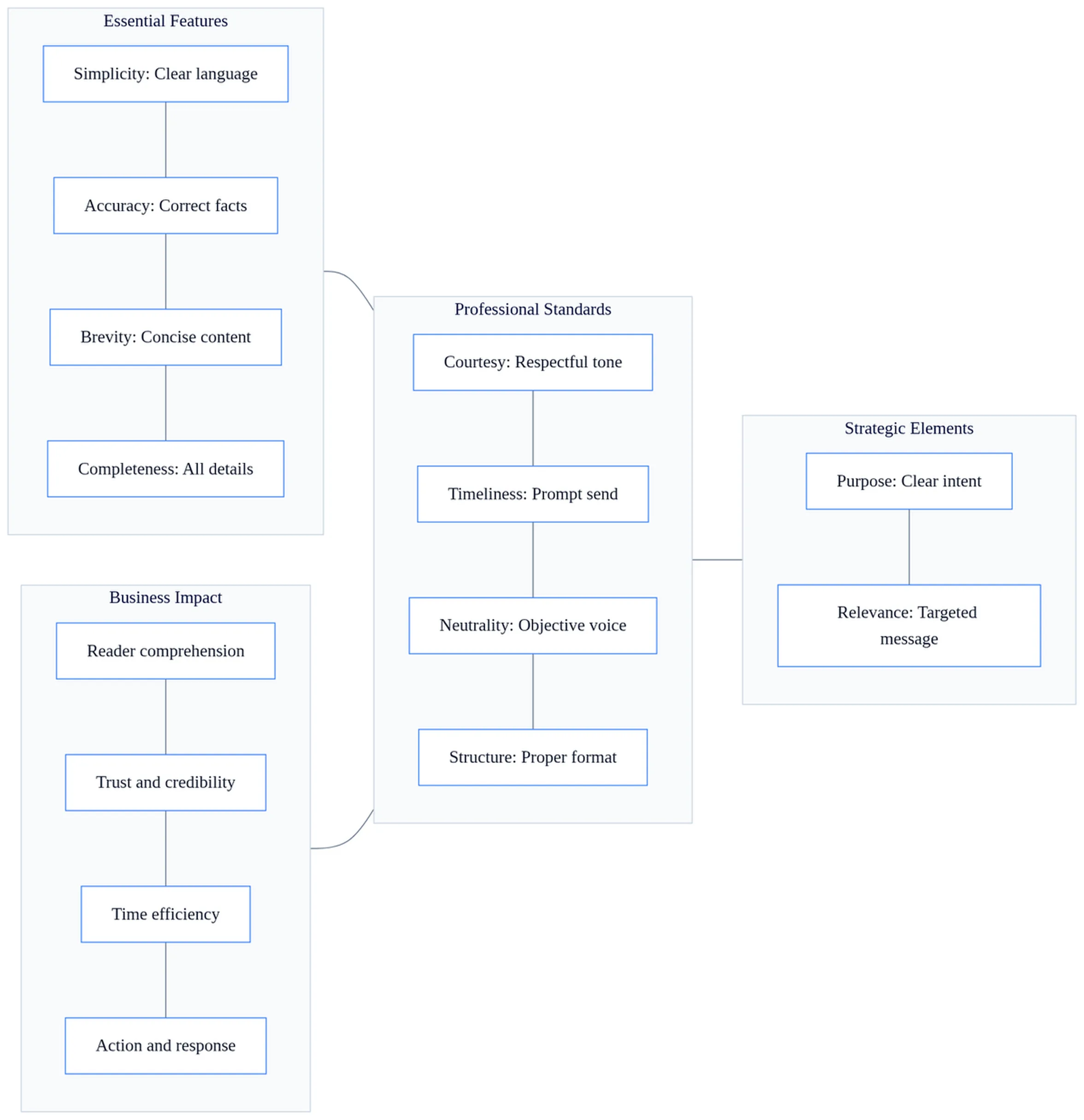
These features matter because they directly affect business outcomes. A well-crafted letter builds trust, speeds decision-making, and strengthens relationships. A poorly written one wastes time, creates confusion, and can damage your organization’s reputation. When a supplier receives a vague request, they can’t provide an accurate quote. When a client reads a letter full of errors, they question your attention to detail in other areas.
The features work together as a system. You can’t achieve clarity without simple language. You can’t claim completeness if your facts are inaccurate. Understanding how these qualities interact helps you write letters that accomplish specific business goals.
Clarity and simplicity of language
Simple, direct vocabulary is the foundation of business writing. Your reader should grasp your meaning on the first pass, without re-reading sentences or consulting a dictionary. This means avoiding jargon (unless writing to specialists who share that vocabulary), cutting archaic phrases like “as per your request” or “enclosed herewith,” and choosing short, concrete words over long, abstract ones.
Compare these two sentences:
Complex: “Your aforementioned solicitation has been duly noted and will be subjected to comprehensive evaluation by the pertinent departmental personnel.”
Simple: “We received your request and our team is reviewing it now.”
The second version communicates the same information in half the words and zero cognitive effort. Busy professionals appreciate this efficiency. When you write simply, you signal respect for your reader’s time.
The business risk of unclear language is real. Ambiguous contract terms lead to disputes. Vague instructions result in incorrect deliveries. Complex explanations require follow-up emails that waste everyone’s time. One manufacturing firm lost a $40,000 order because their proposal used technical jargon the client’s purchasing manager couldn’t understand, and the manager chose a competitor with a clearer offer rather than ask for clarification.
Simplicity does not mean oversimplification. Include necessary technical details, but define specialized terms and structure complex information logically. The goal is comprehension.
Accuracy and factual correctness
Every claim, date, figure, name, and reference in your letter must be verifiable. This includes correct spelling of recipient names, accurate job titles, precise dollar amounts, realistic deadlines, and truthful product specifications.
Inaccurate information is worse than no information. It damages your credibility immediately and can expose your organization to legal liability. A letter promising delivery by March 15 when your warehouse knows the shipment won’t arrive until April creates a contractual obligation you can’t meet. A sales letter citing incorrect pricing forces your company to honor the printed price or face accusations of false advertising.
The verification step matters. Before sending any letter with financial data, cross-check figures against source documents. Before committing to a deadline, confirm with the people who will do the work. Before citing a policy, review the current policy manual, not your memory of what it said two years ago.
Accuracy extends to tone and implication. Don’t write “we guarantee same-day shipping” if you mean “we ship same-day when orders arrive before 2 PM.” The first statement creates an absolute promise; the second states a conditional one. Unclear or inaccurate workplace communications are a leading source of employee grievances and management disputes.
Brevity with completeness
This is where many writers struggle: how do you include all necessary information without writing a novel? The tension between brevity and completeness requires deliberate choices about what to include and what to cut.
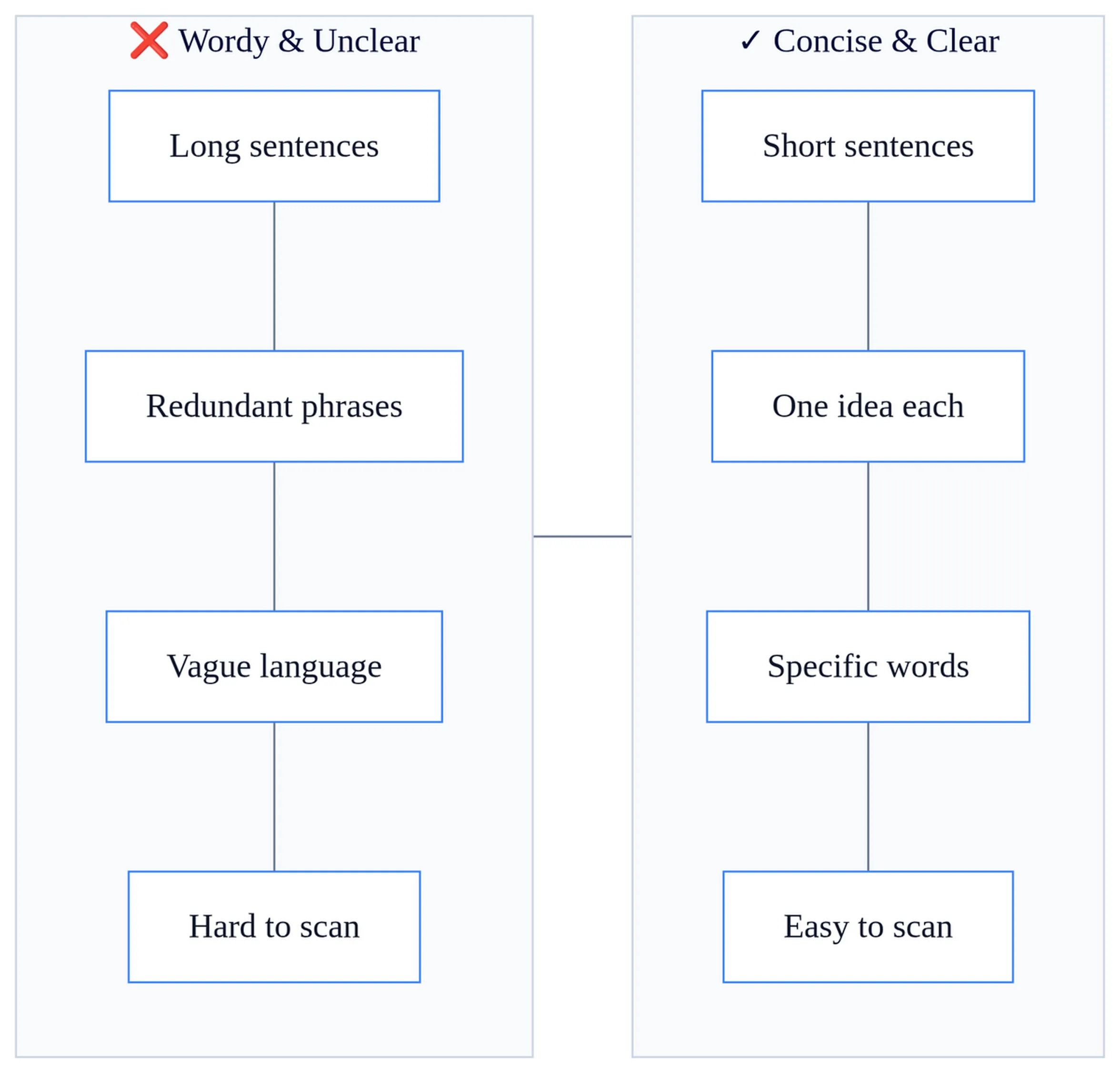
Brevity means eliminating padding, not eliminating substance.
Cut filler phrases like “I am writing to inform you that,” “as you may already know,” and “in this day and age.” These add words without adding meaning. Start with your main point instead of announcing that you’re about to state your main point.
Completeness means your reader has enough detail to act or respond without asking follow-up questions. If you’re requesting a quote, include specifications, quantities, and delivery timeline. If you’re confirming a meeting, state date, time, location, and agenda. If you’re explaining a policy change, cover what’s changing, when it takes effect, and who it affects.
Here’s a practical test: after writing your letter, ask yourself what questions the reader might still have. If you can identify obvious gaps, fill them before sending. One purchasing manager reported that 60% of vendor inquiry letters she receives require follow-up emails because they omit basic details like required delivery dates or budget constraints. That’s not just inefficient writing, it’s a competitive disadvantage. The vendor who includes complete information in the first letter gets their quote request processed faster.
Structure helps balance these competing demands. One idea per paragraph. Front-load the most important information. Use bullet points for lists of specifications or requirements. This approach delivers completeness in a scannable format that respects the reader’s time.
Specific purpose and relevance
Every business letter exists to accomplish one clear goal: request information, lodge a complaint, confirm an agreement, apologize for an error, propose a partnership, or decline an offer. Your reader should be able to state that purpose in one sentence after reading your opening paragraph.
Purpose drives relevance. Include only information that serves your stated goal. If you’re requesting a refund for a defective product, the reader needs the purchase date, order number, description of the defect, and your preferred resolution. They don’t need your company’s founding story, a detailed account of how you discovered the defect, or commentary on industry trends.
Irrelevant details irritate readers and dilute your message. A three-page letter about a simple scheduling change signals poor judgment. The reader wonders: if you can’t distinguish important information from trivia in a letter, can you do it in a project?
Test your purpose clarity with this exercise: can a colleague who knows nothing about the situation read your letter and explain what you want the recipient to do next? If not, revise your opening paragraph to state your purpose more directly. Many of the principles that make letters effective align with the broader 7 Cs of communication framework used across business contexts.
Professional tone and courtesy
Tone is the personality your words convey. In business letters, professional tone means formal register, respectful language, and absence of sarcasm or emotional venting, even when you’re angry about a problem.
Courtesy is not weakness. Polite, professional language builds goodwill and increases the likelihood of favorable responses, even when delivering bad news or making difficult requests. Compare these versions of the same message:
Discourteous: “Your invoice is wrong again. Fix it immediately or we’re switching suppliers.”
Courteous: “We’ve identified a discrepancy in invoice #4521. Could you please review the line items and send a corrected version by Friday? We value our partnership and want to resolve this quickly.”
Both versions communicate the same problem and urgency. The second one preserves the business relationship while still demanding action. The You attitude in business letters takes this further by framing messages around reader benefits rather than writer convenience.
Professional tone also means choosing appropriate salutations and closings. “Dear Ms. Rodriguez” works for formal correspondence; “Hey Sarah” does not, even if you’ve met Sarah once at a conference. When gender is unknown, use the full name (“Dear Jordan Smith”) or the person’s title (“Dear Hiring Manager”).
Reader psychology matters here. Courteous letters receive faster, more helpful responses. Rude or aggressive letters trigger defensive reactions that slow resolution. One customer service director noted that complaint letters using professional, courteous language were resolved an average of three days faster than hostile ones, because staff prioritized the reasonable customers.
Freedom from errors and proper formatting
Grammar mistakes, spelling errors, and punctuation problems undermine your credibility instantly. A letter asking for a $50,000 contract that confuses “their” and “there” makes the reader question your attention to detail in all areas. If you’re careless with words, will you be careless with their money?
Common errors to eliminate: subject-verb disagreement, sentence fragments in formal writing, misplaced apostrophes, inconsistent verb tenses, and misspelled recipient names. The last one is particularly damaging. Misspelling someone’s name signals that you didn’t care enough to check.
Outer quality (the visual presentation) matters as much as inner quality. This includes consistent margins (typically one inch), professional font (Times New Roman, Arial, or Calibri in 11- or 12-point), proper alignment, and correct spacing between elements. The specific layout depends on which of the standard business letter formats you choose, but consistency within that format is mandatory.
Proofreading must be systematic. Spell-check catches obvious errors but misses correctly spelled wrong words (“form” instead of “from”). Read your letter aloud. Your ear catches awkward phrasing your eye misses. Have a colleague review important letters before sending. For critical correspondence like contracts or formal proposals, consider professional proofreading.
Business documents with multiple errors are less likely to achieve their intended outcome than error-free versions.
Timeliness and neutrality
Timeliness means sending your letter when it will be most useful, not a week later when the decision has already been made or the opportunity has passed. Respond to inquiries within 24 to 48 hours when possible. Acknowledge complaints immediately, even if full resolution takes longer. Send thank-you letters within three days of the event.
Delayed letters damage relationships and reduce effectiveness. A job application that arrives two weeks after the posting closes won’t be read. A price quote delivered after the client has already chosen a vendor wastes everyone’s time. In business, timing often matters as much as content.
Neutrality means presenting facts objectively, without emotional language or unsupported personal opinion. This is especially important in letters addressing complaints, disputes, or sensitive workplace matters. State what happened, cite specific evidence, and propose solutions, but avoid accusatory language or assumptions about motive.
Not neutral: “You obviously didn’t read our contract before complaining about the delivery fee.”
Neutral: “The delivery fee is specified in Section 3.2 of our contract, signed on January 15. I’ve attached a copy for your reference.”
Both versions point to the same contract clause. The neutral version does it without insulting the reader’s intelligence or professionalism. Neutrality doesn’t mean you can’t take a position. It means you support that position with facts rather than emotion.
For letters that require persuasion or reader-focused framing, neutrality balances with strategic emphasis. You remain factual while highlighting information that serves your purpose. This is where understanding effective communication principles helps you choose the right balance for each situation.
How features work together: a practical checklist
The features of business letters are interdependent. Brevity without completeness leaves your reader with questions. Accuracy without clarity creates confusion. Courtesy without timeliness frustrates people who needed your response yesterday.
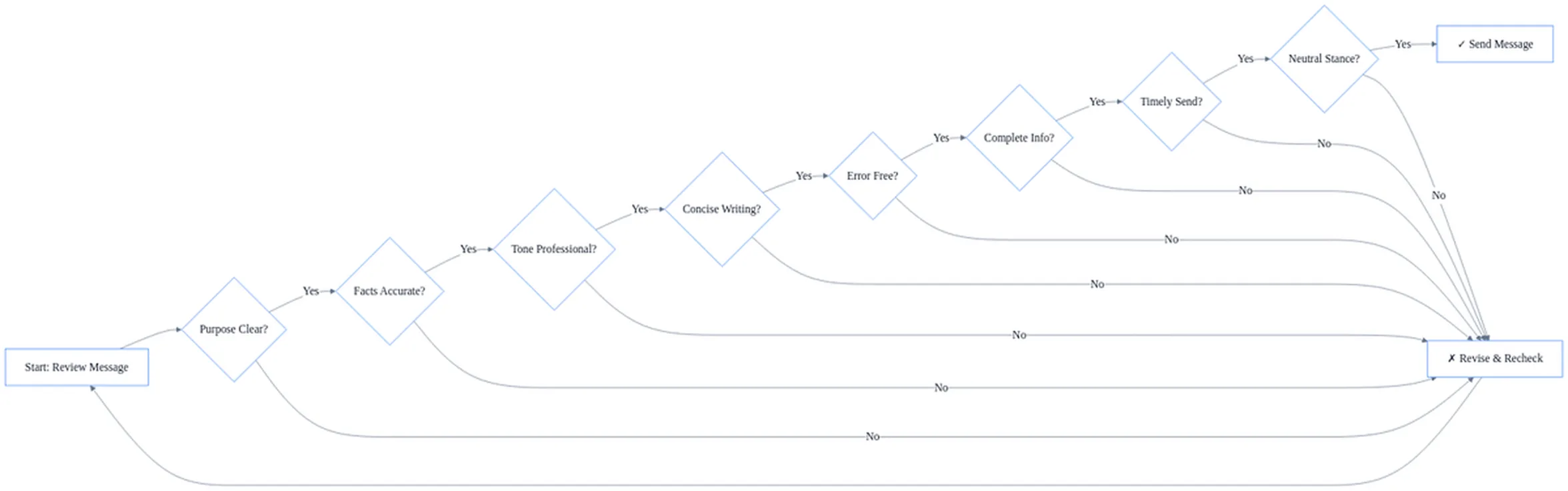
Understanding these relationships helps you make trade-offs. When you must choose between brevity and completeness, ask: will cutting this detail force the reader to send a follow-up email? If yes, keep it. When you must choose between speed and perfection, ask: will this error damage credibility or just irritate a grammar perfectionist? Context determines the answer.
Different letter types prioritize different features:
| Letter Type | Priority Features | Why |
|---|---|---|
| Complaint | Accuracy, courtesy, neutrality | Facts support your case; courtesy increases cooperation; neutrality prevents escalation |
| Inquiry | Clarity, timeliness, specific purpose | Clear questions get useful answers; prompt inquiries show genuine interest |
| Formal offer | Accuracy, completeness, error-free | Every detail may become contractually binding; errors create legal exposure |
| Apology | Courtesy, timeliness, sincerity | Prompt, genuine apologies preserve relationships; delayed or insincere ones worsen damage |
| Routine request | Brevity, clarity, specific purpose | Simple requests should be quick to read and easy to fulfill |
Before sending any business letter, run through this verification checklist:
- Purpose: Can the reader state what you want in one sentence?
- Accuracy: Have you verified all facts, figures, names, and dates?
- Tone: Is the language professional and courteous throughout?
- Brevity: Have you cut filler phrases and redundant information?
- Completeness: Does the reader have enough detail to act without asking follow-up questions?
- Errors: Have you proofread for grammar, spelling, and punctuation mistakes?
- Format: Does the layout follow one of the standard formats consistently?
- Timing: Are you sending this when it will be most useful?
Most writers get one thing wrong: they treat these features as a checklist to apply at the end, during editing. The most effective approach builds them in from the start. Before you write the first sentence, clarify your purpose. As you draft, choose simple words and organize information logically. As you revise, tighten for brevity while checking completeness.
The complete writing process, from planning through final proofreading, is covered in detail in our guide on how to write a professional business letter. For understanding the structural components that support these features, see our breakdown of the parts of a business letter.
The features of effective business letters aren’t arbitrary rules. They’re practical responses to how busy professionals read and process information. Start with clarity and accuracy as your foundation, then layer in the other qualities based on what each specific letter needs to accomplish. If you’re sitting on the fence about whether a particular letter needs all ten features applied equally, it doesn’t. Use the table above to identify which features matter most for your specific situation, then focus your effort there.
Frequently asked questions
What if my letter needs technical details but my reader isn’t a specialist?
Include the technical details, but define specialized terms clearly. Use short sentences to explain complex concepts step-by-step. Avoid jargon unless your reader shares that vocabulary. Structure technical information logically with headers or bullet points. The goal is comprehension, not oversimplification. Your reader should understand without needing to ask follow-up questions.
How do I know if I’ve included enough information without making the letter too long?
After drafting, ask yourself what questions a reader might still have. If obvious gaps exist, fill them. Include specifications, quantities, deadlines, dates, times, and locations relevant to your request or message. One purchasing manager found 60% of vendor letters required follow-ups due to missing details. Complete information in the first letter speeds decisions and gives you a competitive advantage.
Should I use formal phrases like ‘as per your request’ to sound more professional?
No. Phrases like ‘as per your request’ and ‘enclosed herewith’ are archaic and add no meaning. They waste your reader’s time and signal outdated writing habits. Use simple, direct language instead: ‘We received your request’ works better than ‘Your aforementioned solicitation has been duly noted.’ Busy professionals respect efficiency over formality.
What’s the business risk if I’m slightly inaccurate about a deadline or price?
Inaccuracy damages credibility immediately and creates legal liability. Promising March 15 delivery when your warehouse knows it’s April creates an obligation you can’t meet. Citing wrong pricing forces you to honor it or face false advertising claims. Always verify dates, figures, names, and titles against source documents before sending. Accuracy extends to conditional promises too—state limits clearly.
How do I balance sounding professional without using overly complex language?
Professional writing is clear writing, not complex writing. Use short, concrete words instead of long, abstract ones. Choose active voice. Start with your main point instead of announcing you’re about to make one. Eliminate filler phrases. A sentence like ‘We received your request and our team is reviewing it now’ is more professional than vague, wordy alternatives because it respects your reader’s time.