


Interviews can feel like a mystery to many job seekers. You prepare answers, dress well, and walk in with a smile, yet every interview seems different. Why is that? Because there are various types of interviews, and each one is designed with a different purpose in mind.
Understanding these types can turn your confusion into confidence. Whether you’re applying for your first job or aiming for a promotion, knowing how each interview works gives you a clear edge. So, let’s explore the fascinating world of interviews together.
What Are the Main Types of Interviews?
Before we dive into each type, let’s understand what the term really means. An interview isn’t just a conversation; it’s a structured interaction between a candidate and an employer to assess suitability for a role.
You can think of it as a professional bridge — one side represents your skills and ambitions, while the other reflects the company’s needs. Different companies build that bridge in different ways, using various interview methods.
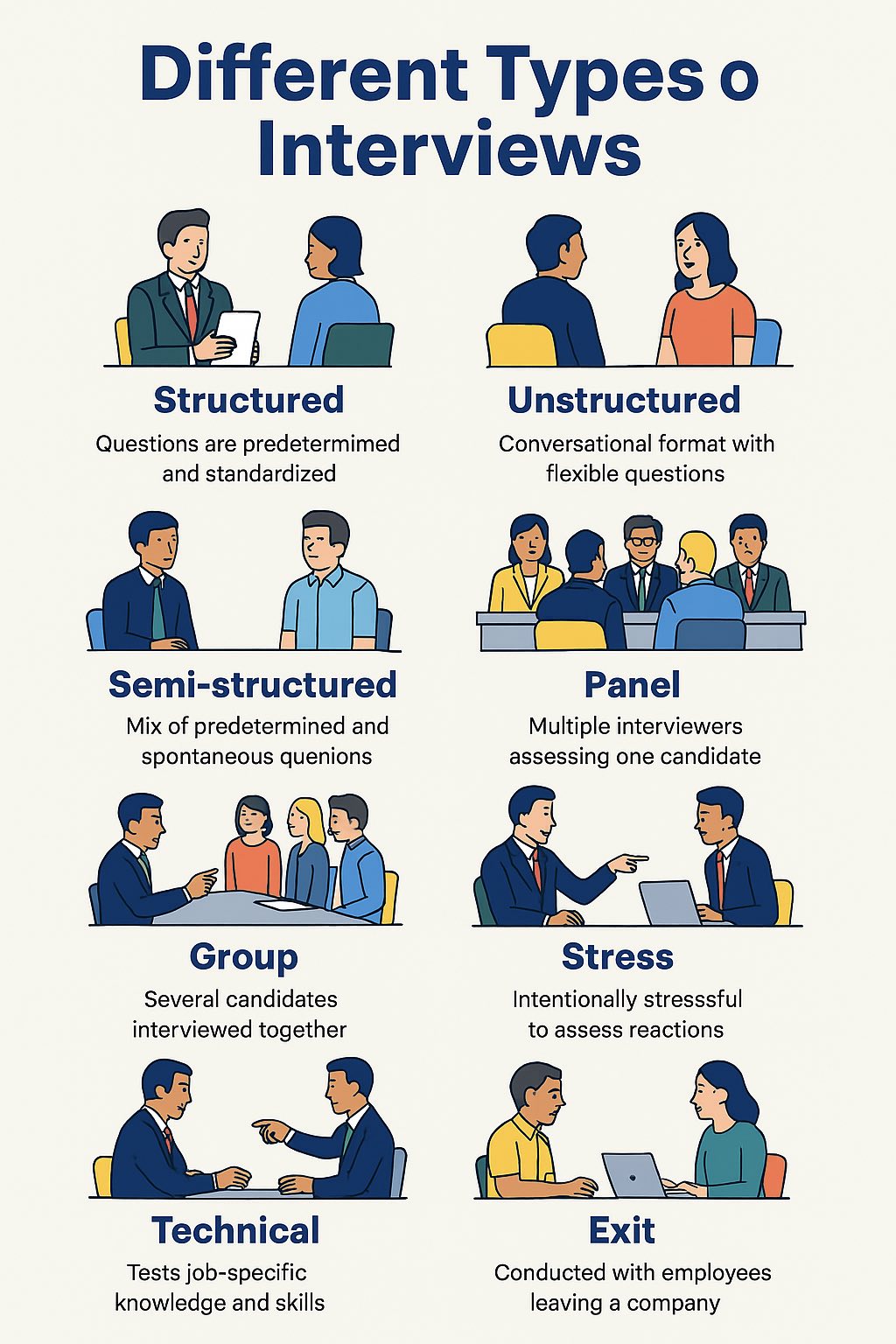
As explained in our earlier post on Interview Definition and Purpose, interviews serve multiple goals: assessing competence, communication, and attitude. Now let’s look at how interviewers do that through different structures and styles.
Structured Interview
A structured interview follows a pre-planned format. The interviewer asks every candidate the same set of questions, in the same order, and often uses a scoring system for answers.
This method ensures fairness and consistency. For example, if you’re applying for a bank job, all applicants might be asked identical questions like, “Describe how you handle pressure at work.”
Advantages of Structured Interviews
- Easy to compare candidates.
- Minimizes bias or favoritism.
- Ensures fairness and transparency.
Disadvantages
- Can feel robotic or impersonal.
- Limits follow-up questions or deeper discussion.
Structured interviews are perfect for roles where specific qualifications or criteria are important, such as government or corporate jobs.
If you want to learn about the entire process from start to finish, check out our guide on The Complete Interview Process.
Unstructured Interview
Unlike the previous type, the unstructured interview is casual and conversational. The interviewer doesn’t rely on a fixed list of questions. Instead, the discussion flows naturally based on your answers.
Imagine chatting with your future boss over coffee, talking about your background and career goals — that’s how unstructured interviews often feel.
Advantages
- Helps build rapport between interviewer and candidate.
- Allows deeper insights into a person’s personality.
- Encourages open and honest communication.
Disadvantages
- Harder to compare different candidates.
- May lead to personal bias.
Employers often use unstructured interviews for creative or leadership roles, where personality matters as much as skill. To understand how interviewers manage such conversations effectively, you can read our post on Qualities of a Good Interviewer.
Semi-Structured Interview
The semi-structured interview is a blend of both worlds. It includes some fixed questions but leaves room for spontaneous follow-ups.
For example, an HR manager might ask, “Tell me about a project you’re proud of,” and then ask more detailed questions based on your response. This flexibility helps interviewers explore your strengths and thinking style without losing focus.
Semi-structured interviews are commonly used in HR departments, universities, and research-based positions.
Panel Interview
A panel interview involves multiple interviewers sitting together to evaluate one candidate. You might face two to five people from different departments — HR, your potential manager, and maybe a senior executive.
Sounds intimidating? Don’t worry! Once you understand how to handle it, a panel interview can actually work in your favor.
How to Succeed in a Panel Interview
- Make eye contact with all interviewers, not just one.
- Address each person respectfully.
- Listen carefully and take your time before answering.
A panel interview often assesses not only your knowledge but also how you communicate under pressure. To polish your manners, refer to our detailed guide on Interview Etiquette.
Group Interview
In a group interview, several candidates are interviewed together. It’s common in sales, hospitality, and management trainee positions.
Employers use this method to see how you interact with others, solve problems, and demonstrate teamwork.
What Interviewers Observe
- Leadership and listening skills.
- Ability to collaborate under pressure.
- Respectful participation and communication.
Here’s a tip: Don’t try to dominate the conversation. Instead, contribute thoughtful ideas and support others when appropriate. Confidence with courtesy always wins.
Stress Interview
The stress interview might sound scary, but it’s designed to test your emotional strength, not torture you.
Interviewers deliberately create a stressful environment by interrupting you, asking tough questions, or showing disinterest to see how you react.
For example, an interviewer might ask, “Why should we hire you when others are more experienced?” The goal is to observe whether you stay calm, polite, and logical.
To handle such moments like a pro, review our post on Guidelines for Facing Employment Interview. It provides simple strategies to build confidence and handle pressure.
Behavioral Interview
A behavioral interview focuses on your past actions to predict your future performance. The idea is simple: past behavior is the best indicator of future behavior.
You’ll often hear questions like:
- “Tell me about a time you resolved a conflict at work.”
- “Describe a challenge you faced and how you overcame it.”
The best way to answer these is the STAR method — Situation, Task, Action, Result. Describe the context, what you did, and how it turned out.
Behavioral interviews are common in modern HR practices because they reveal real-world experience instead of memorized answers.
Technical Interview
The technical interview evaluates your practical knowledge in a specific field. For instance, a software engineer may need to solve coding problems, while an accountant might interpret financial reports.
But here’s the secret: technical skill alone isn’t enough. Employers also observe how you explain your ideas clearly. That’s why communication skills matter so much, even in technical roles.
If you’d like to learn how body language strengthens communication, read our post on the Importance of Non-Verbal Communication. It’s a game-changer for professional success.
Exit Interview
Unlike other interviews, the exit interview happens when you’re leaving a company. It’s your chance to share honest feedback about your experience.
Employers use this feedback to improve workplace culture and management. Though it might feel awkward, being respectful and constructive helps maintain a positive relationship with your former employer.
After all, you never know when paths will cross again!
Other Notable Interview Types
Let’s look at a few more interview formats that are becoming increasingly popular.
1. Case Interview
Common in consulting and business analysis roles, case interviews test your problem-solving skills. You might be given a real business scenario and asked to suggest solutions.
2. Telephonic or Video Interview
With remote work growing, these have become the norm. Always ensure a quiet space, strong internet, and proper lighting.
3. Campus Interview
These are conducted at educational institutions to recruit fresh graduates. It’s often the first professional interview for students, so preparation and attitude matter most.
Comparison Table: Types of Interviews at a Glance
| Interview Type | Structure Level | Focus Area | Best For |
|---|---|---|---|
| Structured | High | Consistency, fairness | Corporate, government jobs |
| Unstructured | Low | Personality, conversation | Creative roles, startups |
| Semi-Structured | Moderate | Flexibility and control | HR, research roles |
| Panel | High | Communication, teamwork | Senior-level roles |
| Group | Variable | Leadership, cooperation | Sales, management training |
| Stress | Low | Emotional control | Customer service, finance |
| Behavioral | Moderate | Past experiences | HR and managerial roles |
| Technical | High | Job-specific knowledge | Engineering, IT, accounting |
| Exit | Low | Employee feedback | All industries |
Tips for Success Across All Interview Types
No matter what kind of interview you face, a few universal principles apply:
- Do Your Homework: Research the company and position.
- Be Punctual: Arrive early, whether online or in person.
- Stay Calm and Confident: Nervousness is normal; preparation reduces it.
- Communicate Clearly: Speak simply and politely.
- Use Body Language Wisely: Smile and maintain good posture.
To understand what truly determines a successful interview, you can read our post on Conditions of the Success of an Interview.
Conclusion
So, now you know — not all interviews are created equal. From structured formats that follow strict patterns to unstructured chats that flow freely, each type reveals something unique about the candidate.
Understanding these types helps you prepare strategically. You can tailor your answers, body language, and confidence based on the situation.
Remember, interviews are not meant to intimidate you; they’re meant to discover your potential. With preparation and the right mindset, you can turn every interview into an opportunity.
If you’d like to improve your presentation skills even further, don’t miss our comprehensive post on Interview Etiquette: Do’s and Don’ts for Candidates. It perfectly complements this guide and helps you shine in any interview setting.
Frequently asked questions
How should I prepare differently for a structured versus unstructured interview?
For structured interviews, memorize specific examples and practice concise answers to common questions—interviewers won’t deviate. For unstructured interviews, prepare broader stories about your background and be ready to expand on them naturally. Know your key strengths and let the conversation guide which ones you highlight. Both require research, but structured demands precision while unstructured rewards flexibility.
What’s the best strategy for standing out in a group interview without seeming aggressive?
Contribute thoughtful comments rather than talking constantly. Listen actively, build on others’ ideas, and ask clarifying questions. When you do speak, be concise and relevant. Support teammates when appropriate—this shows leadership and collaboration, not dominance. Interviewers notice quality over quantity. Balance visibility with respect for others’ airtime.
If I freeze or stumble during a stress interview, should I acknowledge it or move on?
Acknowledge it briefly and move forward. Say something like, “Let me think about that for a moment,” then answer calmly. Stress interviewers are testing your composure, not your perfection. Recovering gracefully shows emotional intelligence and resilience. Pretending nothing happened can seem inauthentic; a quick reset demonstrates professionalism.
How do I maintain eye contact with multiple interviewers in a panel without looking awkward?
Make eye contact with the person asking the question while you answer, then shift to others as you speak. Don’t stare at one person for the entire response. When listening to other panelists’ questions, look at them too. This shows respect and engagement with everyone present, not just your potential manager.
Can I ask for clarification if a semi-structured interviewer’s follow-up question confuses me?
Absolutely. Asking for clarity shows you’re thoughtful and want to give a strong answer. Say, “Could you rephrase that?” or “I want to make sure I understand—are you asking about…?” This is far better than guessing and giving an irrelevant response. Interviewers respect candidates who communicate clearly.
1 Comment
The results are good. But can you expound more because. Types of businesses interviews are ten: employment, performance appraisal, counseling, discipline, termination, induction, consulting,sales,data gathering and order-givinh