


Have you ever played the “telephone game” as a child? Someone whispers a message, and by the time it reaches the last person, the message changes completely. That, in a funny way, explains why understanding the communication process is so important.
In business and daily life, communication is how we share thoughts, ideas, and emotions. However, the process is more complex than just talking. It involves steps, elements, and people who each play a vital role. Knowing how this process works helps us communicate more clearly and avoid misunderstandings.
Before we explore the steps, let’s revisit what communication means. In simple terms, communication is the exchange of information between two or more people to achieve understanding. But to make that exchange successful, we must understand how the communication process unfolds.
What is the Communication Process?
The communication process is the structured path through which information flows from one person to another. It’s a sequence of actions that ensures a message is created, sent, received, and understood.
Think of it as a bridge connecting the sender and the receiver. Without that bridge, ideas remain stuck on one side, never reaching their destination.
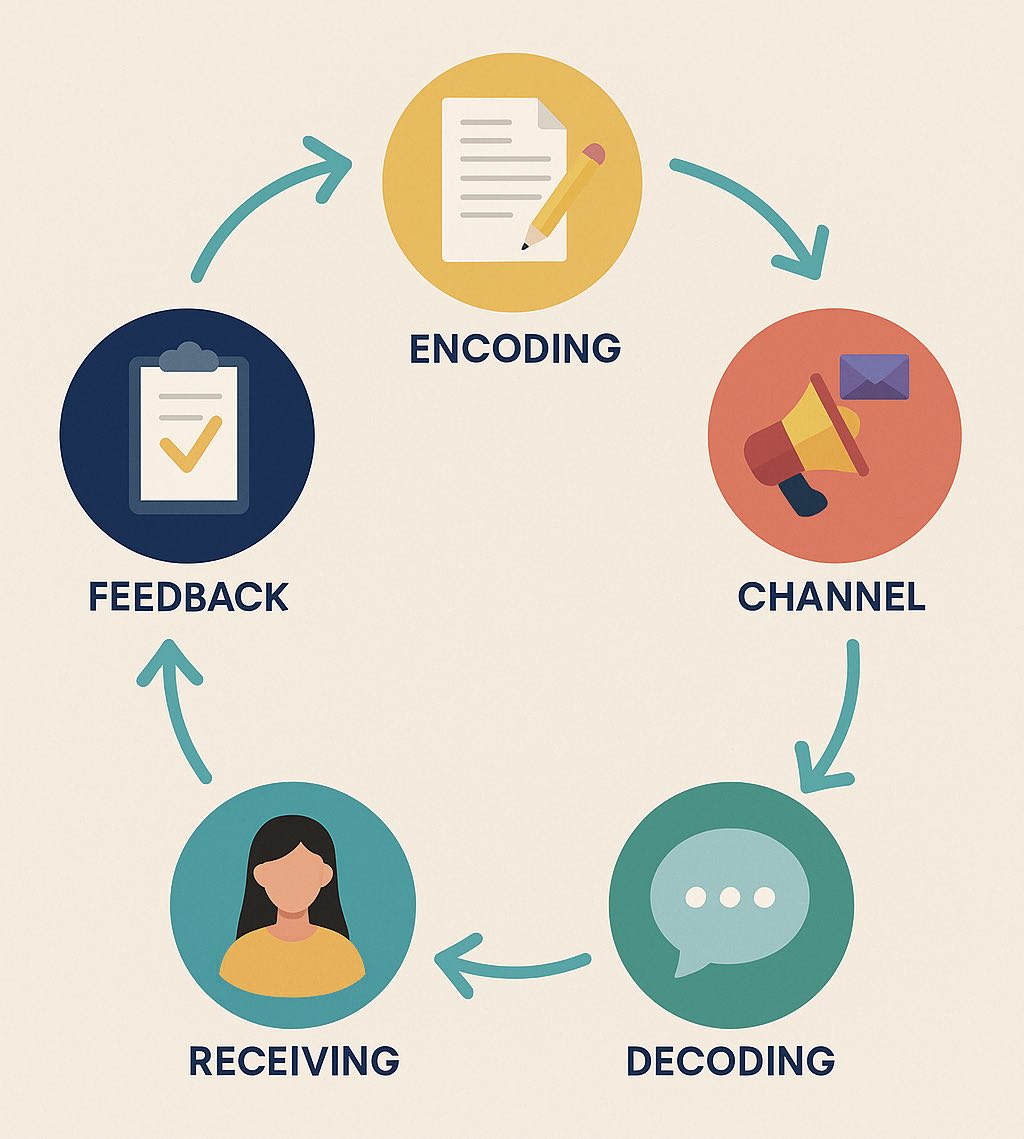
The process is essential because it ensures clarity and mutual understanding. In business, for instance, if a manager fails to communicate expectations properly, the entire team may end up working in the wrong direction.
Simply put, communication is successful only when the receiver gets the exact meaning intended by the sender. That’s why understanding its elements and steps is the foundation of effective communication.
Key Elements of the Communication Process
The communication process includes several essential elements that work together. Let’s break each one down clearly.
1. The Sender (Encoder)
The sender is the person who starts the communication. They generate the idea or thought they want to express and convert it into words, symbols, or gestures.
For example, a teacher explaining a grammar rule is the sender. Their message must be structured and clear so students can easily understand.
A good sender knows their audience. The way you explain a topic to a colleague differs from how you would explain it to a child. The sender’s clarity and tone define how well the receiver understands the message.
2. The Message
The message is the content of the communication—the information, opinion, or feeling the sender wants to share. It could be a report, instruction, request, or even an emotional expression.
The success of communication depends heavily on how well the message is organized. If it’s vague, lengthy, or confusing, the receiver might misinterpret it.
A practical example? Imagine a supervisor sending a long, unclear email with mixed instructions. The team will likely waste time clarifying instead of working. That’s why messages must follow the 7 Cs of communication—clear, concise, concrete, correct, coherent, complete, and courteous.
3. Encoding
Encoding is the process of converting an idea into a form that can be transmitted. It involves choosing the right words, symbols, or gestures to express the message effectively.
For instance, when a manager writes a memo, they encode their thoughts into sentences and paragraphs.
Poor encoding often leads to confusion. Using technical jargon with someone unfamiliar with the topic can result in misunderstanding.
4. Channel or Medium
The channel is the path through which the message travels from the sender to the receiver. It can be oral, written, non-verbal, or digital.
For example, meetings, emails, video calls, and even body language are communication channels. Selecting the right medium depends on the situation and the audience.
A formal letter suits official communication, while a quick text might work for an internal update. For a better understanding, you can check the differences between business letters and emails.
5. The Receiver (Decoder)
The receiver is the person who gets the message. Their role is to understand and interpret it as intended.
Effective receivers pay attention, ask questions, and confirm understanding. For example, in meetings, attentive listeners reduce the need for follow-up clarifications.
Poor listening can cause serious issues. If a team member misunderstands a task, it can affect the entire project. Learning the techniques for improving listening ability can make a huge difference here.
6. Decoding
Decoding is the process through which the receiver interprets the sender’s message. It’s the mirror image of encoding.
The receiver uses their knowledge, experience, and emotions to make sense of what’s being said. For instance, a manager might interpret an employee’s feedback differently depending on their tone or facial expression.
Misunderstanding happens when the receiver decodes the message incorrectly. To avoid this, senders must keep their messages simple and context-aware.
7. Feedback
Feedback is the response given by the receiver to the sender. It indicates whether the message was understood correctly.
Without feedback, communication is incomplete. It’s what makes the process two-way.
Feedback can be verbal (“I understand”) or non-verbal (a nod or smile). In business, it could also be reports or emails confirming instructions.
You can explore more about its importance in necessity or importance of feedback.
8. Noise or Barriers
Noise refers to anything that interferes with communication. It can be literal (background noise), psychological (stress), or semantic (using difficult words).
For instance, a weak internet connection during a video call is physical noise. Similarly, using overly complex words in a simple discussion is semantic noise.
To avoid communication breakdowns, it’s important to identify and minimize such barriers. You can learn more in what is a communication barrier.
Steps of the Communication Process
Now that you know the elements, let’s go through the seven key steps of the communication process, explained with real examples.
Step 1: Idea Generation
Every communication starts with an idea. The sender decides what message they want to deliver.
For example, a company’s HR team may want to inform employees about a new attendance policy. That’s the first step—forming the message.
Step 2: Encoding the Message
Once the idea is ready, the sender encodes it. They decide how to phrase it and what medium to use.
In our HR example, they may write an email using simple, clear language to make sure everyone understands.
Step 3: Transmitting the Message
Now comes the delivery. The sender sends the encoded message through a chosen channel, such as an email, notice, or meeting.
The goal here is to ensure the message reaches the right audience at the right time.
Step 4: Receiving the Message
The receiver gets the message. In our example, employees receive the HR email.
But remember, receiving doesn’t mean understanding. The receiver must actively read or listen to grasp the full meaning.
Step 5: Decoding
At this stage, the receiver interprets the message. They analyze the words, tone, and context.
If the HR message is written clearly, employees will easily understand the new attendance policy.
Step 6: Feedback
After understanding, the receiver responds. Employees might reply with questions or confirm they’ve read the message.
Feedback closes the communication loop and ensures mutual understanding.
Step 7: Overcoming Noise
During every stage, noise can appear. Maybe the email went to spam, or some employees didn’t read it carefully.
This step focuses on recognizing and reducing interference to make the process effective.
Models Explaining the Communication Process
To understand this process better, let’s briefly look at some communication models that visualize how it works.
- Linear Model (Shannon-Weaver Model): A one-way process where information flows from sender to receiver without feedback.
- Interactive Model: Introduces feedback, showing communication as a two-way process.
- Transactional Model: Views communication as a dynamic process happening simultaneously between sender and receiver.
If you’d like a deeper understanding, explore models of communication.
These models help us visualize how messages travel and how feedback shapes the process.
Importance of the Communication Process in Business
In business, communication isn’t just about talking. It’s about achieving goals, maintaining relationships, and avoiding costly mistakes.
Here’s why it matters:
- Ensures clarity and direction
- Builds trust and teamwork
- Helps in better decision-making
- Prevents misunderstandings
- Encourages transparency and employee engagement
A clear communication process is a sign of good management. Learn more about it in role of communication in management.
Common Barriers Affecting the Communication Process
Even the best communicators face barriers. Some common ones include:
- Physical Barriers: Noise, distance, poor connections
- Semantic Barriers: Misuse of words or language differences
- Psychological Barriers: Emotions, stress, or lack of attention
- Organizational Barriers: Rigid hierarchy or unclear roles
Understanding these barriers helps avoid confusion and maintain smooth communication. For detailed examples, visit types of communication barriers.
How to Make the Communication Process More Effective
Here are simple tips to improve your communication:
- Use short, clear sentences.
- Choose the right medium for your audience.
- Encourage open feedback.
- Practice active listening.
- Avoid distractions and noise.
- Be respectful and empathetic.
These principles ensure smoother and more productive interactions in both business and everyday life.
Real-Life Example
Imagine a marketing manager launching a new campaign.
- They plan the campaign idea (Idea Generation).
- They write the proposal (Encoding).
- They present it in a meeting (Transmission).
- The team listens (Receiving).
- They interpret the plan (Decoding).
- They give suggestions (Feedback).
- Any misunderstanding or missing information is resolved (Noise Control).
See how simple communication steps can lead to real success when done correctly?
Conclusion
The communication process may sound technical, but it’s something we all do every day. Whether you’re talking to a friend, sending an email, or giving a presentation, you’re part of this process.
Each element—sender, message, channel, receiver, feedback, and noise—plays a vital role in making communication successful.
Understanding and improving this process helps you connect better, avoid confusion, and achieve your goals. Remember, great communicators are not born; they’re made through awareness and practice.
59 Comments
I’m a professional copywriter, and I found parts of this impossible to understand. Points 2,3 and 4 need some serious clarification work. Sorry, but I’d be fired if I wrote anything as confusing as this. Still everyone else seems to get it. Maybe I should have stuck with my human cannonball act.
shup u header
Finally i got it!!
cool and grt,,,,my headache has ceased due to overwhelming assignment i had abt communication process,,,,,thanks…….
thanx a lot u have made my test in communication process
Thanks a lot, you have increased my understanding according to what communication is all about
thanks a lot. now i m feeling good…
Thx for more communication procces.. I learned so much….
This is very good. thanks.
that is well understand
THANKS ALOT.MY TAKE AWAY ASSIGNMENT IS NOW OVER!
Thank you so much for this kind of summary………. It has helped me so much in my assignment
In short i can say communication is between two parties which is a sender and a receiver when they are transferring the information from one to another.
reading this made my soil myself
Thanks for the information & it’s brief & simple
Thank you very much for that skill.
it would help us alot
Thanks for the knowledge i have gained, love it
Very helpful indeed thank a lot
Very good description of the way communication is done and received.
This is wonderful. My problem with assignment on communication process is finally solved. Tnk u guys
thank you !!!
this is really lovely
THANK YOU FOR CLARIFICATION , WE GET SOME NEW INFORMATIONS
Thank you. I have learnt more
Diagram of concept of communication
Comment: thanks very much for the help
Wow,i can get it all i’ve find.thank u very much.it is briefly written paper for me.
Thanks so much.it has improved my understanding of the content matter..
Really
how many pillars do we have in communication process. kindly help me understand
Thanks alot….it has make my day🆒
Thanks you very much, this has enlight me of what communication process all about
Very helpful to me to understand the process of communication in various ways.
i’m really contradicted by these points, they are quite different from the ones in the books
Thanks. This has enriched my book; the essence and essentials of communication. You have increased my understanding.
Give me specific example of each process please!!?
well said and easily understandable
Communication is good to know what’s going on around you
This has been helpful… Thank you
THANKS FOR YOUR IDEA
communcation is the process of sending and receiving information [massege]and it includes all the way and manner through which we can let other people know and share our exprience.
thaxs ver much fot the communication process,my course work is nw done
Very well sumarized so helpfull
communications simply means is a process by sending data or information though media techenically or locally
To me that is very true since email seems to be the way everyone communicates now.
awesome,you have mightly helped me in research,and for that reason am very grateful.
Thank you so much for the information. It has made my work easier.
thanks now i can mention that stages and express on it
Very Useful, u are a life saver
thank you just learnt alot
so great,am happy i have got to know more abt communiation process,now my course work is done,thxs alot.
Thank you so much it’s brief and simple
Thanks 4 the information 🙂 i got the components of communication . Nice 🙂
helpful and precise notes!
thank you very much,,.
It’s good summary to understood communication thank you so much
Great piece of information…its helpful!
thank you
Thanks. I have learned a lot of information on how the effective communication works in this competitive world
Very informative for understanding communication in this time of age.