


Remember the childhood game where you whisper a phrase down a line of friends and watch it morph into something unrecognizable? That was fun. In business, the same distortion happens every day, and it costs real money, kills projects, and fuels conflict. Your strategy is clear in your head, but by the time it reaches your team, it has transformed into something you never intended.
The culprit is barriers: invisible obstacles that block, distort, or delay your message before it reaches the listener’s brain. This guide identifies the five main categories of barriers to effective oral communication and gives you specific fixes for each one. You will learn to diagnose what is breaking down in real time and adjust before misunderstanding escalates.
What are barriers to effective oral communication?
A barrier is any obstacle that prevents your listener from accurately receiving and understanding your spoken message. It can exist at three points: the sender (you speak unclearly), the channel (noise drowns you out), or the receiver (they are too angry to listen).

Why does this matter? According to a report by communication consultant David Grossman, miscommunication costs companies with 100,000 employees an average of $62.4 million per year (source). Most workplace conflicts trace back to a communication breakdown that could have been caught early.
We organize barriers into five categories:
- Physical and Environmental: Noise, distance, and technology failures that block transmission.
- Psychological and Emotional: Stress, ego, bias, and trust gaps that distort interpretation.
- Linguistic and Semantic: Jargon, accents, and unclear phrasing that obscure meaning.
- Information Overload and Timing: Too much information or the wrong moment for a critical conversation.
- Remote and Hybrid: Digital body language gaps, asynchronous delays, and screen fatigue.
The key principle: identify the root cause before you try to fix it. A jargon problem needs a different solution than an emotional hijacking problem.
What are the main types of communication barriers?
Inside an organization, two more groups apply to every message, spoken or written: organizational barriers, and barriers of status and resistance to change. With the five above, that makes seven main types.
Organizational barriers
- Filtering: Deliberately shaping information as it travels, most often in upward communication. Employees pass on news that makes them look good and hold back problems.
- Too many authority layers: When a message must pass through several levels of hierarchy, each level can distort, shorten or delay it.
- No communication policy: Without clear rules on who communicates what and through which channel, employees hesitate to speak up.
- Negative organizational climate: When top management is dismissive of employee input, people stop offering ideas and raising concerns.
Status and resistance to change
Status or power difference: A manager may ignore a subordinate’s suggestion simply because of the gap in rank, and a subordinate may be afraid to correct a senior colleague. Either way, useful information is lost.
Resistance to change: People who prefer the old way of doing things may meet news of change with inattention, deliberate misreading, rumor or non-cooperation, so the message never takes hold.
Physical and environmental barriers
These are the tangible, external factors that interfere with sound transmission. They are often the easiest to spot but surprisingly common in real workplaces.
Noise and distractions
Imagine conducting a performance review in an open-plan office while the sales team celebrates a deal ten feet away. Your words are competing with laughter, music, and ringing phones. The listener’s brain cannot focus on your voice and filters out chunks of your message.
Auditory noise (traffic, construction, HVAC hum, or chatter) is the number one killer of oral clarity. Visual distractions matter too. A TV flickering in the background, people walking past a glass-walled conference room, or notifications popping up on a shared screen all steal attention.
Fix: Choose quiet venues for important conversations. If you cannot control the environment, acknowledge the distraction and move. For video calls, ask participants to mute when not speaking and turn off notifications.
Technology glitches
Much of business communication now happens through screens. A bad internet connection, an echoing microphone, or a frozen video feed can destroy a meeting. When audio cuts in and out, the brain stops trying to fill gaps and simply tunes out.
Remote and hybrid work amplifies this barrier. A team member dialing in from a coffee shop on a weak connection misses half the discussion. By the time they ask you to repeat yourself, the conversation has moved on.
Fix: Test your technology before critical meetings. Use wired connections when possible. Have a backup communication channel (like a phone number) ready. Different types of oral communication have different tech requirements, a 50-person town hall needs stronger infrastructure than a one-on-one check-in.
Physical distance
Face-to-face communication lets you see the whole person: their posture, micro-expressions, and hand gestures. When walls or oceans separate you, those cues vanish. You cannot see if someone is tapping their foot nervously or if their smile does not reach their eyes.
This loss of visual data makes interpretation harder. A flat “okay” in a phone call could mean genuine agreement, reluctant compliance, or sarcastic dismissal. Without non-verbal cues, you are guessing.
Fix: Use video for sensitive or complex conversations. When video is not possible, confirm understanding explicitly: “What are your next steps?” or “How does this plan sound to you?”
Psychological and emotional barriers
These barriers live inside the mind. They are invisible, which makes them dangerous. They act like a distorting lens, twisting words before the brain even processes them.
Premature evaluation
You are in a meeting. Your colleague starts explaining a problem. Halfway through their second sentence, you think you know where they are going. You stop listening and start formulating your response.
This is premature evaluation: listening to reply instead of listening to understand. You miss nuance, skip over critical details, and often respond to a point they never made. The only antidote is practicing active listening skills, training yourself to wait until the speaker finishes before you construct your reply.
Emotional hijacking
When you are angry, stressed, or anxious, your brain’s logical processing shuts down. Psychologists call this “emotional hijacking.” The American Psychological Association has documented how stress hormones suppress the prefrontal cortex, the part of your brain responsible for rational thought.
If the sender is furious, they might shout or use aggressive language that obscures their actual point. If the receiver is stressed, they might perceive a neutral comment as an attack. A manager giving routine feedback to a burned-out employee might trigger a defensive reaction that has nothing to do with the feedback itself.
Fix: Manage emotional state before critical conversations. If you or your listener is visibly upset, pause. Say, “Let’s revisit this in an hour when we have had time to cool down.” Timing matters more than most people realize.
Fear of public speaking
Anxiety about speaking, often called glossophobia, creates a physical barrier. A speaker suffering from fear of public speaking might mumble, rush through sentences, or avoid eye contact, making their message unintelligible. Their physical fear becomes an obstacle for the listener.
Ego and prejudice
Ego filters out ideas based on who is speaking, not what they are saying. If you believe you already know more than the speaker, you stop listening. If you harbor unconscious bias about their age, gender, accent, or job title, you discount their message before you hear it.
A junior analyst might have the insight that saves a project, but if the senior director dismisses them based on rank, the insight dies. This is not just a moral failing, it is a business liability.
Fix: Practice intellectual humility. Ask yourself, “What if I am wrong?” Seek out perspectives from people who do not look or sound like you. Check your assumptions before you reject an idea.
Trust deficit
Trust is the foundation of all communication. If your listener doubts your credibility, competence, or intent, they will reject or misinterpret everything you say. A salesperson with a reputation for exaggeration will struggle to convince a client even when telling the truth.
Trust is built slowly and destroyed quickly. One broken promise can create a barrier that takes months to repair.
Fix: Build credibility over time through consistency. Do what you say you will do. Admit mistakes openly. Share your reasoning, not just your conclusions, so people understand your intent.
Perception differences and stereotyping
People interpret the same message through their own experience and interests. News of a restructuring may sound like progress to a customer and like a threat to an employee who fears for their job.
Stereotyping judges a person by a group label, as in “all salespeople exaggerate,” so the listener stops weighing what is actually said.
Halo effect
The halo effect is letting one strong impression color everything else about a person. A manager who notices an employee’s excellent attendance record may assume the quality of their work is equally good.
Fear of reprisal
Employees who fear punishment, criticism or looking uninformed keep bad news and questions to themselves.
Inattention
Sometimes the message is clear but the receiver is not paying attention because they are busy, uninterested in the subject, unwell or preoccupied with a personal problem.
Fix: For all four, check your first impression against the evidence, invite bad news without penalty, and choose a moment when the listener can give the message their full attention.
Interpersonal barriers in one-to-one conversations
In a one-to-one exchange, the speaker has a motive, stated or not. The listener guesses it (interpersonal perception), the guess triggers a feeling, and that feeling shapes the listener’s reply. The conversation breaks down wherever this loop goes wrong. See also intrapersonal and interpersonal communication.
- Unclear motive: The speaker has not worked out what they want from the conversation, so the message wanders. Fix: State the purpose in the first sentence.
- Poor encoding: The speaker knows the motive but puts it into the wrong words. Fix: Say the request directly.
- Inaccurate interpersonal perception: The listener misreads the speaker’s motive, often because of a stereotype. Fix: Paraphrase what you heard before reacting.
- Unrecognized emotion: Neither side notices the feelings driving the exchange. Fix: Name the emotion, then return to the point.
Linguistic and semantic barriers
These barriers arise from the words themselves: the vocabulary you choose, the way you pronounce them, and the assumptions you make about shared meaning.
Jargon and technical terms
Every profession has its own language. Marketers talk about “attribution models” and “funnel optimization.” Engineers discuss “latency” and “load balancing.” Accountants mention “accruals” and “amortization.”
Jargon is efficient when everyone in the room shares the same expertise. It becomes a barrier when you assume knowledge your listener does not have. A CFO explaining “EBITDA adjustments” to a warehouse supervisor is building a wall, not a bridge.
Worse, jargon sometimes signals insecurity. A manager who hides behind buzzwords might be masking a lack of clarity in their own thinking.
Fix: Know your audience. Define technical terms the first time you use them. Apply the 7 Cs of Communication, especially Clarity. If a 12-year-old could not follow your explanation, simplify it.
Ambiguous words
A word or phrase can carry different meanings for different people. An advertisement that says “we sell for less” leaves the reader asking: less than what?
Fix: Replace vague comparisons with specific ones.
Accent and dialect differences
A Bangladeshi entrepreneur pitching to a Silicon Valley investor might face comprehension challenges not because of weak ideas but because of unfamiliar pronunciation patterns. Regional accents within the same country can create the same barrier.
This is not about “correct” English. It is about the cognitive load required to decode unfamiliar speech patterns. When the listener is working hard just to parse your words, they have less mental energy left to engage with your ideas.
Fix: Slow down. Enunciate key terms. Repeat critical points in different words. Ask, “Is this making sense?” and watch for confused expressions.
Fact-inference confusion
A fact is verifiable: “Sales dropped 15 percent in Q3.” An inference is an interpretation: “The sales team is not trying hard enough.” When you present an inference as a fact, you create confusion and often resentment.
Fix: Label your inferences. Say, “Here is what I am seeing, and here is what I think it means.” Invite alternative interpretations.
Information overload and timing barriers
Even a perfectly clear message can fail if you deliver too much of it or choose the wrong moment.
Information overload
Working memory is limited. Cognitive science shows that the average person can hold about four chunks of information in their head at once. When you dump a 20-point action plan on someone in a single conversation, their brain stops recording after point five.
A manager who tries to cover three months of feedback in a single annual review overwhelms the listener. They leave the meeting remembering only the first criticism and the last compliment.
Fix: Chunk information into digestible pieces. Prioritize. If you have ten things to say, identify the three that matter most and save the rest for a follow-up. Use the rule: one conversation, one core message.
Poor timing
Timing is a barrier most people ignore. You schedule a “quick sync” at 4:45 p.m. on a Friday when your colleague is mentally checked out. You try to discuss a sensitive personnel issue right after your boss received bad news from their own manager.
Critical conversations require mental and emotional bandwidth. If either party is exhausted, distracted, or upset, the message will not land.
Fix: Ask, “Is now a good time?” before launching into something important. If the answer is anything other than an enthusiastic yes, reschedule. Signal priority clearly: “This is urgent” or “This can wait until Monday.”
Urgency mismatch
You treat a message as urgent; your listener treats it as routine. Or vice versa. A product manager sends a Slack message flagged as high-priority; the developer assumes it is just another feature request and ignores it for two days. By the time they respond, the deadline has passed.
Fix: Align on urgency explicitly. Say, “I need your input by end of day” or “This is for planning purposes; no rush.” Do not rely on subject lines or emoji to convey priority.
Remote and hybrid communication barriers
Remote work has introduced a new category of barriers that did not exist a decade ago.
Digital body language gaps
When half your team is on video with cameras off, you lose the ability to read the room. You cannot see if people are nodding, frowning, or scrolling through email. A frozen video frame or a laggy connection strips away the micro-expressions that signal confusion or agreement.
This is especially problematic for distributed teams spanning continents. A team member in Dhaka joining a meeting hosted in New York at 2 a.m. their time is fighting both fatigue and a screen that flattens all emotional nuance.
Fix: Use video when discussing sensitive topics. Encourage (but do not mandate) cameras on for key meetings. Confirm understanding in writing after the call. Say, “I will send a summary email so we are all aligned.”
Asynchronous delays
Time zones and message queuing create gaps that breed misunderstanding. You send a question at 9 a.m. your time; your colleague in another time zone sees it eight hours later and replies after you have logged off. By the time you read their answer, the context has shifted.
Asynchronous communication is powerful, but it requires discipline. Without it, a two-minute conversation stretches into a three-day email thread.
Fix: Schedule synchronous meetings for complex or emotionally charged conversations. Use asynchronous channels for updates and clarifications, not for negotiations or conflict resolution.
Screen fatigue
Video call fatigue is real. Research from Harvard Business Review shows that back-to-back video meetings reduce engagement (source). Your brain works harder to process flat, pixelated faces than it does to read a live person across a table.
By your fifth Zoom call of the day, you are not absorbing much. Your listener is not either.
Fix: Build breaks into your schedule. Limit video calls to 45 minutes. For routine updates, consider a voice call or a written summary instead.
How to diagnose and fix barriers in real time
Barriers rarely announce themselves. You need a diagnostic process to catch them before they escalate.
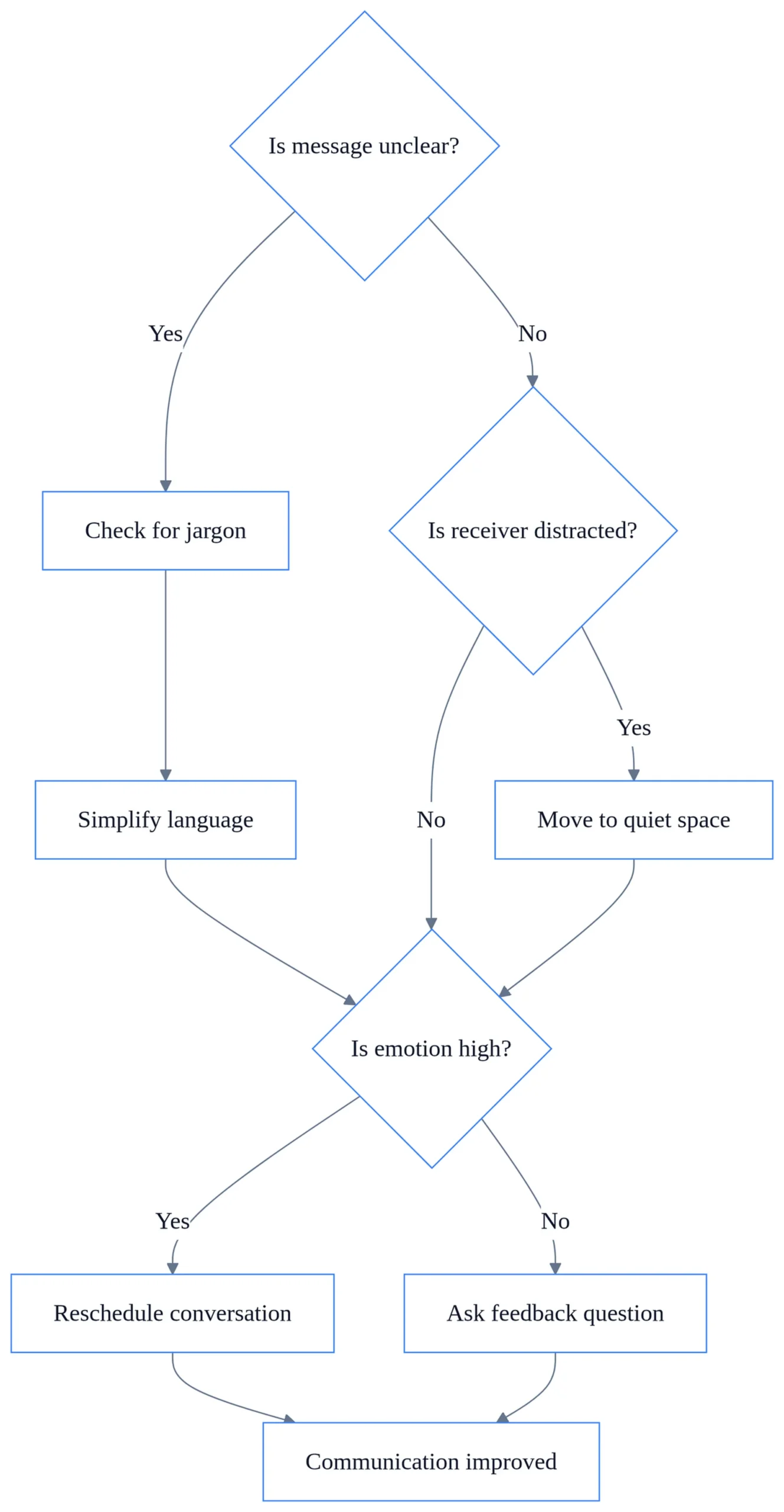
| Barrier Type | Symptom | Immediate Fix |
|---|---|---|
| Physical/Environmental | Listener asks “What?” repeatedly; distracted body language | Move to quieter space; test tech; use video |
| Psychological/Emotional | Defensive tone; visible stress; interruptions | Pause conversation; reschedule; acknowledge emotion |
| Linguistic/Semantic | Confused expressions; requests to repeat; misinterpretation | Simplify language; define jargon; ask clarifying questions |
| Information Overload | Glazed eyes; note-taking stops; disengagement | Pause; summarize key points; chunk remaining info |
| Remote/Hybrid | Silence; delayed responses; cameras off; multitasking | Switch to synchronous meeting; confirm in writing; take a break |
| Organizational | Bad news reaches managers late or not at all; instructions change as they pass down | Go to the source directly; shorten the reporting chain for this message |
| Stereotyping/Halo effect | Ideas judged by who said them; one trait drives the whole assessment | Separate the message from the messenger; check the evidence |
| Interpersonal | Listener responds to a point you did not intend; conversation drifts | State your purpose; ask the listener to paraphrase |
Use the feedback loop
The fastest way to catch a barrier is to ask, “What did you hear me say?” This is not condescending if you frame it as a check on your own clarity, not their comprehension. Say, “I want to make sure I explained that well. Can you summarize what you heard?”
If their summary does not match your intent, you have caught a barrier before it causes damage.
Pause and clarify
If your listener looks confused (furrowed brow, hesitation, or silence), stop. Do not plow ahead. Say, “Let me rephrase that” or “Does that make sense?” Most people assume understanding and keep talking. That assumption is where miscommunication festers.
Adjust the channel
If oral communication is not working, switch channels. Follow up a conversation with a written summary. Use a diagram or a spreadsheet to clarify a complex process. Some messages are better suited to text than speech.
Reschedule if needed
If emotional state or timing is wrong, defer the conversation. A 10-minute delay or a 24-hour postponement is better than a conversation that fails because someone is too angry or too tired to listen.
How can an organization overcome communication barriers?
The steps above fix a single conversation. The steps below are organization-level measures that remove the causes of barriers across the whole workplace.
- Set a clear communication policy. Spell out who communicates what, to whom and through which channel. This fixes the absence-of-policy barrier.
- Flatten the structure. Cut unnecessary authority layers and make lines of authority and responsibility clear. This reduces filtering, distortion and delay.
- Specify the objective of each message. Senders should know the objective of communication before they speak or write, and managers should issue clear-cut orders, instructions and policies. This prevents ambiguity.
- Choose the right medium. Decide between oral and written channels based on the nature, importance and complexity of the message and what the receiver already knows.
- Orient new employees. Introduce new hires to the company’s mission, goals, policies, rules and procedures so they share the same context from the start.
- Train people to communicate. Run seminars, workshops and training programs, and develop managers through delegation and decentralization.
- Use informal channels alongside formal ones. Informal relationships build the goodwill that helps formal messages land.
- Reduce information overload. Send only the information people need and space separate messages out rather than sending them all at once.
- Keep management fair and unbiased. Managers free of political, regional and religious bias, and a cooperative relationship between labor and management, make employees more willing to listen and speak up. This reduces status and trust barriers.
- Audit communication regularly. At set intervals, examine and evaluate the organization’s communication networks, functions and principles.
Building a communication culture that minimizes barriers
Individual fixes help, but lasting improvement requires a culture shift.

Psychological safety
Create space where people can ask questions without fear of judgment. If a junior team member does not understand your jargon, they should feel safe saying, “Can you explain that?” rather than nodding and pretending.
Leaders set the tone. If you model asking clarifying questions and admitting when you are confused, your team will follow.
Transparency and trust
Share context and intent, not just instructions. When people understand why you are asking for something, they are more likely to interpret your message correctly. Trust reduces the psychological barriers that distort communication.
Active listening norms
Make summarizing and clarifying a team habit. In meetings, practice saying, “Here is what I heard you say…” before you respond. This slows the conversation down but eliminates most misunderstandings.
Accessibility
Ensure physical spaces, technology, and language choices include all participants. If someone has a hearing impairment, provide captions. If English is a second language for half your team, slow down and avoid idioms.
Feedback culture
Normalize asking, “Did that land?” after important conversations. Encourage people to say, “I am not following” without embarrassment. The goal is understanding, not performance.
Most teams treat communication barriers as occasional glitches. That is the mistake. Noise, emotion, jargon, timing, and distance distort your message every single day. The teams that communicate well are not more talented; they are more disciplined about diagnosing barriers and fixing them before they escalate. If you are sitting on the fence about whether to address a barrier you have noticed, the answer is almost always yes. Start with one: identify the barrier that costs your team the most, apply the specific fix from this guide, and track whether misunderstandings decrease over the next two weeks. That is how you turn communication from a liability into a competitive advantage.
Frequently asked questions
What if I’m angry during a conversation—should I pause or push through?
Pause. Emotional hijacking suppresses your logical brain, so continuing will likely distort your message or trigger defensiveness in the listener. Take a break, breathe, and return when you can speak from a calmer state. This prevents words you’ll regret and ensures your actual point gets heard clearly.
How do I confirm understanding without sounding like I don’t trust someone?
Use open-ended questions framed as collaboration, not verification. Instead of “Did you understand?” try “What are your next steps?” or “How does this fit with your current workload?” This invites them to share their interpretation naturally and catches misalignment without implying doubt.
Is a phone call better than email if I can’t see the person’s face?
For sensitive or complex topics, yes. A phone call lets you hear tone and respond in real time, catching confusion faster than email. However, if emotions are running high, video is better because facial expressions and body language reduce misinterpretation. Email works only for straightforward, low-stakes information.
What should I do if someone keeps interrupting me mid-sentence?
Pause and name it calmly: “I’d like to finish this thought first.” If it continues, address it privately later. Interruptions often signal the listener is anxious or disagrees, not that your point is unimportant. Understanding their urgency may help you adjust how you deliver information next time.
Can I use jargon if everyone in the room works in the same field?
Use it sparingly. Even within the same industry, people have different backgrounds and experience levels. One person’s standard term might confuse a newer hire or someone from a different department. Define key terms briefly the first time you use them—it takes five seconds and prevents costly misunderstandings.
How do I handle a conversation when I’m not sure what the other person means?
Ask immediately. Say “Can you give me an example?” or “What do you mean by that?” Waiting until later to clarify wastes time and lets misunderstanding grow. Most people appreciate the question—it shows you’re engaged and prevents you both from working from different definitions.
What are the 7 barriers to communication?
Lists differ between textbooks. A practical grouping of seven is: physical and environmental, psychological and emotional, linguistic and semantic, information overload and timing, remote and hybrid, organizational, and status and resistance to change. Each needs a different fix, so name the type before you try to solve it.
How can a company reduce communication barriers across the whole organization?
Treat it as a structural job, not only a personal skill. Set a written communication policy, remove unneeded layers between senders and receivers, train staff, and review how information actually flows at regular intervals.
8 Comments
To overcome communication barriers it is better to understand the other culture….
Great post! As someone who has struggled with communication barriers in the past, I can attest to the importance of overcoming them. It’s fascinating to learn about the different types of barriers and the strategies for breaking them down. Thank you for sharing this valuable information!
To be more effective communicator you needed to know every barrier of communication and avoid it
useful information about Types of communication barriers.
thanks
In order for communication to be effective I believe that one has to listen,understand and then answer…. problem is for some people, they listen to answer… and that may sometimes be a barrier.
Well outlined
Thanks guys
Now days many business started using digital medium like whastapp for business communication.
To be an effective communicator you need to understand what information has to be transmitted,to whom and when