


Every company, big or small, eventually has to sit down and talk with its owners. In corporate language, these owners are shareholders, and the place where this discussion happens is called the Annual General Meeting, or AGM.
Why does it matter so much? Unlike ordinary staff meetings where team progress is discussed, an AGM is where the company reveals its performance, takes critical decisions, and allows shareholders to raise questions. It is a meeting of accountability, transparency, and sometimes drama. Imagine an AGM of a famous tech company where shareholders argue about executive pay. That is how serious these meetings can get.
In this guide, we will explore the definition of an AGM, its legal framework, its purpose, participants, structure, process, and much more. Along the way, I will connect you to related resources such as the company meeting guide to keep the bigger picture clear.
What is an Annual General Meeting (AGM)?
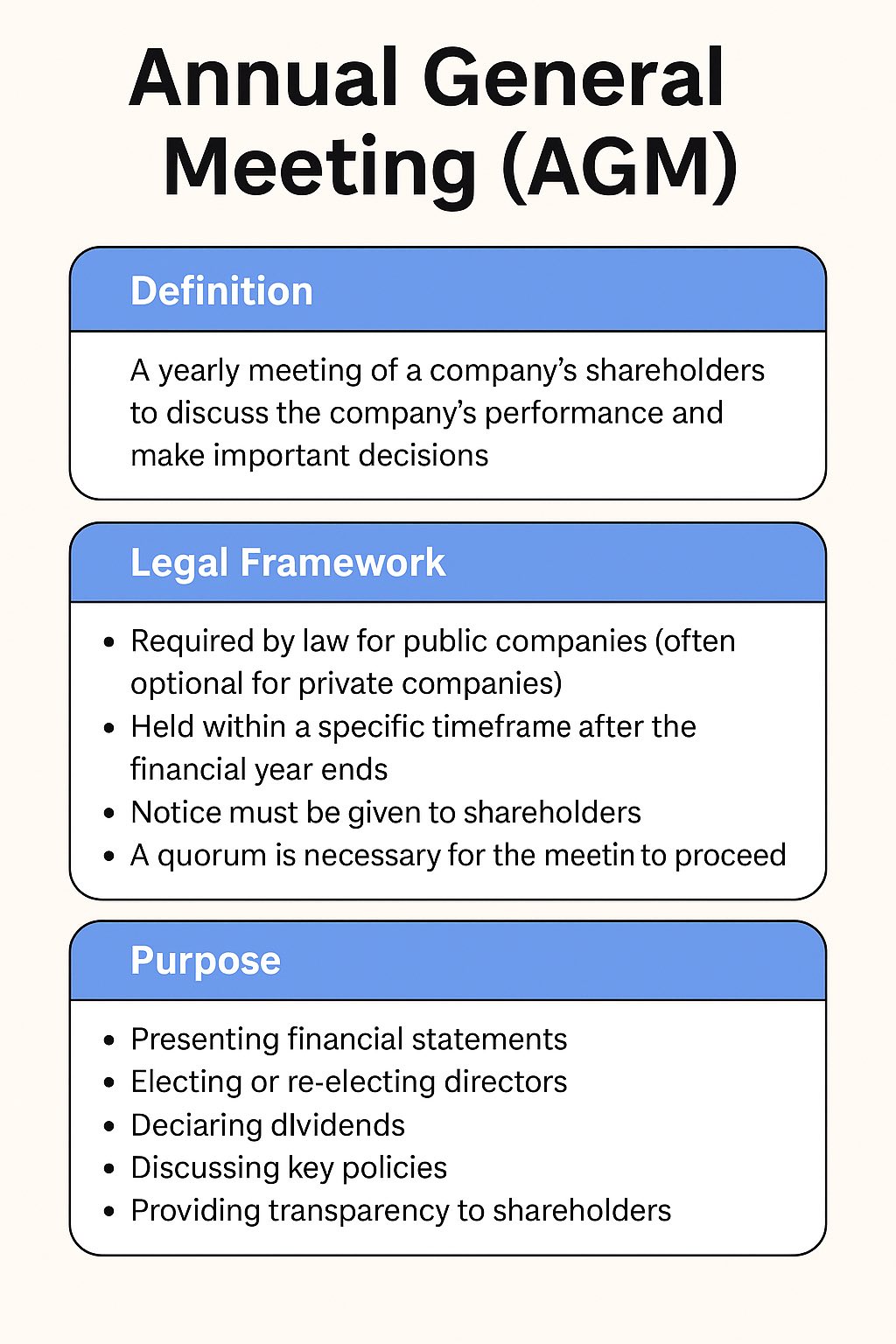
An Annual General Meeting, often called AGM, is a yearly gathering of a company’s shareholders. At this meeting, directors present reports on the company’s performance, financial statements are shared, dividends may be declared, and directors may be elected or re-elected.
The key word here is “annual.” Unlike project meetings or weekly staff check-ins, an AGM happens once a year and is legally required for many companies. It is not optional.
If you read about the types of company meetings, you will know that an AGM is distinct from a board meeting or an extraordinary general meeting. It is designed specifically for shareholder engagement.
Legal Framework of AGMs
The law plays a big role in shaping AGMs. Depending on the country, there are clear rules about when and how AGMs must be held.
Who Must Hold an AGM?
- Public companies are usually required by law to hold an AGM.
- Private companies may be exempt in many jurisdictions, although some still choose to hold them for good governance.
Timeframe for Holding an AGM
- The first AGM must often be held within 18 months of incorporation.
- After that, it must be held once every year, usually within six months of the end of the financial year.
Notice Period
Shareholders must receive proper notice before the AGM. The notice includes date, time, place, and agenda. If you are curious about the details of notices, you can read the guide on notice of meeting.
Quorum
For the AGM to be valid, a minimum number of shareholders, known as quorum, must be present. Without it, the meeting cannot proceed.
These legal requirements are part of the essentials of a valid meeting, which apply to all formal company meetings.
Purpose of an Annual General Meeting
Why go through all the trouble of organizing an AGM? Let us look at its main purposes.
- Presentation of Financial Statements
Shareholders get to see audited reports of how the company performed financially. - Election of Directors
AGMs are used to elect or re-elect directors who run the company. - Declaration of Dividends
Shareholders decide if profits will be distributed as dividends. - Discussion on Policies
Critical company policies such as mergers or acquisitions may be discussed. - Shareholder Questions
This is perhaps the most dramatic part. Shareholders can grill the management about performance and decisions.
The purpose of AGMs is closely linked to the objectives of meetings, but with more legal and financial weight.
Key Participants in an AGM
Who attends an AGM? Let’s break it down.
- Shareholders: The real owners of the company. They have voting rights and can ask questions.
- Directors: They present reports and answer queries.
- Company Secretary: Handles the paperwork, notice, agenda, and minutes.
- Auditors: Present their independent report on the company’s accounts.
The roles of these participants connect naturally with the responsibilities in meetings, which cover chairpersons, secretaries, and members.
Structure and Agenda of an AGM
An AGM follows a structured agenda. It is not a random discussion.
Common Agenda Items
- Reading and approval of the previous minutes.
- Presentation of financial statements.
- Report of directors and auditors.
- Declaration of dividends.
- Appointment or re-election of directors.
- Appointment of auditors.
- Discussion of any special resolutions.
If you want to master agenda writing in general, check out the detailed post on how to write a meeting agenda.
Process of Conducting an AGM
Conducting an AGM is like running a well-scripted show. There is a sequence that must be followed.
- Sending Notice: Shareholders receive proper notice of the meeting.
- Opening by Chairperson: The chairperson opens the meeting and welcomes participants.
- Reading Agenda: Items are discussed one by one in order.
- Reports and Discussions: Financial reports and directors’ updates are presented.
- Resolutions and Voting: Shareholders vote on decisions. Voting may be by show of hands or poll.
- Minutes Recording: The company secretary records decisions. For details, see the post on meeting minutes examples.
- Closing: The chairperson declares the meeting closed.
Importance of AGMs for Shareholders and Companies
Why are AGMs important?
- Transparency: They provide honest reports on performance.
- Accountability: Directors answer to shareholders.
- Participation: Shareholders get a say in decision-making.
- Trust: Regular AGMs build confidence between management and investors.
This importance is very similar to the role of business communication, which also thrives on transparency and clarity.
Advantages and Disadvantages of AGMs
Like any other meeting, AGMs have both strengths and weaknesses.
Advantages
- Legal compliance and good governance.
- Opportunity for shareholders to express views.
- Formal approval of accounts and dividends.
- Strengthens trust.
Disadvantages
- Costly to organize, especially for large companies.
- Time-consuming.
- Sometimes reduced to a symbolic exercise if management dominates.
This reminds us of the advantages and disadvantages of meetings, which you covered in your pillar content.
AGM vs Extraordinary General Meeting (EGM)
People often confuse AGMs with EGMs. Let us clear the air.
- AGM: Held annually, covers routine matters like accounts, dividends, elections.
- EGM: Called anytime during the year to address urgent or special issues.
So, if the company wants to merge with another, it cannot wait for the AGM. An EGM is the right choice.
Role of the Company Secretary in AGM
The company secretary is the backbone of an AGM. Their duties include:
- Drafting and sending the notice.
- Preparing the agenda.
- Recording minutes.
- Ensuring compliance with company law.
If you want to learn more, check the guide on company secretary’s role.
Modern Trends in AGMs
AGMs are no longer confined to big halls with hundreds of people. Technology has changed the game.
- Virtual AGMs: Many companies now allow shareholders to attend online.
- Hybrid AGMs: A mix of physical and virtual presence.
- Electronic Voting: Shareholders can vote securely from anywhere.
- AI Tools: Some companies use AI to summarize discussions instantly.
These modern trends are similar to the way video conferences are reshaping business communication.
Conclusion
Annual General Meetings are not just legal requirements. They are the cornerstone of corporate governance. They ensure accountability, allow shareholders to participate, and provide transparency in how companies are run.
In this article, we covered what an AGM is, its legal framework, purpose, participants, structure, process, importance, advantages, differences with EGMs, and modern trends.
If you want to dive deeper into related concepts, you can explore posts like meeting minutes or notice of meeting. Together, these create a complete picture of how formal meetings keep companies accountable.
So, the next time you hear the word AGM, remember it is not just another meeting. It is the event where the real owners of the company, the shareholders, hold the directors accountable.
Frequently asked questions
What happens if a company doesn’t meet the quorum requirement?
The meeting cannot proceed as planned. The chairperson must adjourn it to a later date. A new notice must be sent to shareholders for the rescheduled meeting. Some jurisdictions allow the adjourned meeting to proceed with fewer shareholders present, but this varies by law. Check your company’s bylaws and local regulations.
Can shareholders attend an AGM remotely or by proxy?
Yes, most companies allow proxy voting, where a shareholder appoints someone to vote on their behalf. Remote attendance via video conference has become standard, especially post-2020. However, rules differ by jurisdiction and company bylaws. Check your notice of meeting for specific instructions on how to participate.
What’s the difference between an AGM and an Extraordinary General Meeting?
An AGM is scheduled annually and covers routine business like financial reports and director elections. An Extraordinary General Meeting (EGM) is called when urgent matters arise between AGMs, such as mergers, major policy changes, or removal of directors. EGMs are not scheduled and require a specific trigger event.
Can a shareholder challenge a decision made at the AGM?
Yes, but only under specific circumstances. If the decision violates company bylaws, shareholders weren’t properly notified, or the process was fraudulent, a shareholder may challenge it legally. However, routine decisions made by majority vote are generally binding. Consult legal counsel if you believe a violation occurred.
What should a company do if it misses the deadline to hold an AGM?
This is a serious compliance issue. The company must hold the overdue AGM as soon as possible and notify shareholders immediately. Depending on jurisdiction, penalties may include fines or loss of certain corporate privileges. The company secretary should file an explanation with relevant authorities and document the reasons for the delay.