


Imagine a CEO standing on a stage, delivering a powerful vision to a thousand employees. Now, imagine a manager quietly pulling a team member aside to discuss a missed deadline. Both of these scenarios rely entirely on spoken words. They are both examples of oral communication. However, the rules, the tone, and the techniques for each are completely different.
In the business world, we often make the mistake of thinking that “talking is just talking.” We assume that if we know how to speak, we know how to communicate. This is a dangerous assumption. Oral communication is not a single act. It is a vast landscape that changes based on who is talking, how many people are listening, and what device is being used.
To master the art of business interaction, you must understand the specific requirements of each type. A strategy that works for a one-on-one meeting will fail miserably in a town hall speech.
In this comprehensive guide, we will break down the various types of oral communication. We will categorize them by the number of participants, the medium used, and the direction of information flow. By the end of this post, you will have a complete toolkit to navigate any speaking scenario.
If you are just starting your journey into this topic, you might want to review our comprehensive oral communication guide to lay a strong foundation first.
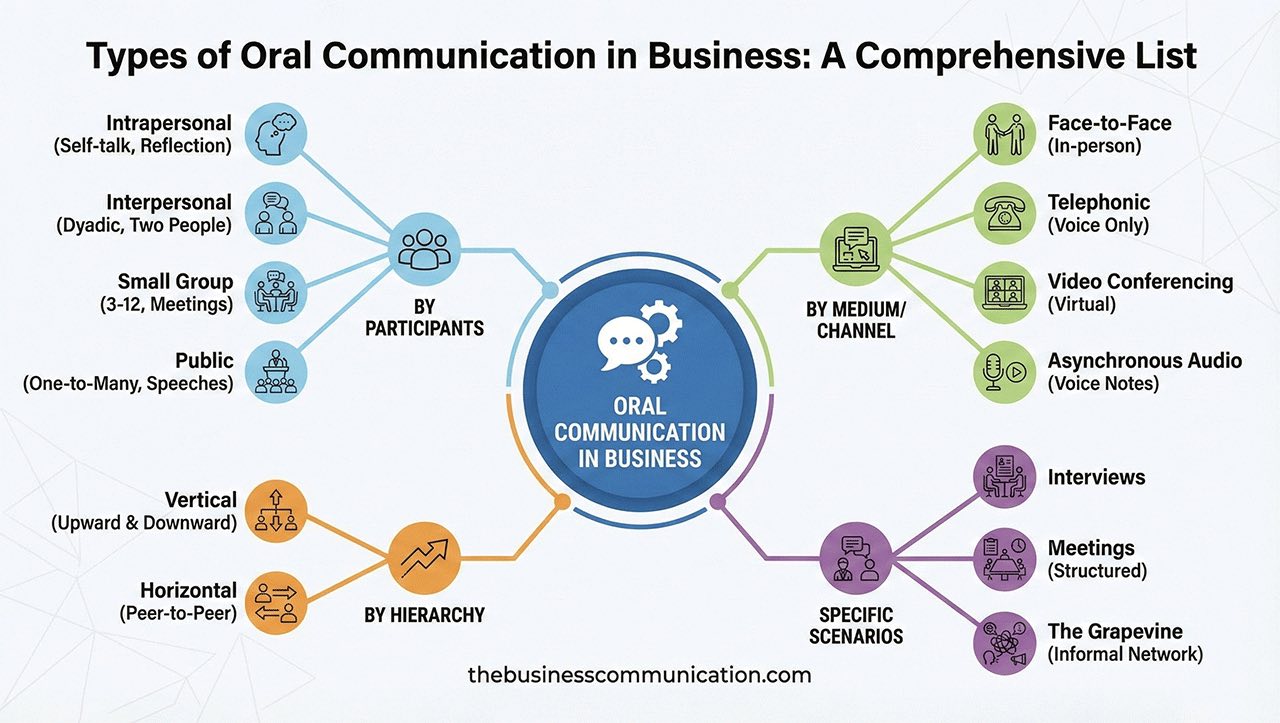
Category 1: Based on Number of Participants
The most common way to categorize verbal interaction is by counting the heads in the room. The number of people involved dictates the level of formality and the feedback loop.
1. Intrapersonal Communication (Speaking to Self)
This might sound strange in a business context. You might ask, “Why would I talk to myself at work?” However, intrapersonal communication is the foundation of all other types. It involves the conversations that happen within your own mind.
Sometimes, this happens out loud. You might mutter to yourself, “I need to remember to email the client,” or you might rehearse a pitch in front of a mirror. This type of communication is essential for self-reflection, planning, and emotional regulation. Before you can lead others, you must be able to communicate effectively with yourself.
2. Interpersonal Communication (Dyadic)
This is the bread and butter of workplace interaction. Interpersonal communication, specifically dyadic communication, involves two people. It is a direct exchange between a sender and a receiver.
In business, this happens constantly. It occurs during performance reviews, mentoring sessions, hiring interviews, or simple desk-side chats. The key feature here is the high level of feedback. Since there are only two people, the exchange is rapid and personal.
This type relies heavily on your ability to read the other person. To master this, you need to understand the dynamics of face-to-face conversations, where non-verbal cues play a massive role.
3. Small Group Communication
When you add a third person to the mix, the dynamic changes. Small group communication typically involves anywhere from 3 to 12 people. Everyone in the group has a chance to speak and interact with the others.
You see this in department meetings, brainstorming sessions, and focus groups. The challenge here is managing the flow. In a group of ten, it is easy for introverts to stay silent while extroverts dominate. A good leader knows how to facilitate this type of communication to ensure everyone contributes.
Understanding the mechanics of small group communication is vital for project managers who need to keep their teams aligned and motivated.
4. Public Communication (One-to-Many)
This is the type that makes most people nervous. Public communication involves one speaker addressing a large audience. The audience is primarily there to listen, and there is very little verbal feedback.
Examples include Annual General Meetings (AGMs), town hall presentations, and keynote speeches at conferences. Here, the focus shifts from interaction to delivery. You need to be structured, engaging, and clear. Since you cannot have a back-and-forth conversation, your message must be perfectly crafted beforehand.
If you are stepping into a leadership role, learning the art of planning a speech is non-negotiable.
Category 2: Based on Medium and Channel
We no longer just speak into the air. Technology has given us new channels for our voices. The medium you choose changes how your message is received.
5. Direct Face-to-Face Communication
This is the gold standard. It happens when all participants are physically present in the same space. It offers the highest “bandwidth” of communication because you have full access to body language, micro-expressions, and environmental cues.
You should choose this method for high-stakes situations. If you are negotiating a contract, hiring a senior executive, or delivering sensitive bad news, do it face-to-face. No technology can replicate the human connection of being in the same room.
6. Telephonic Communication
The telephone is the classic tool for business. It is fast, efficient, and breaks geographical barriers. However, it comes with a limitation: you are blind.
In telephonic communication, your tone of voice becomes 100% of your message. You cannot rely on a smile or a hand gesture to soften a blow. You must be extra careful with your choice of words and your pacing. It is best used for urgent updates, quick clarifications, or checking in on clients where a visual isn’t necessary.
7. Video Conferencing (Virtual Oral Communication)
Since the global shift to remote work, this has become the new normal. Platforms like Zoom, Teams, and Google Meet facilitate this. It is a hybrid of phone and face-to-face interaction.
While you can see the other person, it is not the same as being there. Eye contact is often skewed because of camera placement. There can be lags in audio. To succeed here, you need to master specific video conferencing tools and etiquette, such as looking at the camera lens rather than the screen.
8. Voice Notes and Asynchronous Audio
This is a rapidly growing trend. Tools like Slack, WhatsApp, and Microsoft Teams allow you to send recorded audio messages.
This is “asynchronous” oral communication. You speak now, and they listen later. It is fantastic for explaining complex ideas that would take too long to type but don’t require a live meeting. It respects the receiver’s time while adding the personal touch of your voice.
Category 3: Based on Hierarchy (Flow of Information)
In an organization, communication flows like water. It moves up, down, and sideways. Understanding the direction of the flow helps you understand the power dynamics involved.
9. Vertical Communication (Upward and Downward)
Vertical communication follows the chain of command. It moves between superiors and subordinates. It has two sub-types.
Downward Communication: This flows from the top to the bottom. It includes instructions, policy explanations, and feedback from managers to employees. The goal is to direct and inform. You can explore the specifics of downward communication to ensure your instructions land correctly.
Upward Communication: This flows from the bottom to the top. It includes reports, suggestions, complaints, and feedback from employees to management. This type is crucial for keeping leaders grounded in reality. Without it, management becomes disconnected from the actual work being done.
10. Horizontal (Lateral) Communication
This type of communication happens between people at the same hierarchical level. Think of a marketing manager talking to a sales manager. Or a developer talking to a designer.
Horizontal communication is essential for coordination. It breaks down silos between departments. It tends to be less formal than vertical communication because there is no power imbalance. The goal here is usually problem-solving and synchronization.
Category 4: Specific Business Scenarios
Finally, let’s look at how these types manifest in specific, everyday business activities. These are the practical applications you will encounter.
11. Interviews
An interview is a specialized form of dyadic (or sometimes small group) communication. It is highly structured. One person asks questions, and the other provides answers.
It is not just a chat; it is an assessment. Whether it is a job interview, an exit interview, or a disciplinary interview, the stakes are high. Knowing the different types of interviews can help you prepare the right questions or answers.
12. Meetings
Meetings are structured forms of small group communication. They have a specific purpose, a start time, an end time, and usually an agenda.
Meetings are where decisions are made (or delayed). They can be formal, like a board meeting, or informal, like a daily stand-up. However, without proper management, they can become a massive waste of time. Learning how to run an effective meeting is a critical management skill.
13. The Grapevine (Informal Network)
Not all business communication is official. The grapevine is the informal, unofficial network of communication that exists in every organization. It is the gossip, the rumors, and the casual chats that happen outside of formal channels.
While managers often try to ignore it, the grapevine is powerful. It moves information faster than official channels. Smart leaders pay attention to the grapevine to understand the true morale of the workforce. For a deeper understanding, you should read about types of informal communication grapevine examples.
How to Choose the Right Type?
With so many options, how do you know which one to pick? Here is a simple checklist to help you decide.
- Is the topic sensitive or emotional? Choose Interpersonal Face-to-Face. You need the empathy and non-verbal cues.
- Do you need to reach the entire company? Choose Public Communication. A town hall or a broadcast is best.
- Do you need to coordinate a project with peers? Choose Horizontal Small Group. Get everyone in a room (or a Zoom call) to align.
- Is it urgent but the person is remote? Choose Telephonic. It is faster than setting up a video call.
- Do you need to explain a complex idea without a meeting? Send a Voice Note. It is clearer than text but respects their schedule.
Conclusion
Oral communication in business wears many masks. It ranges from a whisper to a colleague to a speech broadcast to thousands. It travels through air, through wires, and through the internet.
A master communicator is not just someone who is “good at talking.” They are someone who is good at selecting the right mode of talking. They know that a formal review requires a different approach than a brainstorming session. They know when to turn on the camera and when to pick up the phone.
By understanding these different types, you can ensure that your message is not just spoken, but truly heard.
Now that you know the types, the next step is to weigh the pros and cons of using them. Check out our guide on the advantages and disadvantages of oral communication to deepen your understanding.