


Imagine sitting at your desk on a busy Tuesday morning. You have a brilliant idea to cut costs in your department. You open your email client, type out a quick subject line, and hit send.
Two days pass, and you hear nothing.
Eventually, your boss stops by and asks, “Why did you send that as a casual email?”
This is a classic workplace scenario. The content was good, but the delivery method was wrong. While many people think the memo is a relic of the past, it remains a powerhouse for internal communication. However, not all memos are created equal.
If you try to write a disciplinary warning with the same tone you use for a holiday announcement, you are going to have a very confused team. Understanding the different categories of memos is just as important as knowing the standard business memo structure.
In this guide, we will break down the four main functional types of memos. We will explore their specific purposes, the tones they require, and how you can master each one to become a better communicator.
Why Understanding Memo Categories Matters
You might be thinking that a memo is just a memo. Why do we need to complicate things with categories?
The answer lies in the objective. Every piece of business writing has a goal. Sometimes you want to inform, and other times you want to persuade. If you mix these up, your message fails.
For instance, a Request Memo requires a persuasive approach. You are asking for resources or money. Conversely, a Confirmation Memo requires a neutral, factual tone because it serves as a record.
If you use a persuasive tone in a confirmation memo, you might sound manipulative. If you use a neutral tone in a request memo, you might sound weak or indifferent.
Furthermore, knowing the type helps you decide if a memo is even the right channel. Sometimes, a quick email is better. If you are struggling to decide between the two, you should check out our comparison on memo vs email differences to clarify your choice.
Let’s dive into the four specific types you need to know.
1. The Information Request Memo (The Persuader)
The first and perhaps most common type is the Information Request Memo. As a manager or employee, you will often need things from other people. You might need a budget increase, new software, or simply some data from another department.
This memo is not just about asking; it is about selling the idea.
The Goal and Tone
The primary goal here is to get a “Yes.” Therefore, the tone must be persuasive yet professional. You cannot simply demand things. Instead, you must outline why fulfilling your request benefits the company or the reader.
When to Use It
You should use this type of memo when your request requires formal approval or a paper trail. Common scenarios include:
- Asking for a salary increment or promotion.
- Requesting new equipment for the office.
- Asking HR for clarifications on complex policies.
- Seeking permission to attend a paid training seminar.
Key Elements of a Request Memo
To write this effectively, you need to structure your argument logically.
1. The Direct Opening: State your request clearly in the first paragraph. Do not bury the lead. If you want new laptops for the design team, say so immediately.
2. The Justification: This is the heart of the memo. Explain the “Why.” Why do you need this? How will it improve productivity? For example, instead of saying “We want new chairs,” say “New ergonomic chairs will reduce back pain and improve team focus.”
3. The Anticipated Objection: Smart managers know their boss will have questions. Usually, the question is about cost or time. Address this before they even ask. You might say, “While this software costs $500, it will save us 10 hours of manual work per week.”
4. The Call to Action: Be clear about what the next step is. Do you need a signature? Do you need a reply by Friday?
Common Mistakes
The biggest mistake people make here is being too vague. A request that says “We need more support” will be ignored. A request that says “We need two junior interns for the Q4 project” will get attention.
Also, avoid being overly emotional. Keep it business-focused. If you are unsure how to start the drafting process, you can review the steps on how to draft a business memo to get the basics right.
2. The Confirmation Memo (The Documenter)
Next, we have the Confirmation Memo. This is the boring but essential cousin of the Request Memo.
In business, verbal agreements are dangerous. People forget details. People leave the company. People misunderstand each other. The Confirmation Memo exists to solve this problem. It creates a permanent record of what was discussed.
The Goal and Tone
The goal is documentation. The tone must be strictly neutral and factual. There is no room for emotion or persuasion here. You are simply acting as a reporter.
When to Use It
You should use this memo immediately after a significant conversation or event.
- After a client meeting to confirm agreed deliverables.
- Confirming an employee’s resignation acceptance.
- Documenting a disciplinary warning that was discussed in person.
- Verifying the terms of a new project timeline.
Key Elements of a Confirmation Memo
Accuracy is your best friend in this category.
1. Reference the Event: Start by referencing the previous interaction. “This memo confirms our conversation on Tuesday regarding…”
2. List the Key Points: Use bullet points to list exactly what was agreed upon. Be specific with numbers, dates, and names.
3. Ask for Correction: This is a crucial safety net. End the memo by saying, “If this does not align with your understanding of our discussion, please let me know immediately.” This protects you later. If they don’t reply, it implies they agree with your version of events.
Why It Saves Your Job
Imagine you verbally agreed with a vendor that they would deliver on the 15th. They deliver on the 20th and cause you to miss a deadline. If you have a confirmation memo sent on the day of the agreement, you have proof. Without it, it is just your word against theirs.
Unlike other forms of communication that might be fleeting, this memo is about permanence. If you are confused about whether to use a formal notice or this type of memo, understanding the circular vs memo distinctions can help you decide the level of formality needed.
3. The Periodic Report Memo (The Status Updater)
The third type is the Periodic Report Memo. These are the routine updates that keep the wheels of business turning. They are sent at regular intervals—daily, weekly, monthly, or quarterly.
These memos are often designed to be skimmed rather than read word-for-word.
The Goal and Tone
The goal is to update management on progress. The tone should be concise, objective, and data-driven. Managers do not want a story; they want to know if the project is on track.
When to Use It
- Monthly sales reports.
- Weekly project status updates.
- Quarterly financial summaries.
- Daily production logs.
Key Elements of a Periodic Report
Since these are routine, you should use a consistent template.
1. The Summary: Start with a ” Executive Summary” or a snapshot. If everything is green and good, say so. If there is a crisis, highlight it immediately.
2. Visuals: Use charts, graphs, or tables. A sales manager would rather look at a graph showing a 10% increase than read a paragraph describing it.
3. Comparison: Always compare current data with previous data. Is sales up or down compared to last month? Context is key.
4. Future Outlook: Briefly mention what is planned for the next period.
The “Value” Trap
Many employees treat these memos as a chore. They copy-paste data without analysis. However, a good Periodic Report Memo adds value.
Instead of just saying “Sales are down,” add a line explaining why and what you are doing about it. This turns a boring report into a leadership tool.
It is worth noting that these memos are strictly internal. If you need to send a similar update to a mass audience outside your immediate team, you might be looking for a different format entirely. You can verify the definition in our article about what a business memo actually is to ensure you aren’t crossing lines into public relations.
4. The Ideas and Suggestions Memo (The Problem Solver)
Finally, we have the Ideas and Suggestions Memo. This is arguably the most exciting type. This is where innovation happens.
Managers love employees who solve problems. Writing a memo to propose a solution shows initiative and leadership. However, it can be tricky. You don’t want to sound like you are complaining about the current system.
The Goal and Tone
The goal is to propose a solution. The tone should be analytical, positive, and constructive. Never attack the current way of doing things; simply propose a better way.
When to Use It
- Suggesting a change in office dress code policy.
- Proposing new software to replace an outdated system.
- Recommending energy-saving measures to cut utility costs.
- Suggesting a new marketing strategy.
Key Elements of a Suggestion Memo
You need to think like a consultant here.
1. The Problem Statement: Briefly define the issue. “Currently, our invoicing process takes three days, which delays payments.”
2. The Analysis: Explain why this is a problem. “This delay impacts our cash flow and frustrates clients.”
3. The Solution: Present your idea clearly. “I suggest we switch to XYZ Automated Invoicing.”
4. The Benefit: Explain the payoff. “This switch will reduce processing time to 4 hours.”
Navigating Office Politics
Writing this memo requires tact. If you are suggesting a change to a process that your boss created, you need to be careful.
Use phrases like “building upon our current success” or “to further optimize our workflow.” Avoid words like “broken,” “bad,” or “inefficient.”
Transitioning from a problem to a solution requires a clear mind. Regardless of the topic, ensure your suggestions are feasible. Do not suggest a million-dollar solution for a ten-dollar problem.
Quick Comparison: Which Type Should You Use?
To make this easy to digest, let’s look at a quick comparison. Identify your primary goal, and you will know which memo type to choose.
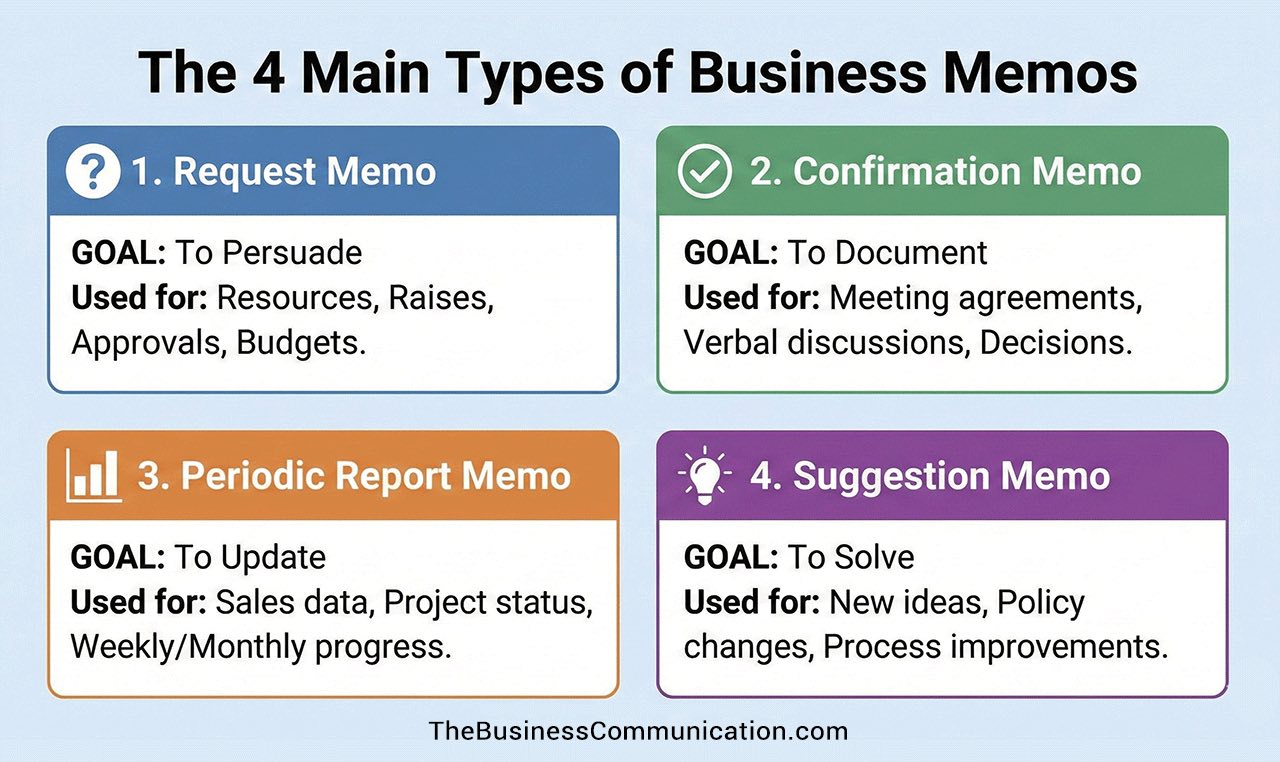
| Memo Type | Primary Goal | Ideal Tone | Key Feature |
| Request | To Persuade | Polite & Convincing | Focuses on benefits |
| Confirmation | To Document | Neutral & Factual | Focuses on accuracy |
| Periodic Report | To Update | Concise & Data-heavy | Focuses on trends |
| Suggestion | To Solve | Analytical & Positive | Focuses on solutions |
How to Adapt Your Tone for Each Type
We have talked a lot about tone, but how do you actually change it?
The structure of the memo—the To, From, Date, and Subject lines—remains exactly the same. The difference is in the verbs and adjectives you choose.
In a Request Memo, you might use soft, cooperative language:
- “It would be beneficial if…”
- “I propose we consider…”
- “This could help us achieve…”
In a Confirmation Memo, you use definitive, past-tense language:
- “As discussed…”
- “We agreed to…”
- “The deadline is set for…”
In a Periodic Report, you use active, metric-based language:
- “Sales increased by…”
- “The team completed…”
- “We are currently tracking…”
In a Suggestion Memo, you use logical, future-oriented language:
- “This change would allow…”
- “Analyzing the current data suggests…”
- “To improve efficiency, we could…”
Matching the tone to the type is the secret sauce. It shows emotional intelligence. It shows that you understand the context of your communication.
Best Practices for All Memo Types
Regardless of the category, there are universal rules that apply to all high-quality memos.
1. Keep it Short
Memos are not novels. They are designed for busy professionals. Try to keep your memo to one page. If you have supporting documents, attach them as appendices.
2. Use Headings
Notice how this blog post is broken up with headings? Your memo should be too. If a manager opens a memo and sees a solid wall of text, they will likely close it. Use headings to guide the reader through your Request, Confirmation, or Report.
3. Proofread
Nothing kills authority faster than a typo. In a Confirmation Memo, a typo in a date could have legal consequences. In a Request Memo, a typo makes you look careless. Always double-check your work.
4. Subject Lines Matter
The subject line is the first thing your reader sees. It should be specific.
- Bad: “Update”
- Good: “Weekly Sales Update – November Week 4”
- Bad: “Question”
- Good: “Request for Budget Approval: Q1 Marketing Campaign”
Conclusion
The humble memo is a versatile tool. It can ask for money, save your job, track progress, or solve complex problems.
The next time you sit down to write, pause for a second. Ask yourself: “What is my goal?”
Are you trying to persuade? Write a Request Memo.
Are you trying to create a record? Write a Confirmation Memo.
Are you updating the team? Write a Periodic Report Memo.
Are you fixing a problem? Write a Suggestion Memo.
Once you identify the type, the tone and structure will follow naturally. This small mental shift will make your communication sharper, faster, and far more effective.
Now that you understand the different types, you are ready to start drafting. If you need a refresher on the actual writing process, head over to our comprehensive guide on how to write a memo step-by-step and get started today.
1 Comment
Comment:I like how you present your work