


Do you remember playing the “Telephone Game” as a child? You whisper a phrase like “I like purple grapes” to the person next to you. They whisper it to the next person. By the time it reaches the end of the line, the message has become “I ride purple apes.”
It was funny back then. However, in the business world, this phenomenon is not a game. It is a disaster.
You might have a brilliant strategy in your head. You might speak clearly. Yet, the message your team receives is completely different from what you intended. This happens because of “noise.”
Communication is rarely a straight line. It is an obstacle course. Even if you have mastered the basics from our oral communication guide, hidden walls can still block your message.
These walls are called barriers. They cause confusion, conflict, and lost revenue.
In this guide, we will identify the most common barriers to effective communication. We will break them down into physical, psychological, and linguistic categories. Most importantly, we will give you actionable strategies to tear these walls down.
What Are Barriers to Effective Communication?
In communication theory, anything that distorts or interrupts the message is called “noise.”
A barrier is simply a blockage. It prevents the receiver from decoding the message correctly. When these barriers exist, the feedback loop breaks. The sender thinks one thing, and the receiver understands another.
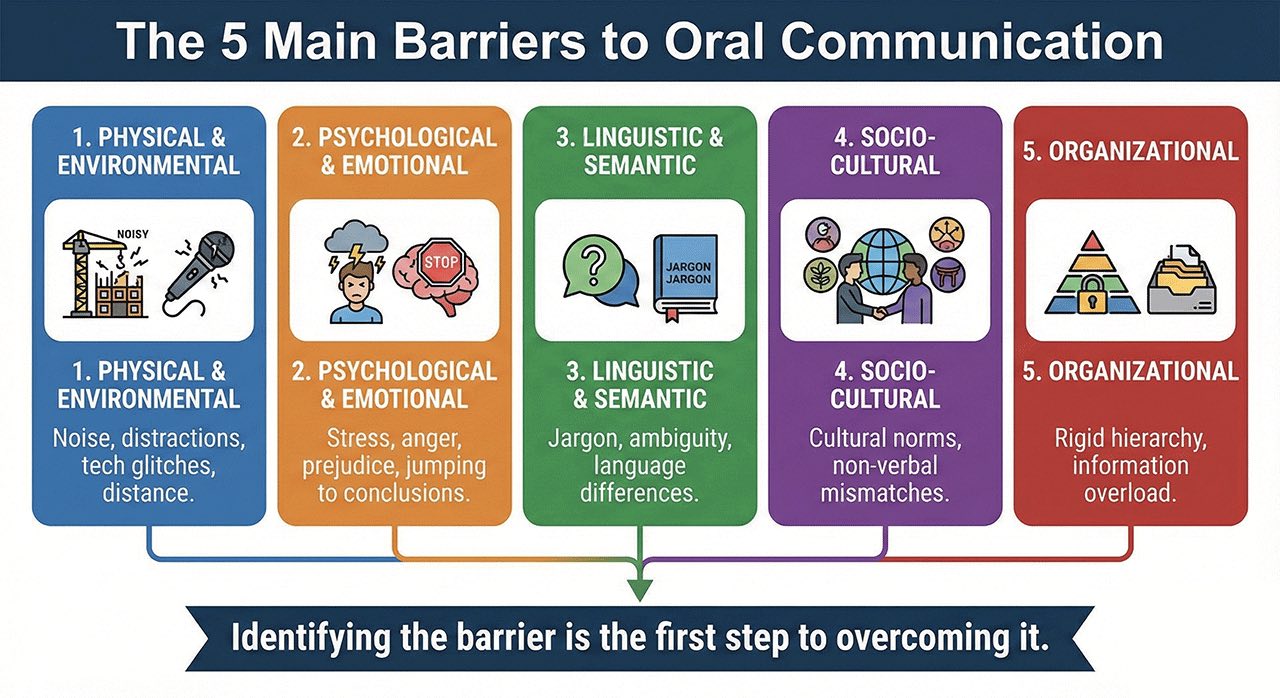
The impact is real. Studies show that miscommunication costs companies millions of dollars every year in lost productivity. It is the root cause of most workplace conflicts.
Identifying these obstacles is the first step to removing them. Let’s look at where things go wrong.
Category 1: Physical and Environmental Barriers
These are the tangible, external factors that interfere with the transmission of sound. They are often the easiest to identify but can be annoying to fix.
1. Noise and Distractions
Imagine trying to have a serious performance review in the middle of a busy construction site. It would be impossible.
Background noise is the number one killer of oral communication. This includes traffic sounds, ringing phones, or the chatter of an open-plan office. When the physical noise is too high, the brain cannot focus on the voice. It filters out parts of the message.
Distractions are not just auditory. Visual distractions, like a TV screen flickering in the background or people walking by, also steal focus.
2. Technology Glitches
We live in a digital age. Much of our talking happens through screens. This introduces a new layer of physical barriers.
A bad internet connection, a microphone with an echo, or a frozen video screen can ruin a meeting. When the audio cuts in and out, the brain stops trying to fill in the gaps. It just tunes out.
To mitigate this, you need to understand the technical requirements for different types of oral communication in business. A town hall requires different tech than a one-on-one video call.
3. Physical Distance
Face-to-face communication is powerful because you can see the whole person. When you are separated by walls or oceans, you lose that connection.
Physical distance removes the ability to read subtle body language cues. You cannot see if someone is tapping their foot nervously under the desk. This lack of visual data makes interpretation much harder.
Category 2: Psychological and Emotional Barriers
These barriers exist inside the mind. They are invisible, which makes them dangerous. They act like a filter, twisting the words before they are even processed.
4. Premature Evaluation (Jumping to Conclusions)
We are all guilty of this. Instead of listening to understand, we listen to reply.
You might assume you know what the speaker is going to say. So, you stop listening halfway through their sentence. You start formulating your counter-argument.
This is a major barrier because you miss the nuance of their message. The only way to fix this is to practice deep active listening skills. You must train your brain to wait until the period at the end of the sentence.
5. Emotional State (Anger and Stress)
Have you ever tried to reason with someone who is screaming? It does not work.
When we are emotional, our logical brain shuts down. This is called “emotional hijacking.” If the sender is angry, they might shout or use aggressive language. If the receiver is stressed or sad, they might perceive a neutral comment as an attack.
Anxiety is another massive blocker. If a speaker suffers from glossophobia or fear of public speaking, their physical fear creates a barrier. They might mumble or speak too fast, making the message unintelligible.
6. Ego and Prejudice
Ego is a silent killer of communication. If you believe you are smarter than the person talking, you will subconsciously tune them out.
Prejudice works the same way. If you have a bias against the speaker’s age, gender, or background, you will filter their words through that bias. You might dismiss a good idea simply because it came from an intern.
Category 3: Linguistic and Semantic Barriers
Language is a code. If the sender and receiver do not use the same codebook, the message fails. These are known as semantic barriers.
7. Use of Jargon and Technical Terms
Every industry has its own language. Engineers speak in acronyms. Marketers speak in buzzwords.
If you use this “insider language” with someone outside your field, you are building a wall. Speaking “Corporate” to a client who speaks “Human” alienates them. They might nod politely, but they have no idea what you said.
To avoid this, you must apply the “Clear” principle from the 7 Cs of communication. Simple words are always better than complex ones.
8. Ambiguity and Vague Words
Words can have multiple meanings. If you tell a team member, “Fix this soon,” what does “soon” mean?
To you, “soon” might mean one hour. To them, “soon” might mean next week. Vague language creates an interpretation gap. This gap is where mistakes happen.
9. Language Differences and Accents
In a global business environment, you will work with people from all over the world. Native and non-native speakers often struggle to understand each other’s pacing or idioms.
A thick accent or a lack of fluency can act as a natural barrier. It requires extra patience from both sides to ensure clarity.
Category 4: Socio-Cultural Barriers
Communication does not happen in a vacuum. It happens within a cultural context.
10. Cultural Norms (Direct vs. Indirect)
Culture shapes how we speak. In some Western cultures, being direct is seen as efficient and honest. In many Asian or Latin cultures, being direct can be seen as rude or aggressive.
If a direct manager speaks to an indirect employee, the employee might feel bullied. Conversely, the manager might feel the employee is being evasive. These misunderstandings can kill a deal.
This is particularly important to remember when applying negotiation skills in business, where cultural missteps can cost millions.
11. Non-Verbal Mismatches
Gestures are not universal. A “thumbs up” means “good job” in the USA, but it is an offensive insult in parts of the Middle East.
Eye contact is another big one. In some cultures, looking a superior in the eye is respectful. In others, it is defiant. If you misread these signals, you misread the message. You must be aware of these differences when interpreting non-verbal cues.
Category 5: Organizational Barriers
Sometimes, the structure of the company itself is the problem.
12. Hierarchy and Status
In highly rigid organizations, communication flows one way: down.
Employees are often afraid to speak up to their bosses. This is the “Mute” effect. They fear that giving honest feedback will be punished. As a result, management never hears about problems until it is too late.
This often happens when there is a strict divide between formal and informal communication. If the culture is too formal, open dialogue dies.
13. Information Overload
We live in an era of too much information. Too many meetings. Too many emails. Too many calls.
When the brain is bombarded with too much data, it shuts down. It stops processing. If you talk for an hour when five minutes would have been enough, you are creating a barrier of boredom.
How to Overcome These Barriers
Now that we know the enemies, how do we defeat them? Here are four actionable strategies to clear the path.
Strategy 1: Simplify Your Message (KISS Principle)
The acronym KISS stands for “Keep It Simple, Stupid.” It is harsh, but effective.
Avoid jargon. Use plain English. Use short sentences. If a ten-year-old cannot understand your message, it is too complex. The goal of oral communication is not to impress people with your vocabulary. It is to be understood.
Strategy 2: Create a Feedback Loop
Never assume the message was received. Verify it.
Don’t just ask, “Did you understand?” People will say “yes” just to be polite. Instead, ask them to rephrase it. Say, “Can you repeat what the next steps are, just so we are on the same page?”
This closes the loop. It forces the receiver to process the information and proves that the transmission was successful.
Strategy 3: Practice Emotional Intelligence
Be aware of your own state. If you are angry, frustrated, or exhausted, do not have that important conversation. Pause.
Wait until you are calm. Emotional intelligence also means reading the other person. If they look stressed, ask them about it. Addressing the emotion first removes the barrier to the logic.
Strategy 4: Reduce Physical Noise
Control your environment. If you have an important call, book a quiet room. Close the door.
If you are working remotely, invest in a good headset with noise cancellation. Turn off notifications on your computer. By removing physical distractions, you signal that the conversation matters.
Conclusion
Barriers to communication are inevitable. There will always be noise. There will always be distractions. There will always be cultural differences.
However, they are manageable. The goal is not to achieve perfect silence. The goal is to create a clear signal that cuts through the noise.
Successful leaders are not the ones who just talk. They are the ones who actively work to tear down these walls. They simplify their words. They listen for feedback. They respect cultural differences.
Identify which barrier is blocking your team today. Is it physical noise? Is it psychological fear? Is it vague language? Once you name it, you can fix it. Apply these solutions, and you will see an immediate boost in your oral communication skills.
Frequently Asked Questions (FAQ)
What is a semantic barrier in communication?
A semantic barrier occurs when words are interpreted differently by the sender and receiver. This often happens due to jargon, slang, or words with multiple meanings (ambiguity).
How does noise affect oral communication?
Noise acts as a physical barrier that disrupts the sound waves or distracts the listener. It prevents the brain from fully processing the auditory information, leading to gaps in understanding.
Why is feedback important in overcoming barriers?
Feedback closes the communication loop. It allows the sender to confirm that the message was received and understood correctly, correcting any distortions immediately.
1 Comment
Now days many business started using digital medium like whastapp for business communication.