


Close Menu
The Business CommunicationThe Business Communication
    What's Hot

    What is talking? Elements of good talking

    May 30, 2026

    Format of Resume – Types of Resume Formats | Contents of Resume

    May 30, 2026

    Factors influencing the meaning of business communication

    May 30, 2026
    Facebook X (Twitter)
    The Business CommunicationThe Business Communication
    Button
    • Basics
      1. Introduction
      2. Communication Skills
      3. Modern Communication
      4. View All

      Factors influencing the meaning of business communication

      May 30, 2026

      Scope of communication

      May 29, 2026

      Nature of Communication – The Business Communication

      May 29, 2026

      What is communication feedback? Causes of poor feedback

      May 27, 2026

      8 Ways To Improve Your Listening Skills

      May 29, 2026

      What Is Communication Style | Classification Of Communication Style

      May 28, 2026

      Meaning Of Cross-Cultural Communication

      May 26, 2026

      Various Styles Reading or Techniques of Reading

      May 12, 2026

      What Is Communication Satellite?

      May 29, 2026

      Advantages Of Electronic Communication In Business

      May 26, 2026

      Role Of Technology In Business Communication

      May 26, 2026

      Problems of Electronic Communication In Business

      May 25, 2026

      What is talking? Elements of good talking

      May 30, 2026

      Format of Resume – Types of Resume Formats | Contents of Resume

      May 30, 2026

      Factors influencing the meaning of business communication

      May 30, 2026

      Advantage and disadvantage of formal communication

      May 30, 2026
    • Forms of Communication
      • Oral Communication
      • Non-Verbal Communication
      • Report Writing
    • Written Communication
      1. Letter Writing
      2. Circular Letter
      3. inquiry letter
      4. Ultimatum Letter
      Featured
      Letter Writing

      Format of Resume – Types of Resume Formats | Contents of Resume

      By Masudur RashidMay 30, 2026
      Recent

      Format of Resume – Types of Resume Formats | Contents of Resume

      May 30, 2026

      Different types of written communication

      May 29, 2026

      What is Director’s Report? What is Auditor’s Report?

      May 28, 2026
    • In Business
      1. Company Meeting
      2. Secretarial Functions
      3. View All

      The Ultimate Company Meeting Guide: Definition, Types, Process, Advantages & Disadvantages

      May 15, 2026

      Difference Between AGM and EGM: A Complete Comparison

      April 8, 2025

      How to Write a Meeting Agenda: Template + Best Practices

      March 15, 2025

      After the Meeting: Follow-Up, Action Items & Accountability

      February 26, 2025

      What Is Organizational Communication – Types of Organizational Communication

      May 27, 2026

      What is Secretary? Types of secretary

      May 11, 2026

      What is talking? Elements of good talking

      May 30, 2026

      Format of Resume – Types of Resume Formats | Contents of Resume

      May 30, 2026

      Factors influencing the meaning of business communication

      May 30, 2026

      Advantage and disadvantage of formal communication

      May 30, 2026
    • Internal Communication
      1. Downward Communication
      2. Horizontal Communication
      3. Upward Communication
      4. View All

      What is downward communication? [Objectives and Methods]

      May 10, 2026

      Essential Elements of Downward Communication: A Complete Guide for Managers

      June 18, 2025

      Advantage And Disadvantages of downward communication

      March 7, 2025

      Key Objectives of Downward Communication in an Organization

      January 26, 2024

      What is Horizontal Communication: Definition, Examples & Importance

      September 21, 2025

      Advantages and Disadvantages of Horizontal Communication (With Real Examples)

      November 9, 2024

      Importance of Horizontal Communication (With Real-Life Examples)

      October 9, 2024

      Upward vs Downward vs Horizontal Communication: Key Differences

      September 7, 2023

      Leadership Styles That Encourage Employees to Speak Up

      August 21, 2024

      Future of Upward Communication in Remote/Hybrid Workplaces

      October 14, 2023

      Upward vs Downward vs Horizontal Communication: Key Differences

      September 7, 2023

      How Informal Communication Spreads Rumor

      June 25, 2023

      What is talking? Elements of good talking

      May 30, 2026

      Format of Resume – Types of Resume Formats | Contents of Resume

      May 30, 2026

      Factors influencing the meaning of business communication

      May 30, 2026

      Advantage and disadvantage of formal communication

      May 30, 2026
    The Business CommunicationThe Business Communication
    Home » Letter Writing » What is Banking Correspondence? Meaning, Types, Structure, and Importance of Bank Letters

    What is Banking Correspondence? Meaning, Types, Structure, and Importance of Bank Letters

    By Masudur RashidNo Comments7 Mins Read Letter Writing
    Facebook Twitter Reddit WhatsApp Telegram Pinterest LinkedIn Email
    Share
    Facebook Twitter Pinterest WhatsApp Email

    Have you ever wondered why banks seem obsessed with paperwork? Even for a simple request, they want it in writing. That is because in the banking world, nothing is more important than official records. And the most reliable record of all is a letter.

    In simple terms, a letter in connection with a bank is a formal written communication between the bank and its customers, or sometimes between two banks. It covers everything from opening an account to sanctioning a loan or even resolving a complaint.

    This article will guide you through the meaning, types, structure, principles, and future of banking correspondence. We will also explore why such letters matter and how they help maintain trust in financial systems. If you have already read our guide on what is business letter and why it is important, think of this article as a specialized version focusing only on banks.

    Characteristics of Banking Correspondence

    Banking correspondence has some unique traits that make it different from casual communication.

    1. Formal and Professional
      Banks do not crack jokes in official letters. Their tone is polite, direct, and strictly professional.
    2. Accuracy and Legality
      A single error in an account number or date can cause huge financial or legal issues. That is why accuracy is a must.
    3. Confidentiality
      Banks handle sensitive data. Every letter must safeguard private information.
    4. Clarity
      A banking letter is not a puzzle. It uses short sentences, simple words, and a clear structure so readers understand the message instantly.

    For a comparison, you can check our article on features of business letter. You will notice many overlaps, but banks take it to a stricter level.
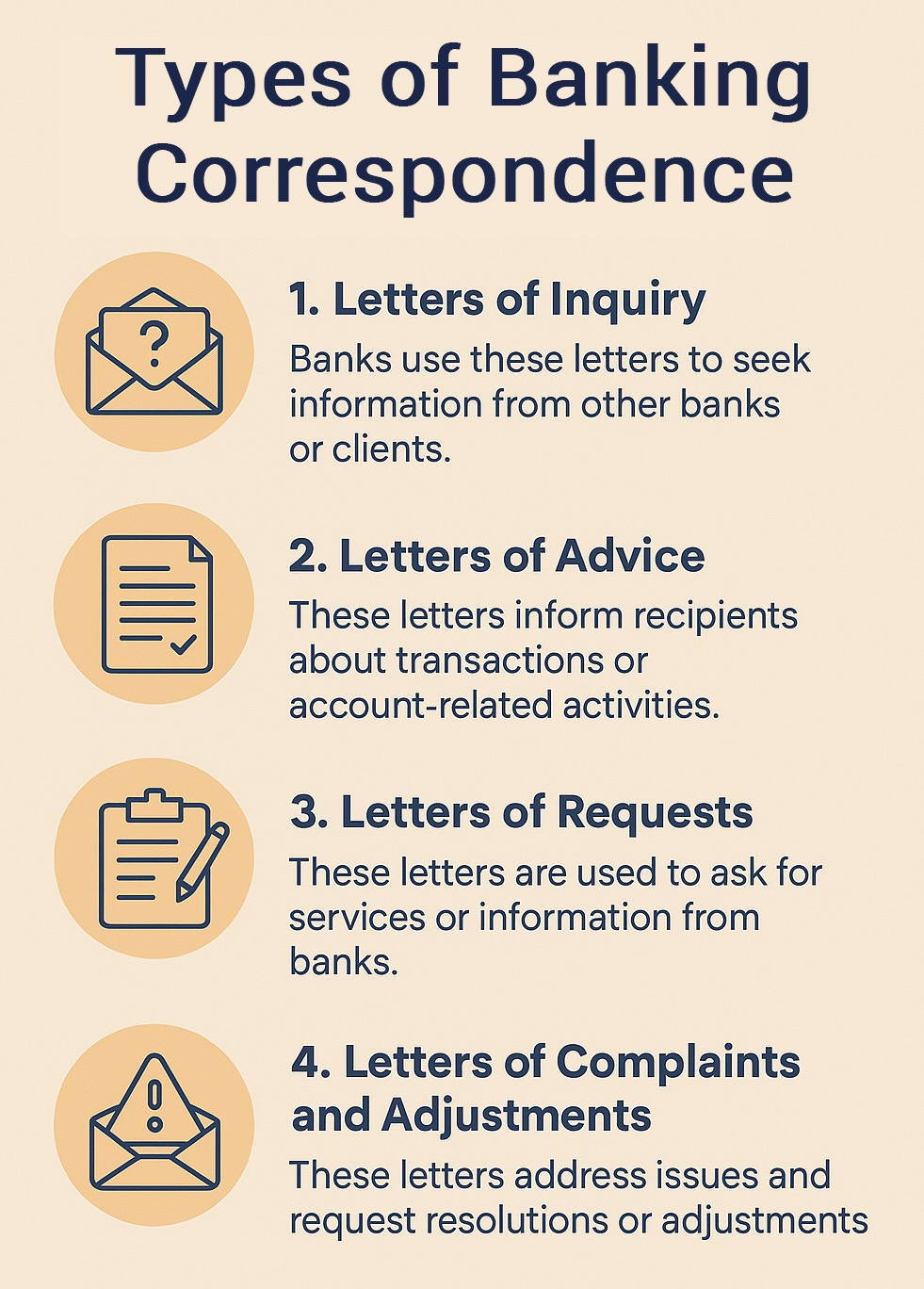
    Types of Banking Correspondence

    Importance of Banking Letters

    Why do banks still use letters in an age of instant messaging? The answer lies in their importance.

    • Official Record: A loan sanction letter is proof you received approval.
    • Legal Evidence: In disputes, written communication holds more weight than spoken words.
    • Trust Building: Customers feel secure when information comes in writing.
    • Clarity in Transactions: Written details prevent misunderstandings.

    Just as we discussed in our article on purposes of business reports, clarity and record-keeping are key goals. Banking correspondence serves exactly the same function, but in the financial world.

    Types of Banking Correspondence

    Banking correspondence falls into three categories: customer-initiated, bank-initiated, and specialized.

    A. Customer-Initiated Letters

    Customers often write letters to banks for different purposes.

    1. Account-Related Requests
      • Applying to open a new account
      • Requesting a cheque book or ATM card
      • Asking for passbook updates
    2. Loan and Credit Applications
      • Loan application letters
      • Requests for repayment schedules
      • Credit facility increase letters
    3. Complaint Letters
      • Wrong debit or credit complaint
      • ATM-related grievances
      • Service dissatisfaction

    If you read our article on how to write an inquiry letter, you will notice that many banking requests are basically specialized inquiry letters.

    B. Bank-Initiated Letters

    Banks also write letters to customers.

    1. Acknowledgement and Confirmation
      • Confirmation of account opening
      • Loan sanction letters
      • Balance certificates
    2. Reminders and Warnings
      • Overdue loan reminders
      • Overdraft limit warnings
      • Penalty notifications
    3. Informational Updates
      • Interest rate changes
      • New service announcements
      • Compliance notices

    These letters protect banks by ensuring terms are communicated clearly.

    C. Specialized Banking Correspondence

    Beyond routine communication, banks also issue specialized letters.

    • Insurance Letters: Premium updates, claim settlements
    • Foreign Exchange Letters: Letters of credit, bill of exchange
    • Investment Letters: Fixed deposit updates, mutual fund advice

    If you want to explore similar communication, check our post on meaning of commercial letter. The logic is almost the same, just with financial details.

    Structure of a Banking Letter

    A good banking letter has a clear structure:

    1. Heading and reference number
    2. Date and address
    3. Subject line
    4. Salutation
    5. Body of the letter
    6. Complimentary close
    7. Signature and designation
    8. Enclosures (if any)

    For a deeper dive into layouts, check our guide on business letter formats.

    Principles for Effective Banking Correspondence

    To be effective, banking letters must follow some principles:

    • Accuracy: No wrong numbers or vague details
    • Clarity: Keep sentences short
    • Politeness: Even complaints must sound respectful
    • Confidentiality: Always protect financial details
    • Use Templates: Templates ensure consistency

    Much like an adjustment letter, banking correspondence can make or break customer trust.

    Difference Between Banking Letters and Business Letters

    While similar, there are key differences:

    • Banking letters are more legally sensitive.
    • They directly involve money transactions.
    • Their formatting is stricter.
    • They are archived longer for compliance.

    If you want to compare, see our article on official letter.

    Common Mistakes in Banking Letters

    Some mistakes are too common:

    1. Writing vague details
    2. Using casual language
    3. Forgetting enclosures
    4. Responding too late

    Our guide on inquiry letter mistakes can also help you avoid these errors.

    Future of Banking Correspondence

    The future is going digital.

    • Emails and secure apps will replace physical letters.
    • AI reminders will handle repayments.
    • Eco-friendly banking will reduce paper use.

    But official letters will remain important for legal records. For more on digital changes, check advantages of electronic communication.

    Conclusion

    Banking correspondence is the backbone of financial communication. It records transactions, builds trust, and protects both banks and customers.

    From account openings to loan settlements, letters guide every step. The format may evolve with technology, but their importance will never fade.

    So, next time you write or receive a bank letter, remember you are part of a system that keeps the financial world stable and trustworthy.

    Frequently asked questions

    Should I send a complaint letter by email or printed mail?

    Email is faster and creates an instant record, but printed mail is safer for serious complaints. Check your bank’s preferred method in account documents or their website. For high-stakes issues (fraud, major errors), send both: email first for speed, then follow with a printed copy via registered mail for legal weight.

    What if my banking letter gets ignored by the bank?

    First, verify the bank received it. Request a written acknowledgment. If ignored after 7–10 days, send a follow-up letter referencing your original date and details. Keep copies of everything. If still unresolved, escalate to the bank’s complaint officer or file a formal grievance with your country’s banking regulator.

    Can I use informal language if my bank relationship is friendly?

    No. Always keep banking letters formal and professional, regardless of your relationship. Banks require this for legal and compliance reasons. Casual tone can create ambiguity, weaken your case in disputes, or be misinterpreted. Friendliness shows in politeness and clarity, not in slang or jokes.

    What details must I include to avoid my request being rejected?

    Include your full name, account number, date, specific request, and reason. Attach relevant documents (ID, proof of address). Be precise: instead of “I need a loan,” write “I request a personal loan of $5,000 for home repairs.” Vague letters get rejected or delayed. Double-check all numbers before sending.

    Is a subject line really necessary in a banking letter?

    Yes. A clear subject line helps the bank route your letter to the right department instantly. Use specific phrases like “Account Opening Request” or “Complaint: Unauthorized Debit on Account 123456.” Without it, your letter may be mishandled or delayed, especially in large banks with high mail volume.

    How long should I keep copies of banking letters I receive?

    Keep all bank letters for at least 7 years. This covers most loan terms and tax requirements. For major transactions (mortgages, investments), keep indefinitely. Store originals in a safe place and digital copies backed up. These letters prove transactions and protect you in disputes or audits.

    Classification of banking correspondence Types of banking correspondence What is meant by letter in connection with Bank?
    Share. Facebook Twitter Pinterest LinkedIn WhatsApp Reddit Email
    Previous ArticleWhat is Written Communication? Definition, Types, and Key Characteristics
    Next Article Leadership Styles That Encourage Employees to Speak Up
    Masudur Rashid
    • Facebook
    • X (Twitter)
    • Instagram
    • LinkedIn

    👋 Hi, I am Masudur Rashid. I studied Management (Honors and Masters) but my real passion has always been Business Communication. Through this blog, I share simple tips, lessons, and resources to help students and professionals communicate with confidence.

    Related Posts

    Letter Writing 114 Mins Read

    Format of Resume – Types of Resume Formats | Contents of Resume

    Letter Writing 114 Mins Read
    Letter Writing 014 Mins Read

    Features of Business Letter – Essential Qualities of Business Letter

    Letter Writing 014 Mins Read
    Letter Writing 013 Mins Read

    Considerable factors while drafting job application

    Letter Writing 013 Mins Read
    Letter Writing 621 Mins Read

    What is appointment letter? Specimen of appointment letter

    Letter Writing 621 Mins Read
    Add A Comment
    Leave A Reply Cancel Reply

    This site uses Akismet to reduce spam. Learn how your comment data is processed.

    Subscribe to Updates

    Get the latest business communication news from TBC.

    By signing up, you agree to the our terms and our Privacy Policy agreement.

    Check your inbox or spam folder to confirm your subscription.

    Top Picks

    Factors influencing the meaning of business communication

    Business communication isn’t just about sending messages, it’s about ensuring those messages are understood the…

    Scope of communication

    The scope of communication defines the range of domains and contexts where communication operates, from…

    Nature of Communication – The Business Communication

    Communication shapes every business interaction, from a quick Slack message to a 3,000-word strategy memo.…

    What is communication feedback? Causes of poor feedback

    Feedback is the receiver’s response to a sender’s message, completing the communication cycle. When feedback…

    Welcome to TheBusinessCommunication.com, your guide to clear and effective business communication. Here you will find simple lessons on report writing, letters, meetings, oral and written communication, and modern tools like email or virtual meetings. Our mission is to make learning communication easy, practical, and fun, so you can apply it in your studies, career, and everyday life.
    We're social. Connect with us:

    Facebook X (Twitter) YouTube LinkedIn RSS
    Top Insights

    What is talking? Elements of good talking

    Format of Resume – Types of Resume Formats | Contents of Resume

    Factors influencing the meaning of business communication

    Subscribe to Updates

    Get the latest business communication news from TBC.

    By signing up, you agree to the our terms and our Privacy Policy agreement.

    Check your inbox or spam folder to confirm your subscription.

    Copyright © 2026 TheBusinessCommunication. All Rights Reserved.
    • Home
    • About Us
    • Contact US
    • Our Authors
    • Privacy Policy
    • Terms and Conditions

    Type above and press Enter to search. Press Esc to cancel.