


"In business, you don't get what you deserve; you get what you negotiate."
This famous quote by Chester Karrass sums up the corporate world perfectly. You might have the best product. You might be the hardest worker. However, if you cannot ask for what you want, you will leave value on the table.
We often think of negotiation as a battle of contracts. We imagine lawyers in suits sliding papers across a long table. But the reality is different. The real magic happens before the ink touches the paper.
Negotiation is, at its heart, a conversation. It is a game of spoken words.
Many professionals fail at negotiation. It is not because their offer is bad. It is because they communicate it poorly. They might use the wrong tone. They might talk too much when they should be listening. Or they might miss the subtle signals the other person is sending.
To master negotiation skills in business, you must first master the art of speaking and listening. In this guide, we will explore how oral communication serves as the engine of every successful deal. We will look at specific strategies, from the power of silence to the art of questioning.
If you are looking to build a strong foundation first, you should check out our comprehensive oral communication guide.
Why Oral Communication is the Engine of Negotiation
You might be wondering, “Can’t I just negotiate over email?”
You can, but you probably shouldn’t. Written communication is great for records, but it is terrible for rapport. Deals are made between people, not papers.
The “Human Element”
Trust is the currency of negotiation. It is very hard to build trust with text on a screen. When you speak to someone, you humanize yourself.
Your voice conveys sincerity. Your hesitation conveys thought. Your laughter conveys friendliness. These elements make the other party want to work with you. They transform you from a “vendor” into a “partner.”
Speed and Adaptability
Imagine you make an offer via email. Then you wait. You have no idea how they reacted. Did they smile? Did they frown? Did they laugh?
In oral communication, the feedback loop is instant. You can see or hear their reaction immediately. If they recoil at your price, you can pivot instantly. You can say, “However, that includes X and Y services.”
This adaptability is impossible in writing. To understand more about when to use which medium, you can review the difference between oral and written communication.
Essential Oral Skills for Successful Negotiation
Knowing the theory is one thing. Applying it is another. Here are four specific oral skills that will give you an edge at the bargaining table.
1. The Power of the Pause (Silence)
Most people are terrified of silence. In a negotiation, they feel the urge to fill every quiet moment with words.
This is a mistake.
Silence is pressure. When you make an offer, stop talking. Do not justify it. Do not apologize for it. Just state it and wait.
The other person will feel the weight of that silence. Often, they will start talking just to relieve the tension. In doing so, they might reveal valuable information or even improve their own offer.
Controlling your pacing is a key part of how you improve oral communication skills. If you talk too fast or too much, you sound desperate.
2. Active Listening to Find Leverage
The biggest myth in negotiation is that the smooth talker wins. In reality, the best listener wins.
You should listen to find their “pain point.” What are they really worried about? Is it price? Is it speed? Is it quality?
If you listen only to reply, you miss these clues. You need to listen to understand. Once you know their pain, you can offer a solution that solves it. This is how you create value.
This level of focus requires advanced active listening skills. It is about hearing what they say and what they don’t say.
3. Tone Control: Assertive vs. Aggressive
There is a fine line between being firm and being rude. That line is usually drawn by your tone of voice.
If you shout or sound angry, the other person will shut down. This is aggressive. Conversely, if you whisper or sound apologetic, they will walk all over you. This is passive.
You need to aim for assertive. Keep your voice calm, steady, and low. This signals confidence. It tells them you are serious but reasonable. This connects back to the concept of paralanguage, which we have discussed before.
4. Framing with the 7 Cs
Ambiguity kills deals. If your proposal is vague, the other party will get suspicious.
Your offer must be clear and concrete. Instead of saying, “We can do a discount,” say, “If you sign by Friday, we can offer a 5% reduction.”
This precision removes doubt. It makes it easy for them to say yes. Applying the 7 Cs of communication ensures your message lands exactly as you intended.
Reading the Opponent: Non-Verbal Intelligence
In a high-stakes negotiation, people rarely say exactly what they mean. They might say, “That sounds interesting,” while crossing their arms and leaning back.
Which signal do you trust? Trust the body.
Spotting Hesitation
Watch for micro-expressions. If you name a price and their eyes widen slightly or they touch their neck, they are stressed.
This tells you that you might have hit a limit. Or, it might tell you that they are bluffing. If they say “That is too high” but their body remains relaxed and open, they are likely just testing you.
Spotting Agreement
You also need to know when to stop selling. If they start nodding, leaning forward, or picking up a pen, they are ready to buy.
At this point, stop pitching. If you keep talking, you might talk yourself out of the deal.
To be a master negotiator, you need to study the importance of non-verbal cues. Recognizing signs of defensiveness versus openness can save a deal from falling apart.
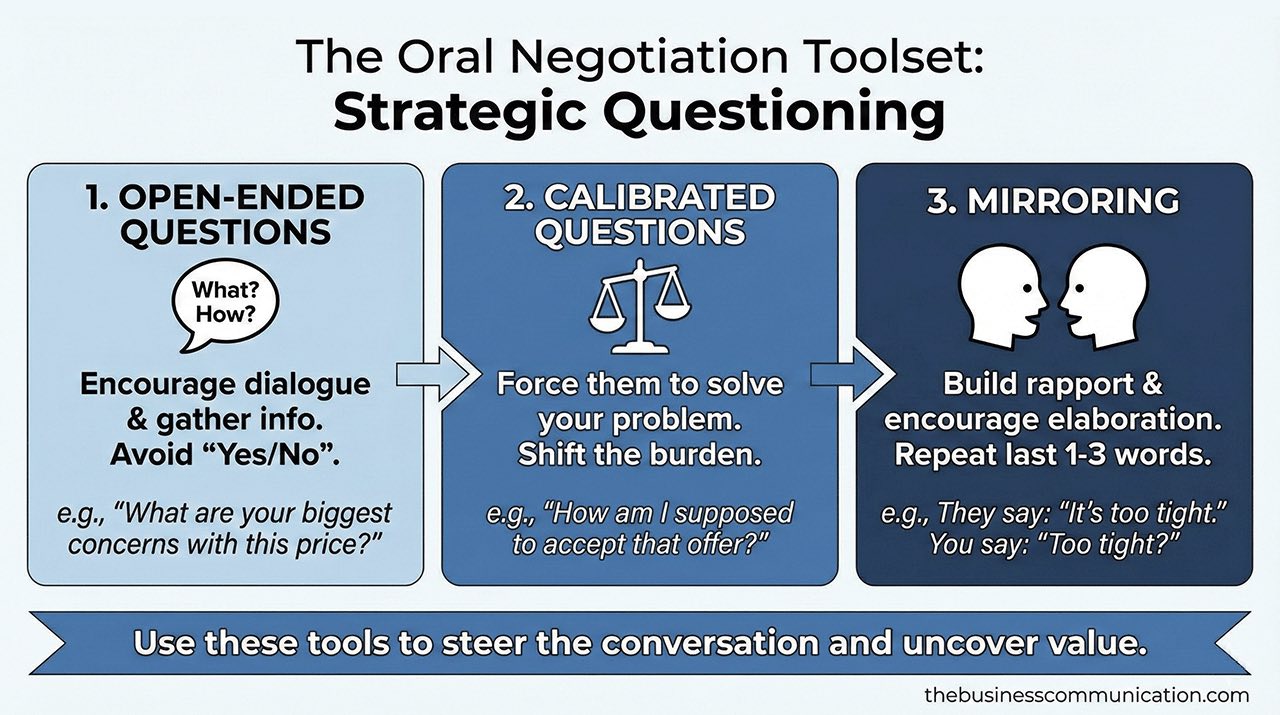
Strategic Questioning (The Oral Toolset)
Statements state positions. Questions open possibilities. The way you ask questions can steer the entire conversation.
Open-Ended Questions
Avoid “Yes” or “No” questions. They shut down the conversation. Instead, ask “What” or “How” questions.
Instead of asking, “Is this budget okay?”, ask, “What are your thoughts on this budget?” This forces them to explain their position. It gives you more data to work with.
Calibrated Questions
This is a technique popularized by FBI negotiator Chris Voss. It involves asking questions that force the other side to solve your problem.
For example, if they make a lowball offer, ask, “How am I supposed to accept that?”
You are not saying no. You are asking them to explain how that offer makes sense. It puts the burden on them to justify their position or improve it.
Mirroring
This is a simple but powerful trick. Repeat the last three words the other person just said.
If they say, “We have a tight deadline.” You say, “A tight deadline?”
Then pause. They will instinctively elaborate. “Yes, we need it by Monday because…” Now you have more information about why they are pressured.
Overcoming Barriers in Negotiation
Even with the best skills, things can go wrong. Emotions flare. Misunderstandings happen. Here is how to navigate the common roadblocks.
Fear of Conflict
Many people accept bad deals simply because they are scared. They are afraid of the tension. They are afraid of hearing “no.”
This fear often stems from a lack of confidence in speaking. It is closely related to fear of public speaking. If you are terrified of the spotlight, you will fold under pressure.
Remember, negotiation is not a fight. It is a problem-solving session.
Cultural Misunderstandings
Business is global. In some cultures, saying “no” directly is considered rude. They might say “maybe” or “we will see.”
If you take that literally, you will be waiting forever. You need to understand the cultural context of the person you are talking to.
Emotional Triggers
Negotiations can get heated. If the other person attacks you personally, do not attack back.
Take a deep breath. Use your active listening skills to validate their emotion. “I can see you are upset about the delay.”
This disarms them. It brings the conversation back to logic.
Virtual Negotiation: Adapting to the Screen
The world has changed. Many deals are now closed over Zoom or Teams. This presents unique challenges.
The Challenge
On a screen, you lose a lot of body language. You cannot see if their foot is tapping nervously. Eye contact is skewed.
The Strategy
You need to over-communicate verbally. Since you cannot rely on subtle cues, you need to be more explicit. Check in more often. “Does that make sense?” “How do you feel about that?”
You also need to pay extra attention to your camera and lighting. If they cannot see your face clearly, they will trust you less.
Make sure you are familiar with the etiquette for different types of oral communication, especially video conferencing.
Conclusion
Negotiation is often portrayed as a mysterious talent. People think you are either born a negotiator or you are not.
That is false. Negotiation is 10% strategy and 90% communication.
It is about knowing when to speak and when to be silent. It is about asking the right questions. It is about reading the room.
A good negotiator is simply an expert communicator who knows what they want. They do not bully their way to a deal. They talk their way to a solution that works for everyone.
So, the next time you walk into a negotiation, do not just focus on the numbers. Focus on the conversation. Listen to the person across from you. Watch their body language. Use your voice as a tool.
You might be surprised at how much more you can get, simply by asking for it the right way.
Frequently Asked Questions (FAQ)
What is the most important skill in negotiation?
While all skills matter, active listening is arguably the most important. It allows you to gather the information you need to influence the other party effectively.
How does tone of voice affect negotiation?
Your tone sets the emotional climate. A calm, assertive tone builds trust and authority. An aggressive tone creates resistance, while a passive tone invites exploitation.
Can you negotiate effectively over email?
It is possible, but it is much harder. You lose the nuance of tone and body language. It is easier for people to say “no” to an email than to a person. Whenever possible, try to move important negotiations to a phone or video call.
Frequently asked questions
What should I do if silence makes me uncomfortable during negotiation?
Silence is intentional pressure, not awkwardness. Remind yourself that the other person feels it too. They’ll often break the silence first and reveal information or concessions. Practice pausing after making an offer. Count to five in your head before speaking again. This discomfort fades with repetition and becomes a powerful negotiation tool.
How do I know if they’re genuinely interested or just being polite?
Watch their body language, not their words. Genuine interest shows as leaning forward, nodding, maintaining eye contact, and picking up a pen. Polite disinterest appears as crossed arms, leaning back, or touching their neck. If their words say yes but their body says no, trust the body. Their nonverbal signals reveal their true position.
Should I negotiate over email if the other party prefers it?
Avoid email negotiation whenever possible, even if they suggest it. Email kills rapport and slows feedback. You can’t read reactions or pivot instantly. Propose a call or meeting instead, framing it as more efficient. If they insist on email, use it only for confirming final terms after you’ve negotiated the key points verbally.
What if I accidentally talk too much and reveal my bottom line?
Stop immediately and don’t compound the mistake by over-explaining. Pause, acknowledge what you said, and redirect: “Let me clarify—that’s our starting position, but there’s room to work together.” Then ask them a question to shift focus back to their needs. This recovers the conversation and prevents further damage.
How do I stay assertive without sounding desperate or aggressive?
Control three elements: volume, pace, and steadiness. Keep your voice calm and slightly lower than normal conversation. Speak slowly and deliberately, not rushed. Avoid filler words like “um” or “like.” This combination signals confidence and seriousness. Aggressive voices are loud and fast; desperate voices are soft and hurried.
What’s the best way to find their pain point without asking directly?
Ask open-ended questions and listen more than you talk. Instead of “Is price your concern?” try “What matters most to you in this partnership?” or “What challenges are you facing right now?” Let them talk. Their pain point emerges naturally. Take notes and listen for what they emphasize, repeat, or show emotion around.