


Writing a job application is one of the most important steps in the journey to employment. It is often the first document an employer reads before deciding whether to invite a candidate for an interview. A well-written application does more than just list qualifications, it represents personality, attitude, and communication skills.
Let us now explore what a job application is, why it matters, the types, the format, and finally, a complete example of a printed job application letter.
What Is a Job Application?
A job application is a formal letter written by a job seeker to an employer expressing interest in a specific position. It is a bridge between the applicant and the organization. The letter introduces the candidate, summarizes their qualifications, and politely requests consideration for the position.
It is often written along with a resume or curriculum vitae (CV). While a resume lists facts and achievements, the job application explains how those achievements relate to the role. It provides context, tone, and a sense of the person behind the credentials.
To understand this format better, you may study how a business letter is structured, as job applications follow similar rules of formal communication.
Why Writing a Job Application Is Important
Employers usually receive many applications for each job. A well-written letter helps your name stand out. It also gives you the opportunity to show motivation and suitability.
A job application serves several important purposes:
- It introduces you to the employer.
Your application tells who you are, your qualifications, and what role you are applying for. - It expresses your interest in the organization.
Employers appreciate when candidates show awareness of their company values or reputation. - It highlights your suitability.
You can match your strengths with the job requirements. - It requests an opportunity.
It ends with a polite request for an interview or further discussion.
As you can see, it is not just a letter, it is your first formal impression, much like other professional correspondences such as a cover letter.
Key Features of an Effective Job Application
An effective job application should be clear, brief, and well-organized. It must leave a professional impression.
Here are the qualities of a good application letter:
- Clarity: Each sentence should serve a clear purpose. Avoid vague expressions.
- Conciseness: Limit the content to one page unless the employer asks for more.
- Politeness: Use respectful and formal language throughout.
- Personalization: Address the correct person rather than using general greetings.
- Accuracy: Ensure the letter has no grammatical or spelling errors.
Correct grammar, structure, and tone are essential parts of written communication. If you need a refresher, see this article on the characteristics of written communication.
Structure of a Job Application Letter
The structure of a job application follows the standard format of a formal business letter. Maintaining this order helps the employer read it quickly and understand your purpose immediately.
1. Heading
Write your full address and the date at the top left corner.
2. Inside Address
Include the name, designation, and address of the employer.
3. Salutation
Use Dear Sir, Dear Madam, or Dear Hiring Manager as appropriate.
4. Subject Line
Clearly mention the job title. For example: Subject: Application for the Post of Sales Executive.
5. Body of the Letter
This part has three short paragraphs:
- Opening: State the job title and source of the advertisement.
- Middle: Highlight qualifications, experiences, and skills.
- Closing: Show enthusiasm and politely request an interview.
6. Complimentary Close
Use Yours faithfully or Sincerely yours followed by your signature and name.
7. Enclosures
List the documents you attach below your name, in the order the employer asked for them. Typical enclosures are:
- Your resume or CV
- Attested (certified) photocopies of academic certificates
- Experience letters, if any
- A recent passport-size photograph, if the advertisement asks for one
Bank and government posts often ask for attested copies and photographs, and some advertisements give a reference number. Quote that number in the subject line so your application reaches the right file. Label each attachment clearly and make sure every copy is legible.
If you want to master this structure, check the detailed explanation of parts of a business letter.
Types of Job Applications
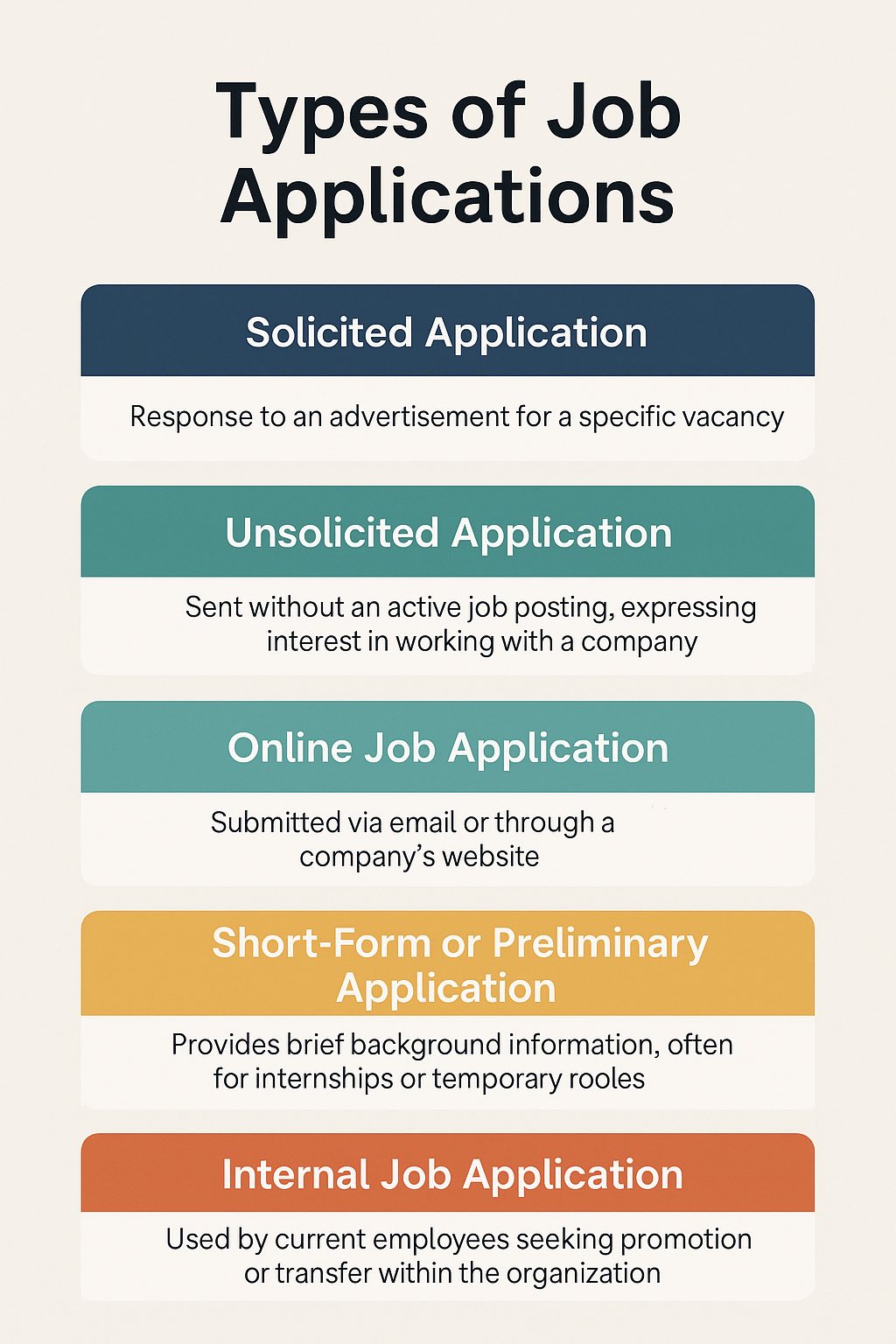
Job applications can be classified based on how and where they are sent. Understanding the types helps you choose the right tone and approach.
1. Solicited Application
This is written in response to an advertisement. It refers to a specific vacancy and includes details related to that job.
See Sample 2 below for a solicited application written in reply to a newspaper advertisement.
2. Unsolicited Application
Here, the applicant sends a letter without any active advertisement. It is used to show interest in working with a company even when there are no open positions.
3. Online Job Application
This is submitted through email or a company’s website. It must be short, simple, and compatible with digital systems.
4. Short-Form or Preliminary Application
This type is used for internships or temporary roles where employers only require brief background information.
5. Internal Job Application
Sometimes, existing employees apply for promotion or transfer. Such applications highlight internal achievements and commitment to the organization.
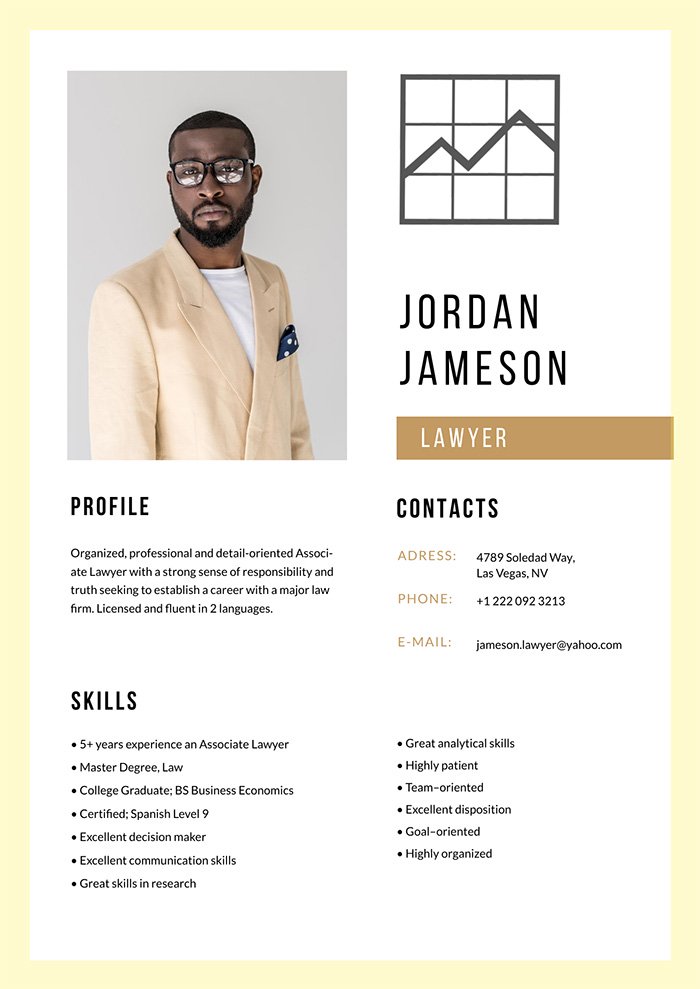
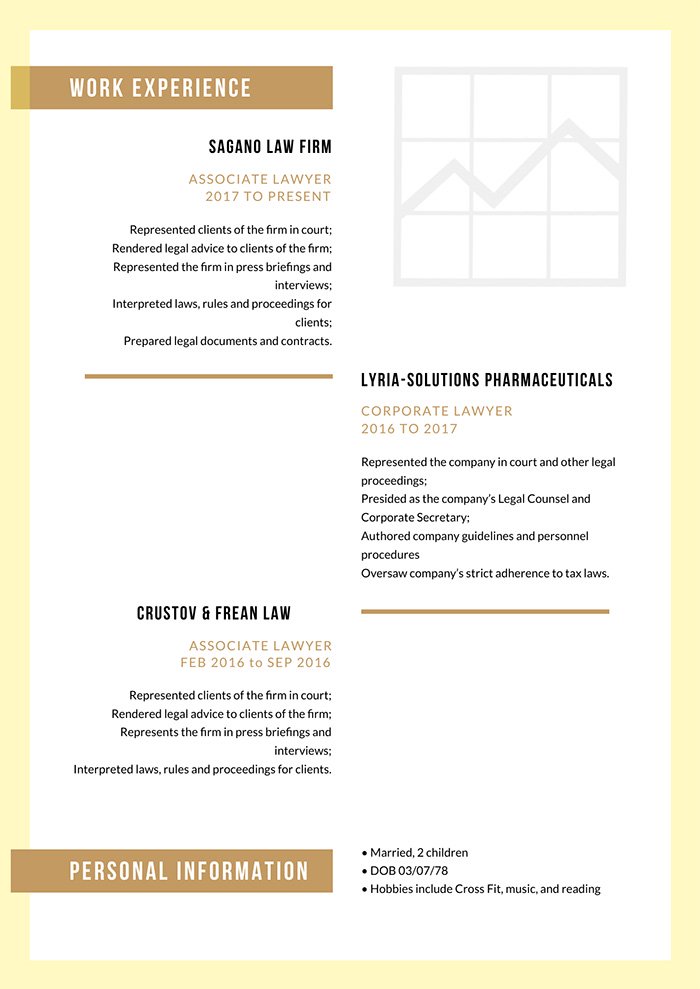
If you are preparing for a specific job role, studying how to write a resume will also be beneficial, since it complements your application perfectly.
How to Write a Job Application: Step-by-Step Guide
Writing a job application requires planning and precision. Follow these steps carefully.
Step 1: Research the Employer
Understand the company’s background and work culture. It helps you align your tone with their expectations.
A simple research checklist:
- Read the job posting three times. First for the general idea, then to mark the two most important requirements, then to note the words the employer uses (for example, “collaboration” or “efficiency”) so you can mirror them.
- Study the company. Read the “About” page, recent news and public statements, or the social media pages and client list of a smaller firm.
- Look up the hiring manager. If the posting names one, check their professional profile to see which skills they value.
- Decode vague requirements. If the posting asks for “strong communication skills,” compare similar roles to work out whether it means reports, presentations or client coordination.
- Write down your findings: company mission, top two requirements, keywords, and anything unusual about the role.
Step 2: Choose the Correct Format
For printed applications, use a standard business letter format. For email, keep it shorter and ensure it reads well on screens.
Step 3: Address the Right Person
Avoid general greetings like “To whom it may concern.” Find the correct name or department.
Step 4: Highlight Your Skills
Use specific examples. For instance, if applying for a marketing position, mention how you managed a successful project or improved sales.
Describe what each duty shows about your skills, not just the duty itself. Focus on the two priorities the posting stresses most, and include internships, volunteer work, certifications and languages when they prove a skill the employer needs.
| Weak (duty-focused) | Strong (skill-focused) |
|---|---|
| Responsible for monthly reports | Prepared monthly financial reports that pointed out cost-saving opportunities |
| Answered customer emails | Resolved customer inquiries by email, using problem-solving and written communication skills |
| Attended training sessions | Completed an advanced Excel course and used it to simplify inventory tracking |
| Worked with an international team | Coordinated with colleagues in different time zones to launch a product on schedule |
| Managed a team of five | Led a team of five to deliver a website redesign before the deadline |
Step 5: Maintain a Positive Tone
Even if you lack experience, focus on what you can contribute.
Step 6: Review and Proofread
Double-check the entire letter before sending. Grammatical errors can damage your credibility.
These steps are part of a broader concept called effective written communication, a foundation of professional success explained in business communication and its importance.
Example of a Job Application Letter (Printed Version)
Below is a complete example of a formal job application letter written in printed format.
House No. 23, Road No. 7
Dhanmondi, Dhaka
October 22, 2025
The Human Resource Manager
XYZ Corporation Ltd.
Motijheel, Dhaka
Subject: Application for the Position of Management Trainee
Dear Sir,
With due respect, I would like to apply for the position of Management Trainee as advertised on your company’s official website. I recently completed my Master’s degree in Business Administration from the University of Dhaka with a concentration in Management and Marketing.
During my studies, I developed strong analytical and leadership skills. I also completed an internship at ABC Textiles Ltd., where I assisted in project planning, employee coordination, and client communication. These experiences strengthened my ability to work effectively in dynamic business environments.
Your company is widely recognized for its commitment to innovation and employee development. I am confident that my academic background and enthusiasm for continuous learning will allow me to make a positive contribution to your organization.
I would be grateful if you could grant me an interview at your convenience. I look forward to discussing how my skills align with your company’s goals.
Thank you for considering my application.
Yours faithfully,
Masudur Rashid
Encl: Resume, Certificates
This sample shows how a formal tone, clear structure, and respectful language make a strong impression. It follows the standard pattern of official letter writing, which emphasizes clarity and professionalism.
Sample 2: Fresh Graduate Applying to a Bank Advertisement
This is a solicited application from a fresh graduate replying to a newspaper advertisement for a Management Trainee post. The bank and the details are illustrative. Replace the bracketed parts with your own information.
[Your Address]
[Date]
The Head of Human Resources Department
ABC Bank Ltd.
[Bank Address]
Subject: Application for the Post of Management Trainee (Ref: [advertisement reference number, if given])
Dear Sir/Madam,
In response to your advertisement in [Newspaper Name] of [date], I would like to apply for the post of Management Trainee. I hold a BBA in Management and an MBA in Human Resource Management, which match the qualifications stated in your advertisement.
I also completed a six-month internship in the Human Resources Department of a private bank, where I [describe one specific task, e.g., screened applications and scheduled interviews]. During the internship, I [state one real result you can support].
I am confident that my education and internship experience will help me contribute to the growth and efficiency of your bank. I would be grateful for the opportunity to attend an interview at your convenience.
Yours faithfully,
[Your Name]
Enclosures:
1. Resume
2. Attested photocopies of all certificates
Common Mistakes to Avoid
Even talented candidates sometimes make small mistakes that cost them job opportunities. Avoid the following:
- Using informal language. Keep the tone professional and courteous.
- Writing long paragraphs. Recruiters prefer concise writing.
- Copying templates blindly. Always personalize your letter.
- Ignoring proofreading. Spelling and grammar errors signal carelessness.
- Repetition of information. Do not restate everything from your resume.
- Focusing on what you want. Lines like “this role would help me grow” center your needs. Explain what you offer the employer instead.
- Ignoring submission instructions. If the posting asks for a PDF, a file name format, a set number of references or a deadline, follow it exactly.
- Adding irrelevant personal details. Leave out marital status, religion, hobbies, reasons for leaving past jobs and salary expectations unless the employer asks for them.
Avoiding these mistakes will help you maintain a good impression.
Tips for Writing an Impressive Job Application
- Be specific: Mention concrete skills and achievements.
- Use strong action verbs: Words like achieved, organized, or led make sentences powerful.
- Keep the layout clean: Use proper spacing and margins.
- Stay honest: Never exaggerate experiences.
- Show enthusiasm: Employers notice genuine interest.
- Keep a copy: Save every application with the original job posting so you can review both before an interview.
Remember, a well-prepared application often leads to further communication such as interview letters, appointment letters, or joining confirmations.
Difference Between Job Application and Other Employment Letters
Many people confuse a job application with other employment-related letters. Here is a simple comparison:
| Type of Letter | Purpose | Timing |
|---|---|---|
| Job Application | Express interest in a job | Before interview |
| Resume | Present qualifications | Attached with application |
| Cover Letter | Persuade employer to read resume | Along with application |
| Interview Letter | Invite candidate for interview | After shortlisting |
| Appointment Letter | Confirm selection | After approval |
| Joining Letter | Confirm acceptance and joining | Before starting work |
Each document has its own function, but they are all part of a sequence of professional communication that begins with a well-crafted job application.
Job Applications in the Digital Age
Today, most employers use digital platforms to collect applications. Online forms and emails have replaced printed submissions in many industries.
When applying online, keep the following in mind:
- Use simple formatting to ensure compatibility with Applicant Tracking Systems (ATS).
- Include job-related keywords naturally in the text.
- Attach files in PDF format unless otherwise stated.
- Use a professional email subject line, for example, Application for the Post of Sales Officer.
- Use the exact job title and the skill terms from the posting, because ATS software matches your text against those keywords.
- Follow any file-naming rule the employer gives, such as LastName_FirstName_Application.pdf.
Many employers now use online application forms or job portals instead of letters. Fill in every required field, paste plain text into text boxes so the formatting does not break, and upload your resume in the format the portal asks for. If the form has a cover letter box, use the same opening, skills and closing you would use in a letter.
Email Version of Sample 2
Subject: Application for the Post of Management Trainee: [Your Name]
Dear Sir/Madam,
I am applying for the post of Management Trainee advertised in [Newspaper Name] on [date]. I hold a BBA in Management and an MBA in Human Resource Management, and I completed a six-month internship in the HR Department of a private bank, where I [specific task].
My resume and scanned copies of my certificates are attached as PDF files. I would welcome the chance to discuss my application at an interview.
Yours faithfully,
[Your Name]
[Phone Number] | [Email Address]
Modern communication technology has made job hunting faster, but it still values clarity, politeness, and professionalism just as much as traditional methods.
Conclusion
A job application is not just a formality, it is a powerful tool for communication. It demonstrates how effectively you can express your thoughts in writing, how well you understand the role, and how sincerely you wish to join the organization.
By following the correct format, avoiding common errors, and maintaining a professional tone, you can create a letter that captures attention. Whether you are applying for your first job or a senior position, remember that the art of writing a clear and respectful job application is a lifelong skill.
Above all, take your time, review your work, and let your words reflect your confidence and professionalism. With practice and attention to detail, your job application can be the key that opens the door to your next great opportunity.
Frequently asked questions
Should I send my job application as a printed letter or email?
Check the job posting first. If it specifies a method, follow that instruction. For printed applications, use standard business letter format on quality paper. For email, keep it concise and ensure it displays well on mobile devices. When in doubt, email is faster and more common today, but printed letters stand out for traditional industries.
What if I don’t know the hiring manager’s name or title?
Call the company’s main line and ask for the hiring manager’s name. If you cannot reach anyone, use “Dear Hiring Manager” or “Dear Hiring Team.” Avoid generic greetings like “To Whom It May Concern.” Spending two minutes to find the correct name shows effort and increases the chance your letter reaches the right person.
How long should my job application letter actually be?
Keep it to one page maximum. Aim for three short paragraphs in the body: opening (state the position), middle (highlight relevant skills and experience), and closing (express enthusiasm and request an interview). Employers skim applications quickly, so concise writing works better than lengthy explanations.
Can I use the same application letter for multiple job openings?
No. Customize each application to the specific job and company. Change the job title, company name, and tailor your qualifications to match the role’s requirements. Generic letters are obvious to employers and reduce your chances. Personalization shows genuine interest and effort.
What should I do if the job posting doesn’t list specific requirements?
Research the company’s website and industry standards for that role. Highlight transferable skills, relevant experience, and your ability to learn quickly. In your opening paragraph, mention why you are interested in the company specifically. This approach shows initiative and genuine enthusiasm for the position.
Is it acceptable to mention salary expectations in my job application?
Only if the job posting specifically asks for it. Otherwise, avoid mentioning salary in your application letter. Wait until the employer brings up compensation during the interview stage. Discussing salary too early can eliminate you from consideration or weaken your negotiating position.
How do I write a job application with no experience?
Lead with your education, internships, academic projects and volunteer work, and show what each one proves about your skills, as in the fresh graduate sample above. Keep a positive tone and focus on what you can contribute.
Should I end a job application with “Yours faithfully” or “Yours sincerely”?
In British-style letters, use “Yours faithfully” when you open with “Dear Sir/Madam” and “Yours sincerely” when you address the reader by name. In American-style letters, “Sincerely” is used in both cases.
3 Comments
Need a resume for this above letter
Need a resume for this above letter
great issues altogether, you just received a
new reader. What could you suggest about your put up that you just made some days in the past?
Any certain?