


Bank correspondence follows strict conventions that protect both institutions and customers. This guide presents three annotated specimen letters, overdraft requests, verification requests, and complaints, with explanations of the language, structure, and credibility markers that make each one effective.
What is bank correspondence and why it matters
Bank correspondence is formal written communication between account holders and financial institutions. Unlike casual business emails, these letters create legal records that banks rely on for compliance, dispute resolution, and lending decisions.
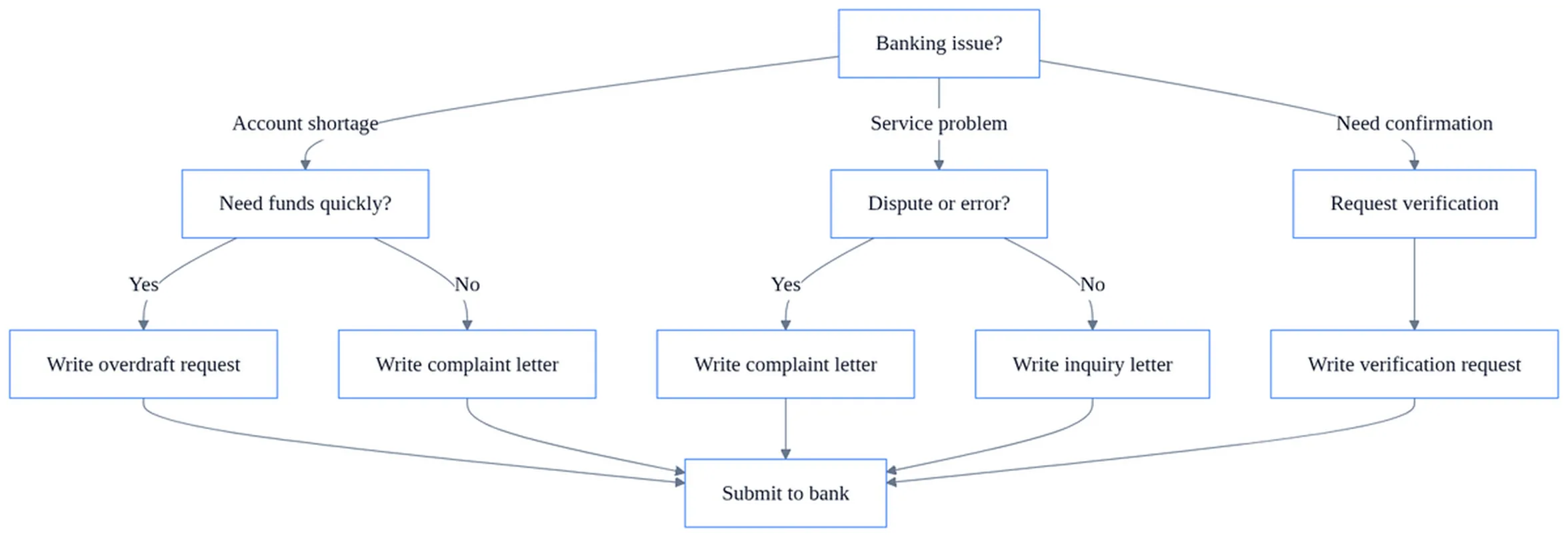
Banks require formal letters for several reasons. Written requests establish a clear paper trail when money changes hands or account terms shift. Regulatory bodies often mandate documentation for transactions above certain thresholds. A properly formatted letter also signals that you understand professional norms, which builds confidence when you’re asking for credit or disputing a charge.
Common scenarios requiring bank correspondence include overdraft or loan requests, account closure instructions, balance certificate requests for audits or visa applications, and formal complaints about unauthorised transactions or service failures. Each scenario demands slightly different language and supporting details, but all share the same foundation: clarity, specificity, and professional tone.
Bank letters follow the same business letter format and structure as other formal correspondence, but they emphasise numerical precision and relationship history more heavily. Where a sales letter might appeal to emotion, a bank letter appeals to facts.
Key elements that make bank letters effective
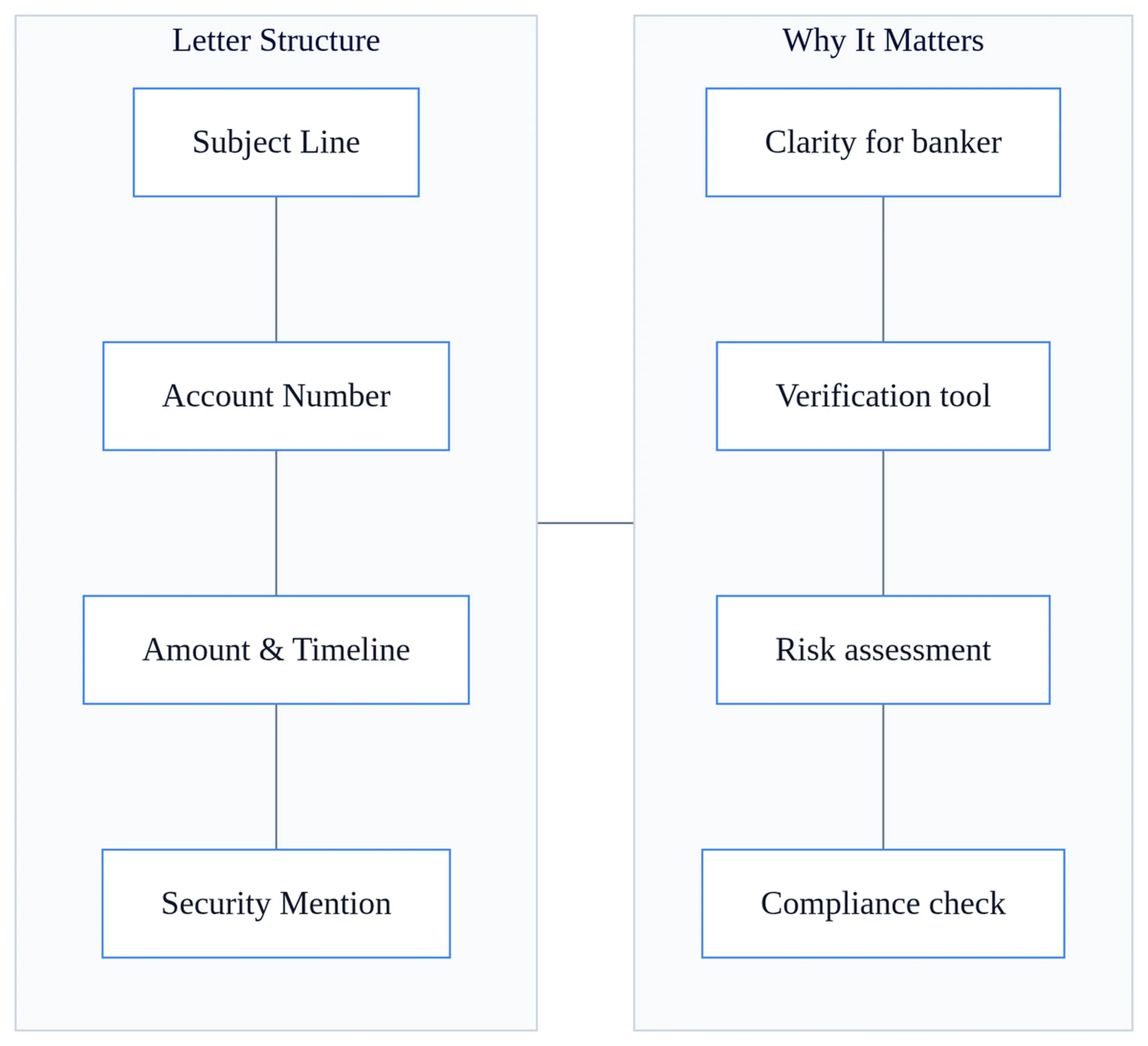
A subject line that states your request upfront saves the banker time. “Granting overdraft of Tk. 5,00,000/- against Current account No. 1616” tells the reader exactly what you need before they read a single paragraph. Vague subjects like “Urgent Request” or “Account Issue” get pushed to the bottom of the queue.
Account details matter more than you think. Include your account number, account type (current, savings, fixed deposit), and branch name in the opening paragraph. Banks handle thousands of accounts; making the officer hunt for your details slows approval and increases error risk.
Credibility markers separate approved requests from rejected ones. Mention how long you’ve held the account, whether you’ve borrowed before and repaid on time, and any stable deposit patterns. The overdraft specimen below references “satisfactorily since long ago” and a previous Tk. 3,00,000 overdraft that was “fully repaid in time.” These phrases do heavy lifting, they tell the banker you’re a known quantity, not a flight risk.
Specific amounts and timelines demonstrate planning. “I need money soon” fails. “Tk. 5,00,000 for three months” succeeds because it lets the bank assess risk, calculate interest, and schedule repayment. Precision signals competence.
Professional tone means respectful but direct language. No pleading (“I desperately need this loan”), no threats (“If you don’t approve this, I’ll close my account”), no casual phrases (“Can you hook me up with some cash?”). The formal vs. informal communication distinction is non-negotiable in banking.
Security or collateral mentions belong in overdraft and loan requests. Even a phrase like “against necessary security” shows you understand the bank needs protection. If you’re offering specific collateral, property deeds, fixed deposit receipts, inventory, list it clearly.
Specimen 1: Bank overdraft request letter (annotated)
Below is a complete overdraft request with annotations explaining why each element works. This specimen comes from a small trading firm in Sylhet that needed short-term working capital during a project ramp-up.
| Letter Section | Why It Works |
|---|---|
| Letterhead: M/s. Abul Hossain and Company, 34/3, Zinda Bazar, Sylhet. Phone: 654329 | Establishes legitimacy. A printed letterhead signals you’re a registered entity, not an individual making an impulsive request. |
| Reference date: October 30, 2019 | Creates a timeline for follow-up. If the bank doesn’t respond within a week, you can reference this date when you inquire. |
| Recipient: The Manager, Janata Bank, Zinda Bazar Branch, Sylhet | Addresses the decision-maker by title and location. Never use a generic “To Whom It May Concern” for financial requests. |
| Subject: Granting overdraft of Tk. 5,00,000/- against Current account No. 1616 | Front-loads the ask. The manager knows what you want before reading the body, which speeds internal routing. |
| “We are maintaining the above stated current account with your renowned bank satisfactorily since long ago.” | Establishes relationship length and positive history. “Satisfactorily” is banking code for “we’ve never bounced a check or overdrafted without permission.” |
| “Recently, we have invested a significant amount of fund in a medium-scaled engineering project.” | Explains why you need the overdraft without sounding desperate. The project framing suggests growth, not crisis. |
| “The project will go to its regular production by December 2011 and then we shall be able to overcome this crisis smoothly by the revenues generated from that project.” | Provides a repayment timeline and revenue source. Bankers want to know where the money to repay will come from. “Regular production” implies predictable cash flow. |
| “We have enjoyed an overdraft of tk. 3,00,000/= (Three lac) only from your bank against the same current account and have made full repayment of that loan in time.” | This is the credibility anchor. Previous borrowing + on-time repayment = low risk. Always mention past performance if you have it. |
| “We request your kind honor to grant us an overdraft of Tk. 5,00,000/-(Five lac) only for three months against necessary security.” | Reiterates the amount, duration, and security offer. The phrase “necessary security” signals you’re open to collateral discussions. |
| “Expecting your best cooperation” / “Sincerely Yours” / Signature with designation | Standard professional closing. The signature includes the proprietor’s name and company name, reinforcing accountability. |
What the banker is looking for: Can this customer repay? The letter addresses this by showing past repayment, explaining the temporary cash crunch, and projecting revenue from the new project. The mention of “necessary security” tells the bank they can mitigate risk with collateral.
One element most people miss: the letter frames the cash shortage as temporary and project-driven, not structural. A letter that said “We’re struggling to pay suppliers and need help” would trigger alarm. This one says “We’re growing and need bridge financing,” which is a completely different risk profile.
Specimen 2: Account verification or balance certificate request
Businesses and individuals often need balance certificates for loan applications, visa processing, audits, or tender submissions. These requests are straightforward, you’re not asking the bank to take risk, just to confirm facts.
Sample structure:
[Your letterhead]
[Date]
The Manager
[Bank Name]
[Branch Name and Address]
Subject: Request for Balance Certificate for Account No. [XXXXX]
Dear Sir/Madam,
I am maintaining a savings account (Account No. 987654321) with your branch since March 2018. I require a balance certificate as of [specific date] for submission to [purpose: e.g., “the Canadian High Commission for visa processing” or “our external auditors for annual financial review”].
Kindly issue the certificate at your earliest convenience. I am available to collect it in person or receive it via registered post at the address on file.
Thank you for your assistance.
Sincerely,
[Signature]
[Your Name]
[Contact Number]
Key phrases that work: “I am maintaining” (present tense shows active relationship), the specific account number, the exact purpose (banks need to know where the certificate is going for compliance reasons), and “at your earliest convenience” (polite but clear urgency).
Tone here is professional and brief. You don’t need to justify why you need the certificate or explain your financial history. The bank will verify your identity, check the account, and issue the document. Most branches process these requests within 2-3 business days if you provide all details upfront.
Specimen 3: Bank complaint or dispute letter
When verbal complaints fail or the issue is serious, unauthorised transactions, incorrect charges, service lapses, escalate to a formal letter. Written complaints create accountability and often trigger internal review processes that phone calls don’t.
Sample structure:
[Your letterhead or return address]
[Date]
The Branch Manager
[Bank Name]
[Branch Address]
Subject: Complaint Regarding Unauthorised Debit of Tk. 25,000 from Account No. [XXXXX]
Dear Sir/Madam,
I hold a current account (No. 112233445) with your branch. On reviewing my statement dated September 15, 2023, I noticed an unauthorised debit of Tk. 25,000 on September 12, 2023, with the narration “POS Transaction – [Merchant Name].”
I did not authorise this transaction. My debit card was in my possession throughout this period, and I have not shared my PIN or card details with anyone. I reported this discrepancy to your customer service desk on September 16, 2023 (reference number CS-2023-9876), but have not received a resolution.
This unauthorised debit has caused significant disruption to my business cash flow. I request that you:
- Reverse the Tk. 25,000 debit immediately
- Investigate how this transaction was processed without my authorisation
- Provide a written explanation within seven working days
I have attached a copy of my account statement highlighting the disputed transaction. I am available for any further verification you require.
I trust you will resolve this matter promptly.
Sincerely,
[Signature]
[Your Name]
[Contact Number]
What makes this effective: The letter is firm but not hostile. It provides the incident date, transaction amount, and reference number from the earlier verbal complaint. It states the impact (“disruption to my business cash flow”) without dramatics. The numbered list of requested actions makes it easy for the bank to respond point-by-point.
Avoid accusatory language like “Your bank has stolen my money” or emotional appeals like “I’m devastated by this.” Stick to facts, timelines, and clear requests. Banks respond faster to calm, documented complaints than to angry rants.
Common mistakes in bank correspondence and how to avoid them
Vague requests sink more applications than bad credit. “I need a loan” tells the banker nothing. “I request a term loan of Tk. 10,00,000 for 24 months to purchase inventory for our retail expansion” gives them something to evaluate. Specificity signals that you’ve thought through the numbers.
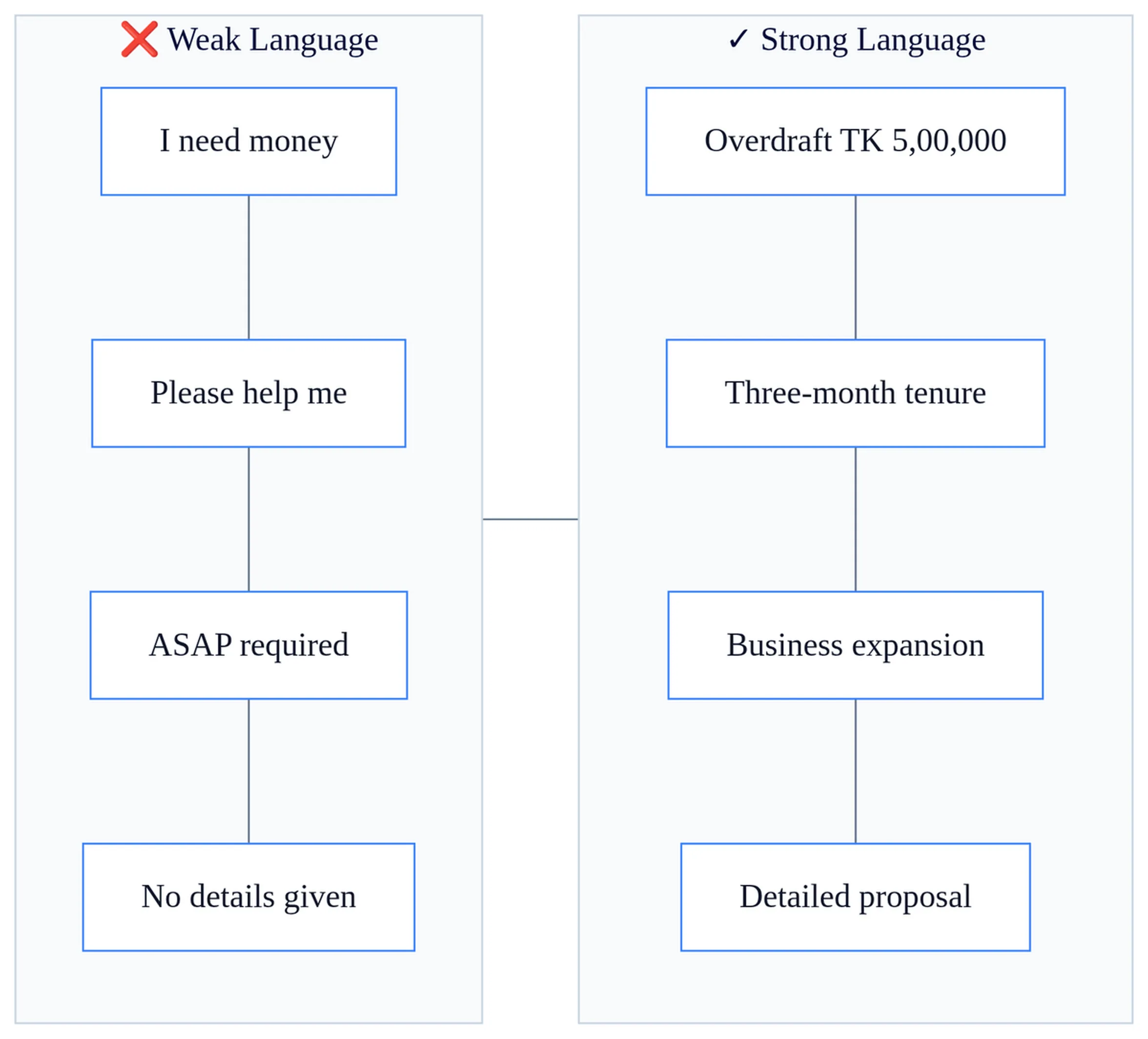
Emotional or accusatory language damages your credibility. Phrases like “Your incompetent staff” or “I’m shocked and appalled” put the reader on the defensive. Even if you’re furious about a service failure, keep the tone professional. State the problem, the impact, and the resolution you expect.
Missing account details or letterhead make you look careless.
If the bank has to call you to ask for your account number, you’ve already signaled that you don’t take the request seriously. Use a proper letterhead if you’re writing on behalf of a business. If you’re an individual, include your full name, address, and contact number at the top.
Overstating your financial position backfires during verification. If you claim your business has “always maintained a healthy balance” but the bank’s records show frequent overdrafts, you’ve just torpedoed your credibility. Be honest about challenges and frame them as temporary or project-specific.
Submitting informal emails instead of formal letters for major requests is a growing mistake. A quick email works for balance inquiries or branch hour questions. It doesn’t work for loan applications, account closures, or formal disputes. When the stakes are high, format matters. Follow the parts of a business letter structure and submit a properly formatted document.
Tone and language expectations in banking vs. general business letters
Banks expect conservative, formal language. Slang, contractions, and casual phrases that might fly in a marketing email will get you flagged as unprofessional. Write “I request” instead of “I’d like,” “we have maintained” instead of “we’ve kept,” and “at your earliest convenience” instead of “ASAP.”
Facts and figures matter more than persuasion. A sales letter might build emotional appeal before revealing the price. A bank letter leads with numbers: the amount you need, the account you’re referencing, the date the problem occurred. Bankers read dozens of letters daily; they skim for data points. Bury the numbers in flowery language and you’ve wasted their time.
Respect for hierarchy is non-negotiable. Always address the branch manager or relevant officer by title. “Dear Sir/Madam” is acceptable if you don’t know the name. “Hey” or “Hi there” is not. In South Asian banking culture especially, formal address signals respect and increases the likelihood of a favorable response.
Brevity is valued. A 300-word letter beats a 1,000-word essay. State your request, provide necessary context, and close. Don’t rehash your entire banking relationship unless it’s directly relevant to the current ask. The written communication principles of clarity and conciseness apply doubly in banking.
Digital vs. formal letter submission: what banks expect today
When to email versus print and submit in person depends on the request’s significance and your bank’s policies. Balance certificate requests and minor inquiries often work via email. Overdraft applications, loan requests, and formal complaints usually require printed letters on letterhead, signed in ink, and submitted at the branch.
If your bank accepts email submissions, format matters. Attach the letter as a PDF, not a Word document. Use a formal subject line: “Overdraft Request – Account No. 1616 – Abul Hossain and Company.” The email body should be brief: “Dear Sir/Madam, Please find attached my formal request for an overdraft facility. I am available to provide any additional documentation you require. Sincerely, [Name].”
Signature requirements vary. Some banks accept scanned signatures on emailed PDFs. Others require a wet signature on paper. For high-value requests, assume you’ll need to submit the original in person. Call your branch to confirm their process before you send anything.
Record-keeping protects you. Keep a copy of every letter you send, whether digital or printed. Note the date and method of submission. If you hand-deliver a letter, ask for a stamped acknowledgment copy. If you email, save the sent message. When disputes arise months later, your records become evidence. Maintaining correspondence files is standard practice across industries, but it’s especially critical in banking where transactions and timelines matter legally.
For those learning how to write a professional business letter, bank correspondence offers excellent practice because the stakes are real and the feedback is immediate, you either get the overdraft, certificate, or resolution, or you don’t.
Most people over-rely on charm or persuasive language in bank letters. That approach works in sales. In banking, the numbers and your track record do the talking. Use the specimens above as templates, adapt the language to your situation, and proofread twice before submission. A well-crafted letter won’t guarantee approval, but a sloppy one guarantees delay.
Frequently asked questions
Should I send a bank letter by email or printed mail?
Printed mail is safer for formal requests like overdrafts or complaints. Email works for routine inquiries, but banks often require original signatures on financial documents for legal compliance. Check your bank’s website or call ahead—some now accept scanned PDFs, but others still demand physical copies. When in doubt, print and mail.
What if I don’t have a long account history to reference?
Focus on what you do have. Mention consistent deposit patterns, any previous small loans you repaid on time, or a co-signer with stronger history. If truly new, emphasize stability: steady employment, property ownership, or business registration. Banks assess risk differently for new accounts, so lead with facts that offset short tenure.
Can I use a bank letter template word-for-word or must I customize it?
Customize it. Templates show structure, but bankers spot generic letters instantly—they signal you didn’t think through your specific request. Change account numbers, amounts, timelines, and reasons to match your situation. A personalized letter takes 15 minutes and dramatically improves approval odds.
What happens if I mention collateral I can’t actually provide?
Don’t. Banks verify collateral before approving. If you claim a property deed or fixed deposit and can’t produce it, the bank rejects the request and flags your account as unreliable. Only list collateral you own outright and can hand over immediately if needed.
Is it acceptable to follow up with a phone call after sending a bank letter?
Yes, after 5-7 business days. A brief call confirms receipt and shows genuine interest, but don’t pressure. Say: “I sent a letter on [date] regarding [subject]. Has it reached your desk?” This is professional follow-up, not pestering. Avoid calling the same day you mail.
Should I explain a past overdraft or missed payment in my letter?
Only if the bank will discover it anyway. If you do address it, be brief and factual: “We experienced a temporary cash flow delay in 2018 due to [specific reason], which we resolved within 30 days.” Then pivot to current stability. Never volunteer problems unprompted—let the bank ask.