


Close Menu
The Business CommunicationThe Business Communication
    What's Hot

    Memo vs. Business Letter: Key Differences & When to Use Which

    December 3, 2025

    Mastering Negotiation Skills: The Role of Oral Communication

    December 2, 2025

    Non-Verbal Cues: How Body Language Impacts Oral Communication

    December 2, 2025
    Facebook X (Twitter)
    The Business CommunicationThe Business Communication
    Button
    • Basics
      1. Introduction
      2. Communication Skills
      3. Modern Communication
      4. View All

      Types of Communication: A Complete Guide to Classifications & Methods

      October 7, 2025

      Qualities of good communication | Requirements of effective communication

      September 26, 2025

      Business Communication Roles: Key Functions And Examples

      September 9, 2025

      What is Communication Process? Steps And Examples Explained

      September 7, 2025

      Meaning Of Cross-Cultural Communication

      October 19, 2025

      8 Ways To Improve Your Listening Skills

      August 11, 2025

      Various Styles Reading or Techniques of Reading

      July 6, 2025

      What Is Communication Style | Classification Of Communication Style

      March 16, 2025

      What Is The Video Conference? Advantages & Disadvantages of Video Conferencing

      April 30, 2025

      Advantages And Disadvantages Of Satellite Television In Business Communication

      November 16, 2024

      What Is Voicemail? Advantages and Disadvantages Of Voicemail

      October 13, 2024

      What Is Communication Satellite?

      August 12, 2024

      Memo vs. Business Letter: Key Differences & When to Use Which

      December 3, 2025

      Mastering Negotiation Skills: The Role of Oral Communication

      December 2, 2025

      Non-Verbal Cues: How Body Language Impacts Oral Communication

      December 2, 2025

      Glossophobia: How to Overcome the Fear of Public Speaking

      December 2, 2025
    • Forms of Communication
      • Oral Communication
      • Non-Verbal Communication
      • Report Writing
    • Written Communication
      1. Letter Writing
      2. Circular Letter
      3. inquiry letter
      4. Ultimatum Letter
      Featured
      Letter Writing

      Memo vs. Business Letter: Key Differences & When to Use Which

      By Masudur RashidDecember 3, 2025
      Recent

      Memo vs. Business Letter: Key Differences & When to Use Which

      December 3, 2025

      Advantages and Disadvantages of Business Letter: A Comprehensive Analysis

      October 20, 2025

      Inquiry Letter for Job Vacancy (Samples & Email Scripts)

      October 19, 2025
    • In Business
      1. Company Meeting
      2. Secretarial Functions
      3. View All

      Virtual Meetings for Companies: Tools, Etiquette & Challenges

      October 19, 2025

      Participants Responsibilities in Meeting

      October 7, 2025

      Meaning of Company Secretary | Appointment of Company Secretary

      May 29, 2025

      What is Annual Business Report – The Business Communication

      January 22, 2025

      What is Secretary? Types of secretary

      January 21, 2025

      What Is Organizational Communication – Types of Organizational Communication

      December 18, 2024

      Functions of a Private Secretary

      April 21, 2024

      Qualifications of a Private Secretary

      October 4, 2023

      Memo vs. Business Letter: Key Differences & When to Use Which

      December 3, 2025

      Mastering Negotiation Skills: The Role of Oral Communication

      December 2, 2025

      Non-Verbal Cues: How Body Language Impacts Oral Communication

      December 2, 2025

      Glossophobia: How to Overcome the Fear of Public Speaking

      December 2, 2025
    • Internal Communication
      1. Downward Communication
      2. Horizontal Communication
      3. Upward Communication
      4. View All

      Essential Elements of Downward Communication: A Complete Guide for Managers

      August 17, 2025

      Key Objectives of Downward Communication in an Organization

      June 26, 2025

      The Effectiveness of Downward Communication: Factors, Barriers, and Measurement

      April 13, 2025

      Advantage And Disadvantages of downward communication

      April 10, 2025

      Upward vs Downward vs Horizontal Communication: Key Differences

      December 19, 2024

      Differences Between Horizontal and Vertical Communication

      September 21, 2024

      What is Horizontal Communication: Definition, Examples & Importance

      March 15, 2024

      Importance of Horizontal Communication (With Real-Life Examples)

      December 28, 2023

      Psychological Safety & Upward Communication: Building Trust at Work

      October 25, 2025

      Common Barriers to Effective Upward Communication and Solutions

      October 15, 2025

      Future of Upward Communication in Remote/Hybrid Workplaces

      May 29, 2025

      Upward vs Downward vs Horizontal Communication: Key Differences

      December 19, 2024

      Memo vs. Business Letter: Key Differences & When to Use Which

      December 3, 2025

      Mastering Negotiation Skills: The Role of Oral Communication

      December 2, 2025

      Non-Verbal Cues: How Body Language Impacts Oral Communication

      December 2, 2025

      Glossophobia: How to Overcome the Fear of Public Speaking

      December 2, 2025
    The Business CommunicationThe Business Communication
    Home » Interview » How to Prepare for an Interview: Step-by-Step Guide for Candidates

    How to Prepare for an Interview: Step-by-Step Guide for Candidates

    By Saiful IslamNo Comments7 Mins Read Interview
    Facebook Twitter Reddit WhatsApp Telegram Pinterest LinkedIn Email
    Share
    Facebook Twitter Pinterest WhatsApp Email

    Have you ever walked out of an interview thinking, “I could have done better”? You’re not alone. Most candidates lose opportunities not because they lack skills, but because they weren’t properly prepared.

    So, if you’re wondering how to prepare for an interview, you’ve landed in the right place. This step-by-step guide will walk you through everything — from research to follow-up — so you can impress employers with confidence and professionalism.

    Understanding the Purpose of an Interview

    Before learning how to prepare, it’s important to understand why interviews exist. Employers don’t just want to test your knowledge; they want to see how you think, communicate, and behave under pressure.

    In short, interviews reveal who you really are beyond your resume. If you want to understand the deeper purpose behind interviews, read our post on Interview Definition and Purpose. It explains how interviews help both the employer and candidate make the right decision.

    So, now that you know why interviews matter, let’s explore how to prepare like a pro!
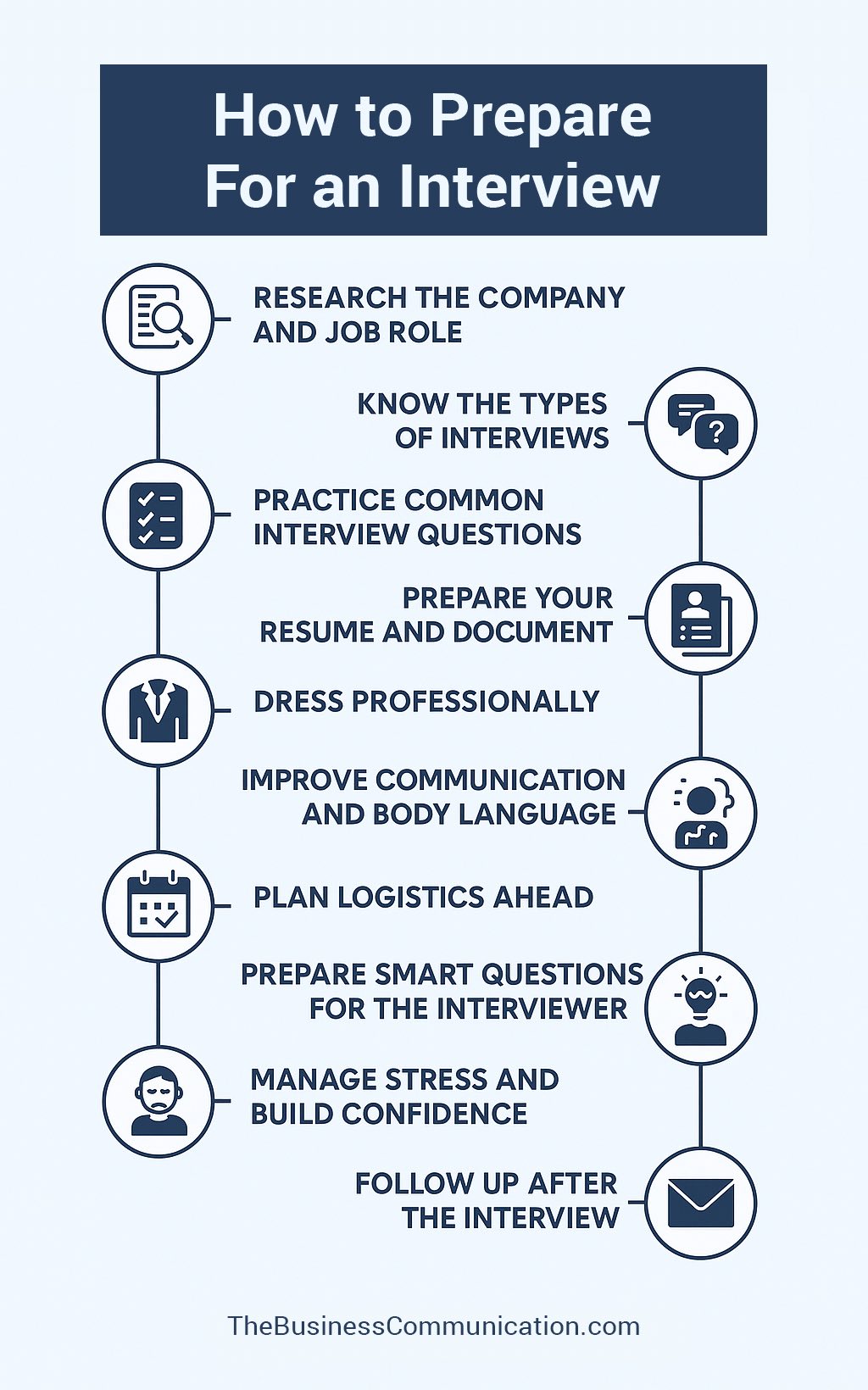
    Prepare for an Interview

    Step 1: Research the Company and Job Role

    Imagine showing up to an interview and not knowing what the company does. That’s like going to a wedding without knowing who’s getting married!

    Start by visiting the company’s website. Learn about its mission, vision, products, and recent news. Check the “About Us” and “Careers” pages. Also, browse their social media profiles for the latest updates.

    Why It Matters

    When you understand the company’s goals, you can tailor your answers to fit their expectations. For example, if the company values teamwork, you can highlight times you worked well in a team.

    To see how research fits into the bigger picture, check our detailed guide on The Complete Interview Process: From Application to Offer.

    Step 2: Know the Different Types of Interviews

    Did you know that not all interviews are conducted the same way? Some are structured, while others feel like friendly conversations. Each type requires a slightly different approach.

    Here are a few examples:

    • Structured Interviews: Fixed questions and scoring systems.
    • Panel Interviews: Multiple interviewers asking questions.
    • Group Interviews: Several candidates assessed together.
    • Technical Interviews: Focused on skills and expertise.

    You can explore all of these in our post on Different Types of Interviews. Understanding the format in advance helps you prepare both mentally and strategically.

    Step 3: Practice Common Interview Questions

    Let’s be honest — most interviewers ask similar questions. The challenge is answering them naturally. Here are some you’ll almost always hear:

    1. Tell me about yourself.
    2. Why do you want to work here?
    3. What are your strengths and weaknesses?
    4. Where do you see yourself in five years?
    5. Why should we hire you?

    How to Answer Effectively

    Use the STAR method:

    • Situation: Describe the context.
    • Task: Explain your role.
    • Action: Share what you did.
    • Result: End with the outcome.

    Practicing these questions will help you sound confident instead of rehearsed. To improve your overall strategy, visit Guidelines for Facing Employment Interview. It’s packed with practical tips to build composure and clarity.

    Step 4: Prepare Your Resume and Documents

    Think of your resume as your ticket to the interview. But even the best tickets get rejected if they’re messy or incomplete.

    Checklist Before You Go

    • Carry multiple printed copies of your resume.
    • Attach your cover letter and reference list.
    • Keep academic and experience certificates in a clean folder.

    If you’re unsure how to structure your resume, refer to our detailed post on Format and Contents of Resume. A clean, error-free resume shows professionalism and attention to detail.

    Step 5: Dress Professionally

    What you wear says a lot about you before you even speak. Dressing right is one of the simplest yet most powerful interview preparation steps.

    Tips for Dressing Smartly

    • For corporate jobs, choose formal attire like a suit or blazer.
    • For creative roles, opt for smart casuals.
    • Avoid flashy jewelry, strong perfume, or casual footwear.

    For a detailed guide, visit What to Wear for Interview. Remember, your outfit should make you look confident, not uncomfortable.

    Step 6: Improve Your Communication and Body Language

    Good communication can win hearts, and good body language can win jobs. Employers often notice how you speak, listen, and carry yourself.

    Communication Tips

    • Maintain eye contact but don’t stare.
    • Smile genuinely, not constantly.
    • Sit straight, with relaxed shoulders.
    • Avoid crossing your arms or fidgeting.

    Understanding body language is vital, and our post on Importance of Non-Verbal Communication will help you master this art.

    Step 7: Plan Logistics Ahead

    You might have the best answers and the best suit, but showing up late can ruin it all.

    Checklist Before the Big Day

    • Confirm the interview time and location.
    • Plan your route and check travel time.
    • Keep an extra copy of your resume handy.
    • Charge your phone and keep important contacts saved.

    If it’s an online interview, test your camera, internet, and lighting. A smooth setup makes you look organized and reliable.

    Step 8: Prepare Smart Questions for the Interviewer

    An interview isn’t a one-way street. Asking smart questions shows that you’re serious about the role.

    Examples of Good Questions

    • What does a typical day look like in this position?
    • How does your company measure success?
    • What qualities do you value most in employees?

    Avoid asking about salary or vacation too early. Instead, show curiosity about growth, learning, and teamwork. It’s one of the easiest ways to stand out.

    Step 9: Manage Stress and Build Confidence

    It’s normal to feel nervous before an interview. Even experienced professionals get butterflies!

    Tips to Calm Your Mind

    • Take slow, deep breaths.
    • Visualize a successful interview.
    • Prepare positive affirmations like, “I am ready and confident.”

    To learn more about what contributes to interview success, visit Conditions of the Success of an Interview. Confidence grows when preparation meets positivity.

    Step 10: Follow Up After the Interview

    Once your interview is over, don’t just wait silently. A thoughtful follow-up can make a lasting impression.

    How to Write a Thank-You Message

    Send a short email within 24 hours. Thank the interviewer for their time and restate your interest in the role.

    Here’s a quick example:

    “Dear [Interviewer’s Name],

    Thank you for the opportunity to discuss the [Position] role today. I truly enjoyed our conversation and remain very interested in joining your team.

    Best regards,
    [Your Name].”

    You can get more examples in our post on Business Thank-You Letter to Clients.

    Common Mistakes to Avoid

    Even the most prepared candidates make small mistakes. Let’s avoid them!

    • Not researching the company enough.
    • Talking too much or interrupting.
    • Arriving late or overconfident.
    • Forgetting to switch off your phone.
    • Dressing inappropriately.

    And of course, don’t forget basic manners — politeness never goes out of fashion.

    Bonus Tips for Long-Term Career Growth

    Preparing for an interview doesn’t end with one session. Keep improving your skills regularly.

    • Join workshops or webinars related to your field.
    • Improve your writing and speaking ability.
    • Build strong professional connections.
    • Stay updated with industry news.

    Interviews are not just tests; they’re opportunities to grow. So, treat each one as a learning experience, not just a judgment day.

    Conclusion

    Preparing for an interview might feel overwhelming, but once you follow these steps, it becomes a manageable, even exciting, journey. From researching the company to practicing your answers and dressing well, every detail adds up.

    Think of it this way: preparation isn’t about memorizing, it’s about becoming the best version of yourself.

    If you’d like to take your readiness even further, check out our helpful guide on Interview Etiquette: Do’s and Don’ts for Candidates. Combine etiquette with preparation, and you’ll walk into every interview with unstoppable confidence.

    Good luck — your dream job is waiting for you!

    Good Interviewer
    Share. Facebook Twitter Pinterest LinkedIn WhatsApp Reddit Email
    Previous ArticleThe Complete Interview Process: From Application to Offer
    Next Article 7 Major Mass Communication Theories Every Marketer Should Know
    Saiful Islam
    • Website

    👋 Hi, I am Saiful Islam. I completed my Honors and Masters in Management, and I enjoy writing about Business Communication. Here, I share practical insights and ideas to help readers improve their professional and academic communication skills.

    Related Posts

    Interview 419 Mins Read

    Advantages and Disadvantages of Interview in Communication

    Interview 419 Mins Read
    Interview 17 Mins Read

    Different Types of Interviews: Structured, Unstructured, Panel And More

    Interview 17 Mins Read
    Letter Writing 18 Mins Read

    What Is Interview Letter? Meaning, Format & Examples

    Letter Writing 18 Mins Read
    Interview 15 Mins Read

    What to Wear for Interview [Guide For Men and Women)

    Interview 15 Mins Read
    Add A Comment
    Leave A Reply Cancel Reply

    This site uses Akismet to reduce spam. Learn how your comment data is processed.

    Subscribe to Updates

    Get the latest business communication news from TBC.

    By signing up, you agree to the our terms and our Privacy Policy agreement.

    Check your inbox or spam folder to confirm your subscription.

    Top Picks

    Types of Communication: A Complete Guide to Classifications & Methods

    Communication is the invisible glue that holds our world together. Whether you are ordering a…

    Qualities of good communication | Requirements of effective communication

    Whenever the sender and also recipient understand the meaning connected with communication virtually just as,…

    Business Communication Roles: Key Functions And Examples

    In every workplace, communication is the glue that holds everything together. It connects teams, builds…

    What is Communication Process? Steps And Examples Explained

    Have you ever played the “telephone game” as a child? Someone whispers a message, and…

    Welcome to TheBusinessCommunication.com, your guide to clear and effective business communication. Here you will find simple lessons on report writing, letters, meetings, oral and written communication, and modern tools like email or virtual meetings. Our mission is to make learning communication easy, practical, and fun, so you can apply it in your studies, career, and everyday life.
    We're social. Connect with us:

    Facebook X (Twitter) YouTube LinkedIn RSS
    Top Insights

    Memo vs. Business Letter: Key Differences & When to Use Which

    Mastering Negotiation Skills: The Role of Oral Communication

    Non-Verbal Cues: How Body Language Impacts Oral Communication

    Subscribe to Updates

    Get the latest business communication news from TBC.

    By signing up, you agree to the our terms and our Privacy Policy agreement.

    Check your inbox or spam folder to confirm your subscription.

    Copyright © 2025 TheBusinessCommunication. All Rights Reserved.
    • Home
    • About Us
    • Contact US
    • Our Authors
    • Privacy Policy
    • Terms and Conditions

    Type above and press Enter to search. Press Esc to cancel.