


Close Menu
The Business CommunicationThe Business Communication
    What's Hot

    Problems of Electronic Communication In Business

    October 23, 2025

    Objectives of Business Communication: Strategic Goals for Modern Organizations

    October 18, 2025

    Leadership Styles That Encourage Employees to Speak Up

    October 11, 2025
    Facebook X (Twitter)
    The Business CommunicationThe Business Communication
    Button
    • Basics
      1. Introduction
      2. Communication Skills
      3. Modern Communication
      4. View All

      Objectives of Business Communication: Strategic Goals for Modern Organizations

      October 18, 2025

      Factors influencing the meaning of business communication

      May 20, 2025

      Scope of communication

      April 6, 2025

      The Strategic Role of Communication in Management: Driving Organizational Success

      March 27, 2025

      8 Ways To Improve Your Listening Skills

      September 17, 2025

      Various Styles Reading or Techniques of Reading

      March 30, 2025

      What Is Communication Style | Classification Of Communication Style

      May 27, 2023

      Meaning Of Cross-Cultural Communication

      November 25, 2022

      Problems of Electronic Communication In Business

      October 23, 2025

      Advantages and Disadvantages of Email in Modern Business Communication

      June 28, 2025

      What Is Communication Satellite?

      December 24, 2024

      What Is Multimedia In Communication || Importance Of Multimedia

      October 4, 2024

      Problems of Electronic Communication In Business

      October 23, 2025

      Objectives of Business Communication: Strategic Goals for Modern Organizations

      October 18, 2025

      Leadership Styles That Encourage Employees to Speak Up

      October 11, 2025

      Upward Communication Case Study: Examples from Tech, Healthcare & Education

      October 10, 2025
    • Forms of Communication
      • Oral Communication
      • Non-Verbal Communication
      • Report Writing
    • Written Communication
      1. Letter Writing
      2. Circular Letter
      3. inquiry letter
      4. Ultimatum Letter
      Featured
      Letter Writing

      How to Write an Effective Circular Letter: Step by Step Guide

      By Masudur RashidSeptember 27, 2025
      Recent

      How to Write an Effective Circular Letter: Step by Step Guide

      September 27, 2025

      Difference Between Official Letter and Business Letter: Key Distinctions Explained

      August 18, 2025

      College Admission Inquiry Email – Samples

      August 16, 2025
    • In Business
      1. Company Meeting
      2. Secretarial Functions
      3. View All

      Meaning of Company Secretary | Appointment of Company Secretary

      May 6, 2025

      Participants Responsibilities in Meeting

      January 28, 2025

      How to Facilitate Productive Project Meetings

      January 22, 2025

      The Ultimate Company Meeting Guide: Definition, Types, Process, Advantages & Disadvantages

      October 22, 2024

      Functions of a Private Secretary

      August 12, 2025

      What Is Organizational Communication – Types of Organizational Communication

      December 7, 2024

      Qualifications of a Private Secretary

      May 5, 2024

      What is Secretary? Types of secretary

      March 6, 2024

      Problems of Electronic Communication In Business

      October 23, 2025

      Objectives of Business Communication: Strategic Goals for Modern Organizations

      October 18, 2025

      Leadership Styles That Encourage Employees to Speak Up

      October 11, 2025

      Upward Communication Case Study: Examples from Tech, Healthcare & Education

      October 10, 2025
    • Internal Communication
      1. Downward Communication
      2. Horizontal Communication
      3. Upward Communication
      4. View All

      Essential Elements of Downward Communication: A Complete Guide for Managers

      September 13, 2025

      Types of Vertical Communication: Upward and Downward Communication Explained

      May 18, 2025

      What is downward communication? [Objectives and Methods]

      January 1, 2024

      Advantage And Disadvantages of downward communication

      December 23, 2023

      What is Horizontal Communication: Definition, Examples & Importance

      January 21, 2025

      Importance of Horizontal Communication (With Real-Life Examples)

      November 26, 2023

      Upward vs Downward vs Horizontal Communication: Key Differences

      December 24, 2022

      Advantages and Disadvantages of Horizontal Communication (With Real Examples)

      October 15, 2022

      Leadership Styles That Encourage Employees to Speak Up

      October 11, 2025

      Upward Communication Case Study: Examples from Tech, Healthcare & Education

      October 10, 2025

      Types of Vertical Communication: Upward and Downward Communication Explained

      May 18, 2025

      Psychological Safety & Upward Communication: Building Trust at Work

      October 8, 2024

      Problems of Electronic Communication In Business

      October 23, 2025

      Objectives of Business Communication: Strategic Goals for Modern Organizations

      October 18, 2025

      Leadership Styles That Encourage Employees to Speak Up

      October 11, 2025

      Upward Communication Case Study: Examples from Tech, Healthcare & Education

      October 10, 2025
    The Business CommunicationThe Business Communication
    Home » Introduction » Effective Communication: Definition, Essential Qualities, and Requirements

    Effective Communication: Definition, Essential Qualities, and Requirements

    By Masudur RashidNo Comments8 Mins Read Introduction
    Facebook Twitter Reddit WhatsApp Telegram Pinterest LinkedIn Email
    Share
    Facebook Twitter Pinterest WhatsApp Email

    Have you ever explained an idea to someone, only to have them look at you with total confusion? Or perhaps you sent an email that you thought was polite, yet the receiver felt offended. We have all been there. It is frustrating.

    We speak, write, and gesture every single day. Yet, many of us struggle to get our true message across. This is where the difference between simply talking and effectively communicating lies.

    Effective communication is the glue that holds businesses, relationships, and teams together. It is not just about vocabulary or grammar. Rather, it is about connection.

    In this guide, we will dive deep into what effective communication really means. We will explore its essential qualities and the requirements you need to master it. Let’s get started.

    What is Effective Communication?

    Most people think communication is just exchanging words. However, effective communication goes much deeper than that. It is the process of exchanging ideas, thoughts, opinions, knowledge, and data so that the message is received and understood with clarity and purpose.

    Think of it this way. If you speak, but the other person misunderstands your intent, you have not effectively communicated. You have just made noise.
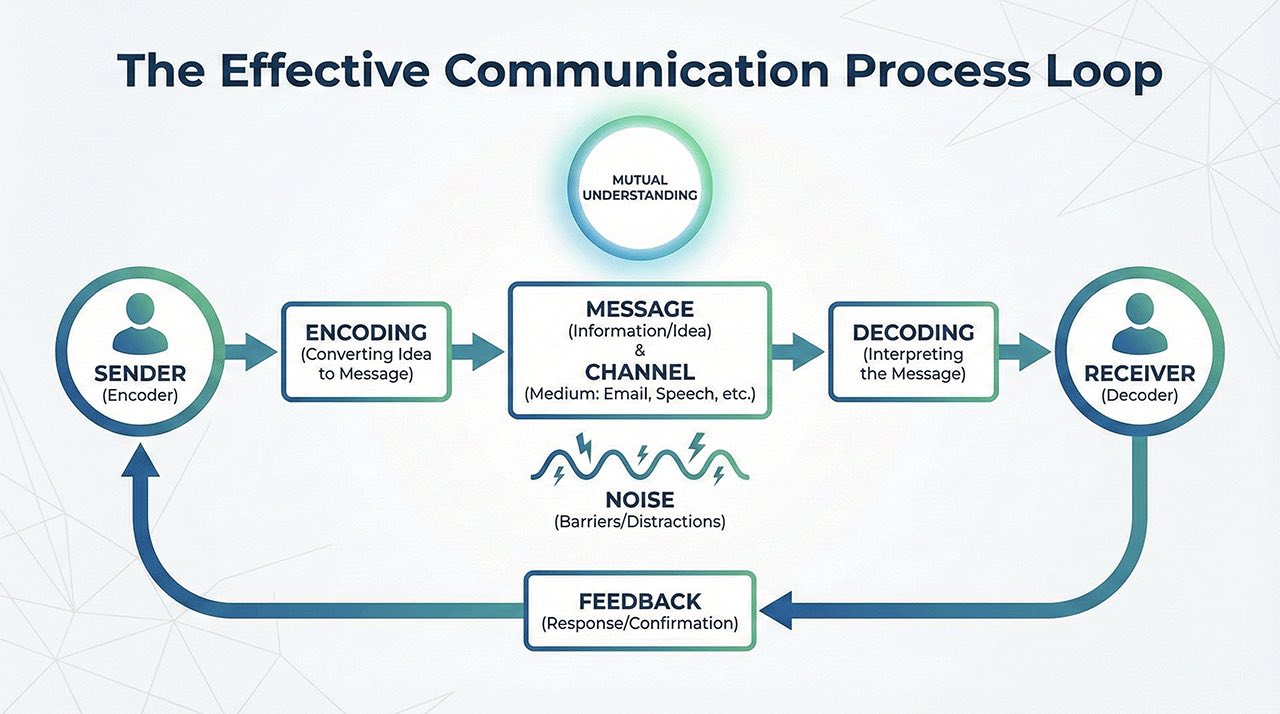
    Effective Communication Process

    The core objective here is mutual understanding. The sender and the receiver must be on the same page. When communication is effective, both parties feel heard and understood.

    It involves a loop. You encode a message, transmit it, the other person decodes it, and then they provide feedback. If any part of these communication cycle steps breaks down, the whole process fails.

    So, effective communication is about more than just information. It is about understanding the emotion and intentions behind the information.

    Why is Effective Communication Important?

    You might wonder why we are making such a big deal out of this. Can’t we just talk? Well, poor communication is expensive. It costs businesses money and costs individuals their relationships.

    Building Trust

    Trust is the foundation of any relationship. Whether it is with your boss, your spouse, or your client, honest and clear communication builds trust. When people understand you, they are more likely to trust your leadership and your decisions.

    Conflict Resolution

    Misunderstandings fuel conflict. A simple comment can turn into a major argument if not delivered or received correctly. Conversely, effective communication acts as a bridge. It helps resolve issues before they blow up.

    Team Engagement

    In a business setting, clear direction is vital. Employees who know exactly what is expected of them perform better. They feel more engaged. Above all, it boosts morale when team members feel safe expressing their ideas.

    10 Essential Qualities of Good Communication

    What makes a great communicator? Is it their voice? Their confidence? While those help, the true qualities of good communication are often more subtle.
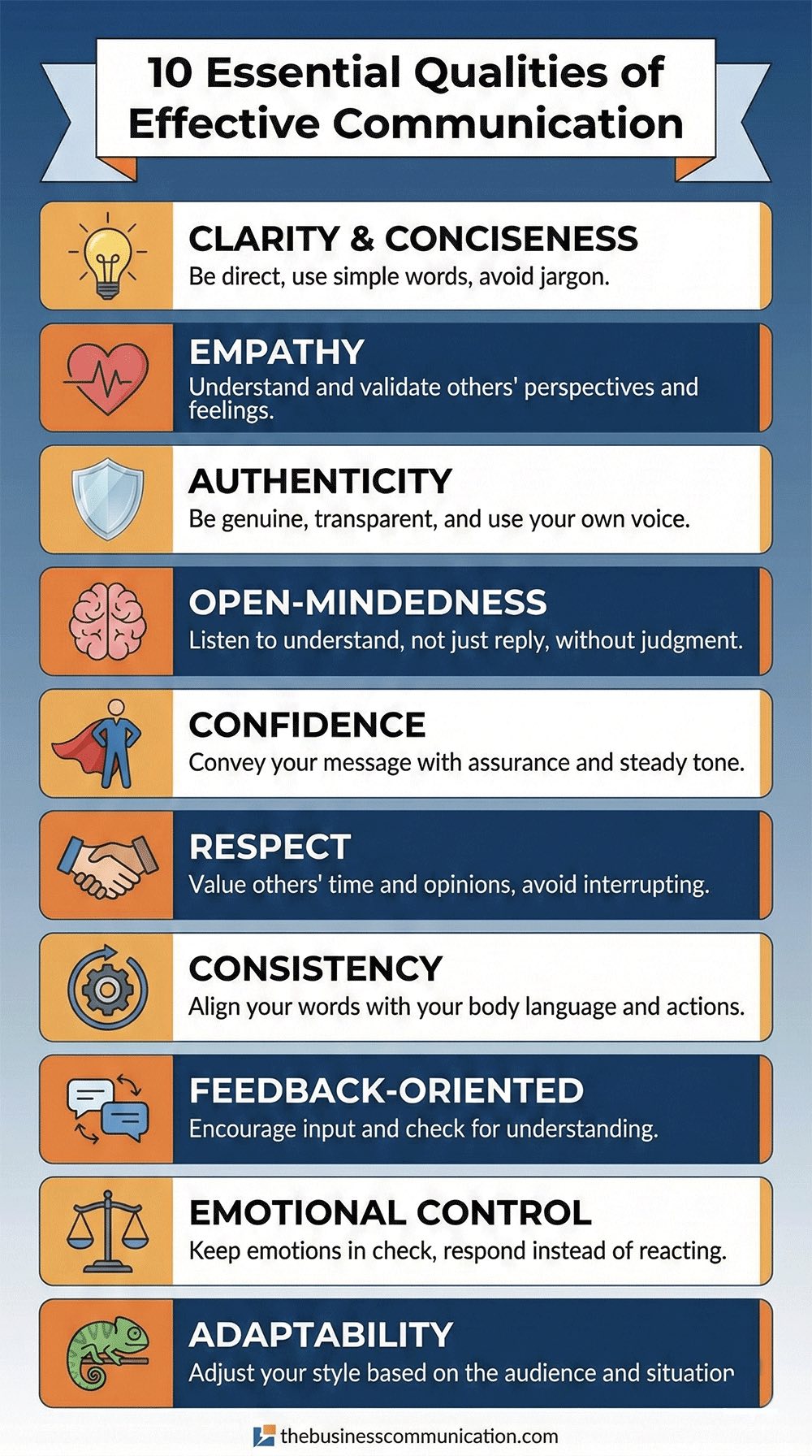
    Essential Qualities of Effective Communication

    Here are the 10 traits you should cultivate.

    1. Clarity and Conciseness

    Time is precious. No one wants to read a five-page email that could have been three sentences. Be direct. Use simple words.

    Avoid jargon that confuses people. If you can say it in fewer words, do it. This aligns perfectly with the standard 7 Cs of communication, which emphasize being clear and correct.

    2. Empathy

    This is a superpower. Empathy means you can see things from the other person’s perspective. You understand their pain points and their emotions.

    When you communicate with empathy, you are not just pushing your agenda. Instead, you are validating their feelings. This creates an instant connection.

    3. Authenticity

    People can spot a fake from a mile away. Be yourself. Authentic communication means being genuine and transparent.

    You do not need to sound like a corporate robot. Use your own voice. Honest communication fosters respect and makes people want to listen to you.

    4. Open-mindedness

    Are you listening to understand, or are you listening to reply? Good communicators enter conversations with an open mind.

    They are willing to listen to opposing views without getting defensive. Regardless of your personal opinion, giving others the space to speak is crucial.

    5. Confidence

    Confidence compels people to listen. It is not about arrogance or being the loudest person in the room.

    It is about conveying your message with assurance. Making eye contact, using a steady tone, and sitting up straight all signal confidence. If you believe in what you are saying, others will too.

    6. Respect

    You must respect the other person’s time and intelligence. Do not interrupt them while they are speaking.

    Even if you disagree, do it respectfully. A respectful tone keeps the door open for future interactions. Otherwise, you risk burning bridges.

    7. Consistency

    Imagine a boss who says “I value your input” but then rolls their eyes when you speak. That is inconsistent.

    Your words must match your body language and your actions. Inconsistent messaging confuses people. We often look at non-verbal cues more than we listen to words. Make sure they align.

    8. Feedback-Oriented

    Communication is a two-way street. A good communicator always checks for understanding.

    Ask questions like, “Does that make sense?” or “What are your thoughts on this?” Encourage the other person to give you input. This ensures the message landed correctly.

    9. Emotional Control

    We are all human. We get angry, frustrated, or excited. However, letting emotions hijack your message is dangerous.

    Effective communicators keep their emotions in check. They take a deep breath before responding to a heated email. They respond, they do not react.

    10. Adaptability

    You cannot talk to your CEO the same way you talk to your best friend. Different situations require different communication styles.

    A skilled communicator reads the room. They adjust their tone, vocabulary, and medium based on the audience.

    Key Requirements for Effective Communication

    Now that we know the qualities, let’s look at the technical requirements. These are the pre-requisites. Without these elements, even the most eloquent speech will fail.

    A Clear Purpose

    Why are you communicating? This seems obvious, but many people skip this step.

    Are you trying to inform? Persuade? Entertain? Or perhaps you are asking for help. Before you open your mouth or type a key, define your goal. If you don’t know your purpose, your audience certainly won’t.

    Shared Language and Code

    This goes beyond just speaking English or Spanish. It is about using a “code” that both parties understand.

    If a doctor uses complex medical terms with a patient, communication fails. The patient hears the words but doesn’t understand the meaning. Ensure your language matches the receiver’s knowledge level.

    Undisturbed Environment

    Noise is a killer. This includes physical noise, like a construction site next door, or digital noise, like a bad Wi-Fi connection.

    You need an environment conducive to interaction. Try to minimize these common communication obstacles as much as possible. If you cannot hear each other, you cannot understand each other.

    Active Participation

    Communication is not a spectator sport. Both the sender and the receiver must be engaged.

    The receiver cannot just passively let the words wash over them. They need to use active listening skills to truly grasp the message. This requires focus and mental energy.

    Proper Timing

    You could have the best idea in the world, but if you pitch it when your boss is running to a meeting, it will fail.

    Timing is everything. Choose a moment when the receiver is attentive and not overwhelmed. Sometimes, waiting an hour makes all the difference.

    The Role of Emotional Intelligence (EQ)

    You cannot discuss communication without mentioning Emotional Intelligence (EQ). They are linked.

    EQ is the ability to understand your own emotions and the emotions of others. High EQ allows you to navigate social complexities.

    For instance, self-awareness helps you understand how you come across to others. Are you looking aggressive? Are you smiling?

    Social awareness helps you “read the room.” You can sense when someone is bored or confused, even if they don’t say it. This allows you to pivot and save the conversation.

    Difference Between “Just Talking” and “Effective Communication”

    We talk all day long. But how much of it is effective? Here is a quick breakdown.

    Talking:

    • It is often one-way.
    • The focus is on speaking or “dumping” information.
    • It is unstructured and often rambles.
    • There is little concern for whether the other person understood.

    Effective Communication:

    • It is a two-way process.
    • The focus is on mutual understanding.
    • It is structured and has a clear purpose.
    • It relies heavily on the significance of feedback to close the loop.

    Talking is easy. Communication takes effort.

    Conclusion

    Effective communication is not a talent reserved for a lucky few. It is a skill. Like riding a bike or learning to cook, you can improve it with practice.

    Start small. In your next conversation, try to listen more than you speak. Check for understanding. Be aware of your body language.

    By focusing on these qualities and meeting these requirements, you will notice a shift. Relationships will improve, and work will become smoother.

    So, are you ready to stop just talking and start communicating? The choice is yours.

    How can communication increase the efficiency of Management? Meaning of effective communication What is effective communication?
    Share. Facebook Twitter Pinterest LinkedIn WhatsApp Reddit Email
    Previous ArticleTypes of Communication: A Complete Guide to Classifications & Methods
    Next Article Format of Resume – Types of Resume Formats | Contents of Resume
    Masudur Rashid
    • Facebook
    • X (Twitter)
    • Instagram
    • LinkedIn

    👋 Hi, I am Masudur Rashid. I studied Management (Honors and Masters) but my real passion has always been Business Communication. Through this blog, I share simple tips, lessons, and resources to help students and professionals communicate with confidence.

    Related Posts

    Introduction 119 Mins Read

    Objectives of Business Communication: Strategic Goals for Modern Organizations

    Introduction 119 Mins Read
    Introduction 03 Mins Read

    Factors influencing the meaning of business communication

    Introduction 03 Mins Read
    Introduction 103 Mins Read

    Scope of communication

    Introduction 103 Mins Read
    Introduction 28 Mins Read

    The Strategic Role of Communication in Management: Driving Organizational Success

    Introduction 28 Mins Read
    Add A Comment
    Leave A Reply Cancel Reply

    This site uses Akismet to reduce spam. Learn how your comment data is processed.

    Subscribe to Updates

    Get the latest business communication news from TBC.

    By signing up, you agree to the our terms and our Privacy Policy agreement.

    Check your inbox or spam folder to confirm your subscription.

    Top Picks

    Objectives of Business Communication: Strategic Goals for Modern Organizations

    Have you ever watched a rowing team in action? Every member rows in perfect sync.…

    Factors influencing the meaning of business communication

    Communication would be the change connected with information, ideas, would like in addition to behavior…

    Scope of communication

    Scope of communication means the normal functioning area of this subject. Since communication is essential…

    The Strategic Role of Communication in Management: Driving Organizational Success

    Management is not just about making decisions. It is about communicating them effectively. You might…

    Welcome to TheBusinessCommunication.com, your guide to clear and effective business communication. Here you will find simple lessons on report writing, letters, meetings, oral and written communication, and modern tools like email or virtual meetings. Our mission is to make learning communication easy, practical, and fun, so you can apply it in your studies, career, and everyday life.
    We're social. Connect with us:

    Facebook X (Twitter) YouTube LinkedIn RSS
    Top Insights

    Problems of Electronic Communication In Business

    Objectives of Business Communication: Strategic Goals for Modern Organizations

    Leadership Styles That Encourage Employees to Speak Up

    Subscribe to Updates

    Get the latest business communication news from TBC.

    By signing up, you agree to the our terms and our Privacy Policy agreement.

    Check your inbox or spam folder to confirm your subscription.

    Copyright © 2025 TheBusinessCommunication. All Rights Reserved.
    • Home
    • About Us
    • Contact US
    • Our Authors
    • Privacy Policy
    • Terms and Conditions

    Type above and press Enter to search. Press Esc to cancel.