


Have you ever wondered how information travels from a company’s CEO to the employees at the lowest level? That’s the magic of downward communication. It’s the lifeline that connects the top management with the people who keep the organization running every single day.
In simple terms, downward communication is the process where messages flow from higher authorities to lower levels in the organizational hierarchy. It helps managers instruct, guide, and motivate their teams. However, like all communication styles, it comes with its own set of advantages and disadvantages.
In this article, we’ll take a deep dive into this fascinating topic, understand how it works, and explore how businesses can make it more effective. So, grab a cup of coffee, and let’s begin!
Definition of Downward Communication
Downward communication means transferring information from superiors to subordinates through the established chain of command. The message flows in one direction — from the top to the bottom.
For example, when a manager gives a memo to team members explaining new company policies, it’s downward communication. It ensures everyone knows what is expected of them.
This type of communication is formal and structured, which makes it different from informal communication where messages can move freely in any direction.
Characteristics of Downward Communication
To understand this better, let’s look at a few key characteristics:
- Top-to-bottom flow: The message always starts from higher management and moves down the chain.
- Formal nature: It follows the organization’s hierarchy and rules.
- Clarity and authority: Messages are usually official, written, and clear.
- Documentation: It often takes written forms like memos, reports, or circulars for record-keeping.
- Limited feedback: Since it’s one-way communication, the response from employees is usually restricted.
Objectives and Purposes
The main goal of downward communication is to guide and control employee actions. It ensures that everyone understands what they must do to achieve the organization’s goals.
Some key objectives include:
- Explaining company policies.
- Giving work instructions and deadlines.
- Providing feedback or evaluation.
- Sharing goals, strategies, and vision.
As discussed in your article on the Objectives of Downward Communication, it also helps in creating harmony among departments and ensures everyone works toward the same direction.
Types of Downward Communication
There are different types of downward communication, and each serves a unique purpose:
- Instructional Communication: Managers provide guidance or instructions to employees about specific tasks.
- Informational Communication: The management shares updates, company news, or new policies.
- Motivational Communication: Leaders send encouraging messages to inspire better performance.
- Evaluative Communication: Supervisors give performance feedback or appraisals.
These messages may be transmitted through circulars, notice boards, video meetings, or even official letters depending on the situation.
Process of Downward Communication
The process of downward communication usually follows these steps:
- Message Formation: The top management creates the message.
- Medium Selection: Choosing how to send the message — via report, memo, meeting, or email.
- Transmission: The message flows down the hierarchy.
- Reception: Subordinates receive and interpret the information.
- Action: The employees act based on the instructions.
In formal organizations, downward communication often appears in documents such as reports, circulars, or even short summaries.
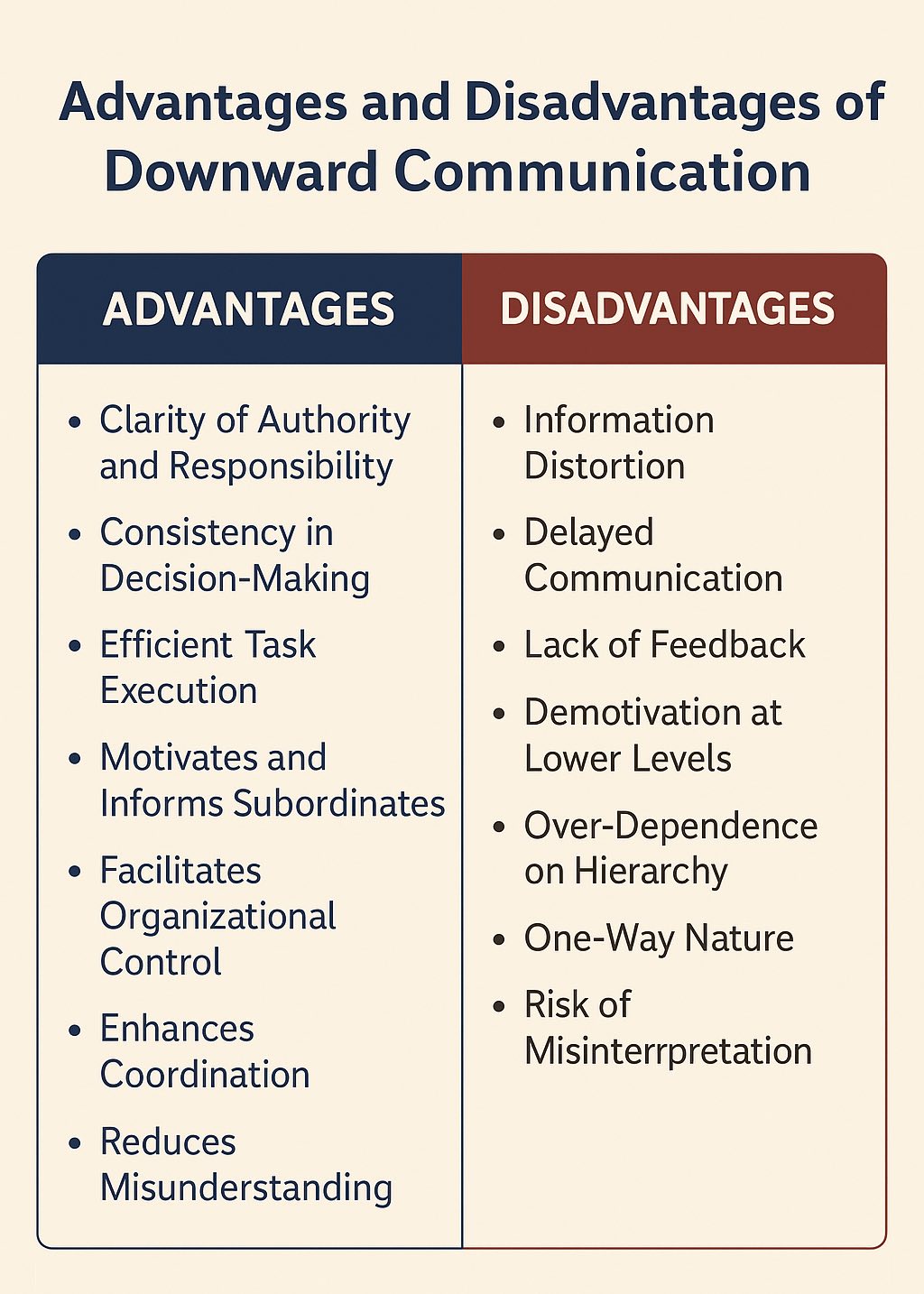
Advantages of Downward Communication
Now let’s explore why downward communication is so vital in an organization.
1. Clarity of Authority and Responsibility
Downward communication ensures that everyone knows who is responsible for what. For instance, when a department head issues clear orders, employees understand their duties. This clarity reduces confusion and duplication of tasks.
2. Consistency in Decision-Making
It helps in maintaining uniformity. Imagine if every team leader gave their own rules — chaos, right? Downward communication ensures decisions are consistent across all departments.
3. Efficient Task Execution
When instructions are clear, employees can work confidently and complete tasks efficiently. For example, a production manager who explains each step properly reduces the chance of mistakes.
4. Motivates and Informs Subordinates
Regular updates from management help employees feel valued and informed. Messages of appreciation like “Great job on the report!” can boost morale instantly.
5. Facilitates Organizational Control
Downward communication gives management control over activities. They can monitor progress and take corrective measures when needed.
6. Enhances Coordination
It helps departments align with organizational goals. For instance, when HR communicates a new recruitment plan, all teams can plan accordingly.
7. Reduces Misunderstanding
Proper communication minimizes confusion about policies, roles, and procedures. This creates a healthier work environment and improves productivity.
If you want to know how communication structure helps in managing business tasks smoothly, check out your post on the Types of Communication Process.
Disadvantages of Downward Communication
While downward communication has benefits, it also comes with challenges. Let’s go through the main drawbacks.
1. Information Distortion
As messages pass through multiple layers, their meaning can change. Think of the “Chinese Whisper” game — by the time it reaches the end, the message is completely different!
2. Delayed Communication
Because it has to move through several levels, the process can be slow. This delay may affect timely decision-making.
3. Lack of Feedback
Employees rarely get a chance to share their opinions or ideas. This lack of two-way communication can make them feel ignored.
If you want to balance it out, read the article on Upward Communication Examples and Benefits. It explains how information can also travel upward effectively.
4. Demotivation at Lower Levels
When employees feel they are only being ordered around, motivation drops. They might think their opinions don’t matter.
5. Over-Dependence on Hierarchy
Too much focus on rank and position can make the system rigid. It limits creativity and innovation.
6. One-Way Nature
Since feedback is limited, misunderstandings often go unnoticed until it’s too late.
7. Risk of Misinterpretation
Different backgrounds, education levels, or experiences can lead to misunderstanding even a simple instruction.
If you’re interested in how to fix such issues, your readers will enjoy your guide on Overcoming Communication Barriers in Business.
Comparison: Downward vs Upward Communication
Downward communication flows from top to bottom, while upward communication moves from employees to management.
Downward communication focuses on direction, control, and information delivery.
Upward communication, on the other hand, allows feedback, ideas, and suggestions to flow upward.
Both are essential. Without upward communication, management may never know how employees feel. If you want to understand how both work together, you can visit Upward vs Downward vs Horizontal Communication.
Strategies to Overcome the Limitations
Downward communication doesn’t have to be one-sided. Here’s how organizations can make it better:
- Encourage Feedback: Create channels for employees to share their opinions.
- Simplify Messages: Use plain, easy-to-understand language.
- Use Modern Tools: Video messages or email newsletters can deliver information faster.
- Provide Training: Teach managers how to communicate clearly.
- Balance Communication: Combine downward and upward systems for better understanding.
For further improvement tips, your readers can also learn from How to Make Downward Communication Effective.
Real-World Examples
Let’s make it practical. Imagine a school principal sending an email to teachers about new attendance policies. That’s downward communication in action.
Or, in a corporate setting, the CEO might send a circular about safety rules. Similarly, a project manager might share a detailed task breakdown report — all of these are examples of downward communication.
However, if the information takes too long or becomes unclear, employees may end up confused or demotivated. Hence, clarity and speed are crucial.
Relation with Report Writing and Documentation
Downward communication is closely connected with report writing and organizational documentation. Reports act as formal tools to convey performance, progress, and decisions from top management to subordinates.
Your post on the Steps in Writing a Business Report offers a great explanation of how reports can be structured to improve clarity and reduce misunderstandings.
Circular letters, memos, and meeting minutes also play a similar role in downward communication, ensuring transparency and consistency in documentation.
If you are new to report formatting, you can also explore Structure of a Market Report for ideas on presenting data effectively.
Conclusion
Downward communication is the backbone of organized workplaces. It provides direction, builds discipline, and ensures that everyone works toward the same goals. However, when it becomes too rigid or one-way, it can harm motivation and creativity.
The best approach is to blend it with upward and horizontal communication, keeping the conversation flowing both ways. After all, communication is most effective when it’s a dialogue, not a monologue.
By implementing feedback loops, simplifying language, and encouraging participation, any organization can turn downward communication into a powerful management tool.
So next time your boss sends you an email full of instructions, smile and think, “Ah, classic downward communication!”
Frequently asked questions
What happens if employees don’t understand a downward message?
Since downward communication is one-way, employees have limited opportunity to ask clarifying questions immediately. This can lead to misinterpretation. To prevent this, managers should encourage follow-up questions after sharing important messages, use clear language, and confirm understanding through brief check-ins or written acknowledgment from team members.
Should I use email or a formal memo for downward communication?
Choose based on urgency and importance. Email works for routine updates and quick instructions. Use formal memos or official letters for significant policy changes, legal matters, or records that need documentation. For sensitive feedback or complex instructions, a face-to-face meeting followed by written confirmation is most effective.
How can I prevent information distortion as messages travel downward?
Keep the chain of command as short as possible to reduce layers where distortion occurs. Use written documentation for critical messages so each level has the exact same information. Have middle managers confirm they understand before passing messages down, and periodically verify that frontline employees received the original message accurately.
What if employees feel ignored because they can’t respond to downward messages?
Balance downward communication with upward feedback channels. After sending important messages, explicitly invite questions via email, suggestion boxes, or team meetings. This maintains the structure of downward communication while showing employees their input matters. Regular two-way check-ins prevent resentment from one-directional messaging.
Can downward communication be too frequent and overwhelm employees?
Yes. Constant messages create information overload and reduce message impact. Prioritize what truly needs downward communication versus what could be optional reading. Group related updates together, use clear subject lines so employees can prioritize, and avoid sending multiple messages on the same day unless urgent.
3 Comments
This is nice grow up big in building the nation for the future betterment of the world.
Good cotents i have liked.
Make a comparison between downward,upward and grapevine communication