


Communication is an essential part of human life. From the moment we wake up to the time we go to bed, we are constantly exchanging messages, whether through words, gestures, or technology. But have you ever wondered how this entire process works? Why sometimes communication succeeds and sometimes fails? To answer such questions, scholars have developed various models of communication. These models help us understand the structure, flow, and function of communication in a simple and systematic way.
What Is a Communication Model?
A communication model is a theoretical framework that describes how messages are sent, received, and understood between people or systems. It acts like a map that shows the path of information from one point to another.
Communication, in real life, is complex. We deal with emotions, contexts, technology, and even misunderstandings. So, communication models were created to simplify and visualize this process. They help identify how information flows, what barriers exist, and where communication can break down.
As explained in your earlier article on the communication process, every exchange has a sender, message, medium, receiver, and feedback. Communication models use these same elements but represent them visually, helping learners and professionals understand the process better.
Communication Process vs Communication Model
The two ideas are closely linked but not the same. The communication process is the actual sequence of steps in any exchange: a sender encodes a message, sends it through a channel, and the receiver decodes it and gives feedback. A communication model is a simplified picture or diagram of that process, used to explain and study it.
| Basis | Communication process | Communication model |
|---|---|---|
| Nature | The real sequence of steps that happens when people exchange messages | A symbolic or pictorial representation of that sequence |
| Understanding | Needs a written description of each component | Can be grasped largely by looking at the diagram |
| Complexity | More complex, as it includes every factor at work | Simpler, as it shows only the main elements |
| Spotting faults | Breakdowns are hard to pinpoint during a live exchange | Easier to see where a message may fail |
| Origin | Happens in every exchange, whether or not anyone studies it | Designed by researchers to explain the process |
Why Communication Models Are Important
Before diving into the types, let us first understand why these models are useful.
- They simplify complex communication.
A model turns an abstract process into a visual diagram that’s easy to grasp. - They help identify problems.
By studying a model, one can locate where communication may fail or face barriers. - They enhance understanding.
They provide a logical structure for students and researchers to analyze communication patterns. - They apply across fields.
From media studies to business meetings, communication models are widely used to study interaction and feedback.
As you might recall from the principles of communication, effective communication relies on clarity, completeness, and feedback. These principles are reflected throughout the different models we will discuss.
Major Types of Communication Models
Over the years, researchers have developed many models, but they usually fall into three major categories:
- Linear Model – One-way communication
- Interactive Model – Two-way communication with feedback
- Transactional Model – Continuous and simultaneous communication
Let us now look closely at each type.
1. Linear Model of Communication
The Linear Model is the simplest and earliest form of communication model. It describes communication as a one-way process, where information flows in a straight line from the sender to the receiver.
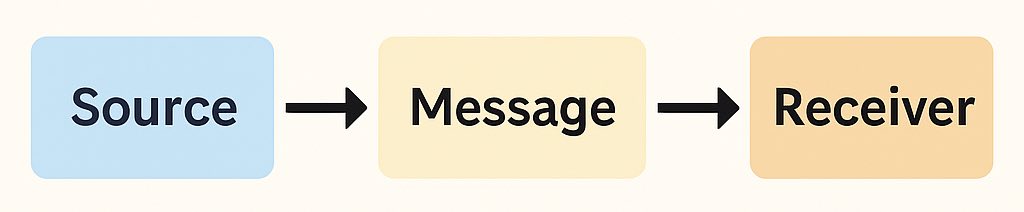
Key Features
- The sender encodes the message.
- The message travels through a channel.
- The receiver decodes it.
- Feedback is not considered.
This model is ideal for explaining mass communication, like TV or radio broadcasting, where the audience cannot immediately respond.
However, it has limitations. It assumes that communication is passive and ignores the receiver’s role in interpretation. Despite this, it laid the foundation for later, more advanced models.
Aristotle’s Model of Communication
Aristotle was one of the first thinkers to study communication systematically. His model focused on speaker, speech, and audience. The aim was persuasion, especially in public speaking. For example, when a teacher gives a lecture, they act as the speaker trying to influence the audience with structured arguments.
Lasswell’s Model (1948)
Harold Lasswell offered a formula-like model: Who says what, in which channel, to whom, and with what effect.
This model is especially useful in media communication and journalism. It focuses on effect and impact, showing that communication is not only about sending a message but also about influencing behavior or opinion.
Shannon and Weaver Model (1949)
Developed for telecommunication systems, this model introduced the idea of noise — anything that distorts the message during transmission. For instance, static on a phone line or a loud background during conversation.
This technical concept was later applied to human communication too. It highlighted how barriers such as distractions, unclear language, or misinterpretations affect message clarity.
This connects closely with your article on barriers to communication, which elaborates on how noise and misunderstanding reduce effectiveness.
2. Interactive Model of Communication
The Interactive Model expanded upon the linear model by adding feedback. Here, the receiver is no longer silent. Instead, communication becomes a two-way process where both parties exchange messages alternately.
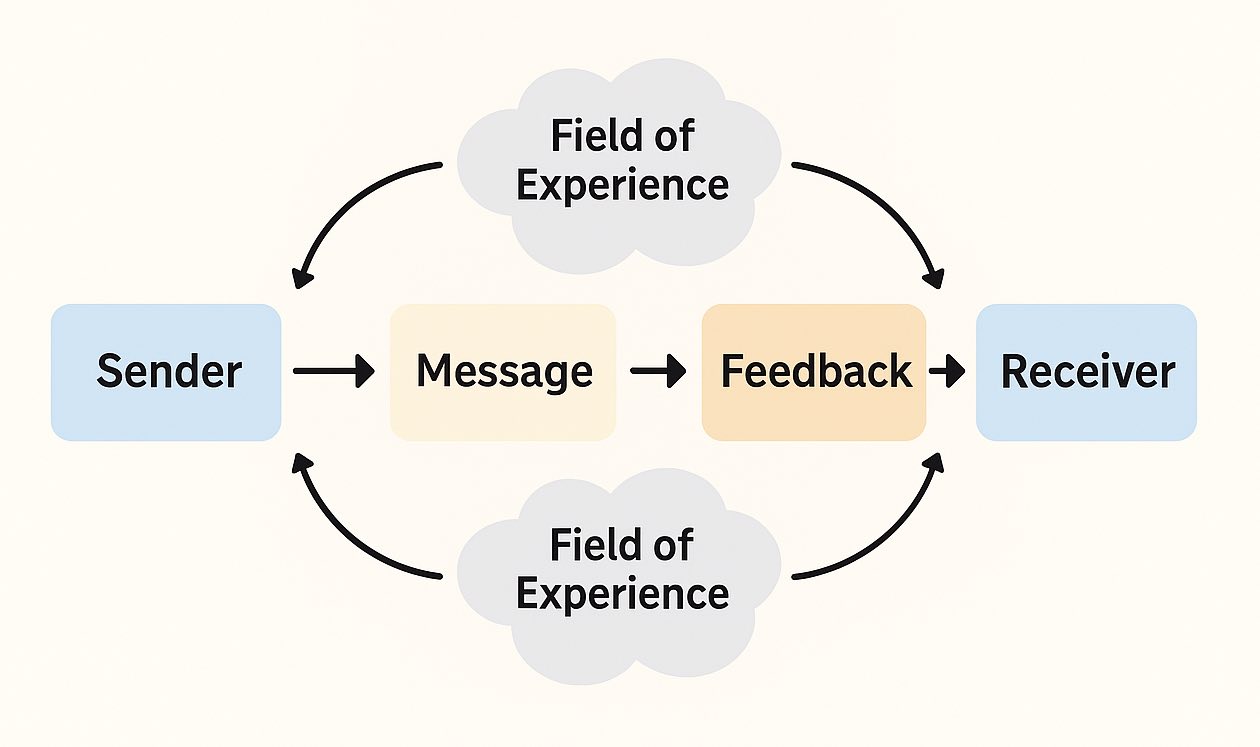
Think of a teacher asking students a question in class. The teacher speaks, the students respond, and both interpret each other’s messages.
Key Features
- Two-way communication
- Feedback from the receiver
- Context and experience influence understanding
This model is practical for describing interpersonal and group communication settings, such as meetings, interviews, or classroom discussions.
Schramm’s Model of Communication
Wilbur Schramm introduced the concept of “overlapping fields of experience.” According to him, successful communication occurs when both sender and receiver share a common background or experience.
For example, when two doctors discuss a medical case, they understand each other easily because they share technical vocabulary. However, the same terms might confuse someone outside the field.
Schramm’s model also emphasized the encoder, decoder, and interpreter roles — showing that both parties interpret meaning actively.
Osgood-Schramm Circular Model
Charles Osgood and Schramm later refined this idea. Their model shows communication as a circular process, where each person acts both as sender and receiver simultaneously. Feedback becomes continuous rather than delayed.
This aligns beautifully with your earlier post on the importance of feedback in communication, which emphasizes how feedback closes the communication loop and ensures understanding.
3. Transactional Model of Communication
The Transactional Model is the most advanced and realistic representation of communication. It treats communication as a simultaneous process, where both parties are active participants, constantly sending and receiving messages in real time.
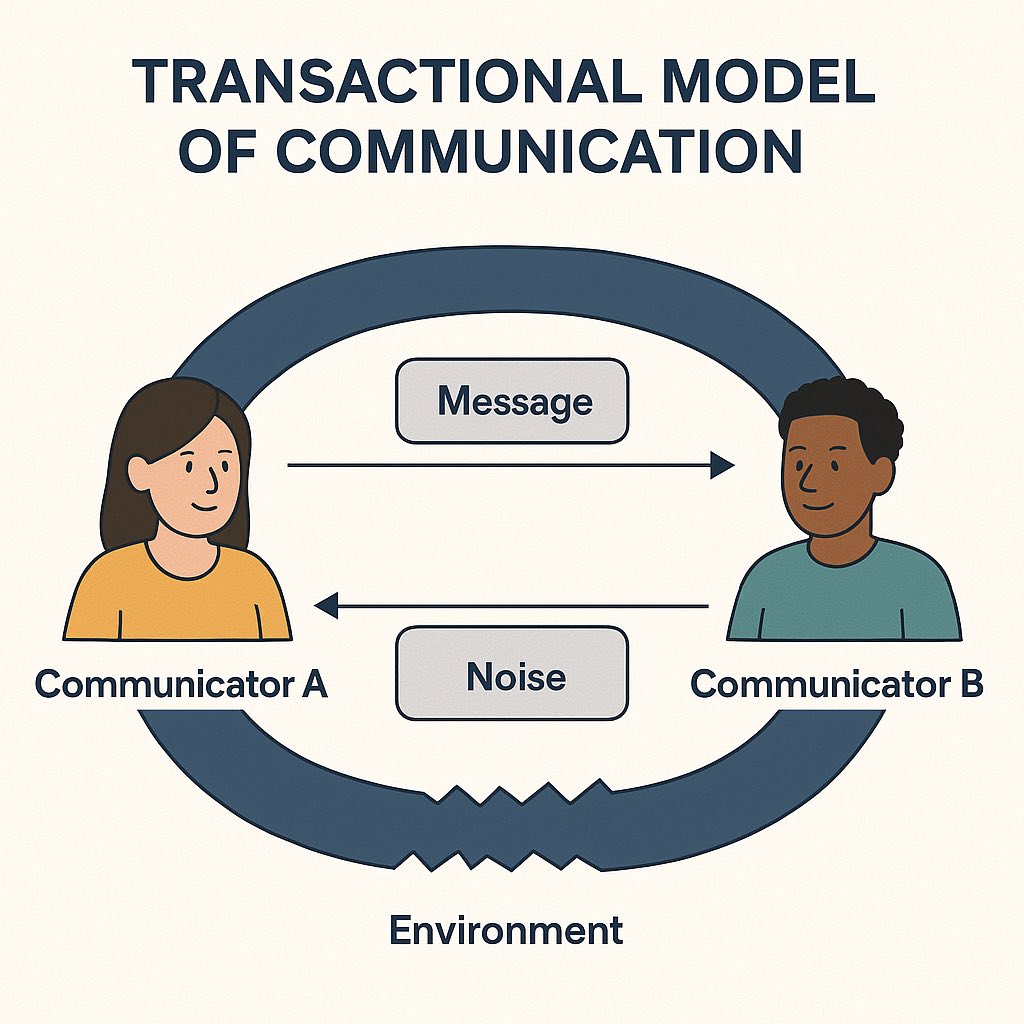
This model recognizes that communication is influenced by context, social systems, culture, and relationships. It also accepts that messages can be verbal or nonverbal, conscious or unconscious.
Key Features
- Communication is dynamic and ongoing.
- Both participants are equal contributors.
- Context, environment, and culture affect meaning.
Imagine two friends talking face-to-face. They use words, gestures, and facial expressions together. Both are continuously sending and receiving cues, adjusting their responses based on each other’s reactions.
Barnlund’s Transactional Model
Dean Barnlund’s model focuses on continuous feedback. It views communication as a constant exchange of cues, both intentional and unintentional. For example, a nod or a smile can convey meaning as effectively as words.
Dance’s Helical Model
Frank Dance compared communication to a helix, a spiral that expands as it moves upward. It symbolizes that communication grows and evolves over time. Each interaction builds upon previous experiences, creating a richer understanding.
For instance, your relationship with a colleague improves as you communicate more. Every conversation adds a new layer of meaning and trust.
This dynamic idea connects well with intrapersonal and interpersonal communication, which explores how self-awareness and personal relationships influence exchanges.
Comparative Overview of the Three Models
| Model Type | Direction | Feedback | Example | Limitation |
|---|---|---|---|---|
| Linear | One-way | None | TV broadcast | No interaction |
| Interactive | Two-way | Yes | Classroom teaching | Feedback delay |
| Transactional | Simultaneous | Continuous | Conversation | Hard to represent visually |
Each model has its purpose. Linear models are best for media, interactive models for education, and transactional models for real-life interpersonal interactions. Together, they give a complete understanding of communication in all contexts.
Applications of Communication Models in Daily Life
Communication models are not only theoretical. They guide our everyday communication in education, business, and technology.
In Mass Media
Journalists and advertisers use Lasswell’s model to analyze how messages influence audiences. Understanding “who says what to whom” helps create persuasive campaigns.
In Education
Teachers apply Schramm’s model to ensure their message matches students’ experiences. When a teacher uses real-life examples, they bridge the “field of experience” gap.
In Business Communication
Transactional communication helps leaders engage with employees in meetings and presentations. Managers who actively listen and respond create a healthier communication climate.
This is similar to what your post on role of technology in communication discusses, showing how modern tools like video calls or emails enhance collaboration.
In Digital Communication
In online classes, Zoom meetings, or social media, multiple communication models often work together. For instance, during a live webinar, the initial presentation follows a linear model, while the Q&A session becomes interactive or transactional.
Advantages and Limitations of Communication Models
Advantages
- Simplify complex processes into clear structures.
- Help identify breakdowns or misunderstandings.
- Useful for teaching and research in communication studies.
- Serve as frameworks for improving public speaking and media production.
Limitations
- Some models are too mechanical, ignoring human emotions.
- They may not represent modern digital communication accurately.
- Cultural differences and nonverbal cues are often overlooked.
- Rigidity: real communication does not always follow a fixed sequence. The linear Shannon and Weaver model, for example, shows the message moving only one way, from sender to receiver.
- Omitted factors: a model keeps the main elements and leaves out minor ones, which sometimes turn out to matter. Lasswell’s formula, for instance, has no element for feedback or noise.
- Lack of detail: a model shows the process through symbols, so it rarely explains how each part works. Dance’s helix shows communication growing over time but not what happens within each exchange.
Despite these limitations, communication models remain valuable tools for understanding and improving how we connect with others.
For example, the study of cross-cultural communication highlights that meaning can shift across cultures, a factor that most classical models did not fully consider.
Modern Perspectives on Communication Models
In today’s world, communication has evolved beyond traditional models. With the rise of technology and social media, messages are no longer limited to one sender and one receiver. Instead, networks of people interact simultaneously across platforms.
Modern models now include concepts like:
- Network communication, where many-to-many interaction occurs.
- Digital feedback loops, such as comments and likes.
- Visual and multimedia channels, including emojis, images, and videos.
Interestingly, these digital models still rely on the foundational theories of Aristotle, Lasswell, Schramm, and others. The core idea remains the same: communication involves sending, receiving, interpreting, and responding to messages.
Conclusion
Communication models provide a structured way to understand how people exchange information. They show us that communication is not random but guided by patterns that can be studied and improved.
From Aristotle’s one-way rhetoric to Barnlund’s dynamic exchange, each model reflects the era and technology of its time. As our world becomes more digital and interconnected, understanding these models becomes even more valuable.
Above all, these theories remind us that communication is both an art and a science. By studying these models, we can become better speakers, listeners, and thinkers. Whether you are writing an email, giving a presentation, or chatting online, a little awareness of communication models can make a big difference in how your message is received.
So next time you send a message, pause for a second and ask yourself — which model am I using right now?
Frequently asked questions
What is the difference between a communication model and a communication process?
The process is the actual sequence of sending, receiving and responding to a message, while a model is a simplified diagram that represents that process. See the process vs model comparison table above for the key differences.
What is the difference between the three models of communication?
The linear model is one-way with no feedback, the interactive model is two-way with feedback that comes in turns, and the transactional model has both people sending and receiving at the same time, shaped by context and culture.
Which model should I use to analyze my workplace communication?
Choose based on your situation. Use the Linear Model for one-way broadcasts (announcements, presentations). Use the Interactive Model for two-way exchanges (meetings, interviews). Use the Transactional Model for complex, simultaneous interactions (negotiations, group discussions). Most workplace communication benefits from the Interactive or Transactional models since feedback and shared context matter.
Why does my message get misunderstood even when I’m clear?
The receiver’s background and experience shape how they interpret your message. Schramm’s model shows that successful communication requires overlapping fields of experience. If you and your audience don’t share common knowledge or context, clarity alone won’t help. Adjust your message to match their experience level or build shared context first.
Can I use the Linear Model for customer service interactions?
No. Customer service requires feedback and two-way dialogue, making the Interactive or Transactional Model more appropriate. The Linear Model ignores the customer’s response and concerns. Using it would result in one-sided communication that fails to address customer needs or resolve issues effectively.
What counts as noise in real business communication?
Noise is anything distorting your message: background distractions, unclear wording, technical glitches, cultural differences, or emotional reactions. The Shannon and Weaver Model identifies noise as a barrier. In business, noise might be a cluttered email, a noisy conference call, or jargon your audience doesn’t understand. Minimize it by choosing clear channels and simple language.
Does feedback always improve communication outcomes?
Feedback improves communication by allowing the receiver to clarify misunderstandings and the sender to adjust their message. However, feedback only helps if both parties listen and respond constructively. Defensive reactions or ignored feedback can worsen communication. The Interactive and Transactional models show feedback’s value, but execution matters.
14 Comments
thank your so much.
Its quite interesting & i love it
Thank u for these good models
What about interactional and transactional model
I so much appreciate the poster of these analyze models.
I need to know about HUB model.,stength and weaknesses
whats the source of this site? may i know the author? thank you for the response.
Hello Mark,
Thanks for commenting here. This website content was written by Masudur Rashid & Ornov Chowdhury Bappi.
I want to extremely appreciate the writer for the knowledge he/she has really shared with me. God really bless you
Communication model is Clare to me now
May I know the similarities of the models?
Very helpfull but you left out the HUB model of communication.
yes I too need to know HUB model
Loved it helps scholars a lot.
Rich knowledge.keep the good job lit