


Communication media are the channels through which messages travel between sender and receiver. This guide covers business communication media: face-to-face, telephone, video, written documents, email, and digital platforms. It does not cover computer-network transmission media such as fiber optics or coaxial cable, which is a separate topic in networking.
Business has six main types of communication media: face-to-face, telephone, video conferencing, written documents, email and messaging, and social and digital platforms. Choosing the right one depends on urgency, message complexity, audience size, and whether you need a documented record.
What is communication media?
Communication media are the channels through which messages travel from sender to receiver. In organizational settings, the channel you choose directly shapes whether your message lands clearly, gets documented, or causes confusion.
A sensitive performance review delivered by email risks misinterpretation. A routine policy update announced in a 30-minute meeting wastes time. Channel choice shapes outcomes more than wording does.
Different media carry different amounts of information. A face-to-face conversation transmits words, tone, facial expressions, and immediate feedback. An email carries only text and whatever emotion your punctuation conveys.
Types of communication media at a glance
Here are the six primary types, each with a one-line example:
- Face-to-face conversation: a one-on-one performance review in an office
- Telephone and voice calls: a regional manager calling a branch for a quick decision
- Video conferencing: a weekly team standup on Zoom or Microsoft Teams
- Written documents: a formal offer letter, a memo announcing policy changes, a project report
- Email and messaging: a project update sent to five stakeholders, or a Slack thread among developers
- Social and digital platforms: a LinkedIn update for stakeholders, or a company intranet post
These six categories cover business communication. For computer-network media (twisted pair, fiber, coaxial, microwave), refer to a networking resource instead.
Media Richness Theory: Why Some Channels Work Better Than Others
Richard Daft and Robert Lengel introduced Media Richness Theory in a 1986 paper published in Management Science. The theory explains why some channels handle complex, ambiguous messages better than others.
Daft and Lengel identified four dimensions of richness: the variety of cues a channel carries (words, tone, body language), and the speed of feedback it allows. The other two are how personal the channel feels to the receiver, and whether it handles natural language or only structured data.
Rich channels like face-to-face conversation score high on all four. Lean channels like formal reports score low. The theory’s practical rule: match message complexity to channel richness. Use rich channels for ambiguous, emotional, or high-stakes messages. Use lean channels for clear, routine, or archival content.
A related framework, Media Synchronicity Theory (Dennis and Valacich, 1999), asks whether the timing of a channel suits the task. Synchronicity matters alongside richness. Both frameworks are useful when planning how your team communicates.
Comparing channels by richness
AI-mediated tools (async video, meeting summaries) now form a distinct layer in many organizations, so a row for them is added alongside the traditional six.
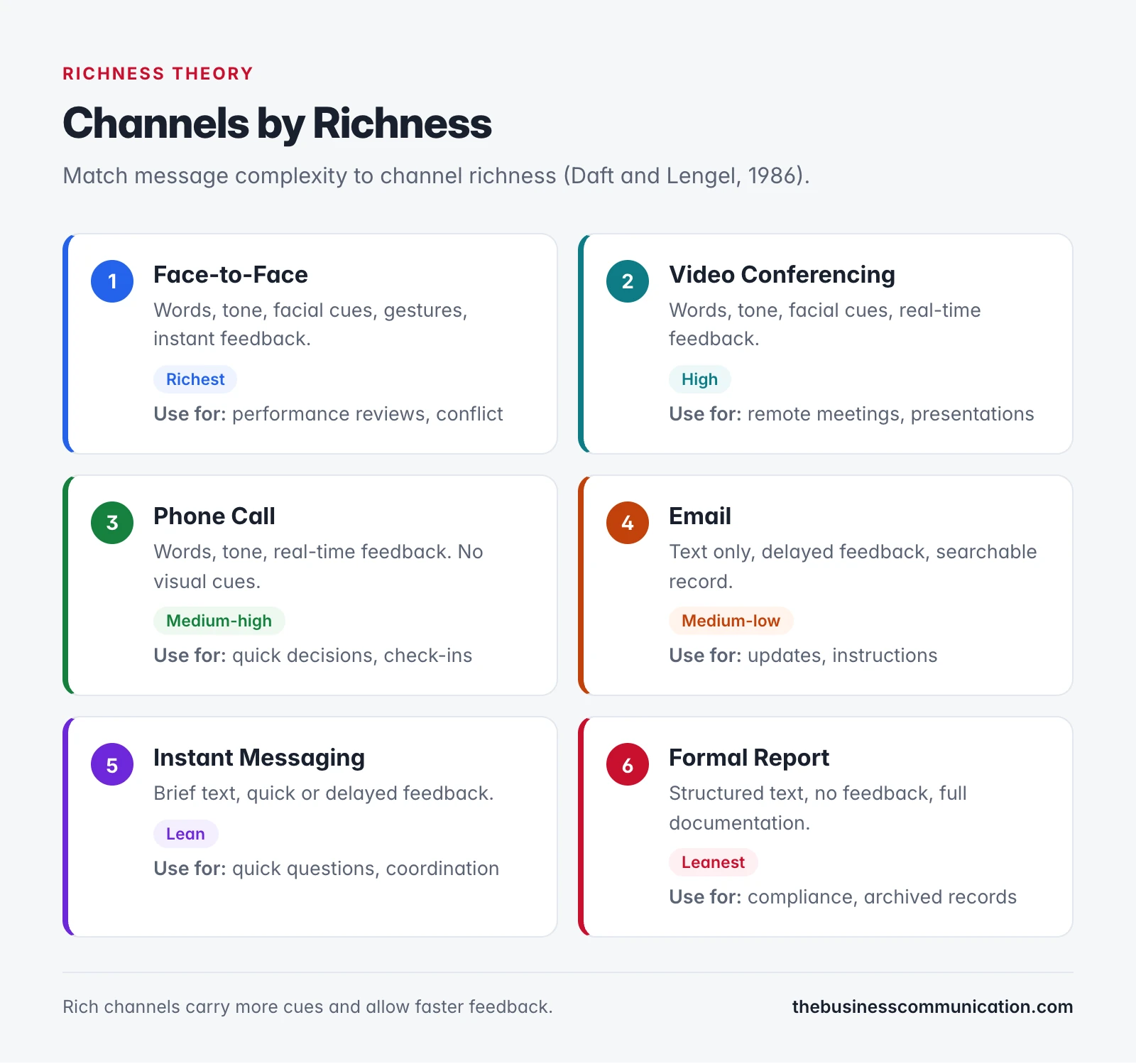
| Media Type | Richness Level | Information Cues | Best Use Cases |
|---|---|---|---|
| Face-to-face conversation | Richest | Words, tone, facial expressions, gestures, immediate feedback | Performance reviews, conflict resolution, relationship building |
| Video conferencing | High | Words, tone, facial expressions, some gestures, real-time feedback | Remote team meetings, client presentations, job interviews |
| Phone call | Medium-high | Words, tone, real-time feedback | Quick decisions, clarifications, informal check-ins |
| Medium-low | Words only, delayed feedback | Routine updates, documented instructions, non-urgent requests | |
| Instant messaging | Lean | Brief text, quick or delayed feedback | Simple yes/no questions, status updates, quick coordination |
| AI-mediated (async video, meeting summaries) | Medium | Words, tone (video), no real-time feedback | Async briefings, distributed teams, recorded walkthroughs |
| Formal report / document | Leanest | Structured text, no immediate feedback | Detailed analysis, compliance records, archived decisions |
Consider a regional manager explaining a 15% budget cut to the team. Sending an email (lean channel) will spark confusion and anxiety.
People cannot ask questions or see the manager’s tone. A video call (rich channel) lets the manager explain context, answer questions in real time, and show that leadership has not walked away.
Synchronous vs. asynchronous media
A practical way to sort communication media is by timing: does the exchange happen in real time, or can participants respond when convenient?
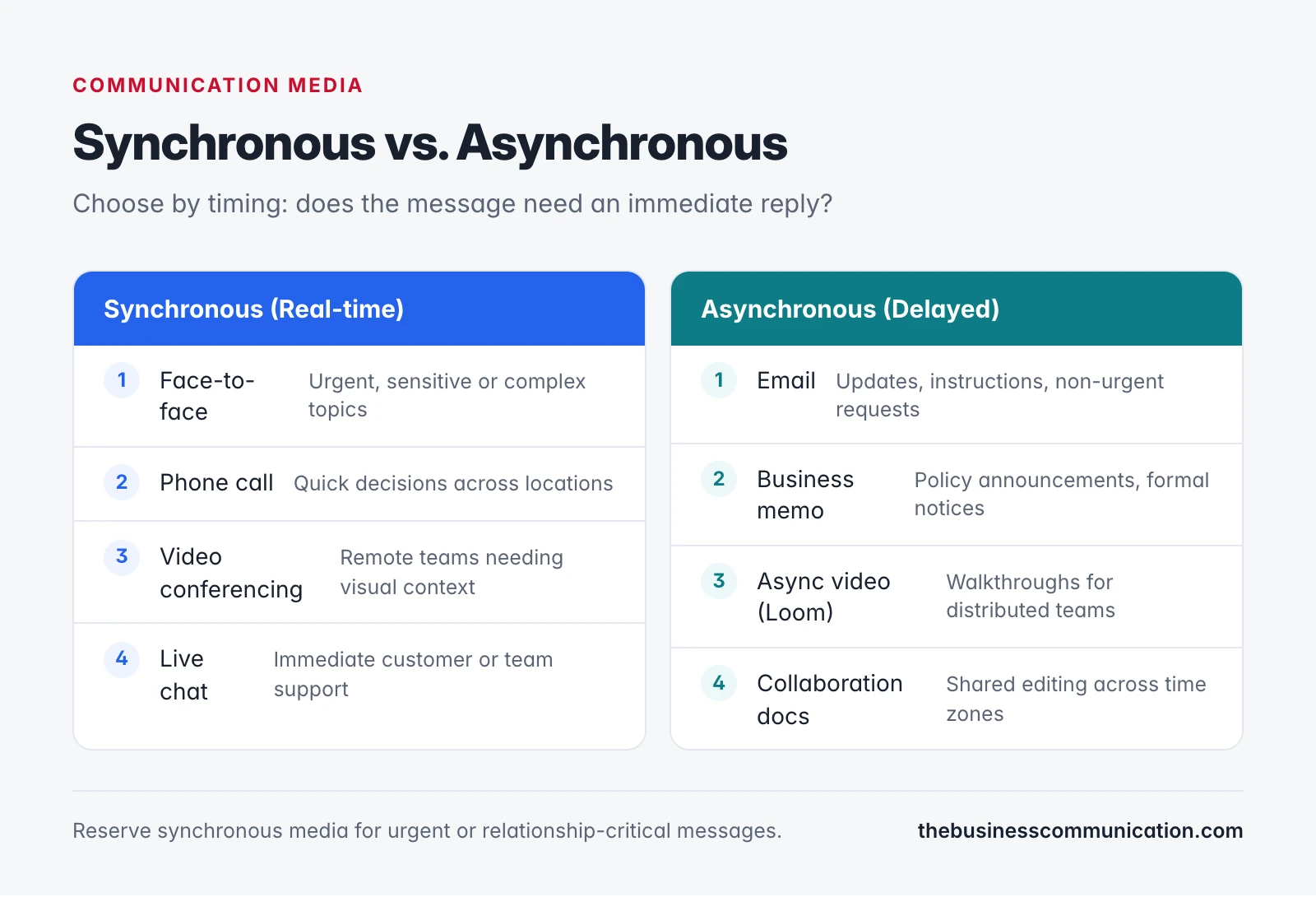
Synchronous media require both sender and receiver to be present at the same time. Face-to-face conversations, phone calls, video conferences, and live chat all demand real-time participation. These channels work best when you need immediate feedback, want to build rapport quickly, or must resolve a complex issue through dialogue.
Asynchronous media allow delayed responses. Email, recorded video messages, documents, and message boards let receivers consume content when convenient. A product manager in Dhaka can send a project update that a colleague in New York reads six hours later. Async channels respect time zones and reduce interruptions.
Hybrid teams commonly mix both. Daily video standups keep alignment; Slack threads handle detailed technical discussion. Many teams err by treating every message as urgent and defaulting to synchronous channels.
Reserve synchronous media for genuinely time-sensitive or relationship-critical communication. For more context on how timing relates to communication types, see our guide on types of communication.
Oral communication media
Face-to-face
Face-to-face conversation is the richest medium available. You pick up micro-expressions, adjust your message mid-sentence based on listener reactions, and build trust through physical presence. Sales negotiations, mentorship sessions, and difficult feedback conversations all benefit from in-person contact.
The advantages and disadvantages of oral communication are most visible here: clarity is high, but there is no automatic record unless you take notes or send a follow-up summary.
Phone and mobile calls
Phone calls strip away visual cues but preserve tone and real-time feedback. A five-minute call often resolves issues that would take 20 emails. Customer service teams, remote sales reps, and executives coordinating across regions rely heavily on voice calls.
The limitation is the absence of visual aids. Trying to explain a complex workflow diagram over the phone frustrates everyone involved. Use phone calls for decisions, clarifications, and informal check-ins, not for detailed walkthroughs.
Video conferencing
Video calls have become essential for distributed teams. Tools such as Zoom, Microsoft Teams, and Google Meet combine visual and auditory channels, allowing participants to see reactions and share screens. Video conferencing works especially well for presentations, collaborative problem-solving, and maintaining team cohesion in remote settings.
Screen sharing makes video more useful than a phone call when you need visual context. A finance team reviewing a live spreadsheet on video shares the same view instantly, cutting the confusion that a verbal description alone would create.
Meetings and conferences
Meetings gather multiple people for synchronous oral communication. A well-run meeting aligns teams, surfaces concerns, and reaches decisions faster than email threads. A poorly run meeting wastes collective time. The difference lies in agenda clarity and participant preparation.
For recurring meetings that have become habitual, ask: does this require real-time discussion, or would an async update work? Many weekly check-ins can become shared documents with a standing comment thread, freeing up hours each month.
Written communication media
Written channels create permanent records and allow careful message crafting. A business letter conveys formality and legal weight. An email balances speed with documentation. A business memo distributes internal information efficiently.
Letters and formal documents
Business letters serve official purposes: contracts, formal proposals, legal notices, and executive correspondence. Despite digital alternatives, letters still signal importance and create legally binding records. A large organization might send offer letters and termination notices as physical documents to ensure formality and receipt confirmation.
Email dominates daily business communication. It is fast, searchable, and self-documenting, which makes it well suited for non-urgent updates and project coordination. Statista (2025) puts global daily email volume at approximately 376 billion. The average professional receives around 120 emails per day (Zippia, 2026).
That volume creates a problem: important messages drown in noise. Use clear subject lines, keep each email to one topic, and move complex decisions to a richer channel rather than running a 20-reply thread.
Memos
Memos communicate internal information concisely. A two-paragraph memo announcing a policy change reaches everyone simultaneously and provides a reference document. Memos suit routine announcements, procedural updates, and brief directives that do not require discussion.
Reports and proposals
Reports and proposals deliver detailed analysis, research findings, and formal recommendations. A market analysis report documents methodology, presents data, and supports strategic decisions. These documents live in archives and inform future planning, making accuracy and clarity essential.
Digital and emerging media
Digital platforms have changed business communication significantly in the past decade, creating hybrid channels that blend written, oral, and visual elements.
Instant messaging platforms like Slack, Microsoft Teams, and WhatsApp enable quick, informal exchanges. A developer can ask a question in Slack and get an answer in 90 seconds, no email formality required. These platforms support threaded conversations, file sharing, and searchable history.
The risk: constant notifications fragment attention, and decisions made in chat threads can get lost.
Collaboration platforms such as Google Workspace, Microsoft 365, and Notion let teams create, edit, and comment on documents simultaneously. Five people can build a presentation together, seeing changes in real time.
A marketing team in Manila can draft content that a design team in London refines eight hours later. This asynchronous-yet-interactive model works well for distributed teams.
Social media serves external communication: brand messaging, customer engagement, and stakeholder updates. LinkedIn posts reach professional networks, and Twitter handles customer service inquiries. These channels offer broad reach but demand careful tone management and quick response times.
AI-mediated channels are a growing category. Tools such as Loom let senders record a brief async video instead of scheduling a meeting. AI summary tools (built into Teams, Zoom, and Fireflies.ai) transcribe and summarize calls automatically.
For cross-timezone teams, these tools cut the meeting load while keeping the verbal richness of a spoken explanation.
Most organizations now use a media mix. A tech startup might coordinate daily work through Slack, hold weekly video standups, document decisions in Notion, and send formal updates via email.
Clear norms matter: which channel handles which message type, what response times are expected, and how to escalate when a channel is not getting results.
How to choose the right medium: a 3-step framework
Media selection should be deliberate, not habitual. Apply these three questions in order:
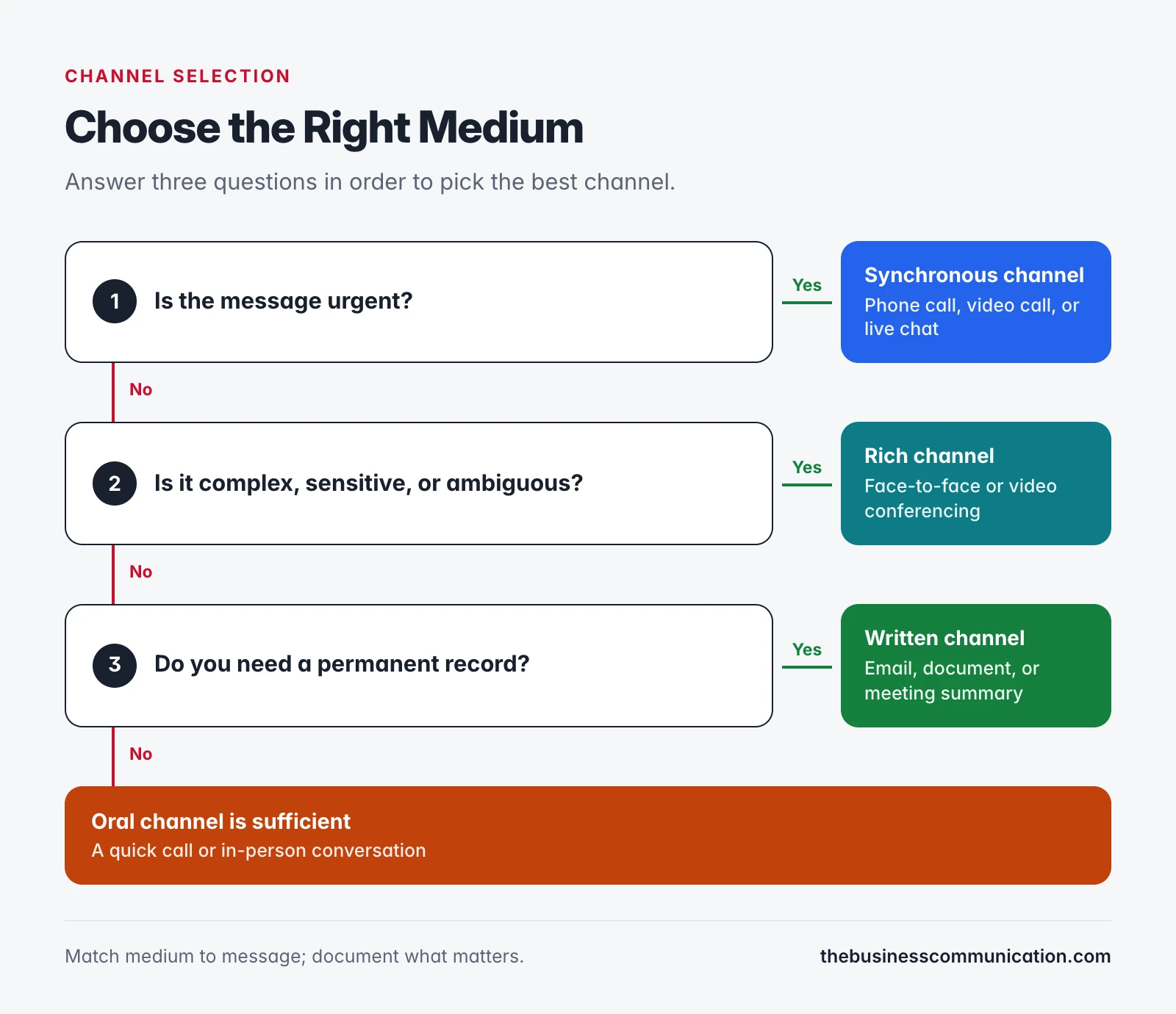
- Is the message urgent? If yes, go synchronous: phone call, video call, or instant message. If no, asynchronous works fine.
- Is the message complex, sensitive, or ambiguous? If yes, choose a rich channel: face-to-face or video call. If no, a lean channel (email, memo) is sufficient.
- Do you need a permanent record? If yes, use a written or recorded channel: email, formal document, or AI meeting summary. If no, oral communication is enough.
Take a new commission structure with multiple tiers and exceptions. Step 1: not time-critical, so async prep works. Step 2: complex and sensitive, so a video call beats a memo. Step 3: HR needs a record, so follow the call with a summary email.
Audience size also matters. One-to-one conversations suit phone calls or direct messages. Team updates work well in email or Slack. Company-wide announcements may need an all-hands video meeting followed by a reference email.
Connectivity limits options too. In rural areas, a small business may default to phone calls and WhatsApp instead of Zoom, simply because bandwidth is inconsistent.
A manager who sends a 2,000-word email when a five-minute conversation would work wastes time on both ends. Knowing which channel fits the moment matters more than knowing every tool available. Match your medium to your message, and document what matters.
Frequently asked questions
What are types of communication media?
In business, the main types are face-to-face, phone calls, video conferencing, email and messaging, written documents (letters, memos, reports), and social and digital platforms. Each type varies in richness, speed, and whether it creates a permanent record.
What are the 7 types of communication?
The seven commonly cited types of communication are verbal, non-verbal, written, visual, formal, informal, and digital. Communication media are the channels you use to deliver any of these types. For example, verbal communication can happen face-to-face (rich channel) or via phone (medium-high richness).
What are 5 different media types?
Five widely recognized business communication media types are: face-to-face, telephone, video conferencing, email, and written documents. Some frameworks add instant messaging and social media for a total of six or seven types, depending on how finely they divide digital channels.
What are the 4 types of communication media?
A simplified four-type model covers oral (face-to-face and phone), written (letters, memos, reports), electronic (email, messaging, video calls), and visual (charts and slides). The six-type model above gives more precision for channel selection.
What is the difference between a communication medium and a communication channel?
The terms are often used interchangeably in business. Technically, the medium is the physical means of transmission (sound waves, email servers). The channel is the pathway used (a phone call, an email thread). In practice, choosing your “channel” and choosing your “medium” mean the same thing.
Should I use email or a phone call to deliver critical feedback?
Use a phone call or face-to-face meeting. Critical feedback requires tone, immediate clarification, and the ability to repair the relationship in real time. Email risks misinterpretation and creates a harsh written record. A synchronous channel lets you gauge the recipient’s reaction and adjust your message as you go.
What if my team is spread across time zones?
Default to asynchronous media for routine updates, decisions, and documentation. Use synchronous channels only when genuinely urgent or relationship-critical. Record video messages or rotate meeting times for important discussions. Asynchronous channels respect time zones, reduce burnout, and still keep teams aligned when you set clear response-time norms.
Can I mix media for the same message?
Yes. Start the discussion in a video call or Slack thread, then send a formal email summarizing the decision and next steps. This captures real-time collaboration and leaves a documented record. Make sure the follow-up summary stands alone for anyone who missed the initial exchange.
Is channel richness theory still relevant with AI and chat tools?
Yes. AI tools add new channel categories: async video with automatic transcription now sits between email (lean) and live video (rich) on the richness spectrum. The principle Daft and Lengel described in 1986 still applies: match message complexity to the information-carrying capacity of the channel, whatever form that channel takes.
13 Comments
coherent. many thanks to you
Very nc
Great to learn about communication,
very nice and helpful
Nice article ! Why don’t you write down on digital medium of comminication like Whastapp API and mails.
It is clear, and understandable..thankyou
what are the types of communications used in media on social justice issues
All types are used. No matter what kind of media, information on social justice issues can be posted everywhere
What does loud media expression means? Concept pls?
Very understandable article
Nice article. Fair explanation of all communication channels.
For a beginner, could you explain the sequence in which he/she should start learning the mentioned skill of communications.
good
Clear article , understandable. Thank you