


Picture this. You have a massive business idea. It is brilliant. You want to pitch it to an investor. Would you send them a long email? Would you send a text message? Probably not.
You would want to meet them. You would want to look them in the eye. You would want to shake their hand.
Despite the rise of Zoom, Slack, and endless emails, nothing beats the power of being there. Physical presence still matters. In fact, it matters now more than ever.
In the fast-paced world of business, we often forget the basics. We hide behind screens. However, real connection happens in person.
Today, we are going to explore face-to-face conversation. We will look at what it is. We will weigh the pros and cons. Above all, we will figure out when you should close the laptop and meet in the real world.
Let’s dive in!
What is Face-to-Face Conversation?
Let’s start with a simple definition.
Face-to-face conversation is a direct discussion between two or more people. It happens in the same physical space. It happens at the same time. There are no screens in between. No delays. Just you and the other person.
It is the oldest form of human interaction. Before we had writing, we had speech. Before we had phones, we had meetings.
It is a key part of the types of oral communication. While phone calls are also oral, they lack the physical element. Face-to-face brings everything to the table. It involves voice, sight, and presence.
Key Characteristics of Face-to-Face Conversation
What makes this method so special? Why can’t a video call replace it completely? Here are the key traits that define it.
1. Physical Presence
You are in the same room. This creates a shared atmosphere. You are breathing the same air. This proximity creates a psychological bond that digital tools cannot mimic.
2. Synchronous Exchange
It happens in real-time. You speak, and they answer immediately. There is no “typing…” bubble. There is no lag. This allows for a dynamic flow of ideas.
3. Rich Media
This is a fancy way of saying “it has everything.” You hear the tone. You see the face. You feel the energy. It is a high-bandwidth form of communication.
Why is Face-to-Face Communication Important?
You might ask, “Why bother?” Traveling takes time. Meetings take time. Why not just send an email?
Well, business is about people. It is not just about data.
Building Trust and Rapport
Trust is hard to build over email. It is easy to misinterpret text. Conversely, meeting someone allows you to gauge their character. A handshake creates a connection. A shared coffee breaks down walls.
Clarity and Understanding
Have you ever sent a joke over text that fell flat? That happens because text lacks tone. In person, you can use your voice to add meaning. You can use your hands to emphasize points. This reduces confusion significantly.
Persuasion Power
Salespeople know this secret. It is much harder to say “no” to someone’s face than to an email. If you need to persuade someone, go see them. Your physical presence adds weight to your words.
Advantages of Face-to-Face Conversation
Let’s get specific. What are the actual benefits? Why is this still the “Gold Standard” of business interaction?
1. Reading Non-Verbal Cues
Words are only half the story. The rest is body language.
When you meet in person, you can see the other person’s posture. You can see their facial expressions. Are they crossing their arms? They might be defensive. Are they leaning in? They are interested.
These body language signals tell you the truth. A client might say “yes” with their words but “no” with their eyes. In a face-to-face chat, you catch these hidden messages.
2. Instant Feedback and Adjustment
Imagine you are presenting an idea. You see the client frown. You know immediately that they are confused.
What do you do? You stop. You explain it differently. You fix the problem right then and there.
In an email, you hit send and hope for the best. You might not know they are confused until days later. In person, you can pivot instantly. This helps you overcome common barriers to effective communication.
3. Confidentiality
The internet never forgets. Emails can be forwarded. Chats can be screenshotted.
Sometimes, you need to discuss sensitive things. Maybe it is a trade secret. Maybe it is a personnel issue.
Face-to-face conversations leave no digital footprint. There are no server logs. It is just between you and them. This makes it the safest channel for private matters.
4. Conflict Resolution
Fighting over text is a nightmare. Everyone gets defensive. The tone gets lost.
If you have a conflict, meet in person. It is harder to be angry at a human being than at a screen. Eye contact creates empathy. It humanizes the other person. You can resolve issues in ten minutes that would take ten emails to fix.
5. Social Bonding
Do not underestimate the “small talk.” Asking about someone’s weekend matters. Noticing their new haircut matters.
These little moments happen naturally in person. They build culture. They turn a group of workers into a team. This social glue is hard to manufacture on a scheduled video call.
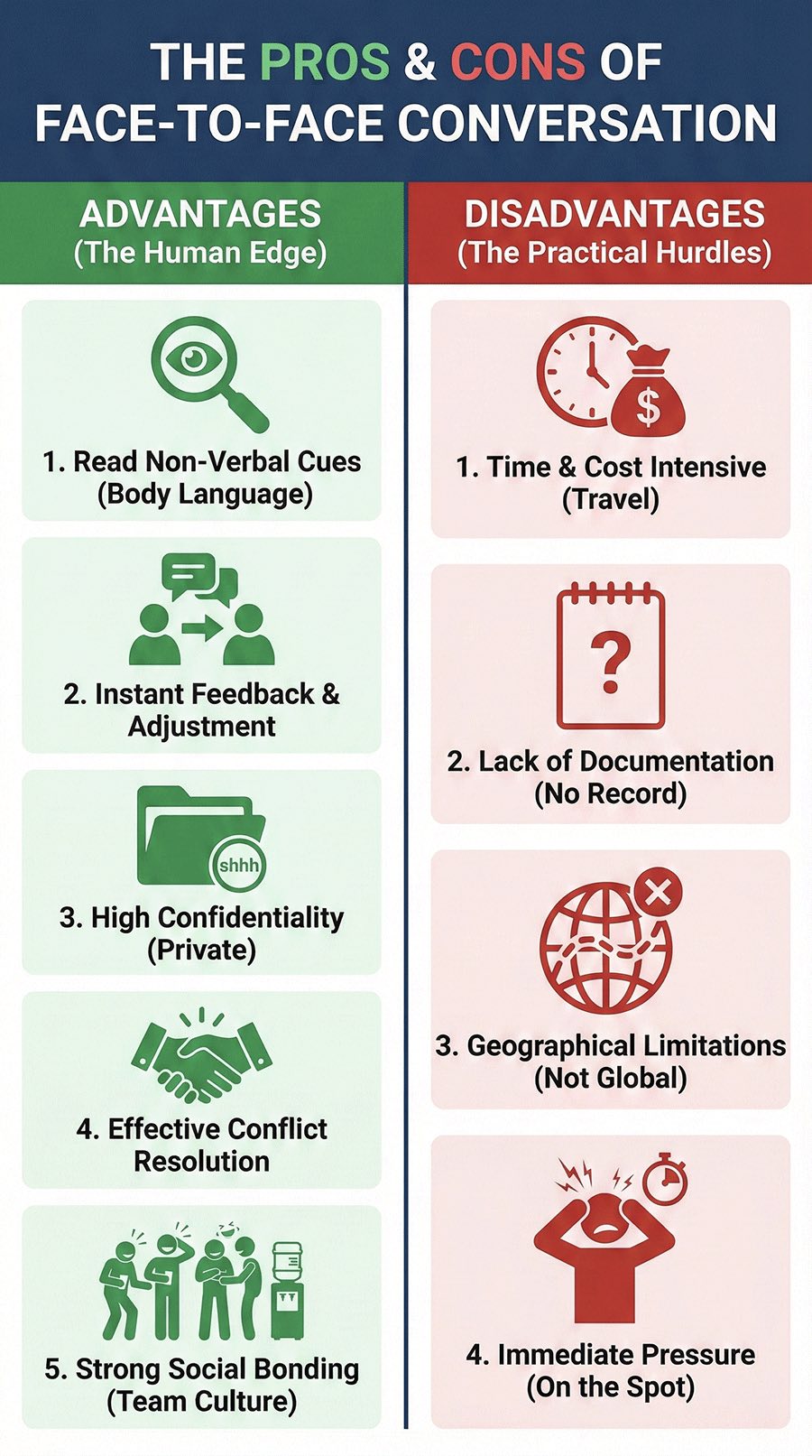
Disadvantages of Face-to-Face Conversation
Is it perfect? Of course not. If it were perfect, we wouldn’t use email. There are downsides to meeting in person.
1. Time and Cost Intensive
This is the biggest hurdle. Meetings take time. You have to commute. You have to park. You have to wait.
If you are flying to meet a client, it costs money. Compare that to a free Skype call. Face-to-face is expensive. You have to decide if the ROI is worth it.
2. Lack of Documentation
“I never said that!”
Have you ever heard that phrase? In a verbal conversation, there is no record. Unless you record the audio, it is your word against theirs.
Emails provide a paper trail. You can search them later. With face-to-face, you have to rely on your memory. Alternatively, you have to take very good notes.
3. Geographical Limitations
We live in a global economy. Your team might be in London. Your client might be in Tokyo.
You cannot meet face-to-face every day. It is physically impossible. This is where digital tools win. They bridge the gap that physical distance creates.
4. Immediate Pressure
Some people are introverts. They like time to think. They like to draft an email, edit it, and polish it.
In a live conversation, you are on the spot. You have to answer now. There is no backspace key. This pressure can be stressful for some people.
Face-to-Face vs. Video Conferencing (Virtual Meetings)
This is the modern debate. Is a Google Meet or Zoom call the same as a face-to-face meeting?
Technically, you can see their face. You can hear their voice. But it is not the same.
Pixel vs. Presence
On a video call, you are looking at a screen. You might be distracted by your own email notifications. You might be looking at your own face in the corner.
Zoom Fatigue
Staring at a camera is draining. Our brains work harder to process non-verbal cues on video. In real life, it feels more natural.
Online meeting platforms are amazing tools. They are efficient. But they lack the energy of a real room.
When to use which?
- Use Video: For quick updates, regular check-ins, and low-stakes info.
- Use Face-to-Face: For building relationships, solving conflicts, and closing big deals.
When Should You Choose Face-to-Face Communication?
You have a busy schedule. You cannot meet everyone. So, when is it absolutely necessary?
Here are a few scenarios where you should prioritize the physical meeting.
1. Hiring or Firing
You are changing someone’s life. Do not do it via email. It is a sign of respect to do this in person.
2. Closing High-Stakes Deals
If asking for a million dollars, show up. It shows commitment. It shows you are serious.
3. Brainstorming Complex Ideas
Whiteboarding on a screen is okay. Whiteboarding in a room is better. The energy of a group works better when bodies are present.
4. Apologizing
Did you mess up? A written apology can look cold. A face-to-face apology shows sincerity. It allows you to use active listening skills to understand their hurt.
Conclusion
We live in a digital age. We have amazing technology that connects us instantly.
Nevertheless, we are human beings. We crave connection. We respond to presence.
Face-to-face conversation is not outdated. It is a premium tool. It is powerful. It builds trust that pixels cannot.
Yes, it takes time. Yes, it costs money. But the value it brings is often priceless.
Next time you have a difficult message to deliver, pause. Don’t open your email app. Instead, walk down the hall. Go visit the client. Sit down and talk.
You might be surprised by how much more effective the communication process becomes when you simply show up.
Technology is efficient. But face-to-face is effective. The best leaders know exactly when to use which.
Are you ready to log off and meet up?
Frequently asked questions
When should I choose a video call over meeting in person?
Use video calls for routine updates, quick decisions, or when travel costs outweigh the benefit. Meet in person for high-stakes pitches, conflict resolution, sensitive negotiations, or when building new relationships. If you need to read body language and adjust in real-time, go in person. If you just need to share information, a call works fine.
How do I document what was discussed if there’s no written record?
Send a follow-up email immediately after the meeting summarizing key points, decisions, and next steps. This creates a paper trail while preserving the trust-building benefits of the in-person conversation. Ask the other person to confirm the summary is accurate. This protects both parties without undermining the relationship.
Is it worth traveling for a meeting that could be a video call?
Calculate the ROI. If the meeting involves persuasion, conflict resolution, or relationship-building with a major client or partner, travel is usually worth it. For routine check-ins or information sharing, skip the trip. Consider the stakes: closing a deal justifies travel; approving a standard report does not.
What if someone seems uncomfortable or defensive during our conversation?
Pause and address it directly. Say something like, “I sense some hesitation. What’s on your mind?” This shows you’re reading their body language and gives them space to be honest. In-person conversations let you adjust tone and approach immediately, turning potential conflict into deeper understanding.
Can I mix face-to-face meetings with remote follow-ups?
Yes. Meet in person to build rapport and align on big-picture goals, then use email and calls for execution and updates. This hybrid approach gets the relationship benefits of in-person time while keeping routine communication efficient. It’s the best of both worlds for ongoing partnerships.
8 Comments
You made to understand what face to face conversation is? thank
Nice
but
If we are trying in notes for also too good then
these notes are too satisfy to student
Thank you for sharing such an article on various aspects of communication.
Very true thanks
You don’t know how much this helped me
Sometimes we conduct the face to face interview, couldn’t it be called formal conversation?
yes u gorm
Very helpfull indeed. I am presenting on a very short notice and this site came in very handy for me.