


We live in a world of speed. You send a WhatsApp message, and it gets read in seconds. You fire off an email, and you expect a reply within the hour.
So, why do we still bother with paper letters?
It seems old-fashioned, doesn’t it? Yet, if you walk into any major law firm or corporate headquarters, you will see stacks of physical mail.
The truth is, despite the digital revolution, the traditional business letter remains the gold standard for formal communication. It carries a weight that an email just cannot match.
However, it is not perfect. It is slow, and it can be expensive.
In this post, we are going to look at both sides of the coin. We will objectively analyze the advantages and disadvantages of using business letters in 2025. This will help you decide exactly when to lick that stamp and when to just hit “Send.”
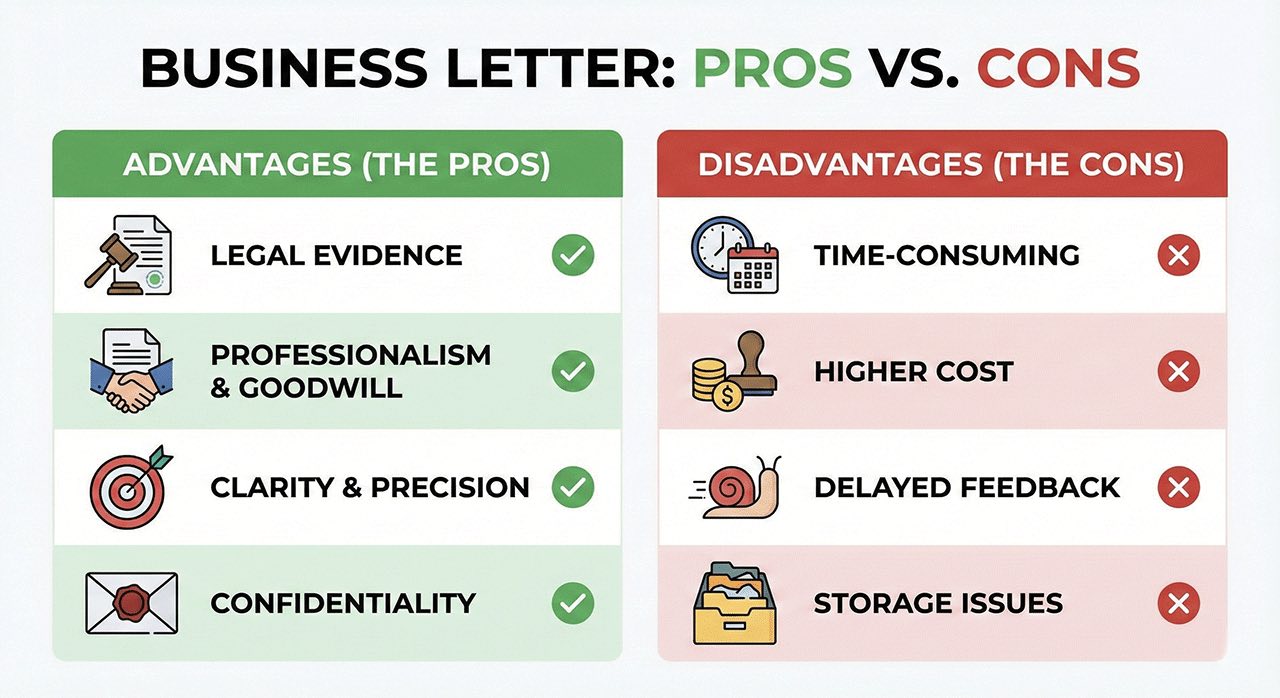
Advantages of Business Letter
Let’s start with the good stuff. Why do businesses still spend money on letterheads, printers, and postage? It comes down to authority and permanence.
1. Legal Validity and Evidence
This is the number one reason. A signed physical letter is a solid piece of evidence.
In legal disputes, a formal letter on official letterhead is often treated with more seriousness than a digital thread. It serves as a permanent, tangible record.
When you sign a contract, offer a job, or issue a formal warning, you want that paper trail. It proves that the transaction actually happened. Unlike digital files that can be corrupted or deleted, a filed letter is hard to dispute.
2. Conveying Professionalism and Goodwill
Imagine you get two ‘Thank You’ notes. One is a quick email. The other is a beautifully printed letter on high-quality paper. Which one feels more special?
The letter wins every time.
Sending a physical letter shows that you care. It shows you took the time to draft, print, and mail the document. This effort builds goodwill.
If you are unsure how to achieve this look, you can check the standard definition of a business letter to understand its professional structure. It is about making a lasting impression on your client or partner.
3. Clarity and Precision
Here is a fun fact. People write differently when they know it will be printed.
When you write an email, you might rush. You might make typos. But when you draft a formal letter, you tend to be more careful. You check your grammar. You refine your tone.
This results in clear, unambiguous communication. Because you cannot just “edit” a sent letter, you are forced to be precise from the start. This reduces the chance of misunderstandings that often happen with quick, casual messaging.
4. Confidentiality and Security
Believe it or not, physical mail can be more secure than email.
Emails can be hacked. They can be forwarded to the wrong person with a single click. We have all heard horror stories of “Reply All” mistakes.
A sealed envelope, however, is private. It goes directly to the recipient’s desk. For highly sensitive documents, organizations still trust the physical seal over digital encryption.
5. Wide Reach (Accessibility)
Not everyone is tech-savvy.
You might be dealing with stakeholders in remote areas where internet access is spotty. Or, you might be communicating with an older demographic that prefers physical mail.
In these cases, the advantages of written communication like letters ensure your message actually reaches the audience, regardless of their technology access.
Disadvantages of Business Letter
Now, let’s be real. If letters were perfect, we wouldn’t have invented email. There are some significant downsides that you need to consider.
1. Time-Consuming Process
This is the biggest pain point. Writing a letter takes time.
You have to draft it. Then you have to proofread it. Then comes printing, folding, stuffing the envelope, and mailing.
In a fast-paced business environment, this delay can be a problem. You cannot use a letter to solve an urgent crisis. It is simply too slow for day-to-day operations.
2. Higher Cost
Sending an email is essentially free. Sending a letter costs money.
You have to pay for the paper. You pay for the toner or ink. You pay for the envelopes and the postage stamps.
Plus, there is the labor cost. If an administrative assistant spends 20 minutes handling mail, that is time they could have spent on other tasks. For a large company sending thousands of letters, these costs add up fast.
3. Delayed Feedback
We are used to instant gratification.
With a letter, you have to wait. It might take three days to arrive. Then, the recipient takes time to read it and write back. Then, the response takes another three days to reach you.
If you need a quick decision, this lag is unacceptable. You should understand the differences between business letter and email to avoid using letters for urgent matters.
4. Storage and Retrieval Issues
Paper takes up space.
If your business relies heavily on letters, you need filing cabinets. You need physical space to store years of correspondence.
Retrieving old data is also a hassle. You cannot just press “Ctrl+F” to find a specific keyword in a stack of paper files. You have to manually search through folders, which is inefficient.
5. Formal Rigidity
Sometimes, a letter feels too formal.
If you have a close relationship with a colleague, sending a formal letter might seem cold or distant. It can create a barrier instead of building a bridge.
For internal quick notes, it is much better to use a memo instead. Memos are designed to be less rigid and more direct for people within the same office.
Comparison: When Do the Pros Outweigh the Cons?
So, how do you decide? It all depends on the context.
Scenario A: Legal Disputes or Contracts
- Verdict: Use a Letter.
- Why: The advantage of legal validity outweighs the disadvantage of slowness. You need the evidence.
Scenario B: Weekly Project Updates
- Verdict: Use Email or Memo.
- Why: The disadvantage of time consumption makes letters a bad choice here. You need speed.
Scenario C: Formal Apology or Invitation
- Verdict: Use a Letter.
- Why: The advantage of conveying goodwill wins. An email apology can feel insincere.
Tips to Overcome the Disadvantages
If you love the authority of letters but hate the inefficiency, there are ways to find a middle ground.
Digitize Your Records
To solve the storage problem, scan your physical letters immediately. Keep the digital copy for easy searching and the physical copy for legal backup.
Use Templates
Don’t start from scratch every time. Create standard templates for common letters like inquiries or complaints. This drastically reduces drafting time.
You can find many ready-made formats in our collection of business letter samples. Using these can save you hours of work.
Conclusion
The business letter is not dead. Far from it.
It remains a powerful tool for establishing authority, ensuring legal protection, and showing professional respect. However, it is no longer the only tool.
The smartest professionals know the difference. They use email for speed and letters for impact.
Above all, remember that the goal of communication is to be understood. Whether you choose paper or digital, make sure your message is clear.
If you are ready to write your next formal document, make sure you follow a proper step-by-step guide to ensure you get the format exactly right.
Frequently Asked Questions (FAQs)
Q: What is the main advantage of a business letter over a telephone call?
A: The main advantage is the permanent record. A phone call is verbal and can be forgotten or disputed. A letter provides physical proof of exactly what was said.
Q: Are business letters still relevant in 2025?
A: Absolutely. While email handles daily tasks, letters are still required for legal notices, formal contracts, HR documents (like offer letters), and high-level stakeholder communication.
Q: Why is a business letter considered a permanent record?
A: Because it can be physically filed and stored for years. In legal or business audits, signed letters are accepted as official history of the company’s decisions and transactions.
Q: Can I use a business letter for internal communication?
A: You can, but it is rare. Usually, you would use a memo for internal matters. Letters are best reserved for external communication with clients or vendors.
Frequently asked questions
When should I use a letter instead of email for urgent matters?
Don’t. Letters take 3-6 days round-trip minimum. Use email or phone for urgent issues. Reserve letters for formal records that need legal weight: contract offers, terminations, official complaints, or formal warnings. Speed and urgency are incompatible with physical mail.
Will a handwritten business letter look unprofessional?
Not if done carefully. Handwritten letters can feel personal and sincere, especially for thank-you notes or relationship-building. However, for legal documents, contracts, or formal complaints, typed letters on official letterhead are safer. Handwriting must be legible and neat.
What if I need a record but the recipient ignores my letter?
Send the letter via certified mail with return receipt. This creates proof of delivery. For critical matters, follow up with an email referencing the letter’s date and content. The combination of physical mail plus digital confirmation gives you the strongest evidence trail.
Can I mix a formal letter with a casual personal note?
Yes, but use caution. A brief handwritten P.S. at the end of a formal letter can add warmth without undermining professionalism. However, if the tone feels too casual, it weakens the letter’s authority. Keep any personal addition brief and relevant.
Is it worth printing letters for a small business with tight budgets?
Only for high-stakes situations: client acquisition, legal matters, or relationship-building with key partners. For routine communication, email is cost-effective. Calculate the cost per letter (paper, ink, postage, labor) against the benefit. Most small businesses use letters sparingly.
How do I know if my recipient prefers letters or email?
Ask directly or observe their communication style. If they’ve always emailed you, start with email. For formal first contact with executives or legal matters, a letter is safer. When in doubt, email first to confirm their preference before investing in printing and postage.
7 Comments
Thank you for you helpful comment, I appreciate it dearly 🙂
very nice.
Very simple language
lol
LOVE IT LADS
hello my friend I am looking for person who would like to have very nice relationship, very long time relationship. Thank you plz send me email
A letter for advantages and disadvantages