


Imagine a situation. A customer bought a product from you last month, promised to pay in two weeks, but here we are six weeks later with no payment in sight. Do you send a friendly reminder, or do you draft a strong notice that demands immediate action? This is where understanding the types of collection letters becomes so important.
Collection letters are not all the same. They change in tone and urgency depending on how overdue the payment is. In this post, we will go through the main types, starting with soft letters, moving to firm ones, and ending with the final notice. By the end, you will know exactly how to adjust your communication style to get results while keeping professionalism intact.
What Are the Types of Collection Letters?
At first glance, you might think a collection letter is simply a standard template. In reality, there are different stages of collection letter writing. Each stage is designed for a specific purpose. A business does not want to damage customer relationships too soon, yet it cannot afford to keep waiting forever.
The sequence usually follows this path:
- Soft collection letter: A polite reminder that payment is overdue.
- Firm collection letter: A stronger message showing urgency.
- Final collection letter: The last step before legal or external action.
This step-by-step process is quite different from the methods of writing collection letters where the focus is on format and writing style rather than tone and type.
Soft Collection Letter (First Reminder)
A soft collection letter is the gentle tap on the shoulder. It is not aggressive at all. In fact, it often sounds like a friendly reminder, almost like saying, “Hey, just checking in, your payment seems to be overdue.”
Definition and Tone
This type is sent when a payment has only recently crossed the due date. The tone is polite, calm, and reassuring. The letter usually assumes that the customer simply forgot or overlooked the deadline.
Purpose
- Maintain goodwill with the client.
- Encourage quick payment without straining the relationship.
- Keep communication lines open.
Key Elements
- A thank-you note for doing business.
- Mention of the amount due and the invoice number.
- Reminder of the original due date.
- A polite request to make payment soon.
Example Scenario
Let’s say you run a small publishing business. A loyal client missed the payment by ten days. Instead of sounding harsh, you send a note that politely reminds them of the pending invoice.
If you want to know what makes such a letter effective, take a look at the factors of collection letters where we explained the qualities that improve impact.
Firm Collection Letter (Second Reminder)
Now picture this. You already sent a soft letter, but weeks have passed and there is still no payment. At this point, the business needs to switch gears. The firm collection letter comes into play.
Definition and Tone
This is more serious in tone than the first. The language is direct, professional, and slightly stronger. It no longer assumes the delay was a simple mistake. Instead, it stresses that immediate action is necessary.
Purpose
- Communicate urgency without losing professionalism.
- Warn that further delay may have consequences.
- Ensure the customer knows the seriousness of the situation.
Key Elements
- Clear statement of how overdue the account is.
- Mention of possible penalties or late fees.
- A direct call to action with a shorter payment deadline.
- Still respectful, but more insistent in tone.
Example Scenario
Suppose an invoice is now 45 days overdue. A polite reminder did not work. A firm collection letter at this stage says, “Your account is overdue, please make payment immediately to avoid further charges.”
For guidance on how tone and wording should shift between letters, check the methods of writing collection letters where we describe the process step by step.
Final Collection Letter (Last Reminder)
The final collection letter is the last stop before external action. It is also known as the final notice or demand letter.
Definition and Tone
This type is firm, authoritative, and leaves no room for doubt. The message clearly states that this is the last attempt to collect payment before taking serious steps.
Purpose
- Give the debtor a final opportunity to pay.
- Demonstrate that the business is prepared to escalate.
- Protect the business by creating strong documentation.
Key Elements
- Mention of previous attempts to contact.
- A strict deadline for payment, often very short.
- A statement of next steps, such as involving collection agencies or legal action.
- Professional but unmistakably firm language.
Example Scenario
Imagine an account is unpaid for over 90 days. The customer has ignored earlier reminders. A final letter states that unless payment is made within seven days, the matter will be referred to a legal authority.
If you want to see real-life wording, we have put together a collection letter sample guide that shows how such letters are written.
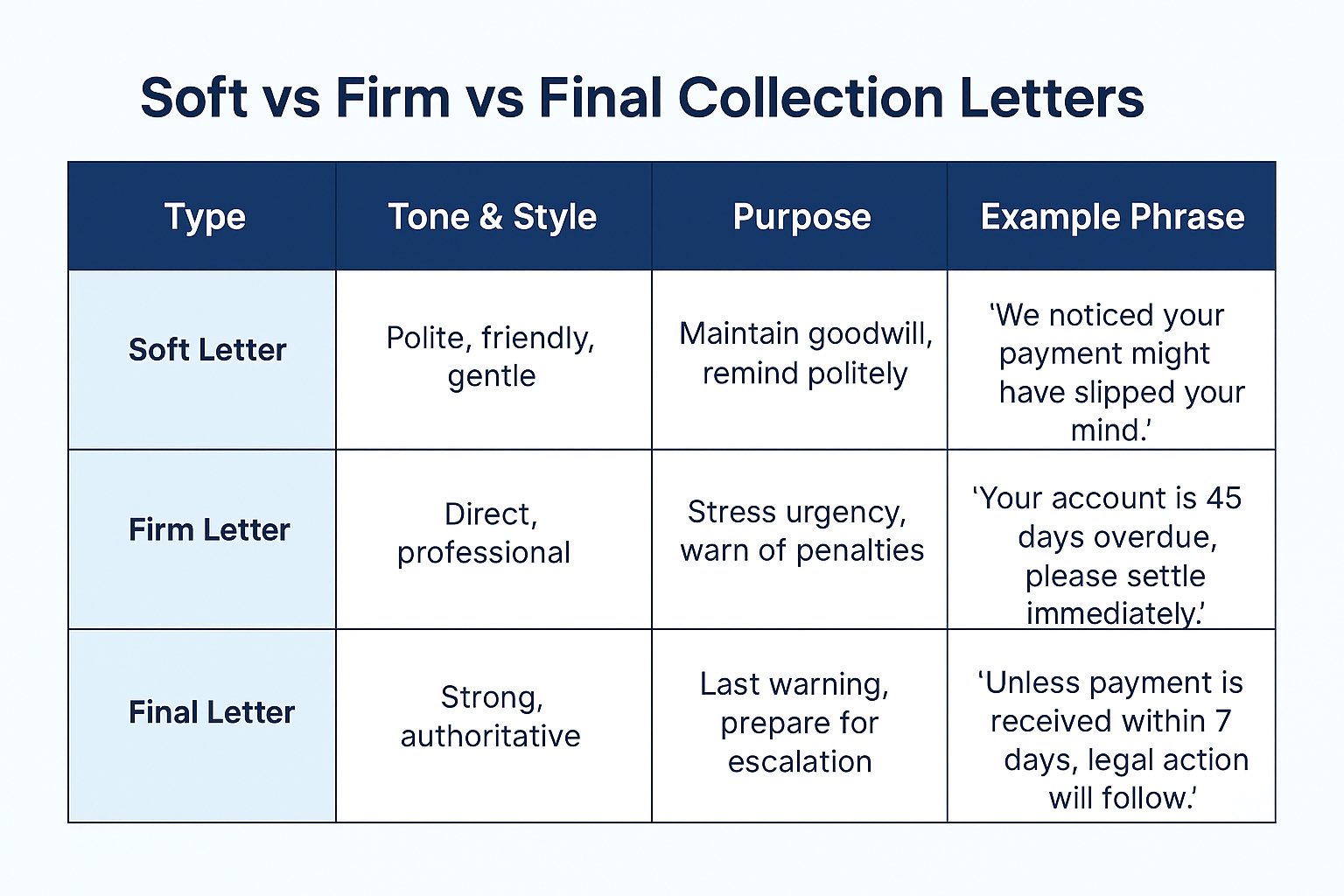
Comparison: Soft vs Firm vs Final Collection Letters
To make it easier, let’s put the three types side by side.
| Type | Tone & Style | Purpose | Example Phrase |
|---|---|---|---|
| Soft Letter | Polite, friendly, gentle | Maintain goodwill, remind politely | “We noticed your payment might have slipped your mind.” |
| Firm Letter | Direct, professional | Stress urgency, warn of penalties | “Your account is 45 days overdue, please settle immediately.” |
| Final Letter | Strong, authoritative | Last warning, prepare for escalation | “Unless payment is received within 7 days, legal action will follow.” |
This table shows how tone escalates step by step.
Importance of Using the Right Type at the Right Time
Why does it matter to use the correct type of letter at the right stage? Because every customer is different. Some are forgetful, others are careless, and a few may be deliberately avoiding payment.
- Sending a final notice too early can damage relationships.
- Sticking with soft letters for too long may delay cash flow.
- A balanced approach shows professionalism and fairness.
Proper documentation of each stage also helps in case of disputes. If the matter reaches court, the business can show that it tried soft and firm approaches before resorting to legal action.
For a deeper look at the considerations, you can explore the factors to be considered in writing a collection letter.
Best Practices for Choosing the Correct Type
Here are some practical tips:
- Start with soft: Always begin gently, especially with loyal customers.
- Escalate gradually: Move to firm only if payment remains unsettled.
- Document everything: Keep copies of all letters for records.
- Match tone with history: If a client has always paid on time, be extra polite in the first reminder.
- Avoid emotion: Stick to facts. Emotional language rarely helps.
By following these best practices, businesses can recover payments effectively while maintaining positive relationships.
Conclusion
Collection letters are not just about money. They are about communication strategy, professionalism, and reputation management. Knowing the types of collection letters and when to use each one makes the process smoother and more effective.
Start with a soft reminder, follow up with a firm message if needed, and finally issue a strong notice when all else fails. This progression ensures fairness to the customer while protecting the financial health of the business.
To strengthen your understanding further, check out some of our collection letter samples where you will see these types in action.
Frequently asked questions
How long should I wait before sending a firm letter after the soft letter?
Wait 2–3 weeks after the soft letter. If no payment arrives by then, the customer has had a reasonable chance to respond. A firm letter at this point signals that the issue is serious without appearing aggressive. The exact timing depends on your industry and payment terms, but don’t wait longer than a month between reminders.
What if a customer disputes the invoice amount in response to my collection letter?
Stop the collection process immediately and investigate the dispute. Request documentation from the customer showing why they believe the amount is incorrect. Review your records carefully. If the dispute is valid, adjust the invoice and send a corrected statement. If it’s not valid, provide clear evidence supporting your original amount and set a new payment deadline.
Can I skip the soft letter and go straight to a firm letter if payment is already very late?
Yes. If an invoice is already 60+ days overdue or this is a repeat offender, starting with a firm letter is appropriate. However, if it’s the customer’s first late payment, a soft letter preserves the relationship. Consider your history with the customer and how overdue the account actually is before deciding.
Should I mention specific consequences like legal action in the final letter if I don’t actually plan to pursue it?
No. Only mention legal action or collection agencies if you genuinely intend to follow through. False threats damage credibility and may expose you to legal liability. Be honest about your next steps. If you will refer to a collection agency, state that clearly. If you won’t, focus on the urgency without empty threats.
Is it better to send collection letters by email or certified mail?
Certified mail creates a legal paper trail and proves delivery, which is valuable for final notices. Email is faster for soft and firm letters. For maximum protection, use certified mail for final letters. For earlier reminders, email is acceptable unless your contract specifies otherwise or the customer has ignored previous emails.
1 Comment
Very useful tips and good enough for anyone who will either conduct or attend an interview.