


Have you ever met someone who is brilliant but cannot explain their ideas? They have a PhD in engineering, yet they struggle to lead a simple team meeting.
On the other hand, have you met someone with average technical skills who climbs the corporate ladder effortlessly? They charm clients. They rally teams. They get promoted.
What is the difference? The answer lies in their communication skills.
Many people confuse this with the “types of communication” like verbal or written methods. However, today we are talking about skills. These are the abilities you need to master those methods.
Knowing how to write an email is a method. Writing a persuasive email that gets a “yes” is a skill.
In this guide, we will break down the essential types of communication skills. We will move beyond the basics. We will look at the tools you need to survive and thrive in the modern workplace.
Let’s get started!
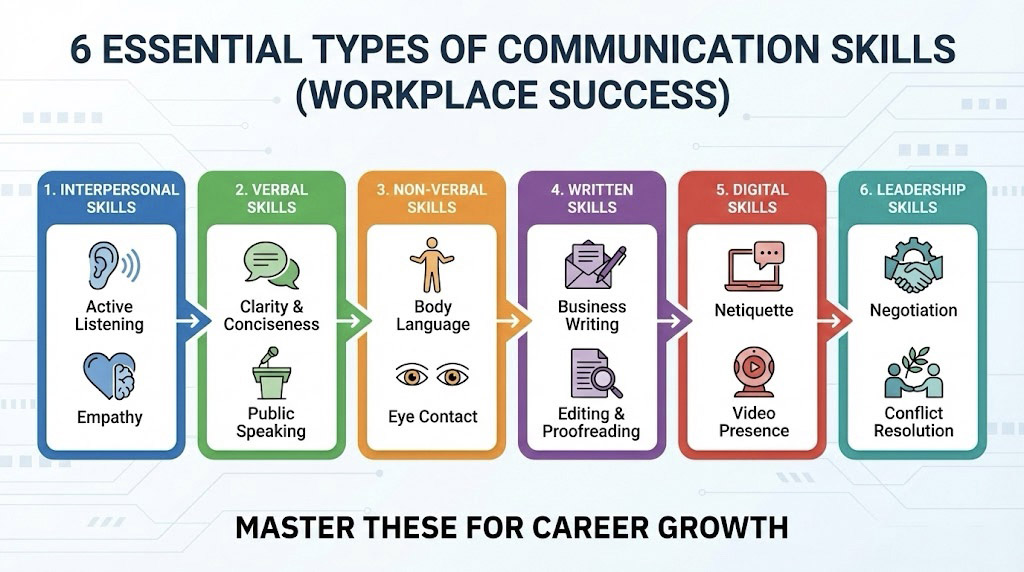
Core Interpersonal Skills (The Foundation)
Before you can lead a boardroom, you must be able to talk to one person.
Interpersonal skills are the foundation. These are the skills you use in one-on-one interactions. If you fail here, you will fail everywhere else.
Active Listening
Hearing is biological. Listening is a skill.
Most people listen to reply. They are just waiting for their turn to speak. That is not listening.
Active listening skills involve fully concentrating on what is being said. You listen to understand, not just to respond.
You nod. You ask clarifying questions. You summarize what they said. This makes the other person feel valued. It prevents misunderstandings. Above all, it builds trust faster than any sales pitch ever could.
Empathy
Can you read the room? Can you understand what someone is feeling, even if they don’t say it?
This is empathy. It is the ability to step into someone else’s shoes.
If a colleague is quiet during a meeting, an empathetic communicator notices. They might realize the colleague is stressed. Instead of pushing them, they offer support. This emotional intelligence (EQ) is often what separates a boss from a true leader.
Patience and Open-mindedness
We all have biases. We all get annoyed.
However, a skilled communicator knows how to pause. They keep an open mind. They don’t judge an idea immediately.
Patience allows you to hear the full story. It stops you from interrupting. It creates a safe space where others feel comfortable sharing their honest thoughts.
Verbal and Presentation Skills (The Delivery)
Now that you are listening, you need to speak.
Verbal skills are not just about having a good vocabulary. They are about delivery. It is about how you package your message so people actually want to open it.
Clarity and Conciseness
Have you ever sat through a presentation that went on forever? It is painful.
Great communicators value time. They follow the “KISS” principle: Keep It Simple, Stupid.
They avoid jargon. They use short sentences. They get to the point. Being concise shows respect for your listener. It ensures your core message doesn’t get lost in a sea of fluff.
Public Speaking
For many, this is a nightmare. In fact, glossophobia (the fear of public speaking) is one of the most common phobias in the world.
Nevertheless, it is a vital skill. You might not speak to a stadium, but you will speak to a team.
Public speaking is the ability to present ideas to a group with confidence. It involves managing your nerves. It involves structuring your speech logically. It transforms you from a silent worker into a visible leader.
Tone and Modulation
“It’s not what you said, it’s how you said it.”
Your voice is an instrument. You need to play it well.
A monotone voice puts people to sleep. A loud voice scares them. Skilled speakers modulate their tone. They whisper to create suspense. They raise their voice to show passion. This variety keeps the audience hooked.
Storytelling
Humans love stories. We have told them around campfires for thousands of years.
In business, storytelling is a superpower. Don’t just give data. Tell the story behind the data.
Instead of saying “Sales are up 10%,” say “We helped 500 new families this month.” Framing facts as narratives makes them memorable. It connects with people emotionally.
Non-Verbal Communication Skills (The Silent Signals)
You are speaking even when your mouth is closed.
Non-verbal skills are about controlling the signals your body sends. If your words say “I am confident” but your hands are shaking, people will believe your hands.
Body Language Control
Are your arms crossed? You look defensive. Are you slouching? You look bored.
Mastering non-verbal cues means using your body to reinforce your message. You stand tall. You use open gestures. You smile.
This makes you appear approachable. It makes you look like a leader before you even speak a word.
Eye Contact
This is tricky. Too little eye contact makes you look dishonest. Too much makes you look creepy.
The skill lies in the balance. You want to maintain friendly eye contact. It shows you are engaged. It shows you are confident.
In a group, you should sweep your eyes across the room. Make everyone feel included. It is a small detail that creates a massive impact.
Mirroring
This is a psychological trick.
Mirroring means subtly copying the other person’s behavior. If they lean forward, you lean forward. If they speak slowly, you slow down.
You do this naturally with close friends. In business, doing it consciously builds instant rapport. It signals to their subconscious brain that “we are the same.”
Written Communication Skills (The Documentation)
In the digital age, we write more than we speak.
Emails, reports, Slack messages, and proposals are the lifeblood of business. If you cannot write clearly, you are in trouble.
Business Writing
Writing for business is not like writing poetry. It is functional.
You need to know how to structure an email. You need to know how to write a subject line that gets opened. You need to use bullet points to make things scannable.
Following a proper business letter guide ensures your professionalism remains intact. A poorly formatted message looks lazy. A well-structured one looks competent.
Editing and Proofreading
Typos happen. However, too many typos destroy your credibility.
The skill here is attention to detail. It is the discipline to re-read your email before hitting send.
It shows you care. It shows you are precise. Nothing undermines a serious proposal faster than spelling the client’s name wrong.
Copywriting and Persuasion
Sometimes, you need to sell.
You might be selling a product. Alternatively, you might be selling an idea to your boss.
Copywriting is the skill of writing to persuade. It uses psychology. It highlights benefits, not just features. It includes a clear Call to Action (CTA). It moves the reader to do something.
Digital Communication Skills (The Modern Necessity)
The world changed in 2020. Remote work is here to stay.
This created a demand for a new set of skills. You might be charming in person, but are you charming on Zoom?
Netiquette
This is internet etiquette.
It involves knowing when to “Reply All” and when not to. It involves knowing that TYPING IN ALL CAPS IS SHOUTING.
It also means respecting boundaries. You don’t Slack message a colleague at midnight. Good digital manners prevent unnecessary conflict.
Video Presence
Video calls are awkward. We all know it.
However, skilled communicators manage it well. They look at the camera lens, not the screen. This simulates eye contact. They ensure their lighting is good. They mute themselves when not speaking.
These small technical adjustments show you are professional and tech-savvy.
Asynchronous Clarity
In remote teams, you often work at different times.
You cannot walk over to someone’s desk to explain your confusing email. Therefore, your written messages must be perfect the first time.
This skill involves over-communicating. You provide all the context. You anticipate questions. You make sure your message stands alone without needing you there to explain it.
Advanced Leadership Communication Skills
As you climb the career ladder, the stakes get higher. Managers need advanced tools.
Feedback Delivery
Giving praise is easy. Giving criticism is hard.
Leaders need to correct behavior without destroying morale. They often use techniques like the “Sandwich Method” (praise-critique-praise).
Understanding the necessity of feedback is crucial. Without it, teams stagnate. A skilled leader frames feedback as an opportunity for growth, not a punishment.
Negotiation and Persuasion
Business is a series of negotiations. You negotiate salaries. You negotiate deadlines. You negotiate contracts.
Negotiation is not about fighting. It is about finding a win-win solution.
You need to understand what the other party wants. You need to be firm but fair. Developing strong negotiation skills directly impacts your company’s bottom line.
Conflict Resolution
Put people together, and they will argue. It is human nature.
A leader cannot hide from conflict. They must resolve it.
This involves de-escalating tension. It involves mediating between two angry parties. You have to remain neutral. You have to focus on the problem, not the personalities. It is high-stress, but it keeps the team moving forward.

How to Improve Your Communication Skills?
You might be thinking, “I wasn’t born with these skills.”
Good news. No one is born with them. They are learned. Here is how you can start.
Practice
Join a club like Toastmasters. It is a safe place to fail. You can practice public speaking without risking your job.
Request Feedback
We are often blind to our own faults. Ask a trusted colleague, “Do I interrupt people?” “Is my writing clear?” Their answers might surprise you.
Observe Leaders
Look at the best communicators in your office. What do they do? Do they pause before answering? Do they smile? Copy them.
Conclusion
Communication is a vast ocean. We have meaning of communication skills covering everything from a simple nod to a complex negotiation.
It encompasses how we listen, how we speak, how we write, and how we act.
You don’t need to master all of these overnight. That is impossible. Instead, pick one. Maybe this week you focus on active listening. Next week, you focus on your email structure.
Step by step, you will get better. You will notice people responding to you differently. Meetings will become easier. Your ideas will get accepted.
These types of communication skills are the keys to the kingdom. Start polishing them today. Your future career will thank you.
Frequently asked questions
How do I know if I’m actually listening or just waiting to reply?
Test yourself: After someone finishes speaking, can you summarize their main point without asking them to repeat it? If you’re planning your response while they talk, you’re waiting to reply. True active listening means your mind is focused on understanding their words, not formulating yours. Practice by asking clarifying questions before you speak.
What if my tone sounds confident but I’m actually nervous during presentations?
Your nervousness won’t show if you control what you can: breathing, pacing, and voice modulation. Speak slightly slower than normal. Pause between sentences. Vary your pitch to stay engaging. The audience doesn’t know your heart is racing. They only hear and see what you project. Practice these techniques until they feel natural.
Is mirroring manipulative, or is it a legitimate communication technique?
Mirroring is legitimate when done subtly and genuinely. You’re not faking—you’re building natural rapport. We all mirror close friends unconsciously. In business, conscious mirroring just speeds up that connection. The key is keeping it subtle. Obvious copying feels fake and damages trust instead of building it.
Should I use storytelling in formal reports, or does it seem unprofessional?
Storytelling belongs in formal reports when used strategically. Open with data, then frame it as a narrative to explain impact. Instead of “Revenue declined 5%,” say “Three major clients left because we missed their deadlines.” This approach makes dry facts memorable and actionable. Balance storytelling with hard numbers for credibility.
How much eye contact is too much in a one-on-one conversation?
Aim for 60-70% eye contact in one-on-one settings. Look at them while they speak and while you respond. Brief glances away are natural and don’t signal dishonesty. Staring without breaking creates discomfort. If direct eye contact feels awkward, focus on their nose or forehead—they won’t notice the difference.
1 Comment
It’s really vry impressive to know those type of communication skills and implement it in our daily life to avoid misunderstanding and lack of trust toward one another .