


Close Menu
The Business CommunicationThe Business Communication
    What's Hot

    Glossophobia: How to Overcome the Fear of Public Speaking

    December 2, 2025

    The Power of Active Listening in Oral Communication: Skills & Techniques

    December 2, 2025

    Psychological Safety & Upward Communication: Building Trust at Work

    October 25, 2025
    Facebook X (Twitter)
    The Business CommunicationThe Business Communication
    Button
    • Basics
      1. Introduction
      2. Communication Skills
      3. Modern Communication
      4. View All

      Glossophobia: How to Overcome the Fear of Public Speaking

      December 2, 2025

      Types of Communication | Different Types of Communication

      October 7, 2025

      Qualities of good communication | Requirements of effective communication

      September 26, 2025

      Business Communication Roles: Key Functions And Examples

      September 9, 2025

      Meaning Of Cross-Cultural Communication

      October 19, 2025

      8 Ways To Improve Your Listening Skills

      August 11, 2025

      Various Styles Reading or Techniques of Reading

      July 6, 2025

      What Is Communication Style | Classification Of Communication Style

      March 16, 2025

      What Is The Video Conference? Advantages & Disadvantages of Video Conferencing

      April 30, 2025

      Advantages And Disadvantages Of Satellite Television In Business Communication

      November 16, 2024

      What Is Voicemail? Advantages and Disadvantages Of Voicemail

      October 13, 2024

      What Is Communication Satellite?

      August 12, 2024

      Glossophobia: How to Overcome the Fear of Public Speaking

      December 2, 2025

      The Power of Active Listening in Oral Communication: Skills & Techniques

      December 2, 2025

      Psychological Safety & Upward Communication: Building Trust at Work

      October 25, 2025

      Oral vs Written Communication: 7 Key Differences You Must Know

      October 21, 2025
    • Forms of Communication
      • Oral Communication
      • Non-Verbal Communication
      • Report Writing
    • Written Communication
      1. Letter Writing
      2. Circular Letter
      3. inquiry letter
      4. Ultimatum Letter
      Featured
      Written Communication

      Advantages and Disadvantages of Business Letter

      By Masudur RashidOctober 20, 2025
      Recent

      Advantages and Disadvantages of Business Letter

      October 20, 2025

      Inquiry Letter for Job Vacancy (Samples & Email Scripts)

      October 19, 2025

      Importance of Short Report – Short Report vs Long Report

      October 10, 2025
    • In Business
      1. Company Meeting
      2. Secretarial Functions
      3. View All

      Virtual Meetings for Companies: Tools, Etiquette & Challenges

      October 19, 2025

      Participants Responsibilities in Meeting

      October 7, 2025

      Meaning of Company Secretary | Appointment of Company Secretary

      May 29, 2025

      What is Annual Business Report – The Business Communication

      January 22, 2025

      What is Secretary? Types of secretary

      January 21, 2025

      What Is Organizational Communication – Types of Organizational Communication

      December 18, 2024

      Functions of a Private Secretary

      April 21, 2024

      Qualifications of a Private Secretary

      October 4, 2023

      Glossophobia: How to Overcome the Fear of Public Speaking

      December 2, 2025

      The Power of Active Listening in Oral Communication: Skills & Techniques

      December 2, 2025

      Psychological Safety & Upward Communication: Building Trust at Work

      October 25, 2025

      Oral vs Written Communication: 7 Key Differences You Must Know

      October 21, 2025
    • Internal Communication
      1. Downward Communication
      2. Horizontal Communication
      3. Upward Communication
      4. View All

      Essential Elements of Downward Communication: A Complete Guide for Managers

      August 17, 2025

      Key Objectives of Downward Communication in an Organization

      June 26, 2025

      The Effectiveness of Downward Communication: Factors, Barriers, and Measurement

      April 13, 2025

      Advantage And Disadvantages of downward communication

      April 10, 2025

      Upward vs Downward vs Horizontal Communication: Key Differences

      December 19, 2024

      Differences Between Horizontal and Vertical Communication

      September 21, 2024

      What is Horizontal Communication: Definition, Examples & Importance

      March 15, 2024

      Importance of Horizontal Communication (With Real-Life Examples)

      December 28, 2023

      Psychological Safety & Upward Communication: Building Trust at Work

      October 25, 2025

      Common Barriers to Effective Upward Communication and Solutions

      October 15, 2025

      Future of Upward Communication in Remote/Hybrid Workplaces

      May 29, 2025

      Upward vs Downward vs Horizontal Communication: Key Differences

      December 19, 2024

      Glossophobia: How to Overcome the Fear of Public Speaking

      December 2, 2025

      The Power of Active Listening in Oral Communication: Skills & Techniques

      December 2, 2025

      Psychological Safety & Upward Communication: Building Trust at Work

      October 25, 2025

      Oral vs Written Communication: 7 Key Differences You Must Know

      October 21, 2025
    The Business CommunicationThe Business Communication
    Home » Introduction » Glossophobia: How to Overcome the Fear of Public Speaking

    Glossophobia: How to Overcome the Fear of Public Speaking

    By Masudur RashidNo Comments8 Mins Read Introduction
    Facebook Twitter Reddit WhatsApp Telegram Pinterest LinkedIn Email
    Share
    Facebook Twitter Pinterest WhatsApp Email

    Your heart starts racing like a drum. Your palms get sweaty. Your mouth feels like you just ate a handful of sand. You look at the crowd, and your mind goes completely blank.

    Does this sound familiar?

    If so, you are not alone. In fact, you are part of a very large club. Millions of people would rather face a swarm of bees than stand on a stage with a microphone.

    This intense anxiety has a name. It is called Glossophobia, or the fear of public speaking. Statistics suggest that up to 75% of the population suffers from this to some degree. It affects students, CEOs, and everyone in between.

    Here is the truth. You do not need to be fearless to be effective. You just need to be functional. The goal is not to eliminate nerves entirely. The goal is to stop those nerves from ruining your message.

    Even those who fully understand the various types of oral communication in business still struggle with the fear of executing them. In this guide, we will dig into the psychology behind this fear. We will also provide you with immediate hacks and long-term strategies to regain your confidence.

    What Causes the Fear of Public Speaking?

    To fix the problem, we first need to understand the root cause. Why does speaking in front of a group feel so dangerous?

    Evolutionary Biology (Fight or Flight)

    Our brains are wired for survival. Thousands of years ago, being watched by a large group of eyes usually meant one thing. You were about to be eaten.

    When you stand on a stage, your primitive brain misinterprets the situation. It sees the audience as a predator pack. It triggers the “Fight or Flight” response. Your body floods with adrenaline. This is why you want to run away.

    Fear of Judgment

    We are social creatures. We crave acceptance. Public speaking opens us up to evaluation. We are terrified of making a mistake, looking foolish, or being rejected by the “tribe.”

    Previous Negative Experiences

    Maybe you forgot your lines in a school play when you were ten. Maybe you stumbled during a presentation at your first job. These memories stick. Your brain tries to protect you from feeling that shame again by making you anxious.

    Lack of Preparation

    Uncertainty breeds anxiety. If you do not know your material inside out, your brain fills the gaps with panic. Conversely, knowing exactly what to say provides a safety net.

    Symptoms of Glossophobia: Am I Just Nervous or Is It a Phobia?

    Being a little nervous is normal. Glossophobia is different. It is an intense, sometimes debilitating reaction. It manifests in three ways.

    Physical Symptoms

    These are the most obvious. You might experience uncontrollable shaking or trembling. Your heart rate spikes. You might feel nauseous or dizzy. Many people experience a dry mouth, making it physically hard to speak.

    Verbal Symptoms

    Your voice might quiver or crack. You might develop a stutter that you do not usually have. In severe cases, you might experience “mind blanking,” where you completely forget what you were going to say.

    Behavioral Symptoms

    This is where it hurts your career. You might actively avoid promotions that require speaking. You might call in sick on days you have to present. This avoidance reinforces the fear.

    Immediate Hacks to Manage Anxiety

    Imagine you are backstage. You are about to go on in five minutes. You are panicking. What do you do? Here are three science-backed hacks to calm down instantly.
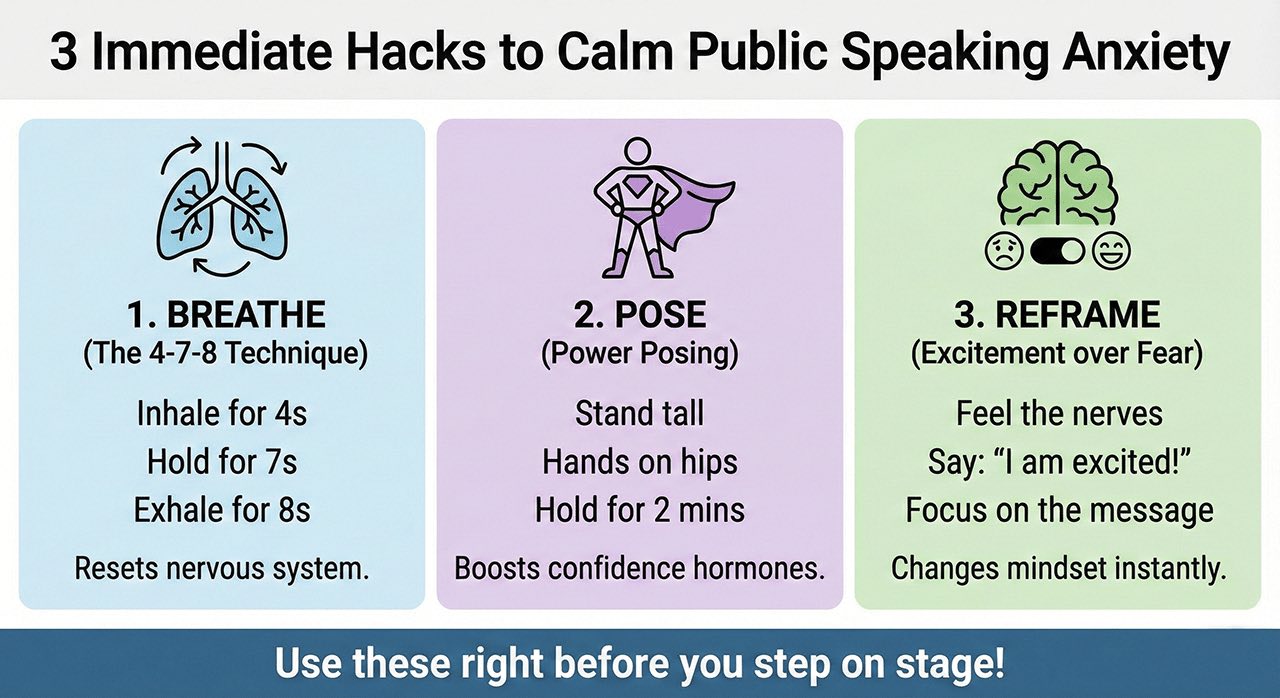
    Fear of public speaking

    1. The 4-7-8 Breathing Technique

    When you are scared, you take short, shallow breaths. This signals your brain that you are in danger. You need to hack your nervous system.

    Try this. Inhale through your nose for a count of 4. Hold that breath for a count of 7. Exhale slowly through your mouth for a count of 8.

    Repeat this four times. This forces your body to switch from the sympathetic nervous system (panic) to the parasympathetic nervous system (calm). It acts like a biological brake pedal for anxiety.

    2. Power Posing (The Amy Cuddy Method)

    Your body language shapes who you are. Research suggests that standing in a posture of confidence can actually change your brain chemistry.

    Before you walk into the room, find a private space. Stand like “Superman” or “Wonder Woman.” Feet apart, hands on hips, chin up. Hold this for two minutes. This can lower cortisol (stress hormone) and boost testosterone (confidence hormone).

    This connection between body and mind is powerful. It shows that non-verbal communication is not just for the audience, but for the speaker too.

    3. Reframe Nervousness as Excitement

    Physiologically, fear and excitement are almost identical. In both cases, your heart races and your palms sweat.

    The only difference is the story you tell yourself. Instead of saying, “I am so scared,” say, “I am so excited.”

    This is called anxiety reappraisal. It is much easier to convince your brain to move from high-arousal fear to high-arousal excitement than it is to calm down completely.

    Long-Term Strategies to Overcome Glossophobia

    The hacks above are band-aids. To truly cure the fear, you need long-term lifestyle changes.

    4. Preparation is the Antidote

    Nothing kills fear like competence. If you know your speech backward and forward, you have less to worry about.

    Do not just memorize the words. Understand the concepts. Practice your speech out loud. Time yourself. Anticipate questions. The more familiar you are with the material, the less brainpower you spend trying to remember it.

    If you struggle with articulation, you should work on specific ways to improve oral communication skills well before the presentation date.

    5. Practice in Low-Stakes Environments

    Do not make your first speech a keynote to 500 people. Start small.

    Practice in front of a mirror. Then, practice in front of your dog. Then, invite a friend over. Join a group like Toastmasters, where everyone is there to learn.

    You can also practice in casual settings at work. Use formal vs informal communication scenarios to your advantage. Speak up more during lunch or small team huddles. These low-pressure wins build your confidence muscle.

    6. Visualize Success

    Top athletes visualize the ball going into the net before they shoot. You should do the same.

    Close your eyes. Imagine walking onto the stage confidently. Imagine the audience smiling. Imagine delivering your closing line perfectly. Imagine the applause.

    Visualization primes your brain for success. It creates a neural pathway that makes the actual event feel familiar and safe.

    7. Shift Focus to the Audience

    Anxiety is selfish. It forces you to focus entirely on yourself. “How do I look? Do I sound stupid?”

    Stop thinking about yourself. Shift your focus to the audience. You are there to give them a gift. You have information that helps them.

    This is where active listening skills come into play. Even as a speaker, you need to read the room. By focusing on their needs and their reactions, you forget to be nervous about your own appearance.

    8. Accept Imperfection

    Here is a secret. The audience does not want you to be perfect. They want you to be real.

    If you stumble over a word, it is okay. If you lose your place, take a breath. No one is judging you as harshly as you judge yourself. In fact, admitting you are a little nervous can make you more relatable and likable.

    When to Seek Professional Help

    For most people, the tips above will work. However, for some, glossophobia is a severe phobia that impacts their daily life.

    If your fear is so intense that it causes panic attacks or prevents you from doing your job, consider seeking professional help.

    Therapy: Cognitive Behavioral Therapy (CBT) is highly effective for phobias. It helps you rewire the negative thought patterns that cause fear.

    Medication: Doctors sometimes prescribe beta-blockers. These block the physical symptoms of anxiety (like shaking), allowing you to get through the speech calmly. Always consult a doctor before taking medication.

    Conclusion

    Fear is a natural reaction. It does not mean you are weak. It means you are human. Even the world’s greatest orators feel a flutter in their stomachs before they speak.

    The difference is that they do not let the fear stop them. They use it as fuel.

    Remember, your voice matters. Your ideas deserve to be heard. Do not let glossophobia rob you of the opportunities that come with strong leadership.

    Start small. Practice these breathing techniques. Reframe your mindset. Overcoming this fear unlocks the massive advantages of oral communication, from persuasion to promotion.

    You have the tools. Now, take the stage.

    Frequently Asked Questions (FAQ)

    Is glossophobia a mental illness?

    It is classified as a social anxiety disorder. While it is a recognized condition, it is very treatable through therapy and practice.

    Can fear of public speaking be cured?

    Yes. Most people can overcome it completely or manage it to a point where it no longer hinders their performance. Exposure therapy (gradually practicing speaking) is the most effective cure.

    Why do I get a dry mouth when speaking?

    When you are anxious, your digestion shuts down as part of the fight-or-flight response. This stops saliva production. Keeping water nearby is a simple fix.

    Share. Facebook Twitter Pinterest LinkedIn WhatsApp Reddit Email
    Previous ArticleThe Power of Active Listening in Oral Communication: Skills & Techniques
    Masudur Rashid
    • Facebook
    • X (Twitter)
    • Instagram
    • LinkedIn

    👋 Hi, I am Masudur Rashid. I studied Management (Honors and Masters) but my real passion has always been Business Communication. Through this blog, I share simple tips, lessons, and resources to help students and professionals communicate with confidence.

    Related Posts

    Introduction 13 Mins Read

    Types of Communication | Different Types of Communication

    Introduction 13 Mins Read
    Introduction 03 Mins Read

    Qualities of good communication | Requirements of effective communication

    Introduction 03 Mins Read
    Introduction 207 Mins Read

    Business Communication Roles: Key Functions And Examples

    Introduction 207 Mins Read
    Introduction 598 Mins Read

    What is Communication Process? Steps And Examples Explained

    Introduction 598 Mins Read
    Add A Comment
    Leave A Reply Cancel Reply

    This site uses Akismet to reduce spam. Learn how your comment data is processed.

    Subscribe to Updates

    Get the latest business communication news from TBC.

    By signing up, you agree to the our terms and our Privacy Policy agreement.

    Check your inbox or spam folder to confirm your subscription.

    Top Picks

    Glossophobia: How to Overcome the Fear of Public Speaking

    Your heart starts racing like a drum. Your palms get sweaty. Your mouth feels like…

    Types of Communication | Different Types of Communication

    Here you will get about kinds or classification or Types of communication. There are several…

    Qualities of good communication | Requirements of effective communication

    Whenever the sender and also recipient understand the meaning connected with communication virtually just as,…

    Business Communication Roles: Key Functions And Examples

    In every workplace, communication is the glue that holds everything together. It connects teams, builds…

    Welcome to TheBusinessCommunication.com, your guide to clear and effective business communication. Here you will find simple lessons on report writing, letters, meetings, oral and written communication, and modern tools like email or virtual meetings. Our mission is to make learning communication easy, practical, and fun, so you can apply it in your studies, career, and everyday life.
    We're social. Connect with us:

    Facebook X (Twitter) YouTube LinkedIn RSS
    Top Insights

    Glossophobia: How to Overcome the Fear of Public Speaking

    The Power of Active Listening in Oral Communication: Skills & Techniques

    Psychological Safety & Upward Communication: Building Trust at Work

    Subscribe to Updates

    Get the latest business communication news from TBC.

    By signing up, you agree to the our terms and our Privacy Policy agreement.

    Check your inbox or spam folder to confirm your subscription.

    Copyright © 2025 TheBusinessCommunication. All Rights Reserved.
    • Home
    • About Us
    • Contact US
    • Our Authors
    • Privacy Policy
    • Terms and Conditions

    Type above and press Enter to search. Press Esc to cancel.