


If you think sales letters are old-fashioned, think again. Despite the rise of social media ads and automated email funnels, the business sales letter is still alive and kicking. Why? Because nothing beats a well-crafted message that feels personal, persuasive, and professional.
Think about it. A sales letter is not a flashy ad or a quick tweet. It is a carefully written piece of communication designed to convince someone to take action. That action could be buying a product, trying a service, or simply considering your brand in the future.
In this article, we will explore what sales letters are, why they are powerful, and how to write them effectively using proven persuasive techniques. To make your life easier, I will also share multiple sales letter templates you can copy and customize for your own business.
If you are still unsure why business letters matter in general, I suggest checking my earlier article on the importance of business communication through letters. That piece sets the foundation, while this one builds on how letters can be used not just for information, but also for persuasion.
What Is a Business Sales Letter?
A business sales letter is a written message that aims to persuade the reader to purchase a product, subscribe to a service, or support a cause. Unlike complaint or adjustment letters, which focus on resolving problems, a sales letter is about creating opportunities.
It works like a silent salesperson. The letter captures attention, explains the benefits, and encourages the reader to act. Above all, it allows you to make your pitch without interruption, giving the recipient time to consider your offer carefully.
Why Sales Letters Still Matter
You might be wondering, in a world of TikTok ads and Instagram reels, do people still read sales letters? The answer is yes. And here is why:
- They feel personal: A good sales letter addresses the reader directly and speaks to their needs.
- They are professional: Written communication still carries authority, especially in business.
- They build trust: Unlike a banner ad that disappears, a letter can be saved, re-read, and shared.
- They complement digital marketing: Sales letters can be mailed, emailed, or attached to a proposal.
Above all, sales letters combine the seriousness of formal communication with the creativity of marketing.
Key Characteristics of an Effective Sales Letter
Just like every business letter has a structure, sales letters also follow certain rules. Let’s break down the must-haves:
- Attention-grabbing headline – Your opening should make the reader curious enough to continue.
- Customer-focused message – Instead of boasting about your product, show how it solves the reader’s problem.
- Emotional appeal – People often buy with emotions and justify with logic.
- Logical reasoning – Provide facts, numbers, and proof to support your claims.
- Clear call to action – Tell the reader exactly what to do next.
If you need help understanding the formal structure of letters in general, check out my breakdown of the parts of a business letter. Those basics also apply here, but with a persuasive twist.
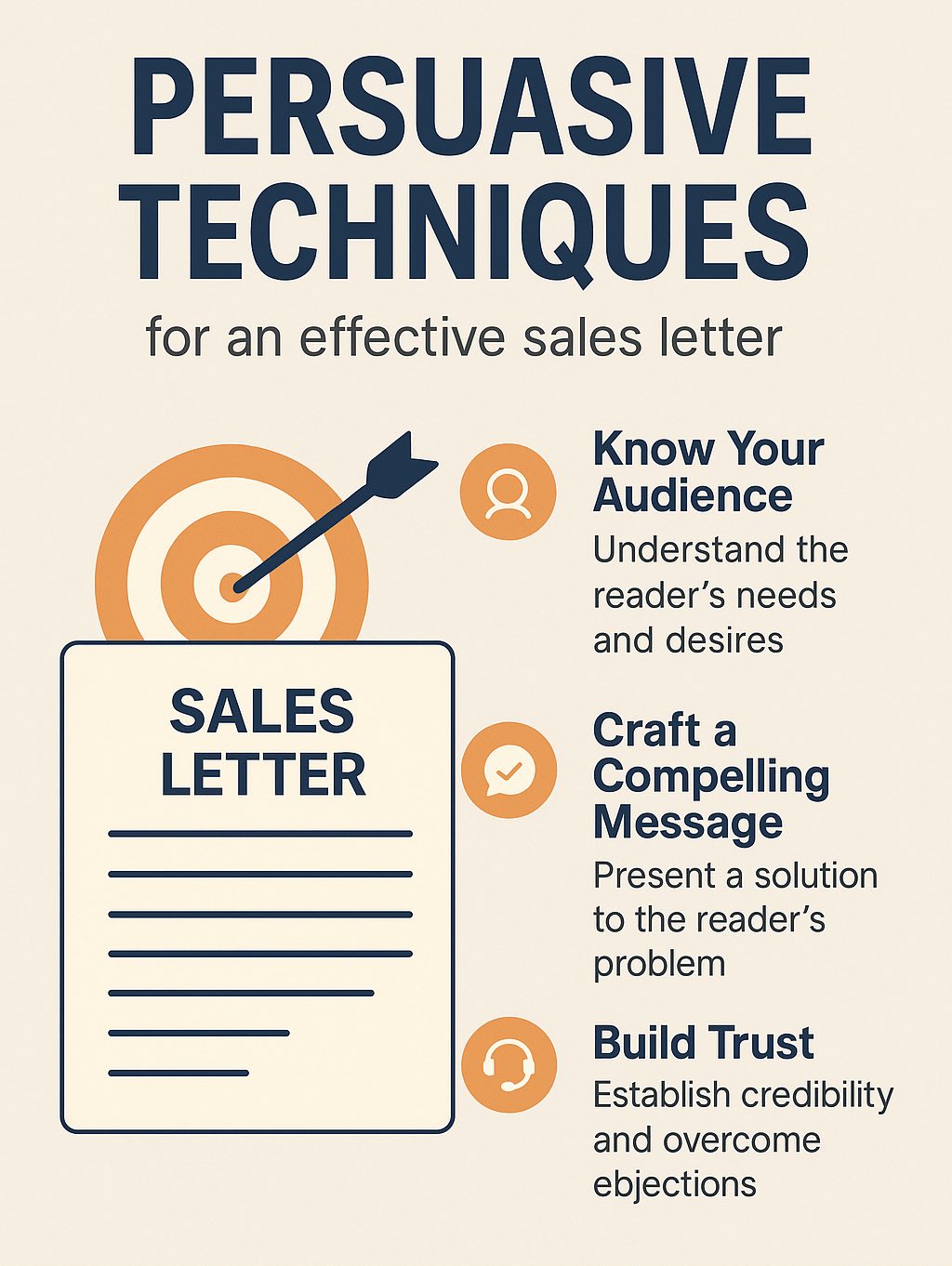
Persuasive Techniques in Sales Letters
Writing a sales letter is both an art and a science. You are not just delivering information, you are convincing someone to act. Here are some proven persuasive strategies.
1. The AIDA Formula
This classic model still works wonders:
- Attention: Start with a hook that makes the reader curious.
- Interest: Explain why the message is relevant to them.
- Desire: Highlight benefits that spark a “want” in the reader.
- Action: Guide them to act immediately.
2. Emotional Triggers
Use emotions like excitement, fear of missing out, or curiosity. For example, “Imagine doubling your sales in just 30 days.”
3. Social Proof
Include customer testimonials or case studies. Readers trust what others say more than what you say about yourself.
4. Scarcity and Urgency
Limited-time offers or exclusive deals push readers to act quickly.
5. Value Proposition
Focus on benefits over features. Instead of saying “Our software has advanced analytics,” say “Our software helps you track every sale so you never miss revenue opportunities.”
Structure of a Sales Letter (Step by Step)
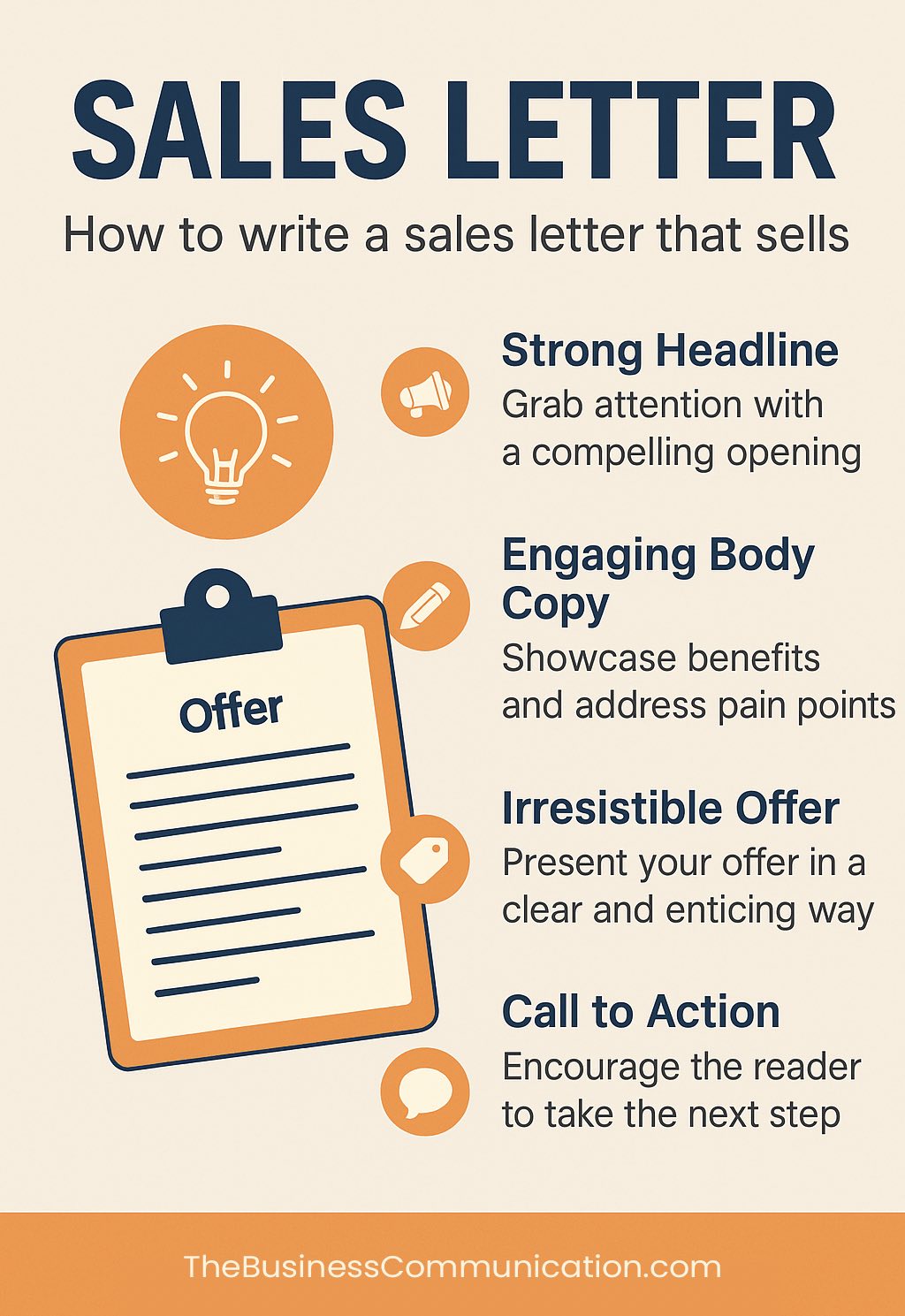
A sales letter is not just a block of text. It should follow a clear structure:
- Headline: Capture attention immediately.
- Introduction: Present a problem or need the reader has.
- Body: Explain how your product or service solves that problem. Build credibility with facts.
- Offer: Show value, add bonuses, or guarantees.
- Call to Action: Tell the reader what to do. Buy, call, visit, or sign up.
- Closing: End politely, reinforcing trust and professionalism.
For more on writing letters step by step, you can revisit my guide on drafting professional business communication.
Types of Business Sales Letters
Not all sales letters look the same. Depending on your audience and purpose, here are the common types:
- Direct sales letters: Sent to customers with a clear purchase offer.
- Introductory sales letters: Used when launching a new product or service.
- Follow-up letters: Sent after a meeting or inquiry to remind the customer.
- Promotional sales letters: Linked to discounts, events, or special seasons.
- B2B sales letters: Formal letters aimed at businesses, suppliers, or corporate clients.
Unlike complaint or inquiry letters, which deal with resolving or requesting information, sales letters actively drive action and revenue.
Examples of Effective Sales Letters (Templates)
Here are some practical templates to use and adapt.
Template 1: Product Launch Sales Letter
Subject: Introducing the Future of Clean Energy for Your Home
Dear [Customer’s Name],
Are you tired of high electricity bills? We have the solution. Our new solar panel system reduces energy costs by up to 60 percent within the first year.
Unlike other systems, ours comes with a 25-year warranty and free installation. Join hundreds of homeowners already saving money and protecting the environment.
Call us today at [Phone Number] to book a free consultation.
Sincerely,
[Your Name]
Template 2: Service Promotion Sales Letter
Subject: Double Your Online Sales in 60 Days
Dear [Client’s Name],
If you are looking for ways to grow your business online, we can help. Our digital marketing services have increased conversions by an average of 35 percent for our clients.
We are offering a limited-time discount on our social media advertising package. Sign up before [Date] and enjoy 20 percent off.
Contact us today at [Website or Phone Number].
Respectfully,
[Your Name]
Template 3: Follow-Up Sales Letter
Subject: Let’s Move Forward Together
Dear [Client’s Name],
It was a pleasure meeting you last week to discuss your expansion plans. Based on our conversation, I believe our financial consulting services can help you achieve your goals faster.
As promised, I am attaching a detailed proposal. I would love to schedule a follow-up call next week to finalize the details.
Looking forward to your response.
Sincerely,
[Your Name]
Template 4: Discount or Seasonal Sales Letter
Subject: Holiday Sale – Save Big on Office Supplies
Dear Valued Customer,
This holiday season, we are giving you more reasons to celebrate. Enjoy up to 40 percent discounts on office supplies until [Date].
Stock up now and save more for your business. But hurry, the offer is valid while supplies last.
Visit our store today or shop online at [Website].
Warm regards,
[Your Name]
Template 5: B2B Sales Letter
Subject: Partnership Opportunity for Long-Term Growth
Dear [Business Owner’s Name],
We are reaching out to introduce our logistics services designed specifically for growing businesses like yours. With nationwide coverage, real-time tracking, and competitive pricing, we can reduce your supply chain costs by up to 25 percent.
Let us discuss how we can support your expansion goals. Please contact me at [Phone Number] to schedule a meeting.
Sincerely,
[Your Name]
Common Mistakes to Avoid in Sales Letters
Even the best intentions can fail if your letter contains errors. Avoid these common pitfalls:
- Being too pushy: Aggressive language turns readers off.
- Overloading with features: Focus on benefits, not technical jargon.
- Poor structure: A messy letter loses credibility.
- Weak or missing CTA: Always tell the reader what to do next.
- Generic tone: Personalization is key. Use the recipient’s name whenever possible.
If you want a contrasting example of poor communication, check my collection of complaint letter samples. They show how customers react when businesses fail to communicate properly. A strong sales letter avoids creating such frustration in the first place.
Conclusion
The business sales letter remains one of the most effective tools for persuasion. By combining attention-grabbing headlines, emotional appeal, logical arguments, and strong calls to action, you can influence readers to act in your favor.
Think of a sales letter as more than a piece of writing. It is a bridge between your offer and your customer’s needs. With the right persuasive techniques and templates, you can turn potential leads into loyal clients.
To strengthen your overall understanding of professional communication, you might also want to revisit my guide on formal letter layouts. With that, plus the strategies in this article, you now have everything needed to craft compelling sales letters that work.
So, next time you want to win a customer, do not just rely on ads or flashy campaigns. Write a letter that connects, persuades, and converts. After all, sometimes the oldest tools are still the sharpest.
Frequently asked questions
Should I send a sales letter by mail or email?
Both work, but choose based on your audience. Email reaches busy professionals quickly and costs nothing. Printed mail stands out in crowded inboxes and feels more personal, especially for high-value offers. B2B sales often succeed with printed letters; consumer campaigns may perform better via email. Consider your target reader’s preference and your budget.
What if my sales letter gets no response?
Non-response usually means your headline didn’t grab attention, the benefit wasn’t clear, or the call to action was weak. Review whether you addressed a real problem the reader has. Test a stronger opening, simplify your offer, and make the next step obvious. Follow up once after two weeks, but don’t oversend.
How long should a sales letter be?
One page is ideal for most situations. Keep it under 400 words. Longer letters work only if every sentence builds toward the sale and includes strong proof or testimonials. Busy readers scan, so use short paragraphs, bold key points, and white space. Respect the reader’s time.
Can I use emotional appeals without sounding manipulative?
Yes, if the emotion matches a real need. Instead of fear-mongering, use excitement or relief. Example: “Stop wasting hours on manual reports” speaks to genuine frustration. Pair emotion with facts and proof. Avoid exaggeration or false urgency. Authentic emotion builds trust; manipulation destroys it.
Should I personalize every sales letter or use a template?
Use a template as your foundation, but personalize the opening and problem statement. Address the reader by name and reference their industry or situation if possible. Generic templates feel lazy, but fully custom letters aren’t scalable. Aim for the middle ground: consistent structure with targeted details.
What’s the best way to handle objections in a sales letter?
Address common objections before the reader thinks them. If price is high, explain ROI or offer payment plans. If skepticism is likely, include testimonials or a guarantee. Don’t ignore doubts; acknowledge them and provide proof. This shows you understand their concerns and have answers ready.