


Meeting minutes serve as the official written record of what happened during a meeting, capturing decisions, action items, and key discussion points. Understanding the different types of minutes and when to use each format helps you document meetings effectively while avoiding common pitfalls that waste time or create confusion later. This guide walks through the three main minute formats, essential preparation steps, and the approval workflow that keeps everyone accountable.
What are meeting minutes?
Meeting minutes are the official written summary of discussions, decisions, and action items from a meeting. They document what was decided, who is responsible for follow-up tasks, and what deadlines apply. Minutes serve as both an accountability tool and a legal record for organizations, particularly for board meetings, annual general meetings, and other statutory gatherings.
Minutes differ from transcripts. A transcript captures every word spoken during a meeting, while minutes summarize the outcomes. If someone says, “I think we should consider three vendors, compare their pricing, and then decide by next quarter,” the minutes would record: “Decision: Review three vendor proposals and select supplier by Q2.” This distinction matters because minutes focus on what was decided, not everything that was said.
According to Wikipedia’s entry on meeting minutes, formal minutes have been used for centuries to document organizational proceedings, with Robert’s Rules of Order establishing standardized practices still used today. Minutes remain essential for attendees who need to recall decisions and for absent members who must catch up on what they missed.
Three main formats of meeting minutes
Not all meetings require the same level of documentation. The three standard formats, action, discussion, and verbatim, serve different purposes.
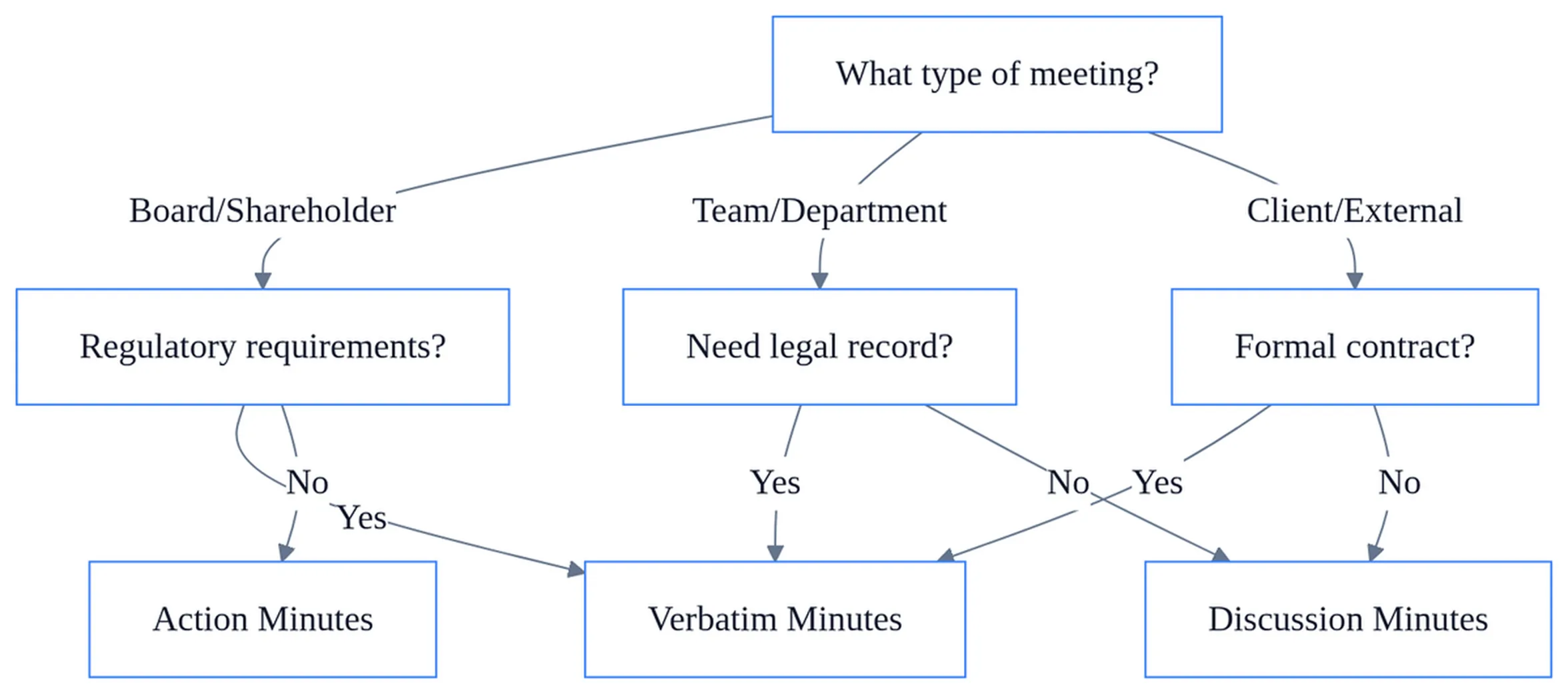
Action format captures only decisions and action items. This is the most common format for routine team meetings, project updates, and operational check-ins. A typical entry might read: “Decision: Launch pilot program in Dhaka office by March 15. Owner: Ravi. Budget: $12,000.” Action minutes are fast to prepare and easy to scan later when someone needs to verify what was decided.
Discussion format includes supporting context alongside decisions. When the reasoning behind a decision matters, perhaps for future reference or to document dissenting opinions, discussion minutes provide that background. For example: “After reviewing three proposals, the committee noted that Vendor B offered superior customer support but higher upfront costs. Decision: Select Vendor B with payment spread over 18 months to manage cash flow. Vote: 5 in favor, 2 opposed.”
Verbatim format records every word spoken, often with timestamps. This format is rarely used outside legal proceedings, regulatory hearings, or high-stakes board meetings where every statement may carry legal weight. Verbatim minutes are time-consuming to produce and difficult to navigate later. Unless your organization faces specific compliance requirements, avoid this format.
Your choice depends on meeting type and regulatory context. A weekly team standup needs action minutes. A board meeting discussing a merger might require discussion minutes. A disciplinary hearing could demand verbatim documentation. When in doubt, consult your organization’s governance policies or legal counsel.
Minutes of narration vs. minutes of resolution
Within the broader minute-taking framework, two specialized approaches exist: minutes of narration and minutes of resolution.
Minutes of narration provide a concise summary of all discussions, reports received, actions to be taken, and decisions made. They include names of participants, proposers and supporters of motions, discussion summaries, and voting patterns. This format works well for regular operational meetings where context and discussion flow matter.
Minutes of resolution record only the main conclusions reached at a meeting. They omit discussion details and focus exclusively on what was resolved. For example: “Resolved: The company will purchase the AEZ photocopier at a cost of $2,500, as recommended by the administrative manager.” This format is standard for annual general meetings and statutory meetings where formal approval is the primary goal.
Different types of company meetings call for different minute styles. Board meetings and AGMs typically use minutes of resolution to maintain legal clarity. Team meetings and project reviews usually employ minutes of narration to preserve context.
Pre-meeting preparation for effective minute-taking
Good minutes start before the meeting begins. The chairperson and secretary should collaborate at least 24 hours in advance to establish recording expectations.
First, confirm which format will be used. If the meeting agenda includes sensitive personnel matters or legal decisions, discussion or verbatim minutes may be necessary. For routine updates, action minutes suffice.
Second, designate a primary note-taker and a backup. In a 90-minute meeting, the primary note-taker may need a break or miss a critical point while formatting earlier notes. A backup ensures nothing falls through the cracks.
Third, clarify the level of detail expected for discussions. Should the secretary capture every suggestion made during brainstorming, or only the final decision? This conversation prevents over-documentation and under-documentation.
Finally, review agenda items in advance to anticipate decision points. If Item 4 involves approving a $50,000 budget, the secretary knows to capture the exact amount, who proposed it, who seconded it, and the vote tally.
Essential elements to capture in minutes
Regardless of format, certain elements must appear in every set of meeting minutes to make them useful and legally valid.
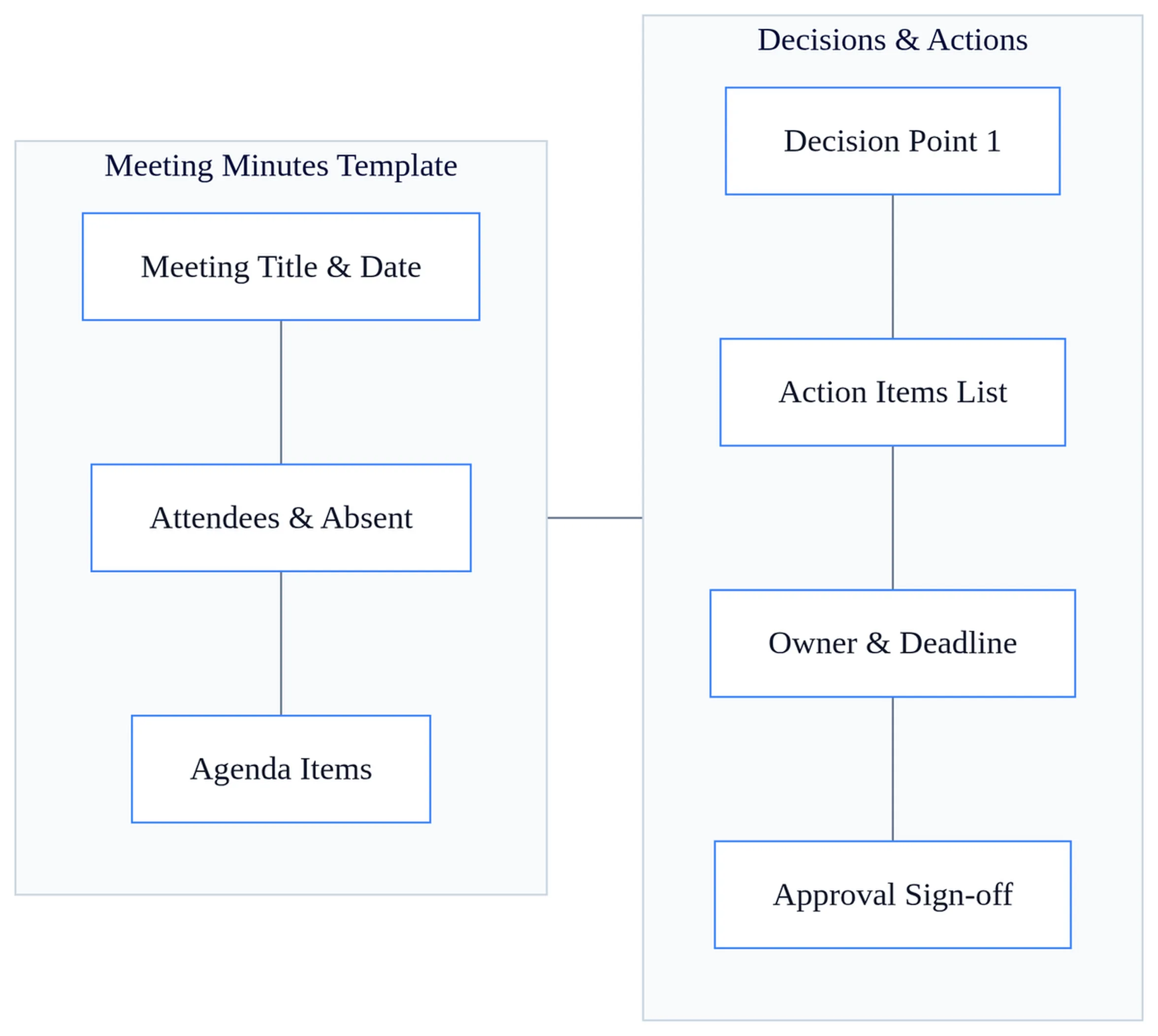
| Element | What to Include | Example |
|---|---|---|
| Header | Organization name, meeting type, date, time, location | Acme Corp Board Meeting, March 15, 2024, 2:00 PM, Conference Room B |
| Attendance | Names of attendees, absent members, quorum status | Present: J. Smith, R. Patel, L. Chen. Absent: M. Rodriguez. Quorum achieved (75%). |
| Agenda Items | Each item discussed with attribution of key speakers | Item 3: Marketing Budget. Presented by R. Patel. Discussion on Q2 allocation. |
| Decisions | What was decided, who proposed/supported, vote tallies if applicable | Decision: Approve $80,000 Q2 marketing budget. Proposed: R. Patel. Seconded: L. Chen. Vote: Unanimous. |
| Action Items | Specific tasks, owners, deadlines, expected outcomes | Action: R. Patel to finalize vendor contracts by March 22. Expected: Three signed agreements. |
| Closing | Date of next meeting, approval signature line | Next meeting: April 12, 2024, 2:00 PM. Minutes approved by: ___________ |
The action items section deserves special attention. Vague entries like “Team to explore options” create confusion. Specific entries like “S. Ahmed to research three CRM platforms and present comparison by April 5” create accountability. Each action item needs an owner, a deadline, and clear success criteria.
For more on tracking and executing these commitments, see our guide on action items and follow-up.
Common mistakes to avoid when writing minutes
Even experienced secretaries fall into predictable traps that reduce the usefulness of their minutes.
Over-documentation happens when the note-taker tries to capture every comment instead of summarizing key points. A 60-minute meeting should not produce 2,000-word minutes. If someone makes three similar points during a discussion, record the conclusion, not all three variations.
Under-documentation is equally problematic. Six months later, when someone asks “Why did we choose Vendor B over Vendor A?” the minutes should provide enough context to answer that question. “Decision: Selected Vendor B” is insufficient. “Decision: Selected Vendor B due to superior customer support and local presence, despite 15% higher cost” preserves the reasoning.
Delayed approval undermines the entire purpose of minutes. According to SHRM best practices, draft minutes should be circulated within 48 hours while details remain fresh in participants’ memories. Waiting two weeks turns minute approval into an archaeological exercise.
Misinterpretation occurs when the secretary records decisions inaccurately or ambiguously. If the meeting decided to “pilot the program in one location,” the minutes must specify which location. “Pilot in Dhaka office” is clear. “Pilot in one location” invites confusion.
Lack of objectivity means inserting personal opinions or editorial commentary. Minutes should never include phrases like “After much unnecessary debate” or “The team finally agreed.” Record what happened, not your judgment about it.
Incomplete action items are perhaps the most damaging mistake. “Marketing team to update website” lacks an owner and deadline. “S. Rahman to update homepage hero image and product descriptions by March 30” creates clear accountability.
Approval and distribution workflow
Writing the minutes is only half the job. The approval and distribution workflow ensures that minutes become official organizational records.

Draft minutes should be circulated within 48 hours of the meeting. This timeline is not arbitrary, it reflects the reality that memory fades quickly. After two days, participants begin to forget details and may struggle to verify accuracy.
The secretary and chairperson should review the draft together before wider distribution. The chair verifies that decisions are recorded accurately, while the secretary ensures formatting and completeness. This review typically takes 15-30 minutes and catches most errors before they reach the full group.
Minutes are formally approved at the next meeting, which is standard practice across most organizations. Attendees should have the opportunity to request corrections before approval. Common corrections include clarifying ambiguous language, adding context to decisions, or fixing factual errors like budget amounts or dates.
Use digital distribution methods like Google Docs, OneDrive, or SharePoint to make minutes accessible to all stakeholders. Email attachments get lost. Cloud-based documents remain available and searchable. Version control matters: the approved version should be clearly marked and the draft version archived or deleted.
Archive approved minutes securely for legal and compliance purposes. Many jurisdictions require organizations to retain meeting minutes for seven years or longer. Board minutes may face even stricter retention requirements. Consult your legal counsel about specific retention policies.
Minutes vs. transcripts: key differences
People often confuse minutes with transcripts, but they serve different purposes.
Minutes are summaries that record what was decided. Transcripts are verbatim records that capture what was said. If a board member delivers a five-minute speech about market conditions before proposing a motion, the minutes might devote one sentence to that context: “After reviewing current market conditions, J. Smith proposed expanding into Southeast Asia.” The transcript would include every word of the five-minute speech.
Minutes are concise, typically ranging from 500 to 1,500 words for a one-hour meeting. Transcripts are lengthy, often exceeding 5,000 words for the same meeting. Minutes highlight decisions and action items. Transcripts preserve the entire discussion, including tangential comments, procedural questions, and informal banter.
Minutes are standard business practice for routine meetings, board meetings, and organizational gatherings. Transcripts are used primarily in legal proceedings, court hearings, and regulatory inquiries where every statement may carry legal significance. Creating transcripts for routine business meetings wastes time and money.
Minutes should exclude tangential discussion unless organizational rules specifically require it. If the team spends 10 minutes debating coffee preferences before addressing the agenda, those 10 minutes do not belong in the minutes. Record the substance, not the noise. This is one area where minutes differ from formats like business memos, which may include more contextual detail.
What most people get wrong: they assume more detail is always better. In minute-taking, more detail is often worse.
The goal is not to recreate the meeting for someone who was absent. The goal is to document decisions and commitments so the organization can move forward. A lean, focused set of minutes that someone can scan in three minutes beats a comprehensive document that no one reads. Effective meeting minutes balance completeness with brevity, capture decisions without editorializing, and create accountability through specific action items. The format you choose should match your meeting type. Prepare before the meeting, distribute within 48 hours, and approve at the next session.
Frequently asked questions
Should I use action or discussion minutes for a routine team meeting?
Use action minutes for routine team meetings unless decisions involve budget, policy changes, or dissenting opinions. Action minutes are faster to prepare and easier to scan later. Switch to discussion minutes only when you need to document the reasoning behind a decision or preserve context for future reference or compliance purposes.
What if the meeting secretary gets sick mid-meeting?
This is why designating a backup note-taker before the meeting starts is critical. The backup should sit near the primary secretary and follow along with the notes. If the primary secretary leaves, the backup seamlessly continues capturing decisions and action items without losing detail or momentum.
Can I use action minutes for a board meeting or AGM?
No. Board meetings and AGMs require discussion or minutes of resolution format to meet legal and governance standards. Action minutes lack the context and voting detail that regulators and shareholders expect. Check your organization’s governance policies or consult legal counsel before choosing a format for formal meetings.
How detailed should I record brainstorming discussions in minutes?
Clarify this with the chairperson before the meeting. For action minutes, capture only the final decision. For discussion minutes, include key suggestions that shaped the outcome, but skip tangential comments. Avoid documenting every idea unless the meeting involves legal or compliance matters requiring comprehensive records.
What’s the difference between minutes of narration and minutes of resolution?
Minutes of narration summarize all discussions, reports, and voting patterns—useful for team meetings where context matters. Minutes of resolution record only final conclusions—standard for AGMs and statutory meetings where formal approval is the goal. Your meeting type determines which format applies.
14 Comments
whether narrative,verbatim action or resolution, if only you understand what the meeting is all about, your brain is bigger than you think and you can always do it. Trust yourself.
please what about an action minute as a type of minute
How do minutes look like
Do the different types of minutes have different ways of writing format?
I need preparation of minutes
It was really nice explained. I like the way it was explained. Thank you. #BABU
Keep me posted on secretaries jobs and roles for effectiness at work
nice
please what is minuting in a file. what difference does it has with minuting in a meeting
How does one compile “Analytical meeting minutes?” Or formulate a template for one?
IF TO SAY, MENUTES OF A MEETING IS VERBATIM, MINUTES TAKER CANNOT TAKE OR EVEN JOT DOWN ALL WHAT HAVE BEING DISCUSS.
plz i need help i have not work in an office before,but i just recieve a job offer to work as a secertary plz what are the things i should know to work as a secertary in a company?
i do training on this sort of position.
Hi pls am a newly posted secretary I need a training on recording of minute