


Have you ever been so frustrated with someone that you felt like saying, “This is your last chance, or else”? That feeling is exactly where an ultimatum letter comes in. In business and professional life, we often face situations where we must put our foot down politely but firmly. The ultimatum letter is the perfect tool for such moments.
In this guide, we will explore everything about ultimatum letters. You will learn what they are, why they matter, how to write them, and even see a sample you can use. By the end of this article, you will feel confident enough to write one yourself without sounding rude or unprofessional.
Definition of an Ultimatum Letter
Let us start with the basics. An ultimatum letter is a formal written message where you clearly state a problem, the action you expect, and what will happen if that action is not taken within a set time. Think of it as the “final notice” in polite words.
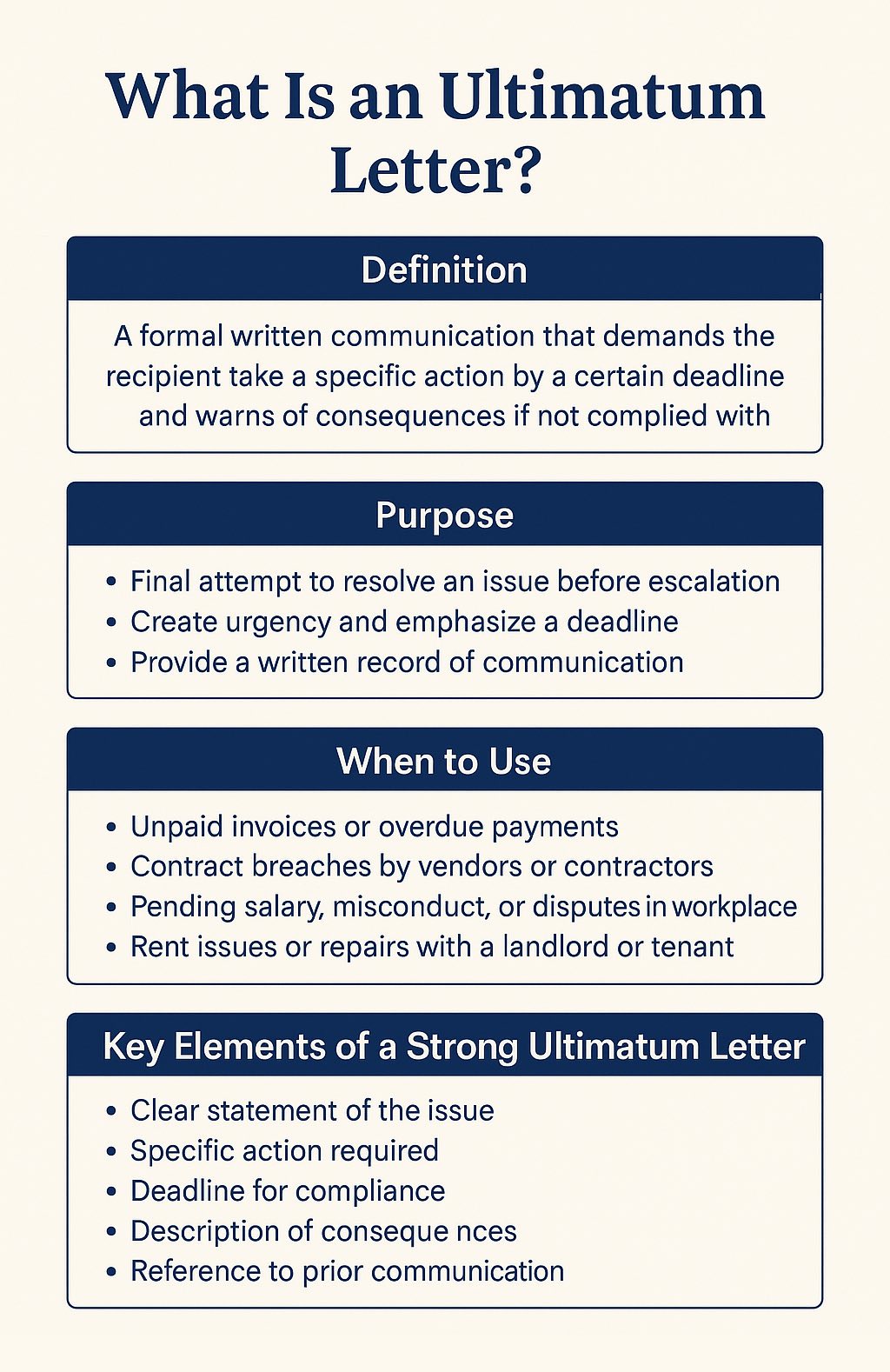
Unlike casual warnings or angry texts, an ultimatum letter is professional. It is usually the last step before taking serious action, like legal proceedings, contract termination, or disciplinary action. The letter works as a formal record that you tried to resolve the issue before moving forward.
How to Write an Ultimatum Letter (7 Steps)
These steps apply to ultimatum letters in business and workplace settings.
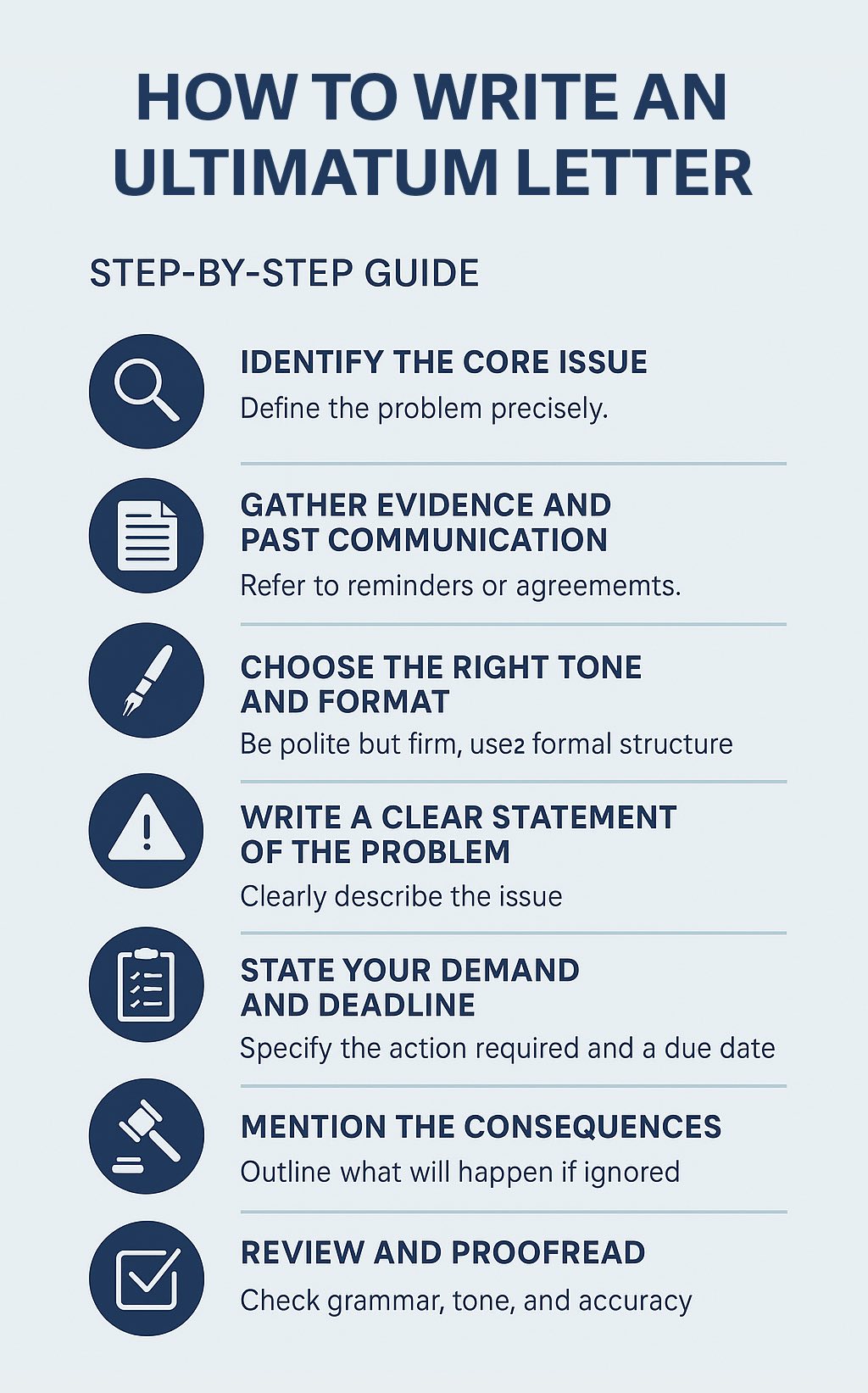
- Identify the core issue. Be exact about the problem. Write “Payment for invoice #567 is now 30 days overdue,” not “You are always late with payment.”
- Gather evidence and past communication. Note the dates of earlier reminders, calls or emails, and attach copies if useful. This shows you have been patient and builds a record in case the matter goes to HR, a lawyer or arbitration.
- Choose the tone and format. Use a formal business letter layout. If you send it by email, use a clear subject line such as “Final Notice Regarding Pending Payment.” Sound firm, not angry.
- State the problem in the opening line. Skip the background story, for example: “I am writing regarding the unpaid balance on invoice #567.” For behavior issues, stay respectful: “We have noticed repeated delays in project deliverables despite earlier reminders.”
- State your demand and deadline. Say exactly what you expect and give a specific date instead of “as soon as possible.”
- Mention the consequences. Say what will happen if the deadline is missed, in professional words rather than threats.
- Review and proofread. Check spelling and grammar, and read the letter aloud. If it sounds angry, rewrite it. For sensitive or legal matters, ask a lawyer to review it before sending.
The wording you choose decides whether the letter sounds firm or hostile. Compare these phrasings:
| Instead of | Write |
|---|---|
| “You are always late with payment.” | “Payment for invoice #567 is now 30 days overdue.” |
| “Pay as soon as possible.” | “Please transfer the payment by [exact date].” |
| “If you do not pay, I will sue you.” | “If payment is not received by the specified date, we may be forced to take legal action.” |
| “Or else we stop working with you.” | “If the payment is not received by the deadline, we will be left with no choice but to suspend further services.” |
Purpose of an Ultimatum Letter
So why send one in the first place? The main purpose is to give the other person one final opportunity to take action. It is a way of saying, “We are serious, but we are still open to resolving this peacefully.”
Ultimatum letters are also important for documentation. If things go legal, you can show that you gave the other side fair warning. This makes you look reasonable in the eyes of a court, a mediator, or even your HR department.
Above all, such letters help create urgency. When someone sees a clear deadline in writing, they are more likely to act quickly. Without this nudge, the problem might continue forever.
When to Use an Ultimatum Letter
You should not send ultimatum letters for every little problem. They are best used when previous reminders or requests have failed. Here are some common situations:
- Business Issues: For example, a client who has not paid an invoice for months. You can write, “Please settle payment by [date], or we will suspend services.”
- Workplace Situations: Maybe your employer is delaying your salary, or you need official confirmation of your job status. An ultimatum letter can push HR to take action.
- Vendor or Contractor Problems: If a contractor is delaying a project, an ultimatum letter can motivate them to finish on time.
- Personal Matters: You might use it with a landlord for urgent repairs, or with a tenant who is behind on rent.
However, there are times you should avoid sending one. If you have never spoken to the person about the issue, try a polite reminder first. Otherwise, you risk sounding aggressive. Also, if you are not ready to take the action mentioned in your letter, do not send it. Empty threats hurt your credibility.
Key Elements of a Strong Ultimatum Letter
A good ultimatum letter is clear, polite, and to the point. Here are the must-have parts:
- Clear Statement of the Issue: Start by briefly explaining the problem. For instance, “Payment for invoice #123 is now 45 days overdue.”
- Reference to Past Communication: Mention earlier discussions or reminders. This shows you tried to resolve the issue before.
- Specific Action Required: State what you expect. “Please transfer the payment amount of $2,000.”
- Deadline: Give a reasonable time frame, like “within 7 business days.”
- Consequences: Politely state what you will do if they ignore the letter. “If payment is not received, we may pursue legal action.”
- Polite Closing: End professionally, like “We appreciate your immediate attention to this matter.”
By including these elements, you keep the letter professional and effective.
Benefits of Sending an Ultimatum Letter
Ultimatum letters may sound scary, but they have many benefits:
- Creates a Written Record: If things go to court, you can prove that you acted fairly.
- Encourages Quick Resolution: Deadlines create a sense of urgency that emails or calls sometimes fail to create.
- Shows Professionalism: A well-written letter shows you are serious but respectful.
- Reduces Misunderstandings: Putting everything in writing avoids “he said, she said” situations.
Risks and Mistakes to Avoid
Even a good tool can backfire if misused. Here are common mistakes:
- Being Too Aggressive: Avoid sounding angry. A letter full of threats can damage relationships permanently.
- Vague Language: Do not say “soon” or “ASAP.” Give an exact date.
- Unrealistic Demands: Asking for something impossible in a short time will only make things worse.
- Skipping Previous Steps: If you never communicated before, an ultimatum letter might shock the recipient.
- Not Following Up: If the deadline passes and you do nothing, the letter loses its power.
Remember, your goal is resolution, not revenge.
Ultimatum Letter Format (Structure)
Let us break down the basic format. Your letter should follow this simple structure:
- Your Name & Contact Details
- Date
- Recipient’s Name & Address
- Subject Line: “Final Notice Regarding Pending Payment”
- Greeting: “Dear [Name],”
- Body:
- First paragraph: State the issue and refer to past communication.
- Second paragraph: Clearly state your demand and deadline.
- Third paragraph: Explain what will happen if the issue is not resolved.
- Closing: “Sincerely” or “Best regards”
- Signature
Keeping the structure neat helps the reader understand the seriousness of your message.
Sample Ultimatum Letter (Example)
Unpaid Invoice (Final Payment Demand)
Here is a simple example you can use as inspiration:
[Your Name]
[Your Address]
[City, State, ZIP]
[Email Address]
[Date]

[Recipient Name]
[Recipient Address]
[City, State, ZIP]

Subject: Final Notice Regarding Pending Payment

Dear [Recipient Name],

This is to formally remind you that payment for invoice #123 dated March 1, 2024, amounting to $2,000, is now 45 days overdue. We previously sent reminders on April 1 and April 15, but we have not received a response.

We kindly request that you settle the outstanding payment within seven business days from the date of this letter. If we do not receive payment by [specific date], we will be left with no option but to initiate legal action to recover the amount.

We hope you take this final opportunity to resolve the matter quickly. Please contact us if you have any questions or require clarification.

Sincerely,
[Your Name]
You can tweak the tone and details to match your situation.
Employer to Employee (Absence or Misconduct)
[Company Letterhead]
[Date]

[Employee Name]
[Designation, Department]

Subject: Final Notice Regarding Unauthorized Absence
Reference: Our letters of [date] and [date]

Dear [Employee Name],

You have been absent from work without approval since [date]. We wrote to you on [dates] asking you to explain your absence, but we have not received a reply.

Please report to the HR Department or send a written explanation by [exact date]. If we do not hear from you by this date, the company will take disciplinary action in line with [company policy / your employment contract].

Sincerely,
[Name]
[Designation, HR Department]
Polite Ultimatum from Employee to Employer
[Your Name]
[Designation, Department]
[Date]

[Manager or HR Manager Name]
[Company Name]

Subject: Request for Payment of Outstanding Salary
Reference: My emails of [date] and [date]

Dear [Name],

I am writing about my salary for [month(s)], which has not yet been paid. I raised this with [HR / my manager] on [dates], but I have not received payment.

I respectfully request that the outstanding amount be paid by [exact date]. If it is not paid by then, I will have to [state a realistic step, e.g., raise a formal grievance].

I value my role here and hope we can settle this quickly.

Sincerely,
[Your Name]
Ultimatum Letter vs Final Notice vs Demand Letter
These terms overlap. A final notice is the last reminder before action is taken, usually about an unpaid bill. A demand letter formally asks for payment or performance and is often the step before a legal claim. “Ultimatum letter” is the broader term for any letter that sets a deadline and states what will happen if it is missed, whether the issue is payment, workplace conduct or a vendor dispute.
Tips for Writing an Effective Ultimatum Letter
- Be Polite but Firm: You can be serious without being rude.
- Keep it Concise: Aim for one page. Long letters lose impact.
- Proofread: Grammar mistakes make you look unprofessional.
- Seek Legal Advice: For sensitive issues, ask a lawyer before sending.
- List Multiple Demands: Use bullet points if you are asking for more than one thing.
- Get Proof of Delivery: Send it by registered post or with an email read receipt.
- Keep Copies: Save a copy of everything you send for your records.
Writing like this shows that you are professional and reasonable, which increases your chance of success.
Conclusion
An ultimatum letter may sound harsh at first, but it is one of the most professional ways to solve problems. It protects your rights, creates urgency, and shows that you are willing to take action if needed. Whether you are dealing with unpaid invoices, delayed salaries, or unresponsive vendors, a well-written ultimatum letter can help you get results without unnecessary drama.
So next time you feel stuck, do not just get angry. Write a clear, polite ultimatum letter and give the other side a chance to fix things. You might be surprised at how quickly they act.
Frequently Asked Questions
What is an example of an ultimatum?
A typical business ultimatum reads: “Please settle payment by [date], or we will suspend services.” It names the problem, the action required, the deadline and the consequence. See the sample letter and templates above for complete examples.
How do you politely give an ultimatum?
Use clear, direct language without emotional words or threats. Avoid words like “must,” “demand,” or “or else.” Instead, say “Please complete this by [date]” and “If this is not resolved, we will [specific action].” Stay professional, acknowledge their perspective briefly, and focus on the problem, not the person.
Is an ultimatum letter legally binding?
Not always, but it creates proof that you tried to solve the issue before taking further steps.
Can I send an ultimatum letter by email, or does it need to be printed?
Email is acceptable and often preferred for speed and documentation. However, if the issue is serious or the recipient ignores emails, send a printed letter via certified mail. This creates stronger proof of delivery. For legal matters, certified mail is safer because it provides an official record that they received it.
Should I send an ultimatum letter if I haven’t tried talking to them first?
No. An ultimatum letter works best after previous attempts to resolve the issue. If you haven’t communicated before, start with a polite reminder or direct conversation. Jumping straight to an ultimatum without prior contact risks sounding aggressive and may damage the relationship unnecessarily. Save the ultimatum letter for when other approaches have failed.
How long should I give them to respond before taking action?
A reasonable deadline is typically 7 to 14 business days, depending on the situation. For urgent matters like safety issues, 3 to 5 days may be appropriate. For complex requests, you might allow 30 days. The key is being realistic about how much time they actually need to comply, not just making it short to sound tough.
What if the recipient ignores it?
Wait until the deadline passes, then follow up immediately to show you are serious. You must follow through with the action you mentioned, like legal proceedings.
What if I’m not actually ready to follow through on the consequences?
Do not send the letter. Empty threats destroy your credibility and make future communication less effective. The recipient will ignore you next time because they know you won’t act. Only mention consequences you are genuinely prepared to pursue. If you might pursue legal action, you can say “we may pursue legal remedies.” If you are unsure about your options, consult a lawyer before sending the letter.