


You might have the best ideas in the room. You might be the smartest person on the team. But if you cannot articulate those ideas, they simply do not exist.
We have all been there. You stand up to speak, and suddenly your palms are sweaty. Your mind goes blank. You start rambling, and you can see the listeners tuning out. It is a frustrating feeling.
Many professionals struggle with anxiety, filler words, or a lack of clarity. This limits their career growth significantly. They often watch others get promoted simply because those people know how to talk.
Here is the good news. Improving oral communication is a learnable skill. It is not some magical talent you are born with. It is a muscle. The more you exercise it, the stronger it gets.
In this guide, we will move beyond theory. We will walk you through 12 proven, actionable tips to transform the way you speak. Whether you are presenting to a board or chatting with a colleague, these articulate speaking techniques will help you command respect.
If you are new to the basics, you should start by reading our comprehensive oral communication guide. This will set the foundation for the advanced tips below.
Phase 1: Preparation and Mindset
Most people think speaking starts when they open their mouths. In reality, great communication starts long before that. It starts in your mind.
1. Know Your Audience and Context
The biggest mistake speakers make is using a “one size fits all” approach. You cannot talk to your CEO the same way you talk to your best friend.
Before you say a word, ask yourself: Who am I talking to? What do they care about?
If you are speaking to senior executives, be brief. Focus on results and bottom lines. If you are speaking to a team of engineers, focus on details and data. Adapting your style is crucial.
This is where understanding the distinction between formal vs informal communication becomes vital. Using a casual tone in a formal setting can damage your credibility instantly.
2. Organize Your Thoughts (The “Rule of Three”)
Have you ever listened to someone who just keeps talking without a clear point? Do not be that person.
Rambling happens when you think while you are speaking. Instead, take a moment to organize your thoughts. A great trick is the “Rule of Three.” The human brain loves patterns of three.
Before you speak, structure your message into three key points. For example: “I recommend this software because it is cheaper, faster, and more secure.”
This adds structure. It helps your audience follow along. This practice directly applies the principles of clarity and coherence we discussed in our post on the 7 Cs of communication.
Phase 2: Verbal Mastery
Now that your mind is ready, let’s focus on the words you choose. You do not need a dictionary in your head to be a great speaker. You just need precision.
3. Expand Your Vocabulary (But Keep It Simple)
There is a misconception that big words make you sound smart. They usually don’t. They often just confuse people.
To improve oral communication skills, you need a strong vocabulary. However, the goal is clarity, not complexity. Use precise words that paint a picture.
Instead of saying “The project was good,” say “The project was efficient.” Instead of saying “We need to talk about this,” say “We need to address this bottleneck.”
Precise language eliminates ambiguity. It ensures your message is received exactly as you intended.
4. Eliminate Filler Words (“Um,” “Ah,” “Like”)
Nothing kills authority faster than filler words. “I, um, think that, like, we should, ah, maybe go with this plan.”
Fillers signal uncertainty. They tell the listener that you are not confident in what you are saying. We use them because we are afraid of silence. We feel the need to fill every second with sound.
The solution is the “Pause Technique.” When you are searching for a word, just stop. Pause. Silence is powerful. It makes you look thoughtful and in control.
5. Be a Storyteller, Not a Databank
Humans are wired for stories. We have been telling them around campfires for thousands of years.
If you rattle off twenty statistics, your audience will forget them in five minutes. If you tell a story about how those statistics affect a real customer, they will remember it for weeks.
Use anecdotes. Use analogies. Make your business points relatable. For instance, instead of saying “our service is fast,” tell a quick story about a client who saved a deadline because of your speed.
Phase 3: Delivery and Non-Verbal Impact
You have the right thoughts and the right words. Now, how do you deliver them? Your voice and body are your instruments.
6. Master Your Tone and Pitch
Have you ever listened to a robot speak? It is monotonous. It puts you to sleep.
Your voice needs variety. This is called modulation. When you want to emphasize a point, raise your volume slightly. When you want to share something serious, lower your pitch.
Think of your voice like music. If it stays on one note, it is boring. If it moves up and down, it keeps the listener engaged.
7. Control Your Speed (Pacing)
Nerves make us speed up. When we are anxious, our adrenaline kicks in. We talk faster and faster to get it over with.
This is a problem for two reasons. First, you sound nervous. Second, the listener cannot keep up with you.
Practice speaking slightly slower than you think is necessary. Enunciate your words. Give your audience time to digest what you are saying. A controlled pace signals confidence.
8. Align Your Body Language
Your words say “I am confident,” but your hunched shoulders say “I am scared.”
Communication is a full-body experience. Your body language must match your words. Stand tall. Keep your chest open. Use hand gestures to emphasize points naturally.
Most importantly, maintain eye contact. This builds trust. If you look at the floor or the ceiling, you look dishonest or unprepared.
Be aware that these rules change depending on the medium. As we explored in the types of oral communication in business, eye contact on a Zoom call means looking at the camera lens, not the screen.
Phase 4: Interaction (The Two-Way Street)
Communication is not a monologue. It is a loop. To be a great speaker, you must also be a great receiver.
9. Practice Active Listening
It sounds counterintuitive, but the best speakers are usually the best listeners.
If you are only waiting for your turn to speak, you are not communicating. You are just broadcasting. Active listening involves fully concentrating on the other person.
Nod your head. Ask clarifying questions. Paraphrase what they said to ensure you understood. This builds rapport. It makes the other person feel valued. To sharpen this specific skill, you can use our techniques for improving listening ability.
10. Read the Room (Emotional Intelligence)
Have you ever seen someone keep talking even though everyone looks bored?
You must be observant. Watch the faces of your listeners. Are they nodding? Are they checking their phones? Are they frowning?
If they look confused, stop and ask, “Does that make sense?” If they look bored, skip to the main point. Being able to pivot based on the audience’s reaction is a hallmark of an advanced communicator.
Phase 5: Continuous Improvement Habits
You cannot read this article and instantly become a master. It takes work. Here are the habits that will get you there.
11. Record and Critique Yourself
This is painful, but it works.
Use your smartphone to record yourself practicing a presentation. Then, watch it.
You will notice things you never realized. “Do I really say ‘um’ that much?” “Do I really sway back and forth like that?” Seeing yourself from the outside is the fastest way to correct bad habits.
12. Ask for Brutally Honest Feedback
Your friends and family might be too nice to tell you the truth. You need honest feedback.
Ask a trusted colleague or mentor. Ask specific questions. Instead of saying “How was I?”, say “Did I speak too fast?” or “Was my main point clear?”
Constructive criticism is the fuel for improvement.
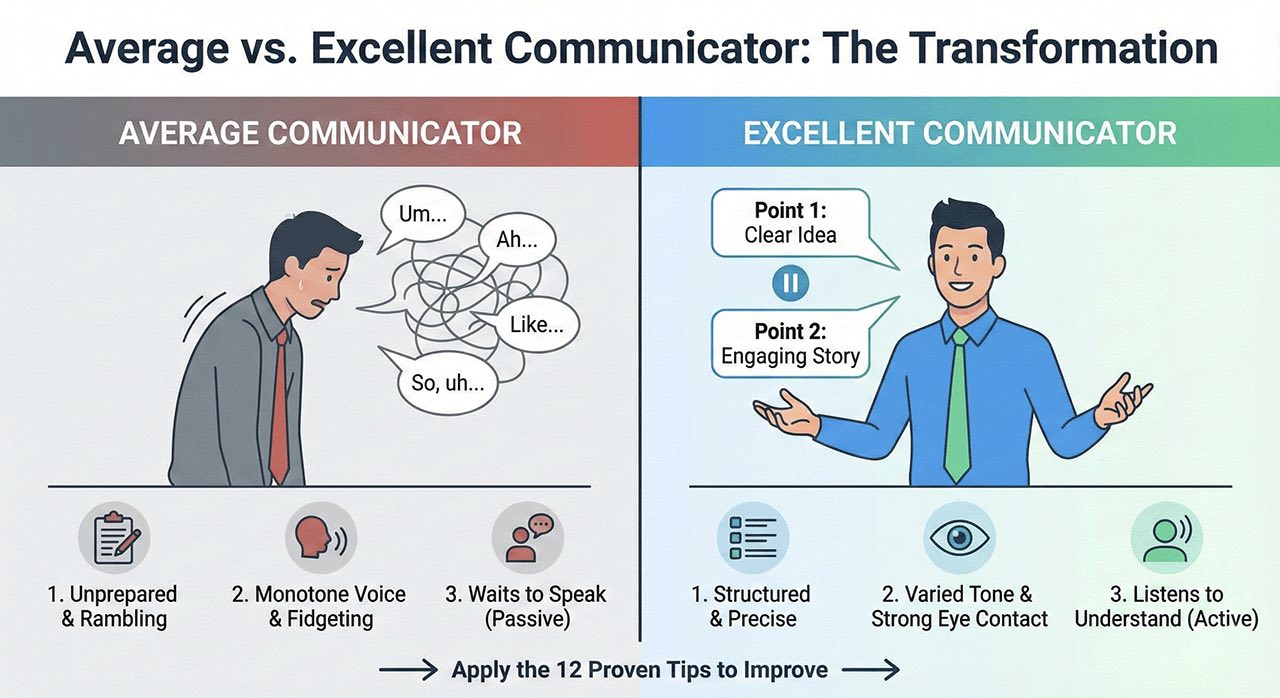
Comparison: Average vs. Excellent Communicators
To visualize the difference these tips make, let’s look at a comparison.
| Feature | Average Communicator | Excellent Communicator |
| Preparation | Wings it. | Knows the audience and goal. |
| Structure | Rambles and goes off-topic. | Uses the “Rule of Three.” |
| Fillers | Uses “um,” “like,” “ah.” | Uses purposeful pauses. |
| Body Language | Avoids eye contact, fidgets. | Open posture, strong eye contact. |
| Listening | Waits to speak. | Listens to understand. |
| Tone | Monotone or too fast. | Varied pitch and controlled pace. |
Conclusion
Improving your oral communication skills is one of the best investments you can make in your career. It affects everything from your job interview to your daily meetings.
Remember, great speakers are made, not born. They practice. They prepare. They are mindful of their words and their body language.
You do not have to master all 12 tips today. Start small. Pick one area, like eliminating filler words, and focus on that for a week. Then move to the next.
However, keep in mind that speaking is just one part of the puzzle. To be truly effective, you also need to understand the importance of non-verbal communication which acts as the silent partner to your spoken words.
Start talking with purpose today. Your future self will thank you.
Frequently Asked Questions (FAQ)
How long does it take to improve oral communication skills?
It varies for everyone. However, with consistent practice, you can see noticeable improvements in a few weeks. Recording yourself helps speed up the process.
Can I improve my communication skills by myself?
Yes, absolutely. You can practice in front of a mirror, record yourself, and read aloud to improve your articulation and flow.
Why is oral communication difficult for some people?
It often stems from a fear of judgment or “glossophobia” (fear of public speaking). Lack of preparation also contributes to anxiety, making it harder to think clearly.
Frequently asked questions
What if I’m naturally soft-spoken or introverted?
Introversion doesn’t prevent strong oral communication. Focus on the tips that don’t require personality change: organize your thoughts clearly, eliminate filler words, and use storytelling. Practice pacing and pausing to command attention without raising your voice. Confidence comes from preparation, not volume. Many effective speakers are introverts who leverage their natural listening skills.
How do I know if I’m speaking too fast or too slow?
Record yourself speaking for one minute, then play it back. If you struggle to follow your own words, you’re too fast. If you feel bored listening to yourself, you’re too slow. Aim for a pace where you can comfortably enunciate each word. Ask a trusted colleague for feedback. Most people underestimate how slowly they should speak in formal settings.
Should I memorize my entire speech or just key points?
Memorizing word-for-word often backfires—you sound robotic and panic if you forget a line. Instead, memorize your three main points and supporting examples. Know your opening and closing cold. This approach lets you stay flexible, maintain eye contact, and respond naturally to your audience while staying on track.
What’s the best way to handle nervousness before speaking?
Nervousness is normal and actually sharpens your focus. Channel it into preparation: practice your three key points multiple times, arrive early to the venue, and do breathing exercises beforehand. Remind yourself that your audience wants you to succeed. The more prepared you are, the less anxious you’ll feel when you start speaking.
Can I use filler words occasionally without losing credibility?
One or two fillers won’t derail you, but they accumulate quickly and undermine authority. Even occasional “ums” signal uncertainty to listeners. The pause technique takes practice but pays off immediately. Start by catching yourself in low-stakes conversations, then apply it to important meetings. Awareness is the first step to eliminating them entirely.
How do I adapt my communication style for different audiences?
Ask yourself three questions before speaking: What’s their expertise level? What outcome do they care about? How much time do they have? Executives want bottom-line results in minutes. Technical teams want data and details. Colleagues want clarity and relatability. Tailor your vocabulary, examples, and depth accordingly while keeping your core message consistent.