


Close Menu
The Business CommunicationThe Business Communication
    What's Hot

    Polite Alternatives to “Just Following Up” and “Per My Last Email”

    October 14, 2026

    How to Follow Up on an Email With No Response: 20 Templates

    October 7, 2026

    How to Write a Professional Email (With 15 Examples)

    October 4, 2026
    Facebook X (Twitter)
    The Business CommunicationThe Business Communication
    Button
    • Basics
      1. Introduction
      2. Communication Skills
      3. Modern Communication
      4. View All

      Medical Appointment Inquiry Email (Clinics/Hospitals)

      September 22, 2025

      Business Communication – Importance of Business Communication

      September 26, 2019

      Guidelines to Improve effectiveness of Cross Cultural Communication

      August 8, 2018

      Types of Communication Skills: Essential Abilities for Workplace Success

      June 7, 2015

      What Is Communication Style | Classification Of Communication Style

      January 1, 2022

      Meaning Of Cross-Cultural Communication

      July 9, 2018

      Various Styles Reading or Techniques of Reading

      March 26, 2017

      8 Ways To Improve Your Listening Skills

      August 8, 2015

      Role Of Technology In Business Communication

      June 24, 2023

      What Is Communication Satellite?

      January 3, 2023

      What Is Multimedia In Communication | Importance Of Multimedia

      November 24, 2022

      What Is The Video Conference? Advantages & Disadvantages of Video Conferencing

      September 19, 2022

      Polite Alternatives to “Just Following Up” and “Per My Last Email”

      October 14, 2026

      How to Follow Up on an Email With No Response: 20 Templates

      October 7, 2026

      How to Write a Professional Email (With 15 Examples)

      October 4, 2026

      Memo vs. Business Letter: Key Differences & When to Use Which

      December 3, 2025
    • Forms of Communication
      • Oral Communication
      • Non-Verbal Communication
      • Report Writing
    • Written Communication
      1. Letter Writing
      2. Circular Letter
      3. inquiry letter
      4. Ultimatum Letter
      Featured
      Written Communication

      Polite Alternatives to “Just Following Up” and “Per My Last Email”

      By Masudur RashidOctober 14, 2026
      Recent

      Polite Alternatives to “Just Following Up” and “Per My Last Email”

      October 14, 2026

      How to Follow Up on an Email With No Response: 20 Templates

      October 7, 2026

      How to Write a Professional Email (With 15 Examples)

      October 4, 2026
    • In Business
      1. Company Meeting
      2. Secretarial Functions
      3. View All

      Future of Company Meetings: Hybrid, AI & Trends for 2026

      October 19, 2025

      After the Meeting: Follow-Up, Action Items & Accountability

      October 19, 2025

      How to Facilitate Productive Project Meetings

      October 19, 2025

      Daily Standup vs Weekly Staff Meeting: Which One is Better?

      October 19, 2025

      What Is Organizational Communication – Types of Organizational Communication

      September 17, 2015

      What is Secretary? Types of secretary

      July 11, 2014

      Polite Alternatives to “Just Following Up” and “Per My Last Email”

      October 14, 2026

      How to Follow Up on an Email With No Response: 20 Templates

      October 7, 2026

      How to Write a Professional Email (With 15 Examples)

      October 4, 2026

      Memo vs. Business Letter: Key Differences & When to Use Which

      December 3, 2025
    • Internal Communication
      1. Downward Communication
      2. Horizontal Communication
      3. Upward Communication
      4. View All

      Advantages and Disadvantages of Downward Communication

      November 21, 2013

      Key Objectives of Downward Communication in an Organization

      November 20, 2013

      Essential Elements of Downward Communication: A Complete Guide for Managers

      November 20, 2013

      What Is Downward Communication? Definition, Objectives, Advantages, and How to Make It Effective

      October 31, 2013

      Importance of Horizontal Communication (With Real-Life Examples)

      November 30, 2013

      Advantages and Disadvantages of Horizontal Communication (With Real Examples)

      October 23, 2013

      Upward vs Downward vs Horizontal Communication: Key Differences

      March 13, 2013

      What is Horizontal Communication: Definition, Examples & Importance

      March 13, 2013

      Future of Upward Communication in Remote/Hybrid Workplaces

      September 13, 2025

      Leadership Styles That Encourage Employees to Speak Up

      September 13, 2025

      Strategies to Enhance Upward Communication in Organizations

      September 8, 2025

      How Informal Communication Spreads Rumor

      December 3, 2013

      Polite Alternatives to “Just Following Up” and “Per My Last Email”

      October 14, 2026

      How to Follow Up on an Email With No Response: 20 Templates

      October 7, 2026

      How to Write a Professional Email (With 15 Examples)

      October 4, 2026

      Memo vs. Business Letter: Key Differences & When to Use Which

      December 3, 2025
    The Business CommunicationThe Business Communication
    Home » Introduction » 7 Cs of Communication: Meaning, Origin, and How to Apply Them (With Examples)

    7 Cs of Communication: Meaning, Origin, and How to Apply Them (With Examples)

    By Masudur RashidNovember 4, 2013Updated:October 18, 202610 Comments9 Mins Read Introduction
    Facebook Twitter Reddit WhatsApp Telegram Pinterest LinkedIn Email
    Share
    Facebook Twitter Pinterest WhatsApp Email

    The 7 Cs of communication are seven qualities that make any message effective: Clarity, Conciseness, Consideration, Concreteness, Correctness, Courtesy, and Completeness. Scott M. Cutlip and Allen H. Center first proposed them in Effective Public Relations (1952).

    Together they serve as a practical checklist for professional writing and speech. Master them, and your messages become clearer and less likely to be misread.

    Who created the 7 Cs of communication?

    Scott M. Cutlip and Allen H. Center introduced the framework in their textbook Effective Public Relations, first published in 1952. The book targeted public relations professionals but became a core text in business communication courses worldwide.

    Cutlip and Center identified what they saw as the essential qualities of clear, persuasive messaging. Over 70 years later, those qualities remain the most widely taught communication checklist in business education.

    Published in the International Journal of Scientific Development and Research in 2023, a study confirms the 7 Cs remain a foundational checklist in professional and academic settings.

    The seven Cs of communication explained

    Each C names one quality your message must have. Together they make a quick pre-send checklist for any email, report, or presentation.
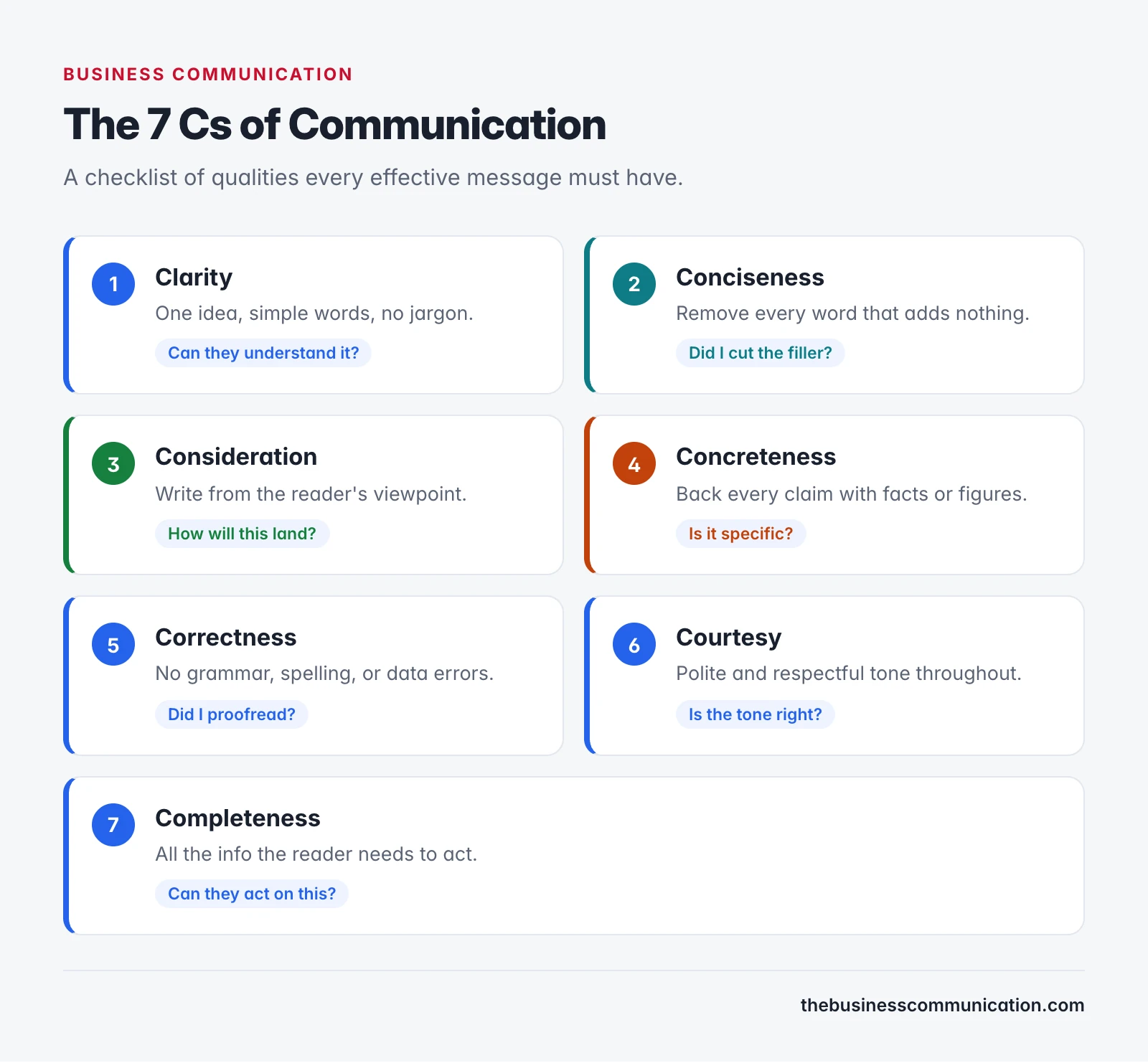
    The 7 Cs of Communication: a numbered grid showing Clarity, Conciseness, Consideration, Concreteness, Correctness, Courtesy, and Completeness with a self-check question for each

    1. Clarity

    Clarity means the message is easy to understand with no room for confusion. Use simple words, short sentences, and one idea at a time. Avoid jargon unless the reader already knows it.

    Think of clarity as removing fog. When the fog clears, the reader sees exactly what you mean without guessing.

    Unclear: “Kindly expedite the resolution of the outstanding procedural matters.” Clear: “Please complete the pending paperwork by Friday.”

    2. Conciseness

    Conciseness means saying more with fewer words. Cut filler, repetition, and unnecessary qualifiers. A concise message respects the reader’s time and stays focused.

    Being brief at the cost of meaning is not the goal. Cut only what adds no value.

    Wordy: “Due to the fact that there was a scheduling conflict, the meeting has been postponed to a later date.” Concise: “The meeting is postponed to Monday because of a scheduling conflict.”

    3. Consideration

    Consideration means thinking about the reader before you write. Ask: how will this land? Is the tone right for this person and situation?

    This principle connects to the You-attitude in business writing. That approach asks writers to focus on what the reader gains, not just what the writer wants to say.

    Without consideration: “You failed to follow the instructions.” With consideration: “There may have been some confusion with the instructions. Let’s review them together.”

    4. Concreteness

    Concreteness means backing every claim with facts, figures, or examples. Vague statements lose credibility. Concrete details make your message trustworthy and easier to act on.

    Vague: “Our sales went up recently.” Concrete: “Sales rose 18% in Q3 compared to the same period last year.”

    5. Correctness

    Correctness means your message is free of grammatical, spelling, and factual errors. One mistake can undermine your entire message. Always proofread before sending.

    Data accuracy matters here too. Wrong numbers in a business report can lead to bad decisions and damage your professional standing.

    6. Courtesy

    Courtesy means keeping the tone polite and respectful, even when the message is difficult. A courteous message protects the relationship and keeps communication productive.

    Discourteous: “Your report had mistakes and came in late.” Courteous: “The report needs a few corrections. I am glad to walk you through them at your convenience.”

    7. Completeness

    Completeness means your message contains everything the reader needs to understand and act. An incomplete message forces follow-up and wastes time on both sides.

    Check that the message answers: who, what, when, where, why, and how. Before sending, ask yourself: could the reader act without asking me anything else?

    Incomplete: “Let’s meet next week.” Complete: “Let’s meet Tuesday, 15 October at 10 AM in Conference Room B.”

    Worked example: applying all 7 Cs to one email

    One good way to see the framework work is to watch it fix a real message. Both emails below are from a fictional company, ABC Ltd.

    Before (violates several Cs): Subject: Report Hi, I wanted to touch base regarding the ongoing situation with the client deliverables, which has been a source of some concern for myself and the team as we move forward in terms of finalising things. There have been mistakes in the documents you sent. You should have checked this before sending. Let me know. Regards, Rafi
    After (all 7 Cs applied): Subject: Q3 Client Report: Two Corrections Needed by Friday Hi Sara, Thank you for submitting the Q3 client report. I noticed two issues that need correction: 1. The revenue figure on page 4 shows BDT 8.2 million, but our records show BDT 7.6 million. 2. The delivery timeline on page 7 lists 30 October instead of 10 November. Could you please update both by end of day Friday, 17 October? I can share the source data if that helps. Best regards, Rafi ABC Ltd.

    The revised email is clear (specific problem named), concrete (exact page and figures), complete (deadline included), and courteous (opens with thanks). It is also concise, considerate (does not blame), and correct.

    Coherent vs Consideration: which 7th C is correct?

    You will find two versions of the 7 Cs depending on your source. Six of the seven principles are identical. Only the 7th C differs between the two lists.

    7th CWhat it meansWho uses it
    ConsiderationThink about the reader’s perspective, feelings, and needsSouth Asian and African exam syllabi, traditional business communication textbooks
    CoherentThe message has a logical flow; each point connects to the nextMindTools, Revolution Learning, project management sources

    Both terms name genuinely useful qualities. The difference comes from how the framework evolved across different publishing traditions. If your exam or course specifies one, use that version.

    For business communication courses in Bangladesh, India, and most African countries, Consideration is the standard 7th C. For US and UK management training, Coherent appears more often. Neither version is wrong.

    Summary table: the 7 Cs at a glance

    COne-line definitionSelf-check questionQuick example
    ClarityState one idea simply, with no confusionCan a new reader understand this immediately?Plain words, short sentences
    ConcisenessRemove every word that adds no meaningDid I cut all filler and repetition?“Because,” not “Due to the fact that”
    ConsiderationWrite from the reader’s viewpointHow will the reader feel reading this?You-attitude, positive framing
    ConcretenessBack every claim with facts or examplesDid I replace vague words with specifics?“18% increase,” not “went up”
    CorrectnessEliminate all errors in grammar, spelling, and dataDid I proofread and verify every fact?Two-step check: tool, then manual review
    CourtesyKeep the tone respectful throughoutWould I be happy to receive this message?Please, thank you, constructive phrasing
    CompletenessInclude all information the reader needs to actCan the reader act without asking me anything?Who, what, when, where, why, how

    Applying the 7 Cs in business and digital communication

    Most of the time you encounter the 7 Cs in formal business writing courses. They matter just as much in digital communication, where messages are shorter and misreadings happen faster.

    According to Grammarly’s 2024 State of Business Communication report, 100% of knowledge workers experience miscommunications at least once a week. A quick 7-Cs check before you hit Send can prevent most of them.

    Business emails and reports benefit most from clarity and conciseness, which prevent information overload. Completeness means the reader rarely needs to reply with follow-up questions. Correctness protects your professional image every time someone reads what you wrote.

    WhatsApp and messaging apps, common in South Asian and African workplaces, present a different challenge. Tone is harder to read in text than in person. A blunt-sounding message can damage a client relationship before you have a chance to explain.

    Video calls and presentations call for clarity and completeness above all. State your key point first, then explain the reasoning. Close with a clear action item so the audience knows exactly what happens next.

    Common barriers that break the 7 Cs

    Even when you apply the 7 Cs carefully, barriers can stop your message from landing. Mismatched language fluency makes clarity and correctness harder to achieve; simpler vocabulary and shorter sentences help both.

    Stress or conflict tends to undercut consideration and courtesy. If a message feels charged, let it sit before sending. Loading too much into one message also works against conciseness; keeping one topic per message usually solves both.

    More detail on each type, with practical strategies to work around them, is in the guide on barriers to effective communication.

    Exam-ready recap: the 7 Cs in one line each

    • Clarity: Express one idea simply, with no room for confusion.
    • Conciseness: Use the fewest words that still carry the full meaning.
    • Consideration: Write from the reader’s viewpoint and think about their needs.
    • Concreteness: Back every claim with facts, figures, or examples.
    • Correctness: Eliminate all errors in grammar, spelling, and factual data.
    • Courtesy: Keep the tone polite and respectful throughout.
    • Completeness: Include all information the reader needs to understand and act.

    These seven qualities also form the foundation of the broader principles of communication that govern effective writing and speech in business, education, and everyday life.

    Frequently asked questions

    What are the 7 C’s of communication?

    Clarity, Conciseness, Consideration, Concreteness, Correctness, Courtesy, and Completeness make up the 7 Cs. Together they form a checklist that makes any message clear, professional, and effective. Introduced by Cutlip and Center in 1952, they apply to written and spoken communication alike.

    What are the 7 principles of communication?

    Many sources call the 7 Cs the seven principles of effective communication. Each principle names one quality a message must have: clear, concise, considerate, concrete, correct, courteous, and complete. Some sources also call them the 7 key principles of business writing.

    What do the 7 Cs mean?

    Each C stands for a different standard your message must meet. Clarity means no confusion. Conciseness means no wasted words. Consideration means thinking about your reader. Concreteness means using facts. Correctness means no errors. Courtesy means a polite tone. Completeness means no missing information.

    What are the 7 Cs of effective written communication?

    In written communication, the 7 Cs guide everything from emails to formal reports. Clarity and conciseness keep the reader’s attention. Consideration and courtesy shape the tone. Concreteness adds credibility. Correctness protects your professional image. Completeness ensures the reader can act without a follow-up.

    Is it Coherent or Consideration in the 7 Cs?

    Both versions exist. The traditional list used in South Asian and African business education includes Consideration. The alternative version used by MindTools, Revolution Learning, and project management sources replaces it with Coherent, which refers to logical flow. Six of the seven Cs are identical in both versions.

    Who came up with the 7 Cs of communication?

    Scott M. Cutlip and Allen H. Center developed the 7 Cs and published them in Effective Public Relations in 1952. The book was written for public relations professionals, but the checklist spread into business communication education and is now taught in management courses worldwide.

    7 C’s of communication Seven C's of communication
    Share. Facebook Twitter Pinterest LinkedIn WhatsApp Reddit Email
    Previous ArticlePrinciples of Communication: 14 Key Rules for Effective Communicators
    Next Article Factors influencing the meaning of business communication
    Masudur Rashid
    • Facebook
    • X (Twitter)
    • Instagram
    • LinkedIn

    👋 Hi, I am Masudur Rashid. I studied Management (Honors and Masters) but my real passion has always been Business Communication. Through this blog, I share simple tips, lessons, and resources to help students and professionals communicate with confidence.

    Related Posts

    Introduction 08 Mins Read

    Medical Appointment Inquiry Email (Clinics/Hospitals)

    Introduction 08 Mins Read
    Introduction 012 Mins Read

    Business Communication – Importance of Business Communication

    Introduction 012 Mins Read
    Introduction 011 Mins Read

    Guidelines to Improve effectiveness of Cross Cultural Communication

    Introduction 011 Mins Read
    Introduction 112 Mins Read

    Types of Communication Skills: Essential Abilities for Workplace Success

    Introduction 112 Mins Read
    View 10 Comments

    10 Comments

    1. yaseen

      you have written very well i was looking for same thing for my college assignment

      Reply
    2. Jaxter japhet

      Easy language you have used hence it’s clear to everyone thanks for your help 🤝🤝🤝🤝

      Reply
    3. Ava Olivia

      Communicating effectively is a skill worth developing. If you want to stand out and network effectively, you must learn how to communicate effectively. The seven Cs of communication are: Clarity, Comprehensiveness, Consistency, Coordination, Confidence, Cooperation and Contact. Whether you’re talking to a group or one person, knowing how to use these seven Cs will help you connect with others and enhance your professional and personal life.

      Reply
    4. Asep Hardiansyah

      Business must be clear in
      determine the message, both formal
      or informal. Because
      an organization consists of
      different people, and
      have many ideas

      Reply
    5. Ume kulsoom

      Well-explained so, anyone can easily understand.

      Reply
    6. John CROSBY

      you spelled correctness wrong in the circle of the 7 C’s you might want to correct that. In the circle, you spelled correctness with an extra E ex correcteness, but in the correctness paragraph you spelled it correct.

      Reply
    7. Pragati Sambrani

      Please proof-read your content. The sentence formation and grammar in this article is incorrect.

      Reply
      • The Business Communication

        We have en-reached our content. Hope it will help you to learn 7c of business communication.

        Reply
      • Alyssa

        It’s still pretty awful and it’s been a year since your comment!

        Reply
      • Pratik

        Many mistakes…i had to understand and form the correct sentences…the irony is…the guy is talking about communication

        Reply
    Leave A Reply Cancel Reply

    This site uses Akismet to reduce spam. Learn how your comment data is processed.

    Subscribe to Updates

    Get the latest business communication news from TBC.

    Write better at work. Get practical guides with real email, letter and report examples.

    One email on Mondays when a new guide is out. Unsubscribe anytime. See our Privacy Policy.

    Almost done! Check your inbox (or spam folder) and click the confirm button.

    Top Picks

    Medical Appointment Inquiry Email (Clinics/Hospitals)

    Trying to call a clinic and being stuck on hold for ten minutes can be…

    Business Communication – Importance of Business Communication

    Business communication is the structured exchange of information within an organization and between the organization…

    Guidelines to Improve effectiveness of Cross Cultural Communication

    Effective cross-cultural communication is not automatic, even in organizations with diverse teams. You need deliberate…

    Types of Communication Skills: Essential Abilities for Workplace Success

    Have you ever met someone who is brilliant but cannot explain their ideas? They have…

    Welcome to TheBusinessCommunication.com, your guide to clear and effective business communication. Here you will find simple lessons on report writing, letters, meetings, oral and written communication, and modern tools like email or virtual meetings. Our mission is to make learning communication easy, practical, and fun, so you can apply it in your studies, career, and everyday life.
    We're social. Connect with us:

    Facebook X (Twitter) YouTube LinkedIn RSS
    Top Insights

    Polite Alternatives to “Just Following Up” and “Per My Last Email”

    How to Follow Up on an Email With No Response: 20 Templates

    How to Write a Professional Email (With 15 Examples)

    Subscribe to Updates

    Get the latest business communication news from TBC.

    Write better at work. Get practical guides with real email, letter and report examples.

    One email on Mondays when a new guide is out. Unsubscribe anytime. See our Privacy Policy.

    Almost done! Check your inbox (or spam folder) and click the confirm button.

    Copyright © 2026 TheBusinessCommunication. All Rights Reserved.
    • Home
    • About Us
    • Contact US
    • Our Authors
    • Privacy Policy
    • Terms and Conditions

    Type above and press Enter to search. Press Esc to cancel.