


Have you ever sat in a meeting, realized a project was heading for disaster, and yet said nothing? You probably kept quiet because you didn’t want to sound silly, or perhaps you were afraid of how your boss might react.
We have all been there.
This silence is the enemy of progress. In a healthy workplace, information shouldn’t just flow down from the top; it needs to bubble up from the bottom. This is what we call upward communication.
In this guide, we will explore everything you need to know about upward communication. We will cover its definition, real-world examples, the barriers that block it, and actionable strategies to build trust in your team.
What Is Upward Communication?
Upward communication is the process where information flows from lower levels of an organization to the higher levels. In plain English, it is when employees share feedback, ideas, concerns, or progress reports with their managers and leaders.
Think of it as a feedback loop.
Most companies are great at downward communication. This is when bosses give orders, set deadlines, and explain policies. However, upward communication goes the other way. It is the voice of the workforce reaching the ears of the leadership.
How It Differs from Other Types
- Downward Communication: Flows from executives to employees (instructions, policies).
- Horizontal Communication: Happens between peers or departments at the same level.
- Upward Communication: Flows from employees to leadership (suggestions, grievances, reports).
Without this flow, leaders are effectively flying blind. They might make decisions without knowing what is actually happening on the ground floor.
Why Is Upward Communication Important?
You might wonder if we really need a fancy term for “talking to the boss.” The answer is yes. Upward communication is not just a buzzword; it is the backbone of a thriving company culture.
When leaders listen, amazing things happen.
1. Better Decision-Making
Leaders often sit far away from the daily grind. They don’t see the glitchy software, the angry customers, or the faulty machinery. Frontline employees do. When these employees speak up, leaders get the data they need to make smart choices.
2. Early Problem Detection
Upward communication acts like an early warning system. If a nurse reports a medication error, the hospital can fix the process before a patient gets hurt. If a developer flags a bug, it can be patched before the product launches.
3. Increased Innovation
Some of the best ideas don’t come from the boardroom. They come from the people doing the work. A customer support agent might have a brilliant idea to reduce call wait times. Without a channel to share it, that idea dies. With upward communication, it becomes a solution.
4. Higher Engagement and Trust
Employees who feel heard are happier. It is that simple. When you know your voice matters, you feel like a partner in the business rather than just a cog in the machine. This boosts morale and keeps good people from quitting.
The Foundation: Psychological Safety
You can have the best suggestion boxes and the most expensive Slack plans, but they will fail without one key ingredient: Psychological Safety.
Popularized by Harvard researcher Amy Edmondson, psychological safety is a workplace environment where people feel safe to take interpersonal risks. It means you can ask a “dumb” question, admit a mistake, or challenge a boss’s idea without fear of humiliation or punishment.
Why It Matters
If employees lack psychological safety, they will retreat into silence. They will worry that speaking up will hurt their performance review or damage their reputation.
To build this safety, leaders must:
- Model Vulnerability: Admit when they are wrong.
- Respond Positively: Thank employees for bad news instead of shooting the messenger.
- Encourage Questions: actively ask, “What are we missing?”.
Common Barriers to Upward Communication
Despite its benefits, upward communication is hard to get right. Information often gets blocked or distorted on its way up the ladder. Here are the most common barriers.
1. Fear of Consequences
This is the biggest one. Employees worry that pointing out a problem will label them as “troublemakers.” They fear retaliation, losing a promotion, or even getting fired.
2. The “Filter” Effect
As a message moves from a junior employee to a supervisor, then to a manager, and finally to a director, it changes. Middle managers might soften the blow of bad news to make themselves look better. By the time the message reaches the top, it is often watered down or incomplete.
3. Ego and Leadership Style
Some leaders believe they already know everything. If a manager has an authoritarian style, they might view feedback as a challenge to their authority. This shuts down communication instantly.
4. Lack of Channels
Sometimes, employees want to speak up, but they don’t know how. If the only way to give feedback is to walk into the CEO’s office, no one will do it. Organizations need clear, accessible paths for communication.
Channels of Upward Communication
To overcome these barriers, you need the right tools. A mix of formal and informal channels ensures that everyone finds a way to express themselves.

Formal Channels
These are structured and scheduled.
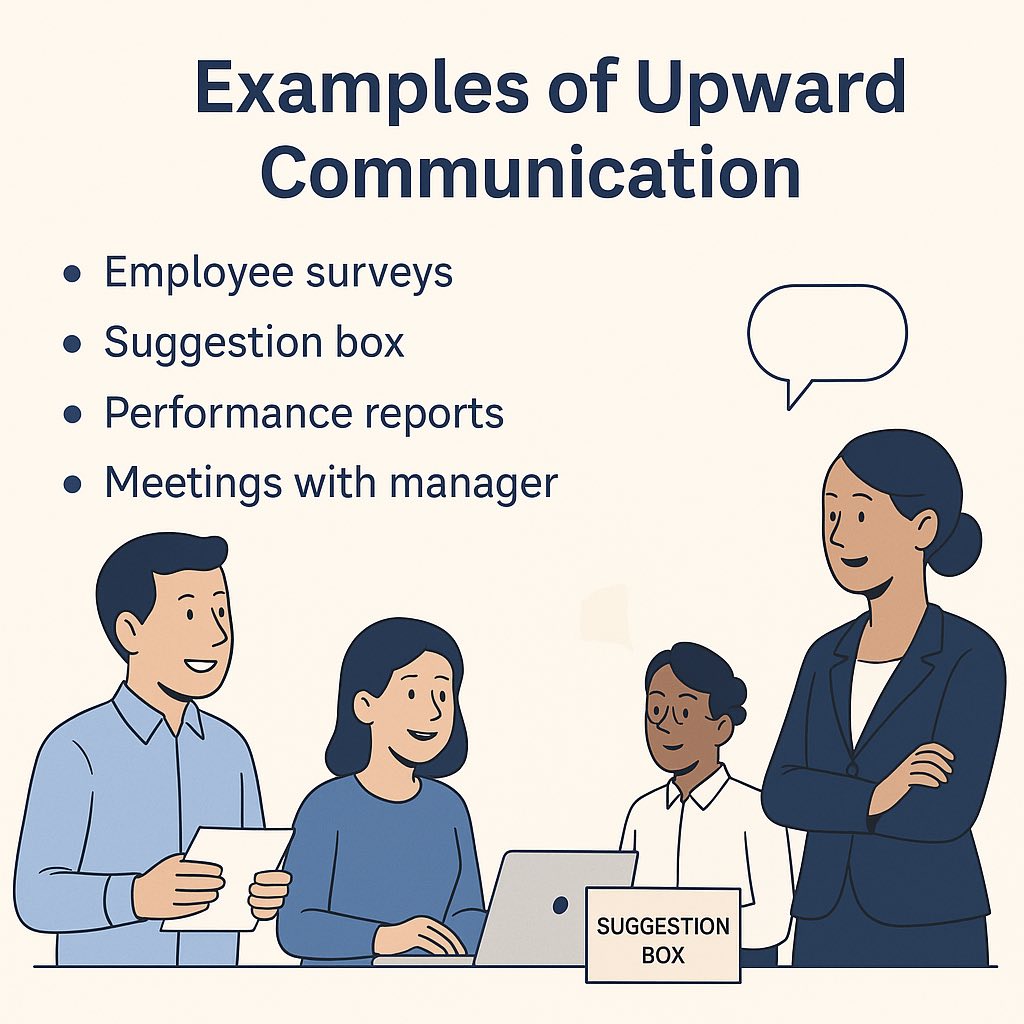
- Employee Surveys: Great for gathering anonymous data from everyone at once.
- Performance Reviews: A dedicated time to discuss personal progress and company roadblocks.
- Reports: Weekly or monthly updates on project status.
- Suggestion Boxes: Whether physical or digital, these allow for detailed feedback.
Informal Channels
These are casual and spontaneous.
- Open-Door Policy: Encouraging employees to drop by for a chat.
- Team Huddles: Quick, daily stand-up meetings to flag immediate issues.
- Casual Conversations: Chats over coffee or lunch where truth often comes out.
Digital Channels
Modern work requires modern tools.
- Instant Messaging (Slack/Teams): Perfect for real-time feedback and quick questions.
- Intranet Portals: For submitting formal grievances or ideas.
Table: Choosing the Right Channel
| Situation | Best Channel | Why? |
| Sensitive personal issue | One-on-One Meeting | Privacy and empathy are needed. |
| Measuring company morale | Anonymous Survey | People are more honest when anonymous. |
| Reporting a software bug | Slack / Jira | Needs to be fast and documented. |
| Suggesting a new policy | Digital Suggestion Box | Allows leadership to review thoughtfully. |
Strategies to Improve Upward Communication
So, how do you actually fix a broken communication culture? Here are proven strategies to get the information flowing.
1. Normalize Feedback
Don’t wait for the annual review. Make feedback a daily habit. Start meetings by asking, “Does anyone see any risks we haven’t discussed?” When feedback becomes routine, the fear disappears.
2. Close the Feedback Loop
Nothing kills motivation faster than a “black hole.” If an employee submits an idea and never hears back, they will stop trying. Even if you can’t implement the idea, acknowledge it. Tell them why it isn’t feasible right now. This shows respect.
3. Train Your Managers
Promoting someone to management doesn’t magically make them a good listener. Invest in training that teaches active listening, empathy, and how to receive criticism without getting defensive.
4. Offer Anonymous Options
Sometimes, the truth is too scary to put a name to. Anonymous surveys or hotlines give employees a safe way to report serious issues like harassment or safety violations.
5. Reward Those Who Speak Up
When someone points out a flaw that saves the company money, celebrate them! Public recognition sends a powerful signal to the rest of the team: “We value the truth here.”
Real-World Case Studies
Let’s look at how different industries put these concepts into practice.
Tech Industry: Speed and Innovation
A mid-sized software company was struggling with bugs. They set up a dedicated Slack channel where anyone—from interns to customer support—could flag issues. Management reviewed this channel weekly and publicly thanked contributors.
Result: Bug resolution time dropped by 30%, and the product quality skyrocketed.
Healthcare: Patient Safety
A hospital noticed nurses were afraid to report “near-miss” errors (mistakes that almost happened). They implemented a “blameless” reporting system focused on fixing the process, not punishing the person.
Result: Reporting went up, but actual errors went down because the hospital could fix the root causes early.
Education: Curriculum Improvement
A private school started “Feedback Friday,” asking teachers to fill out a simple form about lesson plans and resources.
Result: The administration quickly realized a specific textbook was confusing students and replaced it. Teacher satisfaction scores improved significantly.
Advantages and Disadvantages
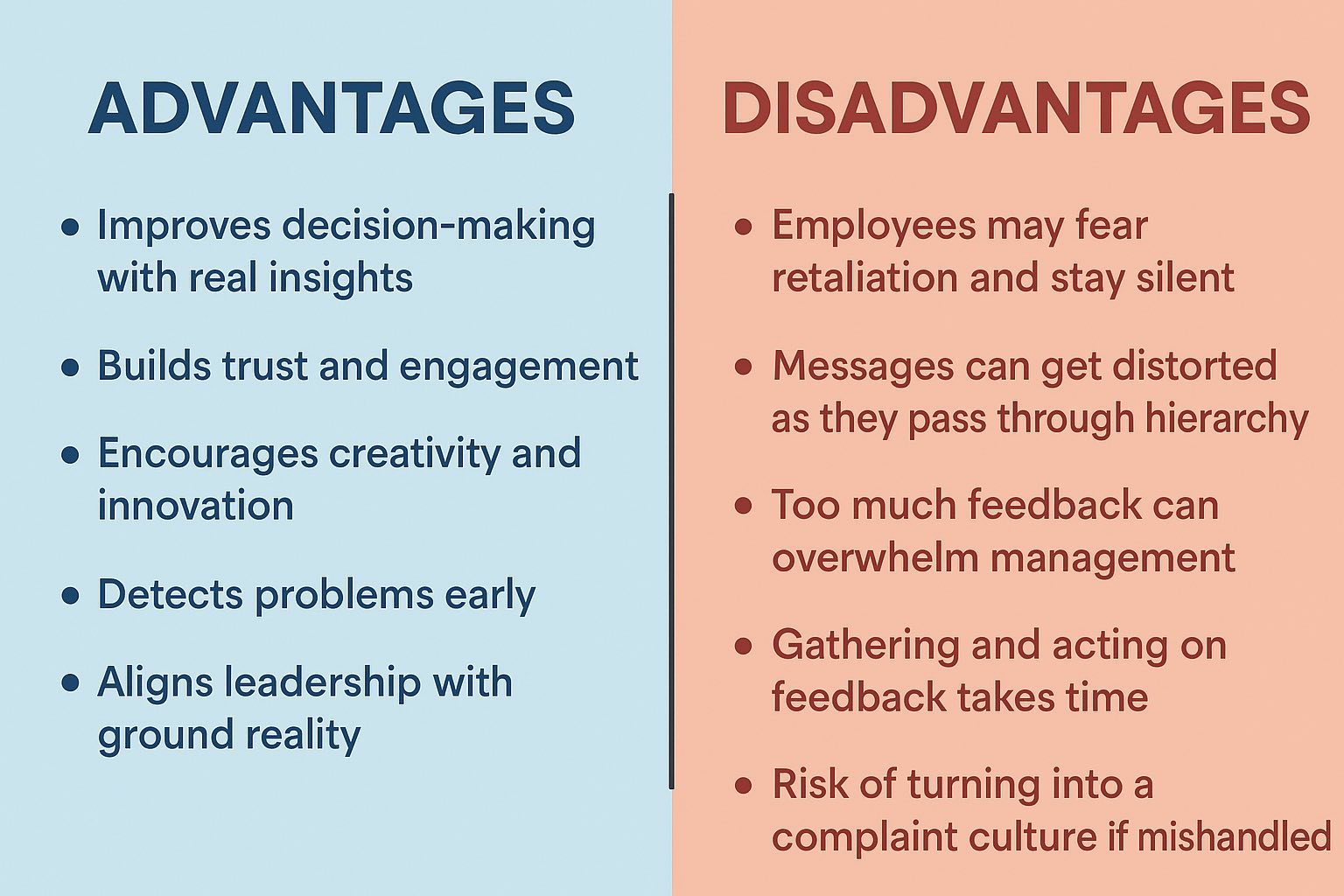
Is upward communication always perfect? Not necessarily. It is important to weigh the pros and cons to manage it effectively.
Advantages
- Reality Check: Leaders know what is actually happening.
- Motivation: Employees feel valued and stay longer.
- Safety: Dangerous practices are spotted early.
Disadvantages
- Information Overload: Leaders can get buried in too many suggestions.
- Distortion: Messages can change as they move up the chain.
- Slow Decisions: Consulting everyone can take time.
- Negativity: If not managed well, it can turn into a complaint session.
Strategy: To minimize the cons, use structured forms to keep feedback organized and teach managers how to prioritize incoming information.
Upward Communication Checklist
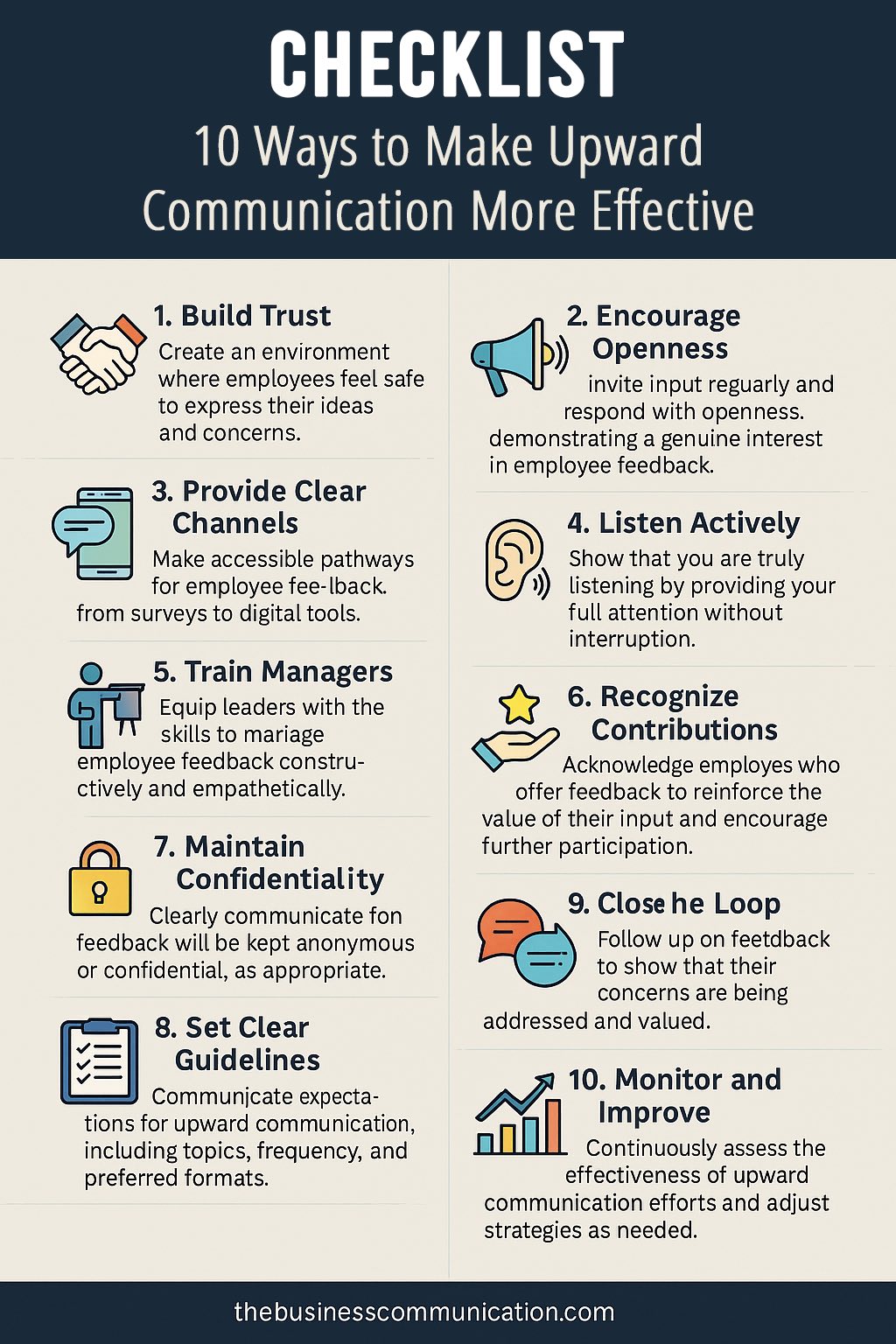
Ready to start? Use this 10-point checklist to assess your organization.
- Build Psychological Safety: Do employees feel safe admitting mistakes?
- Offer Multiple Channels: Do you have both formal and informal ways to talk?
- Normalize Feedback: Is it part of your daily or weekly routine?
- Active Listening: Do managers listen without interrupting?
- Close the Loop: Do you tell employees what happened with their ideas?
- Train Leaders: Are managers coached on how to receive feedback?
- Anonymous Options: Is there a safe way to report sensitive info?
- Recognize Contributions: Do you thank people who speak up?
- Keep it Simple: Are your forms and surveys easy to use?
- Measure & Adjust: do you track participation rates?
Frequently Asked Questions (FAQ)
Q: How is upward communication different from downward communication?
A: Upward moves from employees to leaders (feedback, reports). Conversely, downward moves from leaders to employees (instructions, goals).
Q: What if I am afraid to speak up?
A: Start small. Use anonymous channels if available. Alternatively, find a peer or a manager you trust and share your thoughts with them first.
Q: How can managers encourage quiet employees?
A: Ask specific questions. Instead of “Any questions?”, ask “What is one thing that could go wrong with this plan?” This prompts critical thinking without confrontation.
Q: Can there be too much upward communication?
A: Yes. Information overload is real. That is why it is important to have structured channels like surveys and reports, rather than just relying on constant emails.
Final Verdict
Upward communication is the lifeline of a healthy organization. It turns a group of individuals into a cohesive team that trusts one another.
It requires effort to build. You must break down walls of fear, create safe spaces, and prove that you are listening. However, the payoff is worth it. When employees speak up, the company grows, innovates, and avoids costly mistakes.
So, take the first step today. Ask a question, set up a suggestion box, or simply listen. You might be surprised by what you hear.
Frequently asked questions
What if my manager gets defensive when I share critical feedback?
Stay calm and frame feedback around the issue, not the person. Use “I noticed the process caused delays” instead of “You made a mistake.” If defensiveness persists, document your attempts to communicate and consider escalating through HR or a skip-level meeting with your manager’s supervisor.
Should I report a serious concern anonymously or directly to my boss?
Direct communication builds trust and allows for dialogue, but anonymous channels work if you fear retaliation. For serious issues like safety violations or ethics breaches, use formal channels (HR, ethics hotline, or compliance) regardless of anonymity. Document everything in writing.
How do I know if my workplace actually has psychological safety?
Ask yourself: Do people admit mistakes without hiding them? Do leaders thank employees for bad news? Are questions welcomed in meetings? If you see people staying silent about obvious problems, psychological safety is low. Test it by sharing a small concern first.
What’s the best way to bring up a problem if I’m new to the team?
Build credibility first by doing solid work for 30-60 days. Then frame concerns as questions: “I’m still learning, but I noticed X. Have we considered Y?” This shows respect for existing processes while opening dialogue. Pair observations with solutions, not just complaints.
Can upward communication backfire if I disagree with company strategy?
Disagreement itself isn’t dangerous if handled professionally. Focus on business impact, not personal opinion. Say “This approach might hurt customer retention because…” rather than “I think you’re wrong.” Choose the right forum—a one-on-one is safer than a public meeting for strategic disagreements.
How often should I use upward communication channels without seeming like a complainer?
Quality matters more than frequency. Share feedback when it’s actionable and timely, not every minor frustration. If you’re reporting weekly, ensure each item is substantive. One well-timed suggestion beats ten vague complaints. Leaders respect employees who think before speaking up.
15 Comments
That was musch helpful, Thanks ⭐⭐⭐⭐⭐
Well notes . Thanks alot
satisfied!
It is very helpful to me a lot thanks
Good work indeed
Well explained I appreciate the good work
Good work well explained notes
am fully satisfied by those well analysed notes,,, thanks
Good notes
thanks for the information, it is concise.
Excellent..i have fully satisfied by this notes…
Good notes
Great it help me alot i appriciate it please
Good job well analysed notes . Thank you
It’s really a wondeful notes…highly appreciated