


Imagine you are the captain of a massive ship. You are sailing through foggy waters in the middle of the night. You cannot see the rocks, the other ships, or the storm brewing ahead. Would you feel safe? Probably not.
Running a business without a market report is exactly like that. You are moving forward blindfolded.
In the world of business communication, information is power. A well-written market report gives you that power. It acts as a mirror of the economic condition of a country. It tells you where the market is going, warns you about competitors, and helps you make smart decisions with your money.
But what exactly goes into this document? How do you structure it? Why is it so critical?
In this complete guide, we will break down everything you need to know about market reports. We will explore their importance, the different types, the essential elements, and the principles of writing one effectively.
What is a Market Report?
Simply put, a market report is a document that presents the entire market condition relating to the buying and selling of a particular product. It analyzes prices, supply and demand, and trends.
However, it is more than just a sheet of numbers. It interprets those numbers. It explains why prices are going up or down. It explains why customers are buying less.
Understanding the characteristics of a market report is the first step to mastering business strategy. It bridges the gap between raw data and real-world action. whether you are looking at stock exchanges, vegetable markets, or global trade, this report is your primary tool for navigation.
Why is a Market Report So Important?
You might wonder why managers spend so much time analyzing these documents. The answer is simple. Information is the fuel for taking decisions.
Here is why these reports are indispensable for modern business:
1. It Informs Market Conditions
A market report presents information regarding transactions, buying, selling, supply, demand, and price levels. Interested parties can know everything about a product in a particular market just by reading it.
2. It Helps in Decision Making and Planning
Managers need market information for preparing routine and long-term investment plans. Unlike a guess, a report provides concrete data. As a result, readers can take appropriate decisions regarding production or investment.
3. Forecasting Recession and Boom
By comparing and analyzing the information presented in market reports, business persons can forecast the probable future economic boom or recession. This allows them to take necessary steps before a crisis hits.
4. Expansion of Markets
In this age of globalization, no country can confine its trade culture within its own boundary. By studying market reports, business persons can know global business conditions. Consequently, they can take action to expand their business internationally.
5. Helps in Determining Price
Price is determined by the interaction of demand and supply. Market reports provide information on current and future supply and demand. This helps producers and sellers determine fair present and future prices.
6. Knowledge of Fluctuation Causes
By reading a market report, you can get information relating to the causes and remedies of price fluctuations. If the price of jute drops, the report explains if it is due to oversupply or low demand.
The Different Types of Market Reports
Not all reports are the same. A stockbroker needs a different report than a marketing manager. We can classify these reports in several ways.
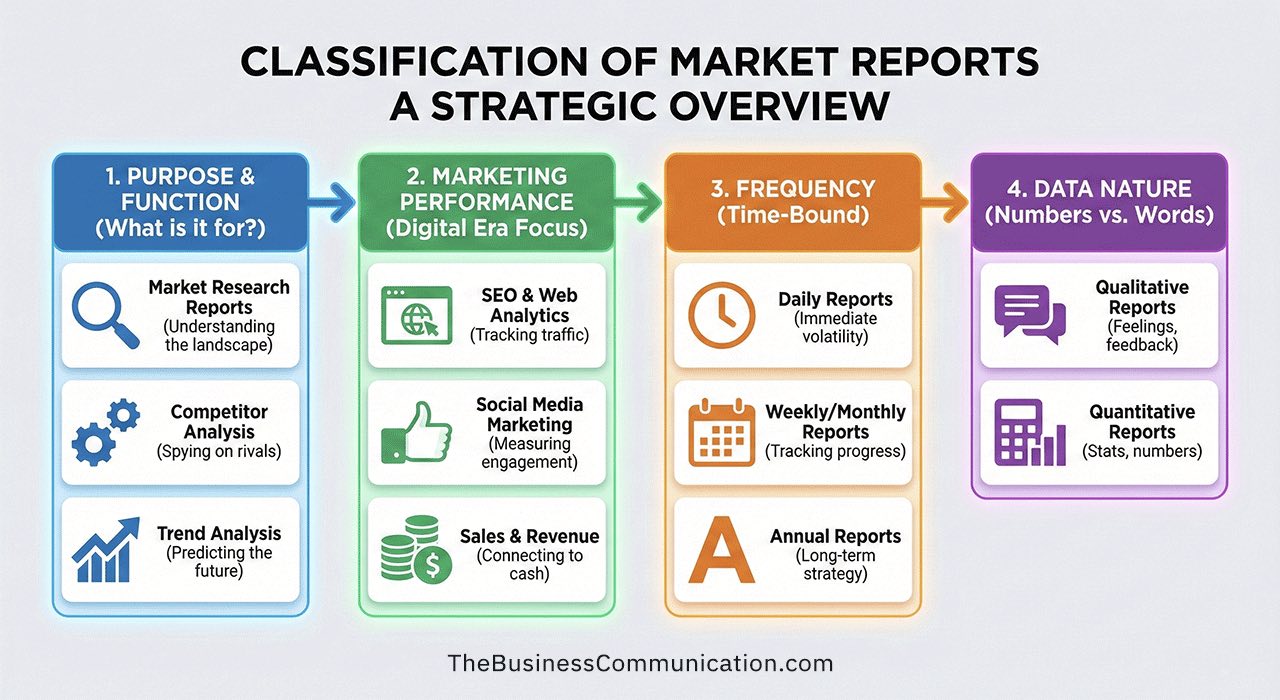
Based on Purpose and Function
- Market Research Reports: This tries to understand the entire landscape. It looks at who the customers are and what they want.
- Competitor Analysis Reports: This identifies your rivals’ strategies. It exposes their strengths and weaknesses using tools like SWOT analysis.
- Trend Analysis Reports: This looks at historical data to forecast where the market is going.
- Product Feasibility Reports: Before launching a product, this report estimates production costs and potential sales to see if the idea is viable.
Based on Frequency (Time-Bound)
- Daily Market Reports: Traders in stock markets need these to track opening and closing prices. They are short and fast.
- Weekly or Monthly Reports: These help managers track short-term progress. They allow for comparison between this month and the last.
- Annual Market Reports: This is the heavy lifter. It looks at the entire year and is often comprehensive and detailed.
Based on Data Nature
- Qualitative Reports: These focus on non-numerical data. They use focus groups and interviews to understand how people feel about a product.
- Quantitative Reports: These rely on statistics, charts, and graphs. They answer questions like “How many?” and “How much?”
Essential Elements: What Must Be Included?
Preparing a market report is a complex task. A haphazardly prepared report cannot attract the attention of the readers. To make it effective, you must incorporate specific elements.
Here is a checklist of the essential ingredients:
1. Title and Market Identity
A market report must have an appropriate title. From the title, the reader should easily understand the subject matter. Also, it must mention the Name and Address of the Market. For example, “Dhaka Stock Exchange” or “Kawran Bazaar Vegetable Market.”
2. Time and Date
The report must specify the Time or Period it covers (daily, weekly, monthly). Equally important is the Date of preparing and publishing. This ensures the reader knows how fresh the information is.
3. Product Details
A short Description of the product traded is vital. For instance, a report on jute should express the quality and features, such as “A bottom” or “B bottom” quality. It should also list the Quantity of the product traded to show volume.
4. Price Information
Incorporation of buying and selling prices is an essential element. It should mention:
- Opening price
- Closing price
- Highest and lowest price
- Average price
5. Market Trends and Indices
The report should present an overall condition of business activities. This often includes a Price Index, which indicates changes in price levels during the period.
6. Causes of Fluctuation
Why did the price change? In a market report, causes of price fluctuations should be clearly mentioned. This might be due to weather, political unrest, or seasonal changes.
7. Reporter’s Opinion
Finally, the report can include an opinion of the reporter regarding future business trends. This enhances the utility of the report for readers who want expert guidance.
Structure of a Market Report: How to Build It
Now that we know what goes inside, how do we organize it?
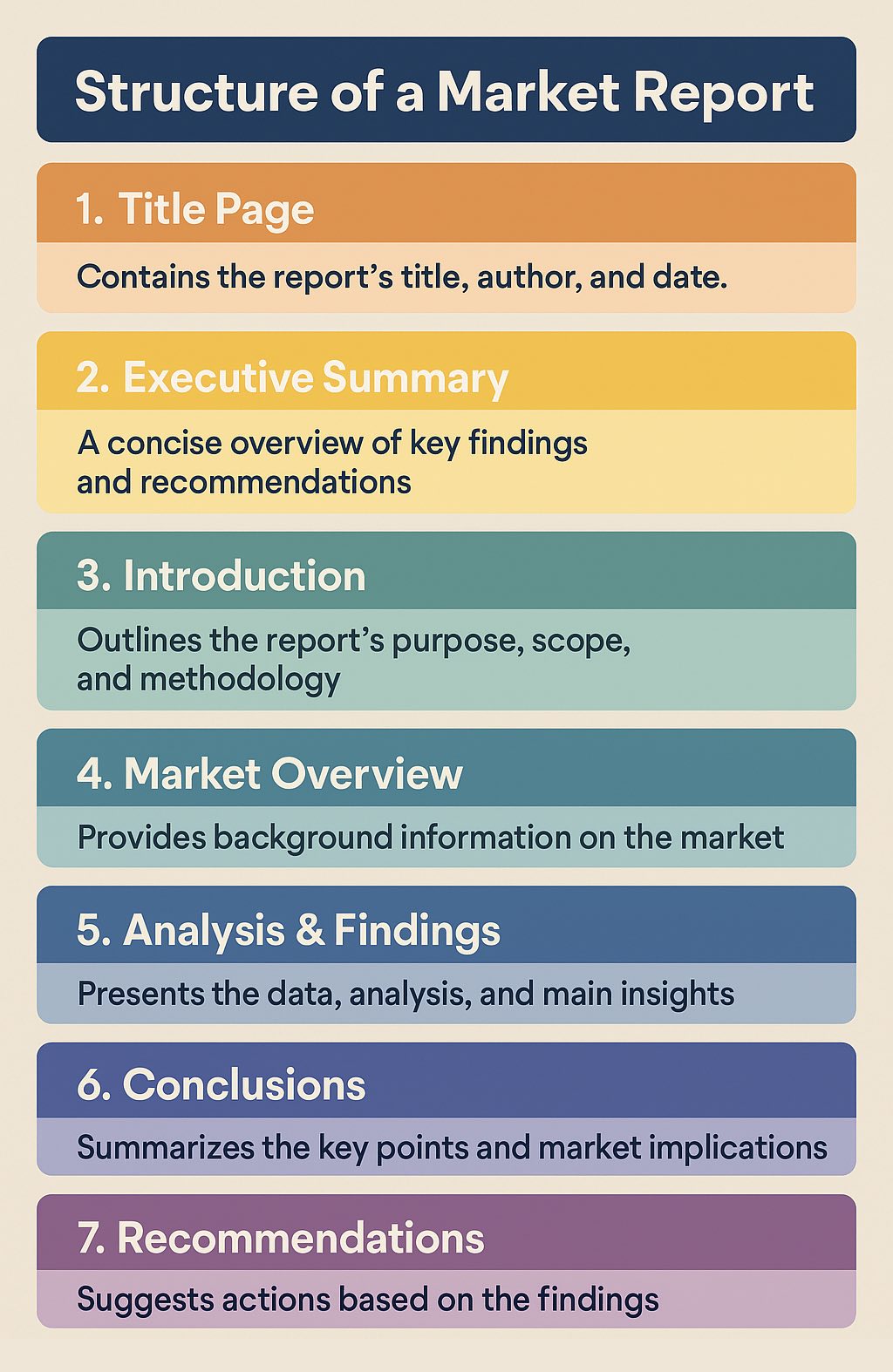
The structure of a market report matters as much as its content. A clear, well-organized report helps readers find what they need quickly. Think of it as building a house. You cannot just throw bricks together. You need a plan.
Most reports follow three major divisions:
Part 1: Preliminary Parts
These are the “front doors” of your report.
- Title Page: This carries the title, organization name, author, and date.
- Table of Contents: Think of this as a road map. It lists sections and page numbers.
- Executive Summary: This is perhaps the most important part. Many busy managers will only read this summary. In a few paragraphs, explain the purpose, findings, and recommendations.
Part 2: The Main Body
This is where the real work happens.
- Introduction: Sets the stage with background info, objectives, and scope.
- Methodology: Describes how you got the data. Was it a survey? Secondary research? A transparent methodology builds trust.
- Findings & Analysis: Here comes the data. Present numbers, tables, and graphs. Unlike a simple list, you must explain what the data shows.
- Discussion: Make sense of the findings. Compare them with past trends or industry benchmarks.
Part 3: Concluding Parts
These sections wrap up the report.
- Conclusion: Summarize key insights without repeating every detail.
- Recommendations: Offer clear suggestions. This determines if the report is actually useful.
- References & Appendices: List your sources to avoid plagiarism and attach raw data here.
Principle Factors of Writing a Market Report
Writing a report is a specialized task. To make it professional and acceptable, you must follow certain principles.
Here are the golden rules for writing a market report:
| Principle | Description |
| Simplicity | Use simple language so readers can understand it easily. |
| Correctness | The report must be free from grammatical and data errors. |
| Accurate Presentation | It must give an exact picture of supply, demand, and price. |
| Neutrality | The report is a neutral statement. It must be free from bias. |
| Impersonal Presentation | Do not address anyone directly. Keep it professional. |
| Consistency | The contents should not contradict each other. |
Why Use Technical Terms?
You should use technical terms to indicate various market conditions. For example, use “upward trend” for price increases or “bearish” for a falling stock market. This adds precision.
The Importance of Clarity
The message must be clear and unambiguous. Clarity depends on the proper arrangement of information. Rather than confusing the reader with long paragraphs, use bullet points and distinct sections.
How to Choose the Right Report for You?
You might be feeling overwhelmed by the options. Which one should you write?
It comes down to three simple factors:
- What is your goal? If you are launching a product, use a Feasibility Report. If you are worried about a rival, use a Competitor Analysis.
- Who is your audience? Is this for the CEO? Keep it short (Executive Summary focus). Is it for the marketing team? Make it detailed.
- What is your budget? Primary research is expensive. Secondary research is cheaper.
Final Thoughts
The business world is moving faster than ever. Trends change overnight. New competitors pop up daily. In this chaotic environment, a market report is your anchor.
We have discussed the different types, the essential elements, and the structure. Regardless of whether you are a student or a CEO, mastering this skill is essential. A well-structured market report is more than a collection of data. It is a tool for decision-making.
So, the next time you look at a pile of data, do not panic. Remember the structure. Follow the principles. Start with a clear title, move to accurate findings, and end with strong recommendations.
1 Comment
Assignment No 2
What is Market Report? Write essential parts and characteristics of Market Report