


Cross-cultural communication is the exchange of information between people from different cultural backgrounds. Culture shapes how we speak, listen, interpret gestures, and make decisions, and when those cultural assumptions clash, misunderstandings follow. This article explains the frameworks that help you decode cultural differences, why they matter in global business, and how to avoid the most common pitfalls.
What is cross-cultural communication?
Cross-cultural communication happens whenever people with different cultural backgrounds interact. The term is interchangeable with intercultural communication. Both describe the same challenge: bridging the gap between distinct sets of values, beliefs, norms, and practices.
Culture is more than food or festivals. It’s the shared system of meaning that tells you when to make eye contact, how to disagree with your boss, whether silence signals agreement or discomfort, and what counts as “on time.” These unwritten rules are learned from childhood and feel invisible, until you encounter someone who follows a different set.
Your cultural environment influences how you think, react, and communicate. A manager raised in Germany may view blunt feedback as respectful honesty. A colleague from Thailand may see the same directness as aggressive and face-threatening. Neither is wrong. They’re operating from different cultural scripts.
When organizations expand across borders or hire multicultural teams, these invisible scripts collide. Effective cross-cultural communication requires recognizing that your way of communicating is not universal, it’s cultural.
High-context vs. low-context cultures
Anthropologist Edward T. Hall introduced one of the most practical frameworks for understanding cultural communication styles: the distinction between high-context and low-context cultures.
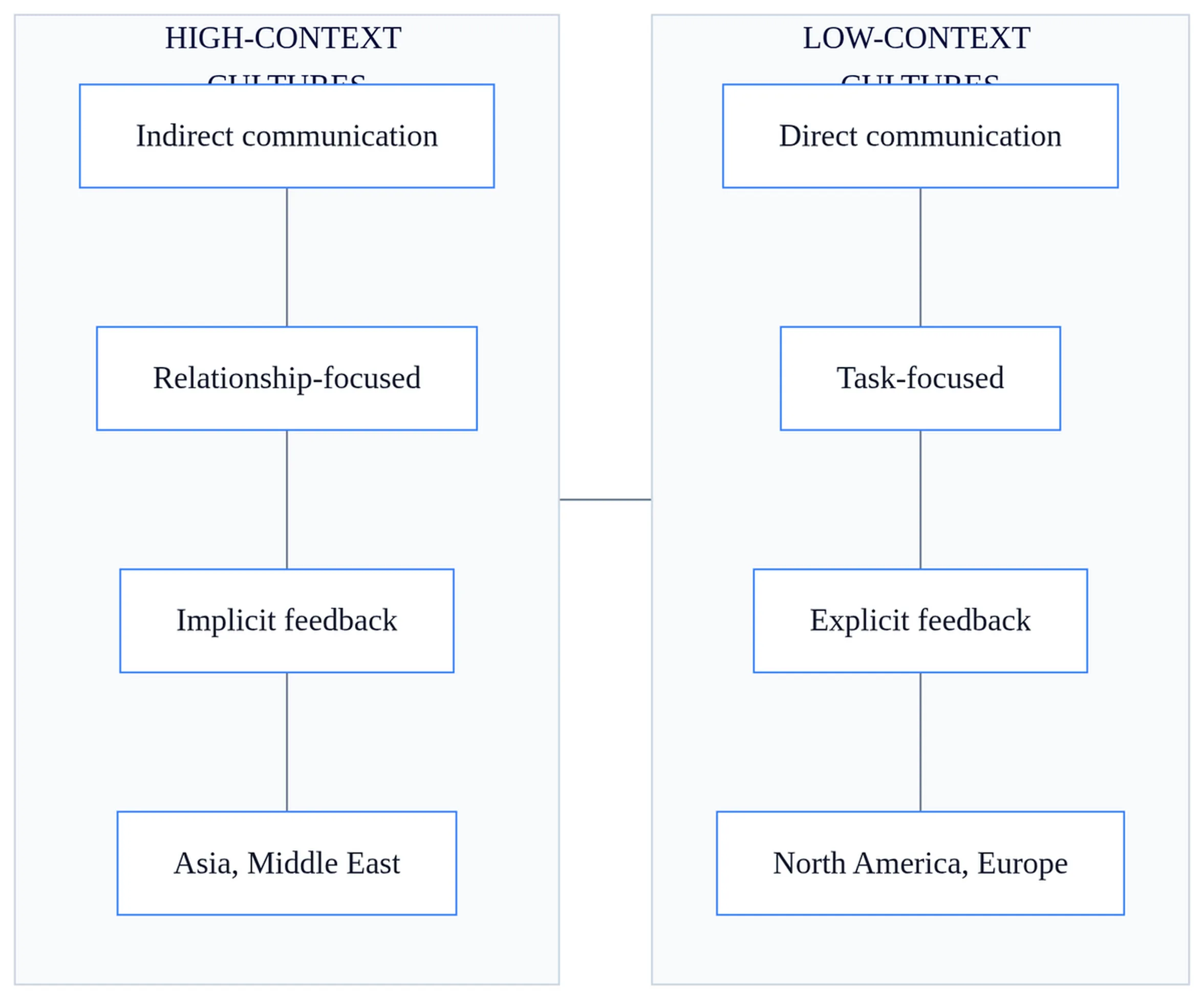
High-context cultures rely on implicit communication. Meaning comes from context, relationships, and nonverbal cues as much as from words. Japan, China, South Korea, the Middle East, and much of Latin America fall into this category. In a Tokyo meeting, a polite “that might be difficult” often means “no.” Reading the room matters more than reading the slides.
Low-context cultures depend on explicit, direct communication. Words carry most of the meaning. The United States, Canada, Germany, the Netherlands, and Australia are low-context. In a Berlin negotiation, “no” means no. Precision and clarity are valued; ambiguity is seen as inefficient or evasive.
These differences shape every business interaction. Feedback in low-context cultures tends to be direct and task-focused. In high-context cultures, criticism is softened, indirect, and delivered privately to preserve harmony. Decision-making in Germany may hinge on a detailed written proposal. In Indonesia, the same decision may require several relationship-building meals before anyone discusses terms.
What most people get wrong: they assume high-context communication is vague or inefficient. It’s not. It’s optimized for long-term relationships and social cohesion. Low-context communication isn’t rude, it’s optimized for speed and clarity among people who may never meet again.
Individualistic vs. collectivist cultures
Another cultural axis that drives communication behavior is the individualism-collectivism spectrum. Individualistic cultures, common in the United States, Canada, Western Europe, and Australia, highlight personal achievement and independence. Your identity is rooted in personal accomplishments.
Collectivist cultures, prevalent across Asia, Africa, the Middle East, and Latin America, prioritize group harmony. Your identity is tied to your role in the group. “We” matters more than “I.”
This shapes workplace communication in concrete ways. In individualistic cultures, employees expect direct feedback, even if it’s critical. Disagreement is seen as healthy debate. In collectivist cultures, public criticism threatens group harmony and causes loss of face. Consensus-building takes precedence over speed.
Consider a software team with American and Indian members. The American engineer might openly challenge a design decision in a group meeting, viewing it as constructive. The Indian colleague might interpret the same challenge as disrespectful or confrontational, preferring to raise concerns privately with the team lead.
Neither approach is superior. Individualistic communication can feel abrasive in collectivist settings. Collectivist communication can feel evasive or slow in individualistic environments. Recognizing the difference helps you adapt your style.
Nonverbal communication differences across cultures
Words are only part of the message. Nonverbal communication, gestures, eye contact, facial expressions, physical distance, and silence, carries meaning that varies dramatically across cultures.
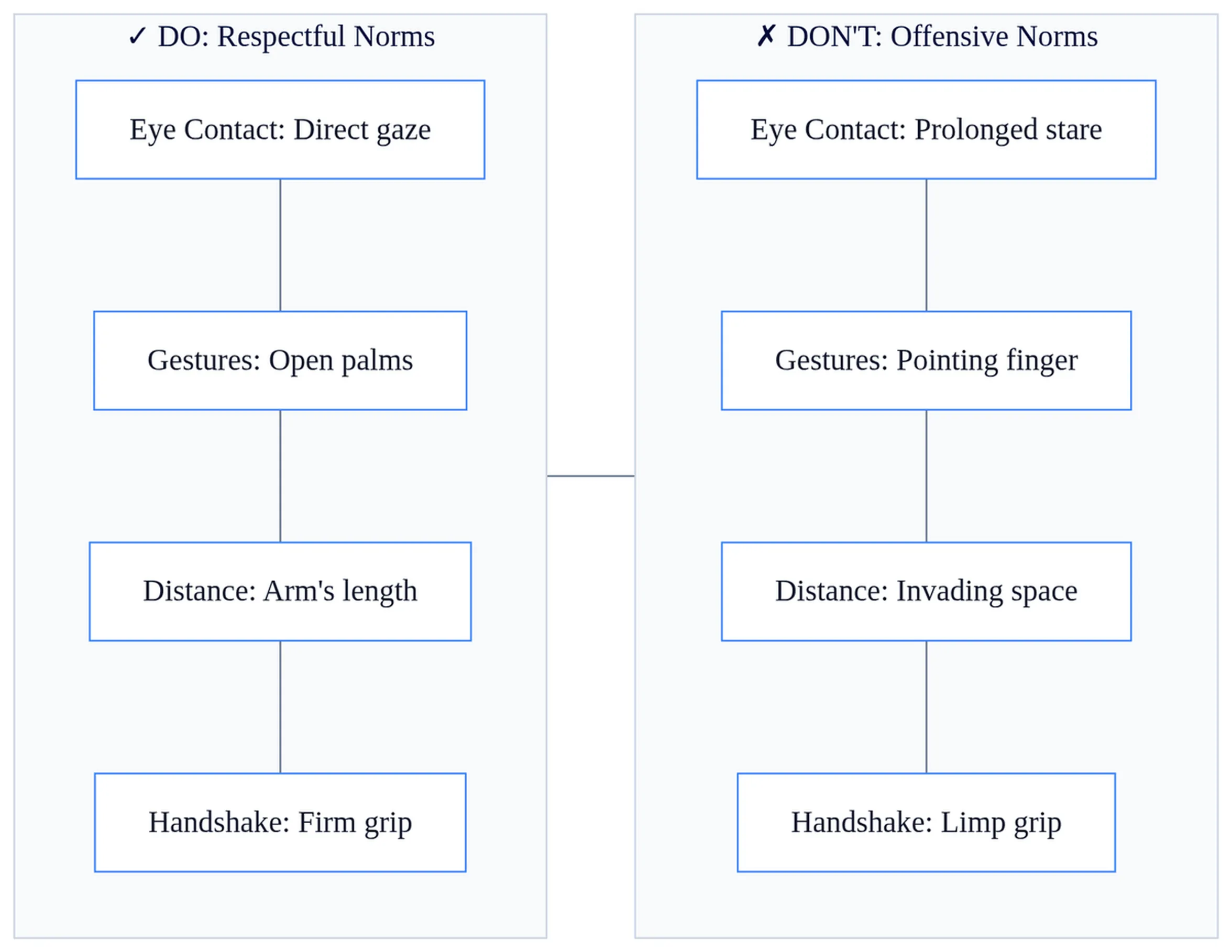
Eye contact is a minefield. In the United States, Canada, and much of Europe, sustained eye contact signals confidence. Avoiding someone’s gaze can seem evasive. In Japan, Korea, and many parts of Southeast Asia, prolonged eye contact with a superior is considered disrespectful. Lowering your gaze shows deference.
Gestures that seem innocent in one culture can offend in another. The thumbs-up is positive in North America but vulgar in parts of the Middle East and West Africa. Pointing with your index finger is normal in the U.S. but rude in Malaysia, where people gesture with an open hand or thumb. The “OK” sign (thumb and forefinger forming a circle) is harmless in America but obscene in Brazil and Turkey.
Physical distance and touch norms differ widely. Northern Europeans and East Asians prefer more personal space, standing an arm’s length apart feels respectful. Latin Americans, Southern Europeans, and Middle Easterners often stand closer and use touch (a hand on the shoulder, a double-cheek kiss greeting) to build rapport. An American manager who steps back during a conversation may seem cold to a Brazilian colleague. A Saudi businessman who stands close may feel intrusive to a Finnish partner. Silence carries different weight. In Finland or Japan, pauses in conversation are comfortable, time to think. In the United States or France, silence can feel awkward, a gap to fill. Misreading these cues creates friction that has nothing to do with the words spoken.
Common cross-cultural communication barriers
Language is the obvious barrier, but it’s rarely the only one. Translation gaps, idioms that don’t transfer, and varying fluency levels create confusion. A phrase like “let’s table that discussion” means “postpone it” in the U.S. but “discuss it now” in the U.K.
Stereotyping is a subtler obstacle. Overgeneralizing based on cultural norms, assuming all Germans are punctual, all Brazilians are relaxed about deadlines, ignores individual variation. Culture influences behavior, but it doesn’t dictate it.
Different communication styles clash when expectations aren’t aligned. A Dutch manager’s direct, unvarnished feedback may be standard practice at home but feel harsh to a team member from the Philippines. An Egyptian colleague’s warm, relationship-first approach may seem inefficient to a Swiss counterpart focused on task completion.
Power distance, the degree to which a culture accepts hierarchical authority, shapes how people communicate up and down the org chart. In high power-distance cultures like India or Mexico, employees rarely contradict a manager in public. In low power-distance cultures like Denmark or New Zealand, challenging your boss is expected. These barriers to effective communication multiply when teams span multiple cultural contexts.
Why cross-cultural communication matters in business
Global markets demand cultural fluency. A product launch that succeeds in Germany may flop in Japan if the marketing message ignores local communication norms. Understanding diverse customer preferences, how they prefer to be approached, what tone resonates, which channels they trust, determines whether you gain market share or waste budget.
Multicultural teams are now standard in organizational communication, especially in technology, finance, and consulting. A London-based fintech with developers in Bangalore, designers in São Paulo, and sales teams in New York faces daily cross-cultural friction. Cultural awareness reduces misunderstandings, speeds decision-making, and improves retention. Employees who feel understood stay longer.
Competitive advantage flows from cultural intelligence. Companies that train managers to navigate cultural differences close deals faster, negotiate better terms, and build stronger partnerships. A U.S. software vendor that adapts its sales process for a Saudi client, investing time in relationship-building before discussing pricing, wins contracts that competitors lose by rushing to the close.
Market expansion requires respecting local business etiquette. In South Korea, exchanging business cards is a formal ritual; you present and receive with both hands, read the card carefully, and never stuff it in your pocket. Ignoring this signals disrespect and can derail a partnership before it starts. In contrast, a casual coffee meeting may be the right first step in Australia.
Workplace harmony improves when leaders acknowledge cultural differences. A manager who understands why a Chinese employee rarely volunteers opinions in meetings, collectivist norms discourage standing out, can create space for input through one-on-one check-ins or anonymous surveys.
Real-world miscommunication scenarios
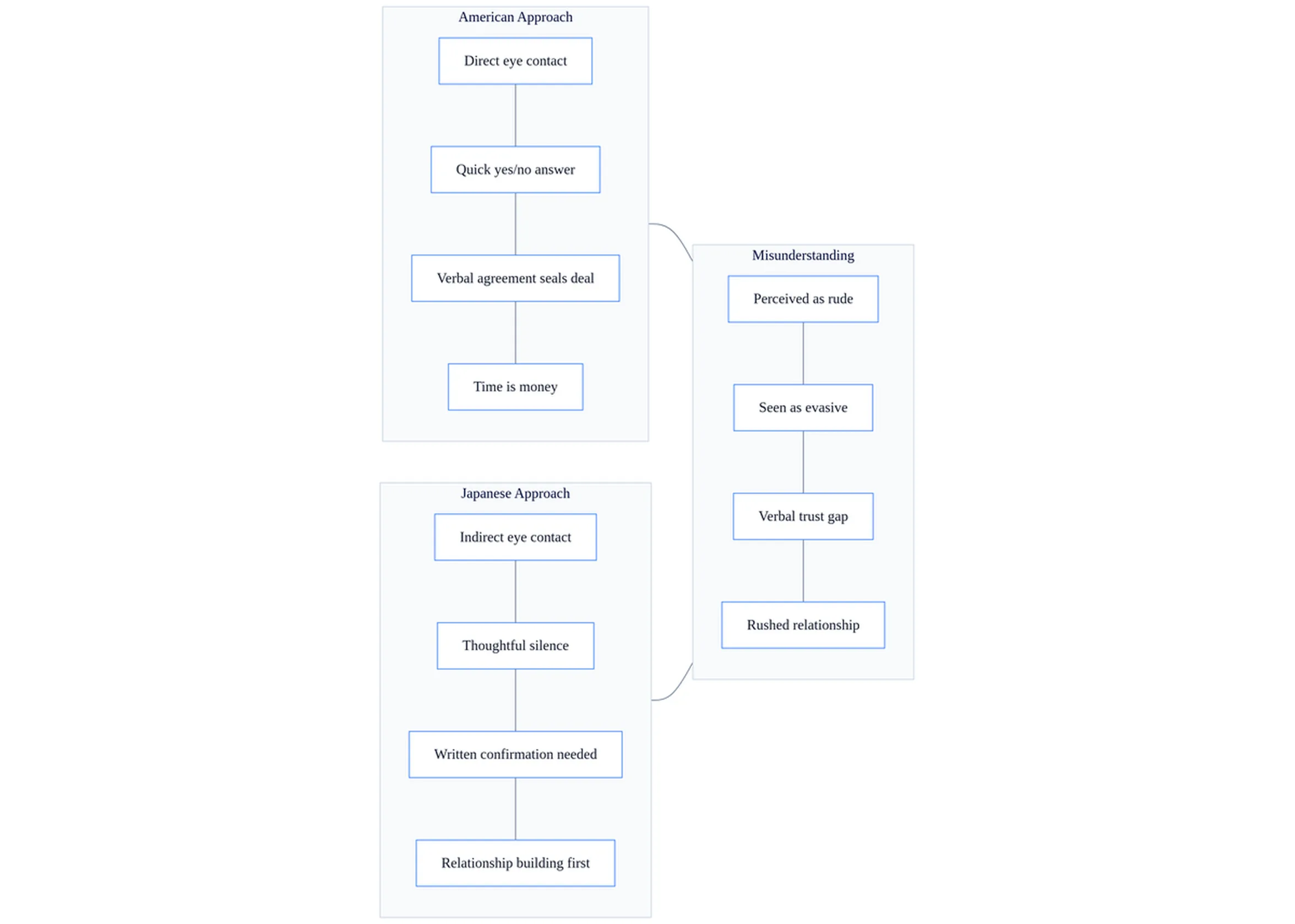
Consider a negotiation between an American purchasing manager and a Japanese supplier. The American opens with a direct question: “Can you deliver 10,000 units by March 15 at $8 per unit?” The Japanese counterpart responds, “We will do our best to meet your needs.” The American hears tentative agreement and moves forward. The Japanese manager meant “that timeline and price are not feasible,” but indirect refusal is the cultural norm. Two months later, the shipment arrives late at a higher cost. Both sides feel betrayed.
A German engineering lead sends detailed, critical feedback on a design document to an Indian team member: “This approach is inefficient. Sections 3 and 5 contain significant errors. Revise and resubmit.” The German sees this as helpful, specific guidance. The Indian engineer reads it as public humiliation, blunt criticism delivered without softening language or acknowledgment of effort. Trust erodes.
An American project manager grows frustrated when a consensus-driven decision process in a Tokyo office takes three weeks. “Why can’t they just decide?” she asks. Meanwhile, the Tokyo team views her push for a quick decision as reckless and disrespectful of the need to align all stakeholders.
Email tone creates friction. An American colleague writes, “Hey, can you send me that report when you get a chance? Thanks!” A recipient in a formal business culture, say, a bank in Frankfurt, reads the casual greeting and vague deadline as unprofessional. The American meant to sound friendly. The German colleague questions the sender’s seriousness.
| Cultural Dimension | Culture A Example | Culture B Example | Potential Clash Point |
|---|---|---|---|
| Communication Style | Direct (Germany, U.S.) | Indirect (Japan, Thailand) | Bluntness perceived as rude; indirectness seen as evasive |
| Decision-Making | Individual authority (U.S., Australia) | Consensus-driven (Japan, Indonesia) | Speed vs. stakeholder alignment expectations |
| Feedback Delivery | Public, task-focused (Netherlands) | Private, face-saving (China, Philippines) | Public criticism causes loss of face and resentment |
| Relationship Priority | Task-first (U.K., Canada) | Relationship-first (Brazil, Saudi Arabia) | Rushing to business feels transactional vs. small talk feels wasteful |
| Time Orientation | Punctuality critical (Switzerland, Japan) | Flexible, event-driven (Mexico, India) | Lateness interpreted as disrespect vs. rigidity seen as inflexible |
Improving cross-cultural communication effectiveness
Start with self-awareness. Your communication style feels natural because it’s cultural. Recognize that directness, eye contact norms, and comfort with silence are learned behaviors, not universal truths. Reflect on your own cultural assumptions before judging others.
Learn the basics of the cultures you work with most. You don’t need to become an expert on every tradition, but knowing whether a business partner comes from a high-context or low-context culture, whether hierarchy matters, and what nonverbal signals to avoid will prevent most blunders.
Practice active listening and ask clarifying questions. If a colleague’s response feels vague, don’t assume evasion. Ask, “Can you help me understand your concerns about this timeline?” Paraphrase what you heard and confirm understanding.
Avoid assumptions. A quiet team member isn’t necessarily disengaged; they may come from a culture where speaking up in groups is uncomfortable. A colleague who avoids eye contact isn’t untrustworthy; they may be showing respect.
For a deeper dive into actionable strategies, see our guidelines to improve cross-cultural communication effectiveness.
If you’re sitting on the fence about whether cultural training is worth the investment, the answer is usually yes. The manager who asks questions, observes carefully, and adjusts their approach will build stronger relationships and lead more effective teams than the one who assumes their way is the only way.
Frequently asked questions
What should I do if my direct feedback offends a colleague from a high-context culture?
Acknowledge the misalignment immediately. Explain that your intent was to improve the work, not criticize the person. In future interactions, deliver feedback privately, frame it as a suggestion rather than criticism, and emphasize the relationship. Ask how they prefer to receive input. Building trust first makes directness less jarring.
Is it safe to use the thumbs-up emoji in international business messages?
Avoid it in messages to colleagues in the Middle East, West Africa, or parts of South Asia, where it’s considered offensive. Stick with neutral emojis like checkmarks or smiling faces, or use text instead. When in doubt, skip emojis entirely in formal cross-cultural communication.
How do I know whether to push for a quick decision or wait for consensus?
Ask directly about decision-making style early. In individualistic, low-context cultures, propose a timeline and expect debate. In collectivist, high-context cultures, allow time for relationship-building and informal alignment before formal meetings. Adjust your pace to match the culture, not your preference.
What if I can’t tell whether someone’s silence means agreement or disagreement?
Don’t assume. In high-context cultures, silence often masks disagreement to preserve harmony. Follow up with open-ended questions: “What are your thoughts?” or “Do you see any concerns?” In low-context settings, silence usually means agreement, but confirming never hurts.
Should I maintain eye contact during video calls with international teams?
Moderate eye contact works across cultures on video. Look at the camera occasionally to simulate direct gaze, but don’t stare constantly. If you know a colleague is from a culture where prolonged eye contact feels disrespectful, soften your gaze and focus more on listening than looking.
1 Comment
Great breakdown of cross-cultural communication! It’s essential for avoiding misunderstandings and creating harmony in today’s globalized world. A must-read for building strong, international connections! 🌍🤝✨