


Have you ever sent an important document, payment, or even a job application and waited anxiously for confirmation? That is where the acknowledgement letter saves the day. In business communication, this simple yet powerful letter ensures the sender knows their goods, documents, or information have been received.
Acknowledgement letters may not be as persuasive as a business sales letter or as detailed as an order letter, but they play a vital role in maintaining trust, professionalism, and accountability. In this guide, we will explore what acknowledgement letters are, why they matter, how to write them, and provide sample templates you can use right away.
What Is an Acknowledgement Letter in Business?
An acknowledgement letter is a formal written response sent by a company or individual to confirm the receipt of goods, documents, services, or payments. It serves as proof that something has been received and is being processed.
Think of it as a polite handshake in writing. Instead of leaving the sender guessing, the recipient sends an acknowledgement letter to confirm, “Yes, we got it, and here’s what happens next.”
In the wider context of communication, this type of letter highlights the professionalism and reliability that businesses strive to maintain. If you want to understand why letters like this matter in the bigger picture, check out the importance of business letters, where I explained why written correspondence remains a cornerstone of corporate interactions.
Why Are Acknowledgement Letters Important?
Acknowledgement letters may look short and simple, but they have several benefits in business communication.
- Builds trust: Clients and partners feel valued when you confirm receipt of their documents or payments.
- Provides proof: The letter acts as official evidence that you received something.
- Strengthens relationships: Quick responses show respect and reliability.
- Prevents disputes: If confusion arises, both parties can refer back to the acknowledgement.
- Enhances professionalism: It shows that your organization follows proper business etiquette.
Above all, these letters serve as a bridge of trust between two parties. While a letter of complaint addresses problems, an acknowledgement letter prevents problems by confirming that communication has been received.
Structure of an Acknowledgement Letter
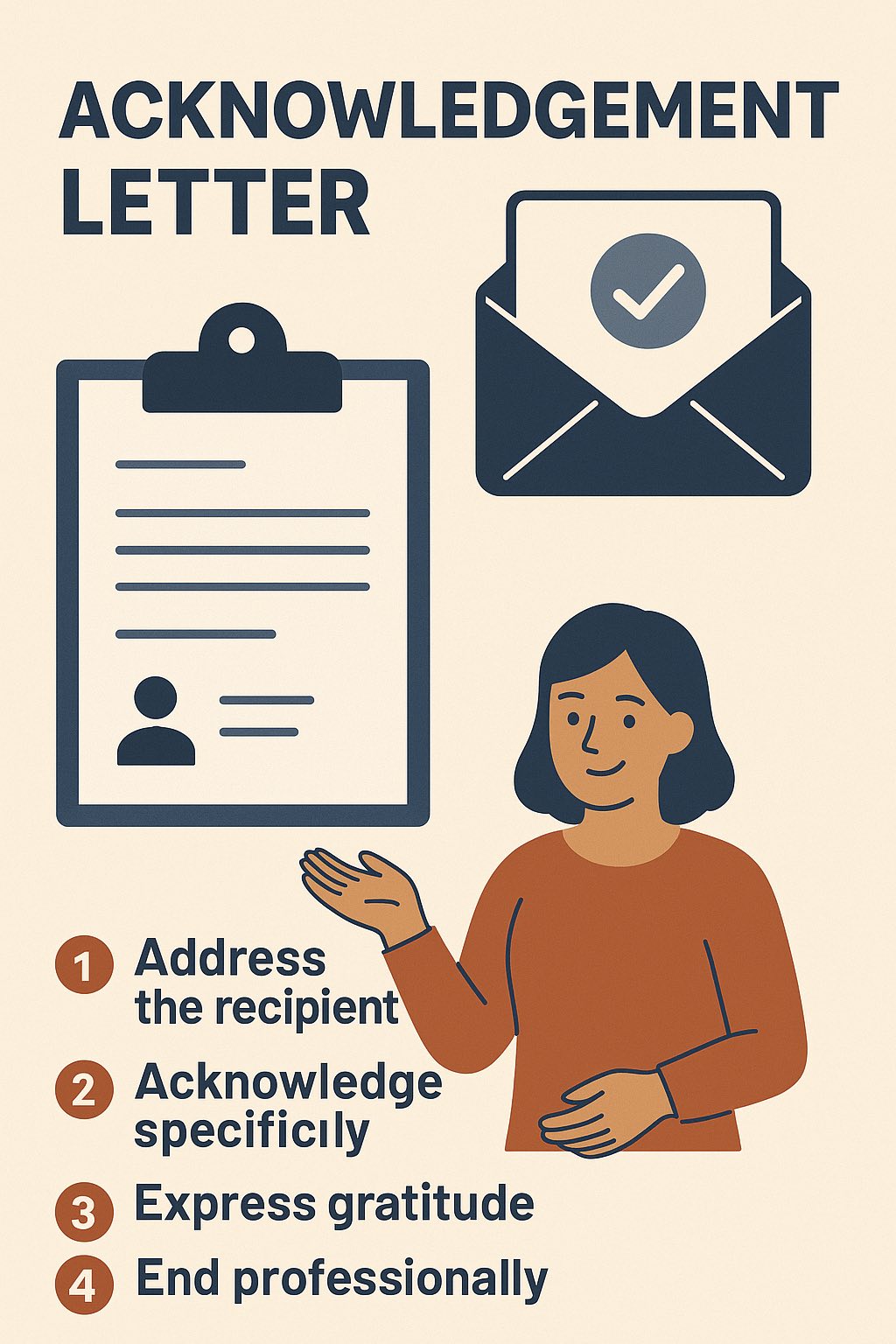
Like other forms of professional correspondence, acknowledgement letters follow a clear structure. If you are familiar with the parts of a formal letter, you will recognize most of these components.
Here is the standard layout:
- Sender’s details – Include company name, address, and contact info.
- Date – The date the letter is written.
- Recipient’s details – The name, designation, and address of the sender whose document or goods you are acknowledging.
- Subject line – Clear and short, such as “Acknowledgement of Payment” or “Acknowledgement of Job Application.”
- Opening line – Thank the sender and confirm what has been received.
- Body – Provide details of what was received, such as the invoice number, documents, or goods. Mention any next steps if applicable.
- Closing line – Express appreciation and offer assurance of further communication if needed.
- Signature – The authorized person’s name, title, and company seal if required.
This structure ensures clarity and professionalism, and it saves time for both the writer and the reader.
Tone and Language in Acknowledgement Letters
Acknowledgement letters are usually short and polite. The tone should always remain professional, concise, and respectful. Here are a few tips for keeping the right tone:
- Be polite and formal: “We acknowledge receipt of…” or “Thank you for your payment…”
- Express gratitude: A simple “We appreciate your cooperation” goes a long way.
- Keep it short: Do not add unnecessary details.
- Provide assurance: Let the sender know what happens next, such as “Your application will be reviewed shortly.”
Unlike a business inquiry letter, which asks for detailed information, an acknowledgement letter simply confirms receipt, so brevity is key.
Types of Acknowledgement Letters
There are several situations where an acknowledgement letter is used. Here are the most common types:
Acknowledgement of Receipt of Goods
Sent by a buyer to confirm goods were received in good condition.
Acknowledgement of Receipt of Documents
Common in legal, educational, and business contexts. It confirms that important paperwork has been received.
Acknowledgement of Payment
Sent by a company or supplier to confirm they have received a customer’s payment.
Acknowledgement of Job Application
HR departments often send these letters to job applicants to confirm that their application has been received and will be processed.
Acknowledgement of Order
Sent by suppliers to confirm they received an order request. This type works as a follow-up to an order letter and assures the buyer that the order will be processed.
Sample Acknowledgement Letters
Here are practical templates for different types of acknowledgement letters. You can customize them as needed.
Sample 1: Acknowledgement of Receipt of Goods
Subject: Acknowledgement of Delivery of Goods
Dear [Supplier’s Name],
We acknowledge the receipt of 100 office chairs delivered on February 20, 2025, under invoice number INV-2345. The goods were received in good condition and matched the specifications mentioned in the order.
We appreciate your prompt service and look forward to future transactions.
Sincerely,
[Your Name]
[Designation]
Sample 2: Acknowledgement of Receipt of Documents
Subject: Acknowledgement of Documents Received
Dear [Name],
This is to acknowledge the receipt of the documents you sent on March 1, 2025, regarding your property registration. We confirm that all papers are in order and will be processed within the next ten working days.
Thank you for your timely submission.
Sincerely,
[Your Name]
[Title]
Sample 3: Acknowledgement of Payment
Subject: Payment Receipt Acknowledgement
Dear [Customer’s Name],
We acknowledge receipt of your payment of $5,000 made on March 5, 2025, for invoice number 4589. The amount has been credited to your account successfully.
We value your promptness and thank you for your continued business.
Sincerely,
[Your Name]
[Accounts Manager]
Sample 4: Acknowledgement of Job Application
Subject: Acknowledgement of Application
Dear [Applicant’s Name],
Thank you for applying for the position of Marketing Executive at [Company Name]. We acknowledge receipt of your application dated February 25, 2025.
Our recruitment team will review your application, and shortlisted candidates will be contacted within two weeks.
We appreciate your interest in joining our company.
Sincerely,
[Your Name]
HR Department
Sample 5: Acknowledgement of Order
Subject: Order Acknowledgement
Dear [Customer’s Name],
We acknowledge receipt of your order dated March 2, 2025, for 200 units of Model X laptops. The order has been recorded under order number OR-8921 and will be delivered by March 20, 2025.
Please find attached a copy of the confirmed order. We thank you for your business and look forward to serving you again.
Sincerely,
[Your Name]
Sales Manager
Common Mistakes to Avoid in Acknowledgement Letters
Even though acknowledgement letters are short, people often make avoidable mistakes. Here are some of them:
- Being too vague: Always mention what exactly you are acknowledging.
- Using casual language: Keep the tone formal and respectful.
- Forgetting details: Include invoice numbers, order numbers, or dates.
- Delayed response: Send the acknowledgement promptly.
- Lack of assurance: Do not forget to mention what happens next if applicable.
These mistakes can create confusion and weaken trust. On the contrary, a clear acknowledgement builds professionalism, much like a well-structured business letter format strengthens overall communication.
Tips for Writing Effective Acknowledgement Letters
Here are a few tips to make your acknowledgement letters more effective:
- Use polite and professional language.
- Always be specific with details.
- Keep the letter short and direct.
- Send the acknowledgement as quickly as possible.
- Maintain consistency in formatting for all your business letters.
Unlike a persuasive sales message, an acknowledgement letter should be concise and straightforward.
Conclusion
The acknowledgement letter in business communication may be small in size, but it carries great importance. It builds trust, prevents disputes, and adds professionalism to your interactions. By following the correct structure, using the right tone, and avoiding common mistakes, you can write effective acknowledgement letters that enhance your credibility.
Remember, business communication is not just about persuasion or complaints. It is also about recognition and confirmation. A polite acknowledgement can make all the difference in building strong and lasting relationships.
If you want to further explore how acknowledgement letters fit into the bigger world of correspondence, you might also check my guide on order letters to see how requests are made, and my article on complaint letter samples to understand how communication handles disputes. Each type of letter plays its own role, and together they create a strong foundation for professional success.
Frequently asked questions
Should I send an acknowledgement letter via email or printed mail?
Email is standard for most business acknowledgements today—it’s faster and provides a digital record. Use printed mail only if the original submission was formal (legal documents, certified payments) or if your industry typically requires it. Match the formality level of what you received.
What if I receive something but it’s damaged or incomplete?
Send the acknowledgement letter anyway, but note the issue clearly in the body. For example: ‘We received 50 units on March 10, but 5 arrived damaged.’ This protects both parties by creating a timestamped record of the problem before disputes arise.
How quickly should I send an acknowledgement letter after receiving something?
Within 24–48 hours is ideal. Quick acknowledgement shows professionalism and reassures the sender their item arrived safely. For time-sensitive items like payments or applications, send it the same business day if possible.
Do I need to include next steps in every acknowledgement letter?
Yes, when applicable. If you’re acknowledging a job application, mention when they’ll hear back. For payments, confirm processing timelines. For goods, state expected inspection or delivery dates. This prevents follow-up questions and builds confidence.
Can I use a template for all acknowledgement letters, or should each be customized?
Use a template as your foundation, but always customize the details: specific invoice numbers, dates, item descriptions, and next steps. Generic templates feel impersonal and may miss critical information that protects both parties legally.