


Close Menu
The Business CommunicationThe Business Communication
    What's Hot

    Memo vs. Business Letter: Key Differences & When to Use Which

    December 3, 2025

    Mastering Negotiation Skills: The Role of Oral Communication

    December 2, 2025

    Non-Verbal Cues: How Body Language Impacts Oral Communication

    December 2, 2025
    Facebook X (Twitter)
    The Business CommunicationThe Business Communication
    Button
    • Basics
      1. Introduction
      2. Communication Skills
      3. Modern Communication
      4. View All

      Types of Communication | Different Types of Communication

      October 7, 2025

      Qualities of good communication | Requirements of effective communication

      September 26, 2025

      Business Communication Roles: Key Functions And Examples

      September 9, 2025

      What is Communication Process? Steps And Examples Explained

      September 7, 2025

      Meaning Of Cross-Cultural Communication

      October 19, 2025

      8 Ways To Improve Your Listening Skills

      August 11, 2025

      Various Styles Reading or Techniques of Reading

      July 6, 2025

      What Is Communication Style | Classification Of Communication Style

      March 16, 2025

      What Is The Video Conference? Advantages & Disadvantages of Video Conferencing

      April 30, 2025

      Advantages And Disadvantages Of Satellite Television In Business Communication

      November 16, 2024

      What Is Voicemail? Advantages and Disadvantages Of Voicemail

      October 13, 2024

      What Is Communication Satellite?

      August 12, 2024

      Memo vs. Business Letter: Key Differences & When to Use Which

      December 3, 2025

      Mastering Negotiation Skills: The Role of Oral Communication

      December 2, 2025

      Non-Verbal Cues: How Body Language Impacts Oral Communication

      December 2, 2025

      Glossophobia: How to Overcome the Fear of Public Speaking

      December 2, 2025
    • Forms of Communication
      • Oral Communication
      • Non-Verbal Communication
      • Report Writing
    • Written Communication
      1. Letter Writing
      2. Circular Letter
      3. inquiry letter
      4. Ultimatum Letter
      Featured
      Letter Writing

      Memo vs. Business Letter: Key Differences & When to Use Which

      By Masudur RashidDecember 3, 2025
      Recent

      Memo vs. Business Letter: Key Differences & When to Use Which

      December 3, 2025

      Advantages and Disadvantages of Business Letter

      October 20, 2025

      Inquiry Letter for Job Vacancy (Samples & Email Scripts)

      October 19, 2025
    • In Business
      1. Company Meeting
      2. Secretarial Functions
      3. View All

      Virtual Meetings for Companies: Tools, Etiquette & Challenges

      October 19, 2025

      Participants Responsibilities in Meeting

      October 7, 2025

      Meaning of Company Secretary | Appointment of Company Secretary

      May 29, 2025

      What is Annual Business Report – The Business Communication

      January 22, 2025

      What is Secretary? Types of secretary

      January 21, 2025

      What Is Organizational Communication – Types of Organizational Communication

      December 18, 2024

      Functions of a Private Secretary

      April 21, 2024

      Qualifications of a Private Secretary

      October 4, 2023

      Memo vs. Business Letter: Key Differences & When to Use Which

      December 3, 2025

      Mastering Negotiation Skills: The Role of Oral Communication

      December 2, 2025

      Non-Verbal Cues: How Body Language Impacts Oral Communication

      December 2, 2025

      Glossophobia: How to Overcome the Fear of Public Speaking

      December 2, 2025
    • Internal Communication
      1. Downward Communication
      2. Horizontal Communication
      3. Upward Communication
      4. View All

      Essential Elements of Downward Communication: A Complete Guide for Managers

      August 17, 2025

      Key Objectives of Downward Communication in an Organization

      June 26, 2025

      The Effectiveness of Downward Communication: Factors, Barriers, and Measurement

      April 13, 2025

      Advantage And Disadvantages of downward communication

      April 10, 2025

      Upward vs Downward vs Horizontal Communication: Key Differences

      December 19, 2024

      Differences Between Horizontal and Vertical Communication

      September 21, 2024

      What is Horizontal Communication: Definition, Examples & Importance

      March 15, 2024

      Importance of Horizontal Communication (With Real-Life Examples)

      December 28, 2023

      Psychological Safety & Upward Communication: Building Trust at Work

      October 25, 2025

      Common Barriers to Effective Upward Communication and Solutions

      October 15, 2025

      Future of Upward Communication in Remote/Hybrid Workplaces

      May 29, 2025

      Upward vs Downward vs Horizontal Communication: Key Differences

      December 19, 2024

      Memo vs. Business Letter: Key Differences & When to Use Which

      December 3, 2025

      Mastering Negotiation Skills: The Role of Oral Communication

      December 2, 2025

      Non-Verbal Cues: How Body Language Impacts Oral Communication

      December 2, 2025

      Glossophobia: How to Overcome the Fear of Public Speaking

      December 2, 2025
    The Business CommunicationThe Business Communication
    Home » Internal Communication » How to Use Grapevine or Informal Communication Effectively

    How to Use Grapevine or Informal Communication Effectively

    By Masudur RashidNo Comments7 Mins Read Internal Communication Informal Communication
    Facebook Twitter Reddit WhatsApp Telegram Pinterest LinkedIn Email
    Share
    Facebook Twitter Pinterest WhatsApp Email

    Think about your last day at work. Did you hear about a new project before the official email arrived? Or maybe a colleague whispered something about management’s new idea during a coffee break? If yes, you already know how powerful informal communication can be.

    Informal networks, also called the grapevine, spread messages faster than official channels. They can build trust, reduce stress, and even spark innovation. However, if left unchecked, they can also spread gossip, rumors, and misunderstandings.

    So, the big question is, how can we use informal communication effectively? Let us explore strategies, principles, and real-life examples that make grapevine communication a positive force in organizations. If you are not familiar with the basics yet, you may want to start with our guide on informal communication definition and examples.

    Why Effectiveness Matters in Informal Communication

    Some people think informal communication is unmanageable. It is natural, so why not let it flow freely? The truth is, while you cannot eliminate it, you can guide it. And guidance is what makes it effective.

    Without effectiveness, grapevine can lead to gossip, privacy breaches, and exclusion. With effectiveness, it can support formal systems, encourage creativity, and improve morale. That is why managing informal networks is not about control, it is about balance.

    For example, if managers provide clear updates, employees will use grapevine to clarify and discuss, not to guess or speculate. Conversely, when formal communication is poor, grapevine fills the gaps with assumptions. That is why effective informal communication matters.

    Key Principles of Effective Informal Communication

    1. Transparency

    Transparency is the best antidote to harmful gossip. When organizations share timely information, rumors lose power. Employees feel included and respected, which makes informal discussions more positive.

    2. Respect and Privacy

    Effective communication respects boundaries. Sharing a funny story is fine, but discussing someone’s salary or personal life is not. Respect keeps grapevine ethical and supportive. If you want to learn more, check our post on ethics of informal communication.

    3. Inclusivity

    Excluding people from informal networks creates mistrust. Inclusivity means making sure everyone feels part of conversations, whether in the lunchroom or in a digital chat group. When everyone feels included, grapevine builds culture rather than divides.

    4. Balance with Formal

    Informal networks are not a substitute for official communication. Instead, they should complement it. For example, a formal policy email can be followed by informal discussions that help employees understand it better.

    5. Timeliness

    Information loses value if it arrives too late. Effective informal communication spreads useful knowledge quickly but responsibly. Instead of waiting for gossip to distort it, ethical employees share facts as soon as they are confirmed.
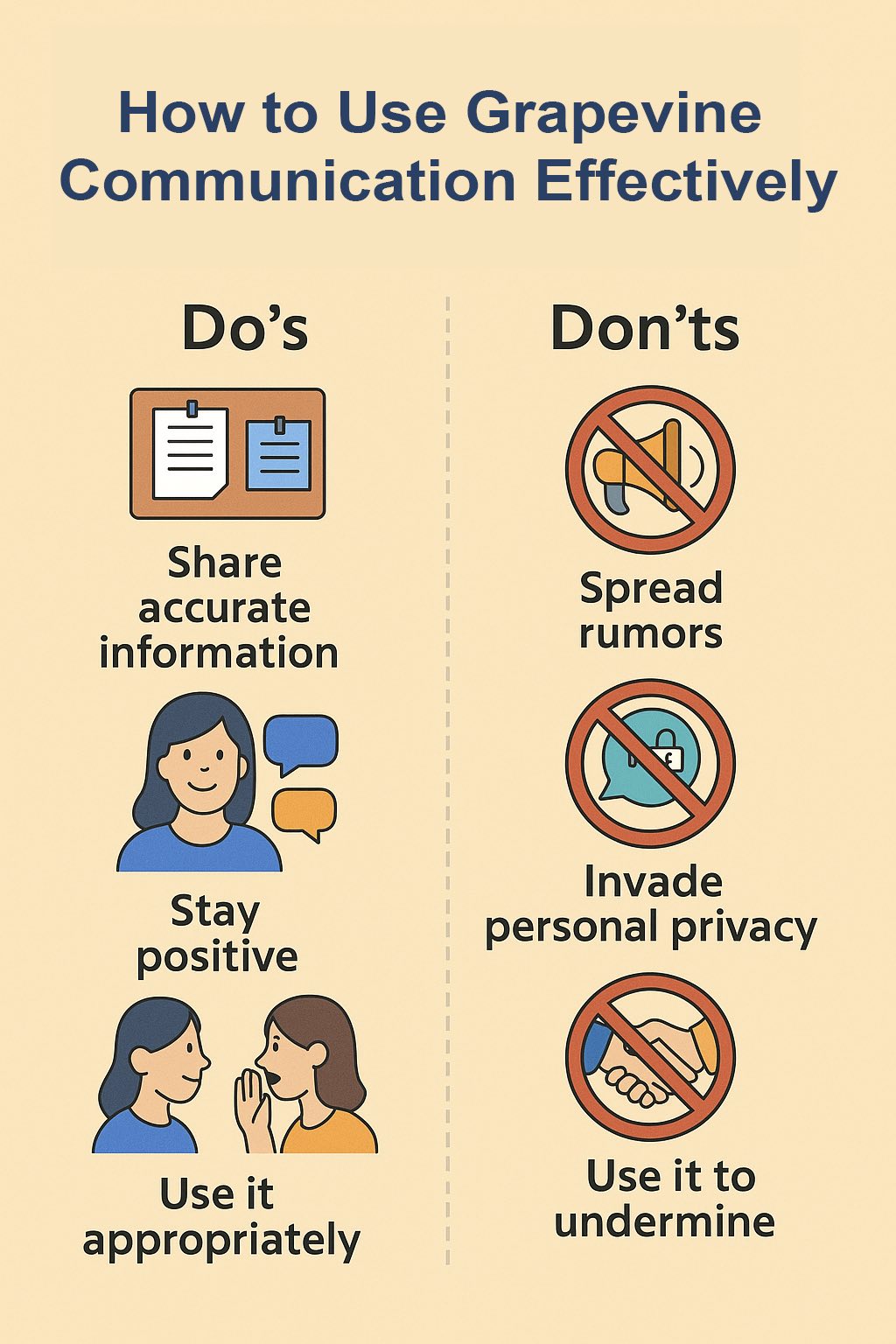
    How to Use Grapevine Communication Effectively

    Role of Managers in Using Grapevine Effectively

    Managers cannot ignore informal communication. Pretending it does not exist is like ignoring the wind. You cannot see it, but you can feel its effect. Smart leaders use grapevine to their advantage.

    • Model Respectful Behavior: If managers avoid gossip, employees follow.
    • Check Morale Informally: A casual lunch chat often reveals more than a survey.
    • Correct Rumors Quickly: If misinformation spreads, managers should clarify before it harms trust.
    • Encourage Positive Sharing: Leaders can praise achievements casually, creating a ripple of positivity.

    A great example is when managers use grapevine to test ideas before formal announcements. This way, they can sense reactions early. For deeper insights, read our guide on ethics of informal communication.

    Strategies to Make Informal Communication More Effective

    Encourage an Open-Door Policy

    When employees feel free to approach managers directly, grapevine becomes healthier. Instead of whispering rumors, people clarify doubts immediately.

    Use Social Spaces for Positive Talk

    Both physical spaces like cafeterias and digital platforms like Slack should be used to share positive news and team achievements.

    Recognize and Engage Informal Leaders

    Every workplace has influencers. These are people others trust. Managers can engage them to spread accurate information and encourage positive vibes.

    Promote Storytelling of Achievements

    Instead of gossip, encourage stories of success. Sharing how a team solved a problem can inspire others more than rumors ever could.

    Monitor Without Being Intrusive

    Managers should keep an ear on grapevine but avoid micromanaging. Over-monitoring kills trust, while light guidance keeps it healthy.

    Grapevine as a Tool for Feedback

    One of the best uses of grapevine is as a feedback tool. Surveys and forms are useful, but casual chats often reveal deeper truths.

    For example, if employees feel stressed, it will surface informally long before HR hears about it officially. By paying attention to grapevine, managers can act early.

    Effective feedback through informal communication helps organizations remain flexible. It is faster, more honest, and often more accurate than formal reports. This is why organizations that balance grapevine well enjoy stronger cultures. For more on strengths and weaknesses, see our post on advantages and disadvantages of informal communication.

    Real-Life Examples of Effective Use

    Case 1: Onboarding New Employees

    A company encouraged casual lunch groups for new hires. This informal setting allowed them to ask questions comfortably. Within weeks, the onboarding process became smoother and morale improved.

    Case 2: Early Warning System

    In another firm, managers learned through grapevine that employees were unhappy with workload. This feedback came before formal complaints. Leaders acted quickly, and employee satisfaction improved.

    Case 3: Collaboration Across Teams

    Employees from different departments started chatting informally during breaks. These conversations led to collaboration on projects that would not have happened formally. The result was innovation and stronger team spirit.

    Common Pitfalls to Avoid

    Over-Reliance on Grapevine

    If organizations depend too much on informal talk, official communication loses value. Important details must still come from formal sources.

    Ignoring Harmful Gossip

    Small rumors grow fast if ignored. Management must address harmful talk quickly before it spreads further.

    Exclusionary Cliques

    When grapevine becomes dominated by small groups, others feel left out. This damages culture and trust.

    If you want to understand how fast and dangerous rumors can be, read our article on how informal communication spreads rumor.

    Practical Tips for Employees

    • Verify before sharing. Do not pass on unconfirmed information.
    • Stay positive. Use grapevine to encourage, not discourage.
    • Respect boundaries. Avoid personal gossip.
    • Be inclusive. Make sure everyone feels welcome in informal chats.
    • Ask questions. If in doubt, go directly to the source.

    Effective informal communication is not just management’s job. Employees play an equally important role in keeping grapevine healthy.

    FAQs on Effective Informal Communication

    Q1: How can grapevine communication be made effective?
    By promoting transparency, respect, and inclusivity, and by balancing it with formal communication.

    Q2: Can organizations control informal communication?
    Not fully, but they can guide it positively and reduce harmful effects.

    Q3: What role does digital media play in effective grapevine?
    Digital platforms accelerate informal talk, making it more important to encourage responsibility.

    Q4: Why is balance with formal communication important?
    Because informal networks are fast and emotional, while formal systems are structured and accurate. Both are needed.

    Conclusion

    Grapevine communication is natural. You cannot stop it, but you can guide it. Used wisely, it becomes a tool for building trust, spreading positivity, and encouraging innovation. Used carelessly, it can spread gossip and harm culture.

    The secret lies in effectiveness. With transparency, respect, and inclusivity, grapevine can strengthen formal systems and create healthier workplaces. Both managers and employees have roles to play. Managers should guide without controlling, and employees should share responsibly.

    Above all, informal communication is not the enemy of formal communication. It is its partner. Together, they create the complete picture of how organizations communicate and grow. For a broader perspective on culture, see our article on informal communication in workplace culture.

    How to use grapevine or informal communication effective?
    Share. Facebook Twitter Pinterest LinkedIn WhatsApp Reddit Email
    Previous ArticleHow to Run an Effective Board Meeting: Tips & Checklist
    Next Article Advantage and disadvantage of formal communication
    Masudur Rashid
    • Facebook
    • X (Twitter)
    • Instagram
    • LinkedIn

    👋 Hi, I am Masudur Rashid. I studied Management (Honors and Masters) but my real passion has always been Business Communication. Through this blog, I share simple tips, lessons, and resources to help students and professionals communicate with confidence.

    Related Posts

    Internal Communication 06 Mins Read

    Psychological Safety & Upward Communication: Building Trust at Work

    Internal Communication 06 Mins Read
    Upward Communication 16 Mins Read

    Common Barriers to Effective Upward Communication and Solutions

    Upward Communication 16 Mins Read
    Internal Communication 04 Mins Read

    Methods of Internal Communication

    Internal Communication 04 Mins Read
    Internal Communication 286 Mins Read

    Advantages & Disadvantages of Informal Communication in Organizations

    Internal Communication 286 Mins Read
    Add A Comment
    Leave A Reply Cancel Reply

    This site uses Akismet to reduce spam. Learn how your comment data is processed.

    Subscribe to Updates

    Get the latest business communication news from TBC.

    By signing up, you agree to the our terms and our Privacy Policy agreement.

    Check your inbox or spam folder to confirm your subscription.

    Top Picks

    Types of Communication | Different Types of Communication

    Here you will get about kinds or classification or Types of communication. There are several…

    Qualities of good communication | Requirements of effective communication

    Whenever the sender and also recipient understand the meaning connected with communication virtually just as,…

    Business Communication Roles: Key Functions And Examples

    In every workplace, communication is the glue that holds everything together. It connects teams, builds…

    What is Communication Process? Steps And Examples Explained

    Have you ever played the “telephone game” as a child? Someone whispers a message, and…

    Welcome to TheBusinessCommunication.com, your guide to clear and effective business communication. Here you will find simple lessons on report writing, letters, meetings, oral and written communication, and modern tools like email or virtual meetings. Our mission is to make learning communication easy, practical, and fun, so you can apply it in your studies, career, and everyday life.
    We're social. Connect with us:

    Facebook X (Twitter) YouTube LinkedIn RSS
    Top Insights

    Memo vs. Business Letter: Key Differences & When to Use Which

    Mastering Negotiation Skills: The Role of Oral Communication

    Non-Verbal Cues: How Body Language Impacts Oral Communication

    Subscribe to Updates

    Get the latest business communication news from TBC.

    By signing up, you agree to the our terms and our Privacy Policy agreement.

    Check your inbox or spam folder to confirm your subscription.

    Copyright © 2025 TheBusinessCommunication. All Rights Reserved.
    • Home
    • About Us
    • Contact US
    • Our Authors
    • Privacy Policy
    • Terms and Conditions

    Type above and press Enter to search. Press Esc to cancel.