


Think about your last day at work. Did you hear any quick gossip in the hallway? Or maybe you joined a casual chat on WhatsApp with your colleagues? If yes, then congratulations, you already took part in informal communication. It may look like random talk, but in reality, it is a powerful channel that shapes workplace culture.
Informal communication, often called grapevine communication, is the unofficial way people share information. It spreads fast, feels natural, and sometimes delivers messages more effectively than official memos. In this article, we will explore the types of informal communication, how each one works, their advantages and disadvantages, and why every manager should pay attention to them.
If you are new to the idea of informal workplace talk, you might want to start with our complete guide on informal communication: definition, examples, and importance . But if you are ready to dive into the patterns, let’s begin.
What is Grapevine Communication? (Quick Recap)
The word grapevine may remind you of plants twisting and spreading in all directions. That is exactly how information moves in informal networks. Grapevine communication does not follow official paths. Instead, it spreads through friendships, social circles, and casual conversations.
It is often quick, emotional, and sometimes even distorted. For instance, one person might say, “I think our team is moving to a new office,” and before long, the story changes into, “The company is relocating to another city.” That is the grapevine at work.
To understand why grapevine exists, you can check our earlier post on factors that influence grapevine communication . For now, let us focus on the main types of informal communication.
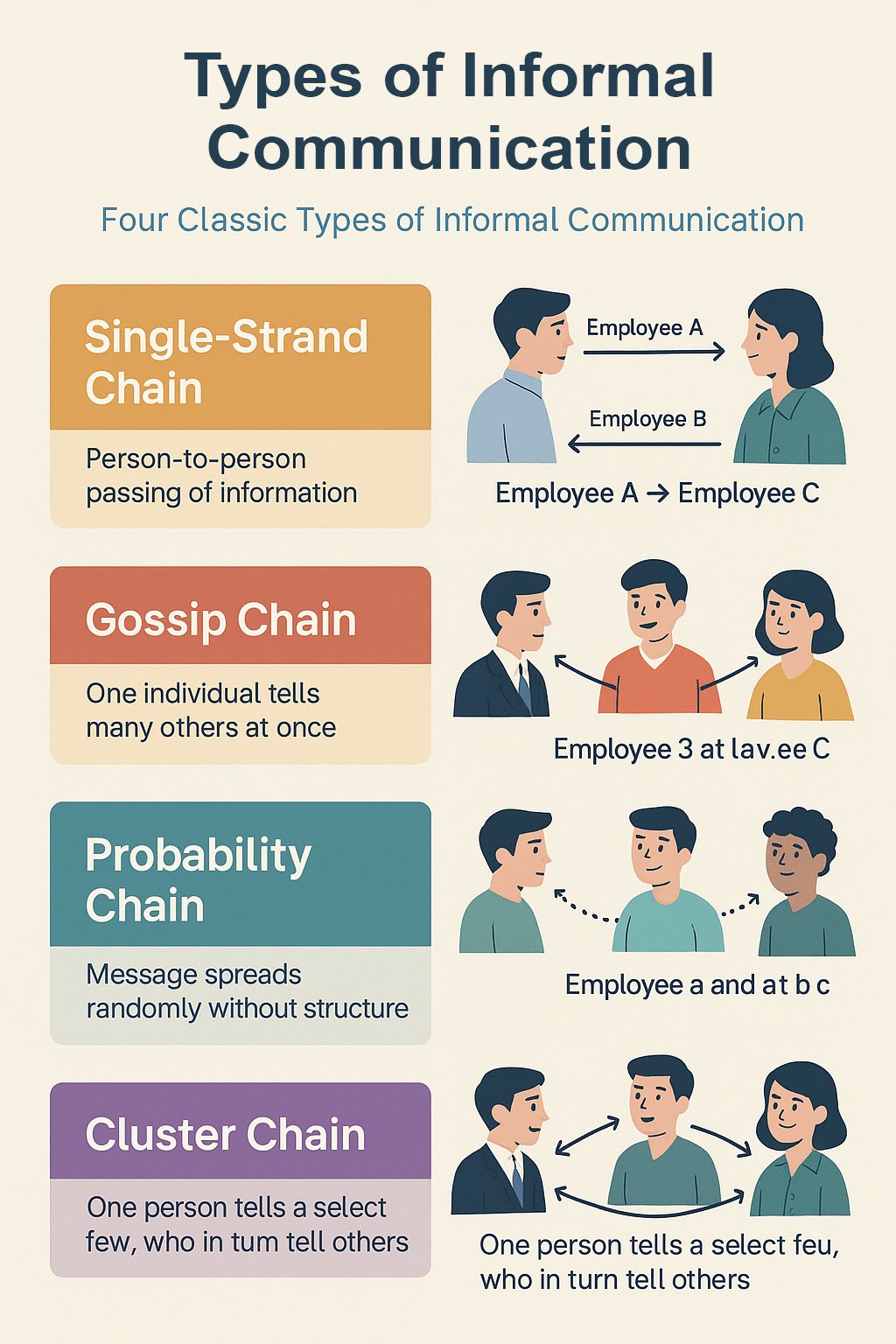
The Four Classic Types of Informal Communication
1. Single-Strand Chain
In the single-strand chain, one person tells another, who then tells another, and the chain continues. It is like the childhood game “Chinese whispers,” where the final message often differs from the original.
For example, imagine an employee tells his colleague that the boss is unhappy with sales. By the time the story reaches the fifth person, it may sound like the boss is firing half the team. That is the weakness of this type.
Still, it is common in large organizations where people pass on information step by step.
2. Gossip Chain
In the gossip chain, one person spreads information to several people at the same time. Think of it like broadcasting.
For example, an employee may return from a meeting and tell everyone in the cafeteria, “We are getting a new project next month.” Within minutes, everyone knows about it.
This type is fast and wide-reaching. However, it can also spread rumors quickly. That is why it is often linked with gossip culture in offices.
3. Probability Chain
The probability chain works randomly. One person shares the news with a few people, and whether it spreads further depends on chance.
Picture this: someone mentions during a tea break that there might be a holiday next week. Some colleagues pass it on, while others ignore it. Eventually, only a small group hears the information.
Unlike gossip chains, probability chains do not reach everyone. But they still play a role in shaping perceptions in smaller groups.
4. Cluster Chain
The cluster chain is the most common type of informal communication. Here, one person shares information with a close group. Then each member of that group passes it on to their own trusted circles.
For example, a team leader may tell a few close friends about a new client deal. Those friends then tell their own networks. Soon, the entire office knows, but through smaller, trusted clusters.
This pattern feels more reliable because people usually share within relationships they trust. That is why cluster chains dominate in workplaces.
If you want a deeper dive into the structure of grapevine, have a look at our article on patterns of grapevine communication .
Real-Life Examples of Each Type
Let us make these types more practical with workplace examples.
- Single-Strand Chain: A secretary tells the assistant manager about an upcoming audit. He passes it to a colleague, who tells another, until the entire department hears.
- Gossip Chain: After a board meeting, one employee shares news of a new CEO appointment with the whole lunch group.
- Probability Chain: Someone whispers about possible salary hikes. A few colleagues pass it along, but others forget about it.
- Cluster Chain: An employee shares promotion news with a few friends. Those friends tell their friends, and soon the entire office celebrates.
These examples show that the types of informal communication exist everywhere, from small teams to large companies.
Importance of Knowing the Types
Why should anyone bother to learn about these patterns? The answer is simple. Recognizing the type of grapevine communication helps managers understand how information spreads.
If a rumor travels via gossip chain, it means the organization has fast informal networks. If the cluster chain dominates, it means trust-based groups control the information flow.
For managers, this knowledge is gold. It helps them identify where to intervene, how to promote healthy chats, and how to minimize harmful gossip. You can find some practical methods in our article on how to use grapevine communication effectively .
Advantages and Disadvantages of Each Type
Advantages
- Single-Strand Chain: Reaches people step by step, making it easier to track.
- Gossip Chain: Spreads quickly and widely.
- Probability Chain: Encourages casual sharing without pressure.
- Cluster Chain: Reliable because people trust their close contacts.
Disadvantages
- Single-Strand Chain: Prone to distortion with every retelling.
- Gossip Chain: Can spread false information at lightning speed.
- Probability Chain: Unpredictable and often incomplete.
- Cluster Chain: Information may become biased inside close circles.
For a detailed look at strengths and weaknesses, check our piece on the advantages and disadvantages of grapevine communication .
Informal Communication in the Digital Age
Now, let us look at modern workplaces. Informal communication no longer depends only on face-to-face chats. Digital platforms like Slack, WhatsApp, and Zoom have become the new grapevine.
- Single-Strand Chain in digital form: One person DMs another, who forwards it again and again.
- Gossip Chain: A post in a group chat that everyone sees instantly.
- Probability Chain: A random comment in a forum that some people notice.
- Cluster Chain: Private group discussions where members share information only with selected people.
Remote and hybrid work have only made these patterns stronger. Informal talk now happens online, but the nature remains the same.
Practical Tips for Managers
How can leaders handle grapevine communication wisely? Here are a few ideas:
- Observe the grapevine: Notice which pattern dominates in your team.
- Encourage positivity: Use informal chats to motivate and inspire, not just gossip.
- Provide clarity: When rumors spread, clarify through formal communication.
- Blend both worlds: Formal announcements followed by informal team discussions work best.
Smart managers do not try to shut down informal networks. Instead, they shape them into healthy, supportive systems.
FAQs on Types of Informal Communication
Q1: What is the most common type of informal communication?
The cluster chain is the most common, as people prefer sharing within trusted groups.
Q2: Which type spreads the fastest?
The gossip chain spreads fastest because one person tells many at once.
Q3: Can informal communication be controlled?
Not completely. But managers can guide it by creating an open culture and addressing rumors early.
Q4: Do digital platforms change grapevine communication?
Yes. They make it faster and broader. But the patterns remain the same, only the medium changes.
Conclusion
Informal communication may look casual, but it has its own clear structure. The four main types of informal communication are single-strand chain, gossip chain, probability chain, and cluster chain. Each works differently, with its own strengths and weaknesses.
In the workplace, grapevine is unavoidable. Instead of fighting it, organizations should understand it, respect it, and use it wisely. Managers who learn to balance formal and informal networks enjoy better teamwork, stronger trust, and faster problem-solving.
If you want to explore the wider communication landscape, check out our guide on types of communication in organizations . It will show you how informal talk fits into the bigger picture of workplace communication.
Frequently asked questions
How can I stop a rumor that started as a single-strand chain?
Interrupt the chain early by correcting the person who told you directly. Ask them to pass the accurate version forward. Since single-strand chains rely on sequential passing, stopping it at one point prevents further distortion. If the rumor has already spread widely, address it publicly through official channels to override the false narrative.
Should managers try to control cluster chains or let them happen naturally?
Let cluster chains operate naturally—they’re built on trust and typically spread accurate information. Instead, focus on being transparent with key influencers in each cluster. When trusted people have correct information first, they naturally share it accurately within their networks. This is more effective than trying to suppress informal communication.
What’s the fastest way to spread important news if I can’t use official channels?
Use a gossip chain pattern by telling multiple trusted people simultaneously. However, use this sparingly for time-sensitive, factual information only. Gossip chains spread fast but risk distortion, so ensure your core message is simple and clear. Follow up with official communication as soon as possible to prevent the story from changing.
Why does the same rumor sound completely different depending on who tells it?
Each person adds their own interpretation, emotion, or details when retelling information. Single-strand chains amplify this effect because each person filters the message through their perspective. Gossip chains and cluster chains also distort messages, but cluster chains tend to preserve accuracy better because people share within trusted relationships where they’re more careful.
Can I use grapevine communication intentionally to share good news?
Yes, but carefully. Cluster chains work best for positive news because trusted groups share accurately. Tell a few respected colleagues who naturally influence their networks. Avoid using gossip chains for sensitive information, as speed often comes with distortion. Always follow up with official confirmation to ensure the message stays accurate.
1 Comment
I like this page it teaches me a lot