


Imagine walking into your office on a Monday morning. Before you even switch on your computer, someone whispers, “Did you hear we might get a new project soon?” A little later, you overhear two colleagues laughing about a funny incident in last week’s meeting. None of this is part of any official communication, yet it matters. This is informal communication, and it shapes the mood, culture, and sometimes even the performance of organizations.
Informal communication is often called the grapevine. It flows naturally, without structure, and often faster than official messages. While you may already know the definition and examples of informal communication , this article takes things further. Here, we will explore the advantages and disadvantages of informal communication in organizations, showing how it can be both a blessing and a curse.
Why Informal Communication Matters in Organizations
Organizations cannot survive without communication. Formal channels are essential for policies, contracts, and official decisions. However, they are not enough. Employees also need casual interactions to feel connected. This is where informal communication plays a role.
Unlike formal channels, grapevine networks spread quickly. They carry emotions, ideas, and concerns that official memos often miss. For example, a policy change may be announced formally, but employees usually discuss it informally during breaks. This casual sharing helps them process information, ask questions, and even vent frustrations.
In short, organizations that understand both systems thrive. If you are curious about the broader comparison, you can read our post on formal vs informal communication .
Key Advantages of Informal Communication
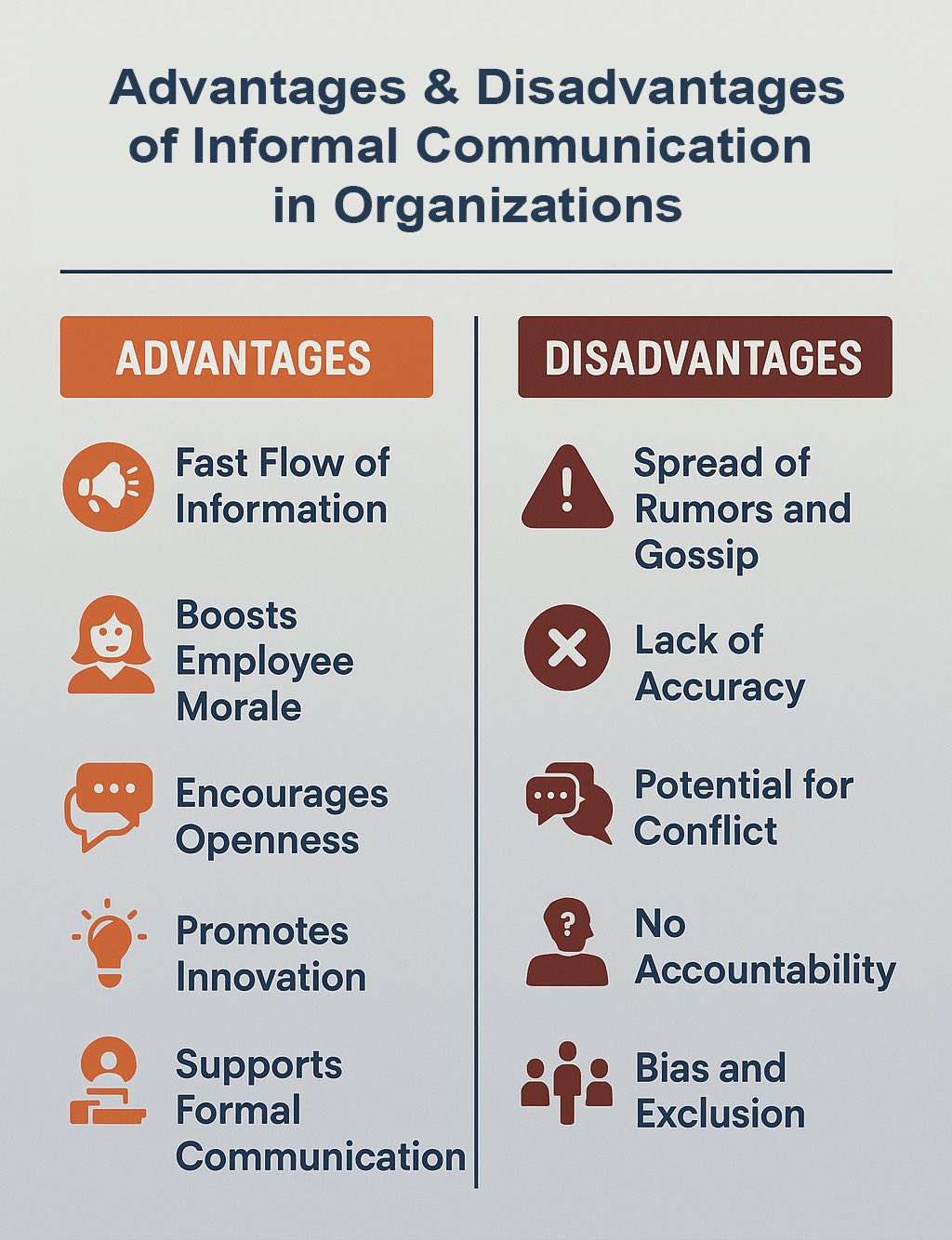
1. Fast Flow of Information
One major strength of informal communication is speed. Messages do not wait for approvals. Instead, they move freely across teams. For instance, when an employee hears about a new product launch, the news might spread across the office in minutes. This quick flow can sometimes be more effective than official announcements.
2. Boosts Employee Morale
People feel more relaxed when they can chat freely with colleagues. These conversations often reduce stress and increase motivation. Imagine a stressful day. A funny story shared during lunch can lighten the mood and help employees return to work with renewed energy.
3. Encourages Openness
Formal communication can feel intimidating. Employees might hesitate to share opinions in meetings. However, in informal chats, they feel free to speak honestly. Managers can use these conversations to understand real concerns. That is why grapevine is often a source of honest feedback.
4. Promotes Innovation
Great ideas rarely come only from boardrooms. Instead, they pop up in casual conversations. Two employees joking about a problem might suddenly discover a creative solution. Informal talks often spark innovation because there is no fear of judgment.
5. Supports Formal Communication
Informal communication fills gaps in formal systems. For example, if an official email is unclear, employees often clarify it through casual chats. These discussions make formal information more understandable. For more on how to strengthen grapevine, check our guide on using informal communication effectively .
Key Disadvantages of Informal Communication
1. Spread of Rumors and Gossip
The biggest drawback is the risk of rumors. Informal communication often distorts facts as they spread. For example, a simple comment like “The company is hiring new staff” might quickly turn into “The company is replacing old staff.” Such rumors can harm morale. You can read more about this risk in our post on how informal communication spreads rumor .
2. Lack of Accuracy
Since there is no formal structure, accuracy suffers. Employees may misunderstand the original message. Without a reliable source, it becomes difficult to know what is true.
3. Potential for Conflict
Misinformation often leads to misunderstandings, which may cause conflict. For instance, if one group believes a rumor about promotions and another group denies it, workplace tension increases.
4. No Accountability
Unlike formal communication, grapevine has no record. When things go wrong, it is hard to trace who started the message. This lack of accountability makes management nervous.
5. Bias and Exclusion
Sometimes, informal communication happens only within small groups. People outside these circles feel left out. This creates a sense of inequality in the workplace.
Balancing the Pros and Cons
So, is informal communication good or bad? The answer lies in balance. It is neither completely positive nor entirely negative. Organizations must encourage the advantages while controlling the disadvantages.
For example, managers should listen to informal talks to understand employee moods. At the same time, they must quickly clarify when rumors appear. Formal announcements paired with informal discussions often create the best results.
Case Examples in Organizations
Example 1: Informal Communication as a Strength
In one company, employees learned about a new training program informally, even before the official memo arrived. Because the news spread so quickly, the training saw higher participation. This shows how grapevine can support organizational goals.
Example 2: Informal Communication as a Weakness
In another case, a rumor about layoffs spread through gossip. Although the management had no such plan, the rumor lowered morale and productivity. By the time leaders clarified, employees had already lost trust.
These examples prove that informal communication can either help or hurt, depending on how it is managed.
Best Practices for Organizations
- Promote a Culture of Openness
When employees feel safe to ask questions, rumors lose power. - Combine Formal and Informal Channels
Use formal systems for accuracy, and let informal chats add warmth. - Encourage Healthy Team Bonding
Social activities create positive grapevine communication. - Train Leaders
Managers should learn to listen carefully and separate facts from rumors. - Address Gossip Quickly
Do not let false information spread unchecked. Clarify with facts immediately.
FAQs on Advantages and Disadvantages
Q1: Is informal communication always good?
Not always. It has many benefits, but it also carries risks like gossip and misinformation.
Q2: Can informal communication harm productivity?
Yes. Rumors and conflicts can distract employees from their tasks.
Q3: How can companies reduce gossip?
By promoting transparency and providing timely formal updates.
Q4: Why is informal communication necessary if formal systems exist?
Because it adds a human touch, encourages creativity, and builds stronger workplace relationships.
Conclusion
Informal communication is like fire. It can warm the workplace, or it can burn trust if uncontrolled. Its advantages include speed, morale, openness, and creativity. On the other hand, it can also spread rumors, cause conflict, and create exclusion.
The smartest organizations do not try to eliminate grapevine communication. Instead, they balance it with formal systems. They encourage the positives while keeping an eye on the negatives. That is how informal networks turn from a risk into a strength.
For a broader perspective, you may want to read about the advantages and disadvantages of grapevine communication . Together, these resources give you a complete picture of how informal talk shapes organizations.
Frequently asked questions
How can I stop rumors before they damage team morale?
Address rumors quickly and directly. When you hear misinformation, clarify the facts immediately through both informal and formal channels. Don’t ignore gossip hoping it disappears—it typically spreads faster. Share accurate information proactively so employees have reliable sources. Regular town halls or email updates also reduce the vacuum that rumors fill.
Should managers participate in informal office conversations?
Yes, but carefully. Managers who engage in casual chats gain honest insight into employee concerns and morale. However, avoid appearing to favor certain groups or sharing confidential information informally. Balance participation with professionalism. Use informal moments to listen more than talk, and always follow up with formal communication on important matters.
What’s the best way to correct misinformation without seeming defensive?
Stay calm and factual. Say something like, ‘I’ve heard that rumor, but here’s what’s actually happening.’ Provide clear, simple facts without blaming people for spreading the false information. Follow up with written confirmation so there’s an official record. Acknowledge why the rumor seemed believable—this shows you understand employee concerns.
Can informal communication replace formal announcements about policy changes?
No. Informal communication should support formal announcements, not replace them. Always document policy changes officially so there’s accountability and a clear record. Use informal channels to explain the reasoning behind policies and answer questions, but rely on formal channels for the official message.
How do I include remote employees in informal workplace communication?
Create intentional informal spaces online—Slack channels for non-work chat, virtual coffee breaks, or team social events. Don’t assume remote workers will naturally participate in hallway conversations. Be deliberate about sharing casual updates and stories across all communication platforms so no one feels excluded.
27 Comments
i like what i read its meaning full
It’s very easy to remember and to know.
its meaning full and easy to understund. thnk u
Your right I love this
Thank you
Actually without communication nothing goes on and no problems solved in organisations,among the marrieds and so on
very wholesome information
it s great for the opportunity of simplifying our commounication through such medias, we can link up the all world.
I have been lectured here and I believe will do well in my exams.
Grapevine can check and balance some managers.If he is planning something bad to his employees and they react early through grapevine,he may go slow and revise himself.On the other hand,grapevine can cause strikes e.g in institutions.Relatedly it can cause destruction of property.0774677286(Kyamoshe-Bufunda ward/Division-Ibanda Municipality-Uganda-Africa.
Thank you very much
thanx 4 ur ideas
TRUE -Communication is a process of exchanging information that involve verbal and nonverbal between two or more person
Comment:
Thanks a lot for more elaborate on use of grapevine
It’s a very good and easy to understandable.
Thanks I appreciate that information was useful
not too bad
I’ve rent but what are the questions partenning to this topic?
i have a one question why so of manager use grapevine as the source of his information.
I really found things hard in class but thank now am satisfied with communication and now i can face my exams with confidence
Communication Is So Important In Society And In Our Daily Life, Xo That, We Can Use Much Formal Com In Order To Present Truly Information, Thanks These Notes Of Grapevine Comm
nice explaination on grapevine, thank you
nice explan
it’s very attractive to study communication skills
this really help me…
It’s not just wow but,more knowledgeable with rich content for business learners like I.
Good Luck please.
Carefully observe the winners, don’t always pay attention to the losers