


We consume media every single day. You scroll through social media in the morning. You listen to the radio or a podcast on your commute. You watch a series on Netflix before bed.
Have you ever stopped to ask yourself why?
Is it just for fun? Or is there something deeper going on?
Mass media is not just about noise or filling up our free time. It actually serves a very specific purpose in our lives. In fact, sociologists have been studying this for decades. Famous scholars like Harold Lasswell and Charles Wright identified specific jobs that media performs to keep society running smoothly.
Think of mass communication as the eyes, ears, and voice of our civilization. Without it, we would be disconnected and lost.
To really understand how this machine works, you might want to refresh your memory on the basics by reading our guide on what is mass communication. That will give you the foundation you need for this deep dive.
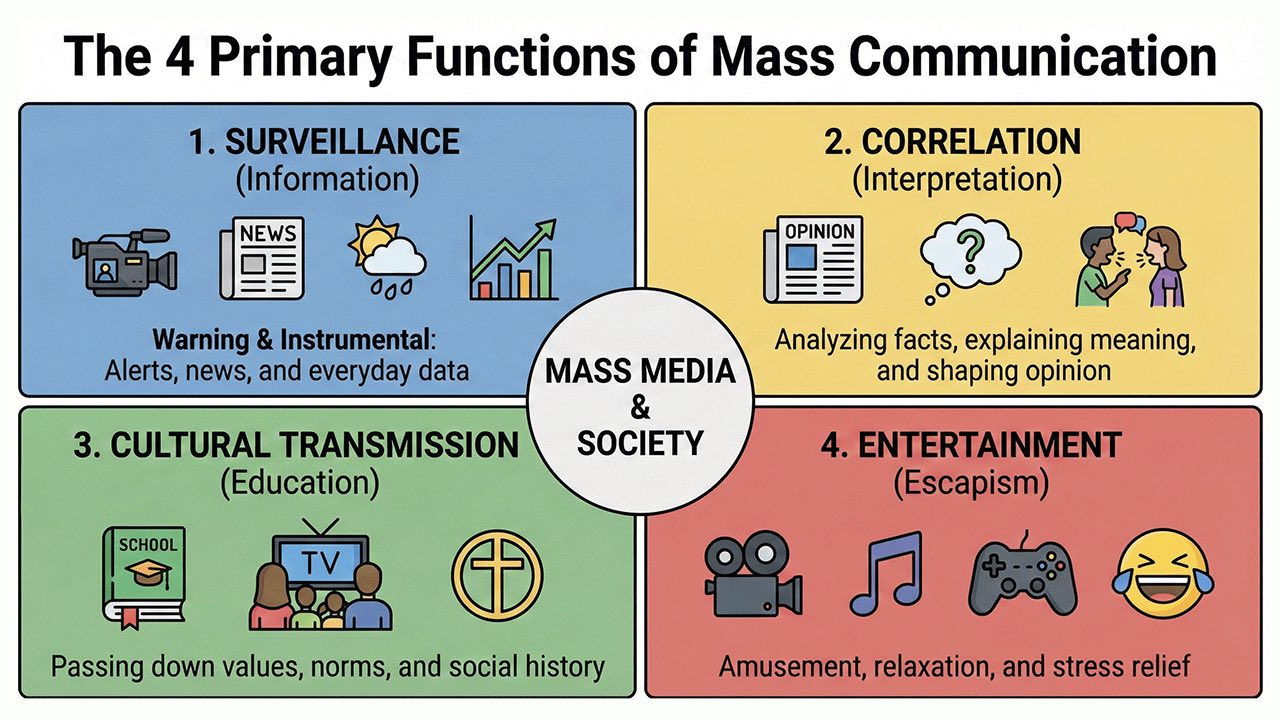
Today, we are going to explore the four primary functions of mass communication. We will look at how they shape our world and why they matter for modern business.
1. Surveillance (The Information Function)
The first and most obvious function is surveillance.
This does not mean the government is spying on you through your TV. In media studies, surveillance refers to the role of the “watchdog.”
Mass media acts as the eyes and ears of society. It scans the horizon for threats, opportunities, and events that might affect us. It gathers information and delivers it to the public.
Without this function, we would be blind to anything happening outside our immediate neighborhood.
Types of Surveillance
Scholars usually break this down into two specific categories.
Warning Surveillance
This is the scary stuff. It is the media’s job to alert us about immediate threats.
Think about a hurricane warning on the news. Think about a report on a stock market crash. Think about updates on a military conflict.
When the media performs warning surveillance, it creates a state of alertness. It helps the public prepare for danger. If a tornado is coming, the local news station saves lives by broadcasting that information instantly.
Instrumental Surveillance
On the other hand, we have instrumental surveillance. This is the helpful, everyday information we use to navigate our lives.
It is the weather report telling you to bring an umbrella. It is a movie review helping you decide what to watch. It is an article about the latest iPhone features.
This type of information is not about survival. Instead, it is about utility. It helps us make better decisions in our daily routine.
If you look at the different types of mass media, you will see that news channels and newspapers are the primary vehicles for this surveillance function. They exist to inform.
Business Context
For business leaders, this function is critical. Companies rely on media surveillance to monitor competitors. They use it to track market trends.
If you do not pay attention to the “news” of your industry, you will be left behind.
2. Correlation (The Interpretation Function)
The second function is called correlation.
This word might sound a bit academic. However, the concept is simple. Correlation is the interpretation of the facts.
The media does not just report that “something happened” (Surveillance). It also explains why it happened and what it means for you.
How It Works
Imagine the news reports that the unemployment rate has gone up. That is a fact. That is surveillance.
But then, you read an editorial that explains why unemployment is up. It might blame government policy. It might blame automation. It might predict what will happen next year.
This analysis is the correlation function.
It helps the audience process complex information. It connects the dots. It helps society reach a consensus on how to react to an event.
You see this everywhere:
- Editorial columns in newspapers.
- Political commentary on YouTube.
- Policy analysis on business blogs.
- Influencers sharing their opinions on a new product.
The Gatekeeping Connection
This function is closely tied to the concept of gatekeeping.
Editors and producers decide which stories are important. They decide which viewpoint gets the spotlight.
By interpreting the news, the media helps shape public opinion. It tells us how to value certain events over others.
You can see the mechanics of this in our detailed post on the mass communication process. It explains how information passes through these filters before it reaches you.
3. Cultural Transmission (The Education Function)
The third function is cultural transmission. Sociologists often call this “socialization.”
This is the process of passing down knowledge, values, and norms from one generation to the next.
In the past, you learned everything from your parents or your village elders. Today, mass media has taken over a huge part of that role.
The Teacher of Society
Mass media teaches us how to behave. It shows us what is considered “right” and what is considered “wrong” in our culture.
Think about the movies you watched as a kid. The hero was usually brave and honest. The villain was usually greedy and cruel.
Without realizing it, you were learning societal values. You were learning that honesty is good and greed is bad.
This happens through:
- Educational Content: Textbooks, documentaries, and “how-to” videos.
- Religious Broadcasts: Sharing spiritual values with a mass audience.
- Fiction and Drama: Stories that reinforce our cultural history and identity.
Why It Matters
Without cultural transmission, society would feel disjointed. We would not have a shared history. We would not have common references.
If you quote a line from a famous movie and a stranger laughs, that is cultural transmission at work. You share a bond created by media.
This function ensures the continuity of our civilization. It helps immigrants learn the customs of a new country. It helps children understand the world beyond their home.
To see how broad this influence is, you should explore the scope of mass communication. It covers how media touches every aspect of our social life.
4. Entertainment (The Escapism Function)
The fourth and final function is entertainment.
This is the function we engage with the most. It provides amusement, relaxation, and escapism.
The Shift in Importance
Historically, academics looked down on this function. They thought entertainment was just “fluff.” They believed the media should only be used for serious education and news.
However, they were wrong.
In the modern world, entertainment is arguably the most dominant function. We live stressful lives. We work hard. We deal with anxiety.
Mass media provides a necessary release valve. It allows us to escape our problems for a few hours. It brings joy and laughter.
The Digital Revolution
This function has exploded with the rise of technology.
In the past, you had to wait for your favorite show to air on TV. Now, you have on-demand access to millions of hours of entertainment.
Platforms like Netflix, Spotify, and TikTok exist almost entirely for this purpose. They are designed to keep us entertained.
We discuss this shift extensively in our guide to digital media mass communication. The internet has turned entertainment into a 24/7 global industry.
Interestingly, entertainment can also blend with other functions. A movie can be entertaining (Function 4) while also teaching a moral lesson (Function 3). A comedy show can make you laugh while criticizing politics (Function 2).
The Business Application: Why Marketers Care
Now, let’s put on our business hats. Why should a marketer or an entrepreneur care about sociological functions?
Because every successful campaign taps into one of these pillars.
When you create content for your business, you need to decide which function you are serving.
Strategic Alignment
If you are writing a press release about a new product launch, you are performing Surveillance. You are informing the market about news.
If you are writing a blog post explaining why your product helps the environment, you are performing Correlation. You are interpreting the facts for your customers.
If you create a funny viral video to build brand awareness, you are performing Entertainment.
The Mistake Many Make
Many businesses fail because they confuse these functions.
They try to be “entertaining” when the customer just wants “surveillance” (facts). For example, if I am looking for your pricing page, I do not want a funny joke. I want instrumental surveillance. I want the data.
Conversely, if I am scrolling TikTok for fun, I do not want a dry lecture about your corporate history.
Understanding these functions helps you choose the right tone and the right channel. It is a key part of the role of mass communication in business.
Combining Functions
The best brands master the art of combining them.
Think about a Super Bowl commercial. It is usually highly entertaining (Function 4). But it also informs you about a new product (Function 1) and reinforces cultural values like friendship or patriotism (Function 3).
When you can hit multiple buttons at once, your message becomes powerful.
Conclusion
Mass communication is not a random collection of videos and articles. It is a structured system that keeps society functioning.
It acts as our watchman through Surveillance.
It acts as our analyst through Correlation.
It acts as our teacher through Cultural Transmission.
And it acts as our jester through Entertainment.
Whether you are a student writing a paper or a CEO planning a strategy, you must recognize these roles.
The next time you turn on the TV or open an app, ask yourself: “Which function is this serving right now?” You will start to see the media in a whole new light.
Now that you know what the media does, you might be curious about the practical side of things. I recommend diving into our post on the mass communication process next to see the mechanics behind these functions.