


A resume is your professional story condensed into one or two pages, a targeted summary of your qualifications, experience, and skills designed to convince an employer you’re worth interviewing. This guide walks you through the eight essential characteristics that separate effective resumes from those that never make it past the first screen, including modern considerations like ATS optimization, quantified achievements, and the balance between technical skills and interpersonal strengths.
What is a resume? Definition and purpose
A resume is a structured, written summary of your education, employment history, skills, and professional accomplishments. Unlike a curriculum vitae (CV), which provides a comprehensive academic record often spanning multiple pages, a resume is a concise, targeted document tailored to a specific job opening. Most resumes run one to two pages, depending on your career stage.
The primary purpose of your resume is to secure an interview. Think of it as a marketing document that sells your value to an employer in the 20 to 30 seconds a hiring manager typically spends on an initial review. Recruiters often screen dozens or hundreds of applications for a single position, so your resume must quickly demonstrate fit for the role.
Your resume is the foundation of the job application process, working alongside your cover letter to position you as the solution to an employer’s specific hiring need. It’s not a comprehensive autobiography, it’s a strategic selection of your most relevant credentials arranged to match what the employer is seeking.
Accuracy and honesty as the foundation
Truthfulness is non-negotiable. Employers routinely verify credentials, employment dates, and educational background. A single fabricated detail can disqualify you immediately or lead to termination months after you’re hired.
Exaggeration is equally damaging. If you claim “expert-level proficiency” in a software tool you’ve used only occasionally, you’ll struggle in interviews or on the job. Instead, use honest descriptors: “proficient,” “working knowledge,” or “familiar with” set realistic expectations and build credibility.
Be precise with dates. If you left a job in March but round up to “June” to hide a gap, background checks will catch the discrepancy. Gaps in employment are common and manageable; dishonesty about them is not. Fact-check every line before you submit, including phone numbers, email addresses, and the spelling of previous employers’ names.
Customization and job-description alignment
Generic resumes rarely succeed. The most effective approach is to maintain a master resume, a comprehensive document listing all your experience, skills, and achievements, then create tailored versions for each application.
Start by reading the job description carefully. Identify the keywords, required skills, and priority qualifications the employer lists. Mirror that language in your resume where truthful. If the posting asks for “stakeholder engagement” and you’ve done that work but called it “client relations,” adjust your wording. Applicant Tracking Systems (ATS) scan for keyword matches, and human recruiters look for evidence you understand their specific needs.
Reorganize sections when it makes strategic sense. Career changers often benefit from a “Relevant Experience” section that pulls together transferable skills from multiple roles, rather than a strict chronological layout. Entry-level candidates might lead with education and projects; seasoned professionals usually open with a professional summary and work history. Prioritize the achievements and skills that directly address the role’s pain points. If the job shows budget management, your bullet point about reducing departmental costs by 22% belongs near the top of your experience section, not buried at the end.
Quantified achievements and results-focused language
Hiring managers don’t want to read job descriptions, they already know what a marketing coordinator or financial analyst typically does. They want to know what you accomplished in those roles. Replace activity-based statements with outcome-driven bullet points.
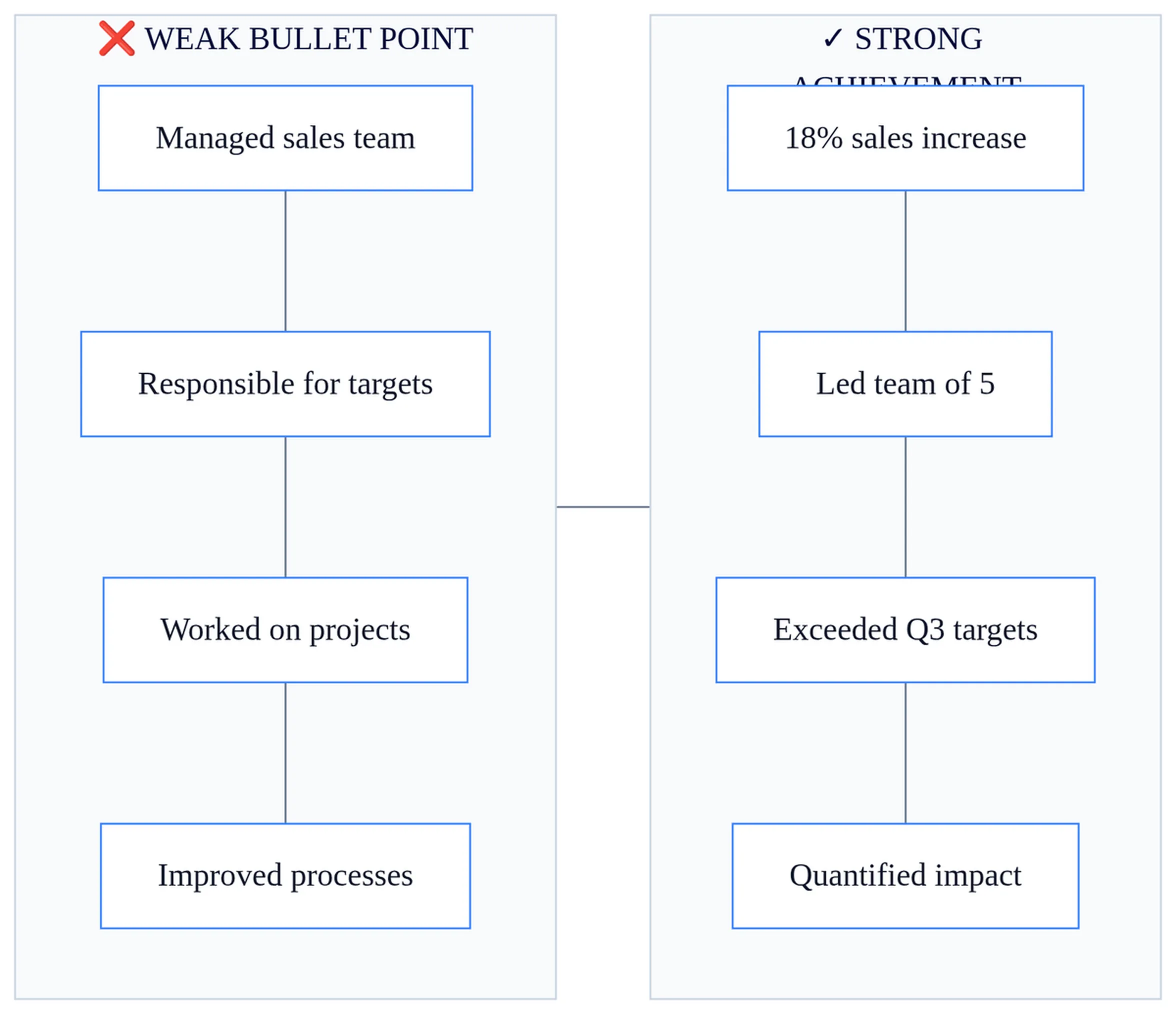
The PAR method (Problem-Action-Result) provides a useful framework. Instead of “Managed social media accounts,” write “Increased Instagram engagement 34% in six months by launching weekly video series and optimizing post timing.” The second version tells a story: you identified an opportunity, took specific action, and delivered measurable results.
Use concrete metrics wherever possible: percentages, dollar amounts, timelines, team sizes, or project scopes. “Led team of five analysts to deliver $1.2M cost-saving initiative three weeks ahead of schedule” beats “Strong leadership skills” every time. Numbers give employers a clear sense of scale and impact. Soft skills need evidence, not adjectives. Don’t just list “excellent communication skills.” Show it: “Presented quarterly financial reports to C-suite executives and board members, translating complex data into actionable recommendations.” This demonstrates communication ability through context and responsibility level.
| Weak (Activity-Focused) | Strong (Results-Focused) |
|---|---|
| Responsible for customer service | Resolved 95% of customer complaints on first contact, improving satisfaction scores from 3.2 to 4.6/5 |
| Managed sales team | Led team of eight sales representatives to 18% revenue increase, exceeding Q3 targets by $240K |
| Assisted with marketing campaigns | Coordinated email marketing campaign that generated 320 qualified leads and 12% conversion rate |
| Worked on budget planning | Reduced operational expenses 14% ($180K annually) by renegotiating vendor contracts and streamlining processes |
Visual design and ATS-friendly formatting
Your resume must satisfy two audiences: automated screening systems and human readers. Many companies use Applicant Tracking Systems to parse and rank resumes before a person ever sees them. Poor formatting can cause an ATS to misread your qualifications entirely, even if your experience is perfect for the role.
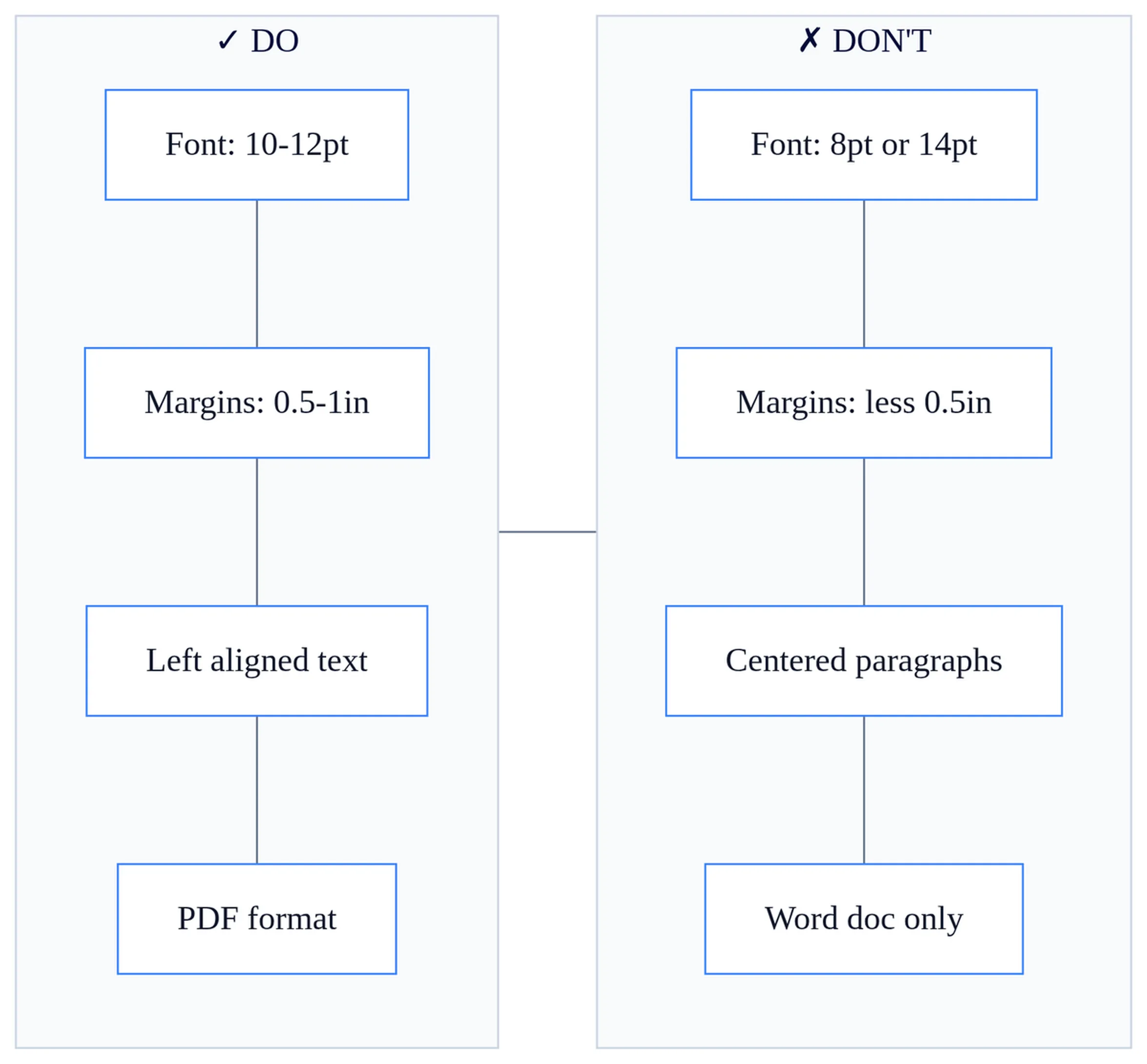
Stick with standard fonts like Arial, Calibri, or Times New Roman in 10-12 point size. Decorative fonts, script text, and unusual typefaces confuse ATS software and look unprofessional. Use 0.5 to 1-inch margins and leave adequate white space between sections. Dense blocks of text are hard to skim; breathing room improves readability for both algorithms and hiring managers.
Keep formatting simple. Left-align your text and use standard section headings like “Work Experience,” “Education,” and “Skills.” Avoid tables, text boxes, headers, footers, and graphics, ATS parsers often can’t read content trapped in these elements. A two-column layout might look elegant, but it can scramble the order of information when an ATS extracts it.
The PDF versus Word debate depends on context. PDFs preserve your formatting across different devices and operating systems, but some older ATS platforms struggle with them. Check the job posting for file format instructions. When in doubt, a .docx file is the safer choice for ATS compatibility, though you sacrifice some visual control. A clean, uncluttered layout signals professionalism and attention to detail. According to Indeed’s career advice, citing a 2018 study, recruiters often form first impressions within about seven seconds based on visual presentation (source). Consistency in date formats, bullet styles, capitalization, and spacing shows carefulness, a quality every employer values.
Completeness without clutter
An effective resume includes all relevant information and nothing extraneous.
Standard sections include contact information (name, phone, email, LinkedIn profile), a professional summary or objective, work experience, education, and skills. Depending on your field, you might add certifications, publications, volunteer work, or professional affiliations. Omit irrelevant personal data. In most countries, including age, photo, marital status, religion, or national origin invites bias and has no place on a professional resume. Some industries and regions have different norms, academic CVs in Europe often include photos, for instance, but when in doubt, leave it out.
The brevity principle matters. Entry-level candidates should aim for one page. Mid-career professionals with 10 to 15 years of experience can extend to two pages if the content is genuinely relevant. Senior executives might justify two full pages. Anything longer risks losing the reader’s attention. Every line should serve your job objective. Cut outdated skills (proficiency in Windows XP doesn’t help you in 2024), irrelevant roles from decades ago, and redundant bullet points that repeat the same accomplishment in different words. Full disclosure means including the information employers need to evaluate you, not padding your resume with filler. A hiring manager for a Dhaka-based digital marketing agency doesn’t need to know about your high school debate trophy, but they do need to see your Google Analytics certification and campaign performance metrics.
Balance of hard skills and soft skills
Employers evaluate candidates on two dimensions: hard skills (technical, measurable abilities like software proficiency, certifications, or language fluency) and soft skills (interpersonal qualities like communication, leadership, and problem-solving). Your resume needs both, presented strategically.
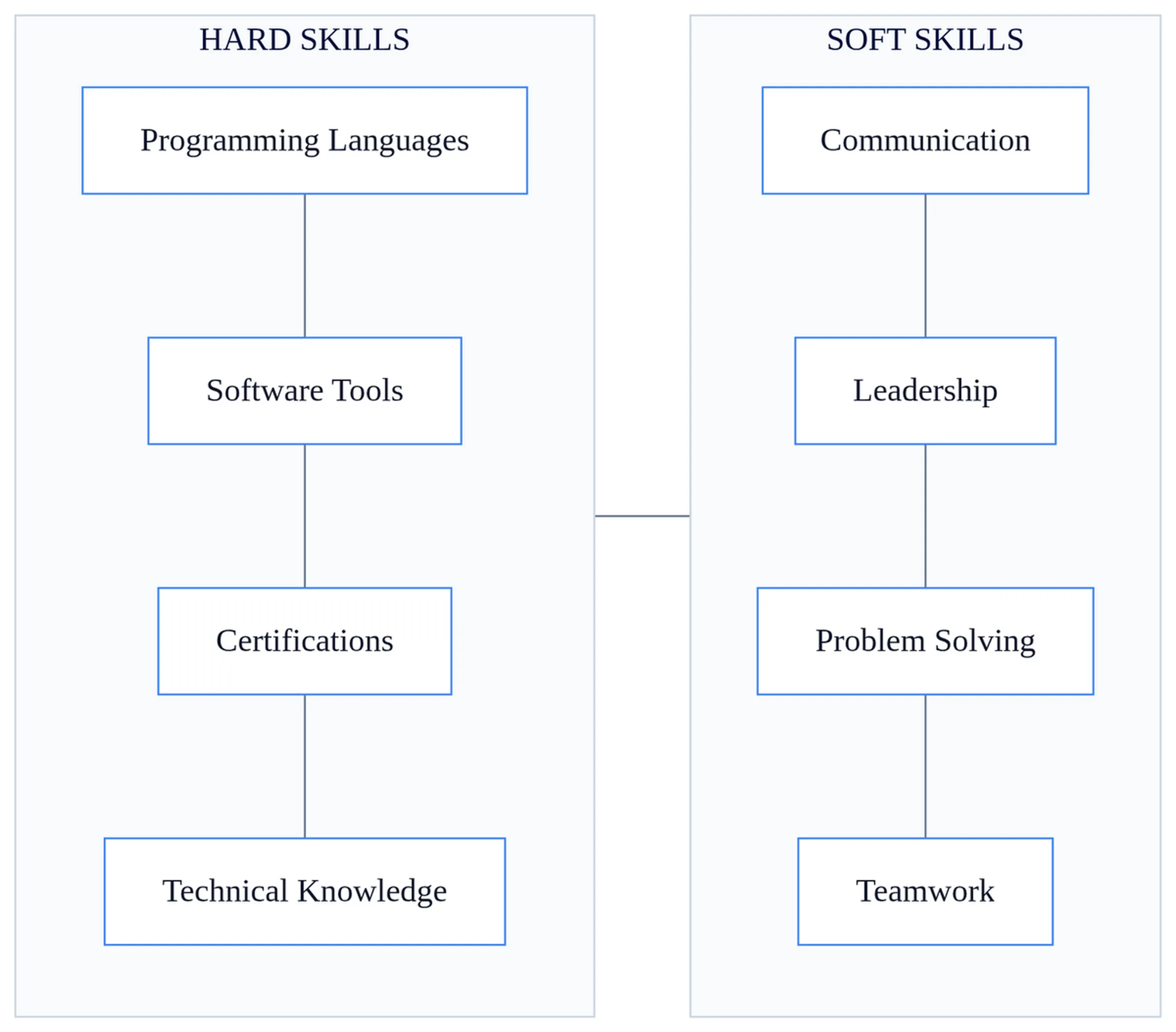
Hard skills are easier to demonstrate and verify. List specific tools, platforms, programming languages, or methodologies relevant to the role: “Python, SQL, Tableau,” “Salesforce CRM,” “Six Sigma Green Belt,” or “Fluent in Bengali and English, conversational Hindi.” These keywords help you pass ATS screening and prove technical fit.
Soft skills require context. Don’t just list “teamwork” or “leadership” in a skills section, show them through your accomplishments. “Facilitated cross-functional collaboration between engineering and product teams to launch feature two months early” demonstrates teamwork, communication, and project management simultaneously. The business communication skills you highlight should be evident in how you describe your work, not just stated as abstract qualities.
According to U.S. Bureau of Labor Statistics projections, jobs requiring strong interpersonal skills are growing faster than those relying solely on technical expertise. A software developer needs coding skills, but also the ability to explain technical concepts to non-technical stakeholders. An accountant needs Excel mastery, but also the judgment to advise management on financial strategy. List six to eight key skills in order of relevance to the target role. If the job posting shows data analysis, that skill should appear before your project management experience. Tailor this section for each application, just as you customize your work history.
Error-free presentation and proofreading
Typos, grammatical errors, and inconsistent formatting are resume killers. They signal carelessness, lack of attention to detail, and poor written communication skills, exactly the opposite of what you want to convey.
Proofread your resume multiple times, ideally on different days and in different formats (on screen and printed). Your brain autocorrects familiar text, so errors hide in plain sight on the fifth read-through. Use spell-check and grammar tools, but don’t rely on them exclusively, they miss context-dependent mistakes like “manger” instead of “manager” or “public” instead of “pubic.”
Check for consistency everywhere. Do you write dates as “Jan 2022” in one place and “January 2022” in another? Are some bullet points complete sentences with periods while others are fragments without? Is “Microsoft Office” capitalized consistently? These small inconsistencies create a sloppy impression. Have a trusted peer review your resume before submission. A fresh set of eyes catches errors you’ve read past a dozen times. Choose someone who understands professional standards, a colleague, mentor, or career counselor, not just a friend who’ll say it looks fine. Their feedback might reveal unclear phrasing, missing context, or stronger ways to frame your accomplishments. This step is especially valuable before interview preparation, since your resume will guide the conversation.
Resume formats and when to use each
Three main resume formats exist: chronological, functional, and combination. Chronological format lists your work history in reverse order, starting with your most recent position, it’s the standard choice for candidates with stable employment history and clear career progression. Functional format organizes content by skill categories rather than job titles, useful for career changers or those with employment gaps. Combination format blends both approaches, highlighting relevant skills upfront while still providing chronological work history.
Format choice depends on your situation and the target role. Most employers prefer chronological resumes because they’re easy to scan and verify. Choose functional format only when your work history doesn’t tell a straightforward story. What most people get wrong: they choose a format based on aesthetics rather than strategy. A visually impressive functional resume won’t help if the hiring manager suspects you’re hiding short tenures or frequent job changes. Transparency usually serves you better than clever formatting.
Key takeaway
Modern resumes must satisfy both automated screening systems and human decision-makers, which means clean formatting and keyword optimization matter as much as compelling content. Invest time in tailoring each application, a generic resume sent to 50 jobs will underperform a customized version sent to 10 carefully selected opportunities. If you’re debating whether to include a particular detail, ask yourself whether it directly supports your case for this specific role. When the answer is no, cut it.
Frequently asked questions
Should I include metrics I can’t fully verify or remember exactly?
No. Use only numbers you can defend if asked in an interview. If you remember improving efficiency but not the exact percentage, write “significantly improved” or use a conservative estimate you’re confident about. Vague claims like “increased by a lot” are weaker than honest specifics. Employers verify achievements; inaccuracy damages credibility more than admitting uncertainty.
How much should I customize my resume for each job application?
Customize strategically, not drastically. Mirror the job description’s language and reorder sections to highlight relevant experience first. If the posting emphasizes project management, lead with your strongest project wins. Don’t fabricate skills or responsibilities. The goal is to show genuine fit, not reinvent yourself for every application.
Is it better to use a creative design or stick with a simple, clean format?
Prioritize ATS compatibility and readability over design flair. Most companies scan resumes with automated systems that struggle with graphics, unusual fonts, and complex layouts. Use clean formatting, standard fonts, and clear section headers. A visually appealing resume that fails ATS screening won’t reach a human recruiter.
What if the job description asks for skills I have but rarely used recently?
Include them if truthful, but be honest about your proficiency level. Use descriptors like “working knowledge” or “previously proficient in” rather than claiming current expertise. During interviews, acknowledge the skill gap and show willingness to refresh. Employers appreciate honesty more than inflated claims you can’t back up.
Should I include employment gaps, or just list jobs chronologically?
List jobs chronologically with accurate dates. Gaps are visible to background checkers anyway, and hiding them damages trust. If gaps are significant, a brief cover letter explanation works better than resume deception. Most employers understand gaps due to illness, caregiving, or job searching and won’t penalize you for honesty.
How do I show soft skills without just listing adjectives?
Demonstrate soft skills through context and responsibility. Instead of “great communicator,” write “Presented quarterly reports to 50+ stakeholders and translated technical findings into business recommendations.” Let your achievements reveal your abilities. Numbers, scope, and outcomes prove capability better than self-descriptions ever will.
3 Comments
You got my attention when you said that you can enhance your resume’s acceptability and appeal when you choose the right format for your resume. This is something that I will share with my daughter so she could consider hiring a resume writer. She has been trying to land a job, but her resume always gets rejected due to cluttered information.
thanks for this blog, it’s really helpful for me,
the charatestics of resume help me to design resume myself thank you for this blog