


Communication is the invisible glue that holds our world together. Whether you are ordering a coffee, negotiating a million-dollar deal, or just chatting with a friend, you are communicating.
However, have you ever stopped to think about how complex this simple act really is? It is more than just talking. It is a vast web of words, gestures, images, and signals.
In the business world, understanding this web is a superpower. If you use the wrong type of communication, you might lose a client. On the other hand, if you master these types, you can lead teams and influence decisions effectively.
Today, we are going to break down the different types of communication. We will look at the channels we use. We will explore the styles we adopt. We will even look at the direction in which information flows.
Ready to become a master communicator? Let’s dive in.
What is Communication?
Before we get into the classifications, let’s define what we are talking about.
Simply put, communication is the process of transferring information from one place to another. It involves a sender, a message, and a receiver.
But here is the catch. The message has to be understood. If I speak to you in a language you don’t know, I am talking, but I am not communicating.
Therefore, effective communication is about shared meaning. It is about making sure the picture in my head matches the picture in yours.
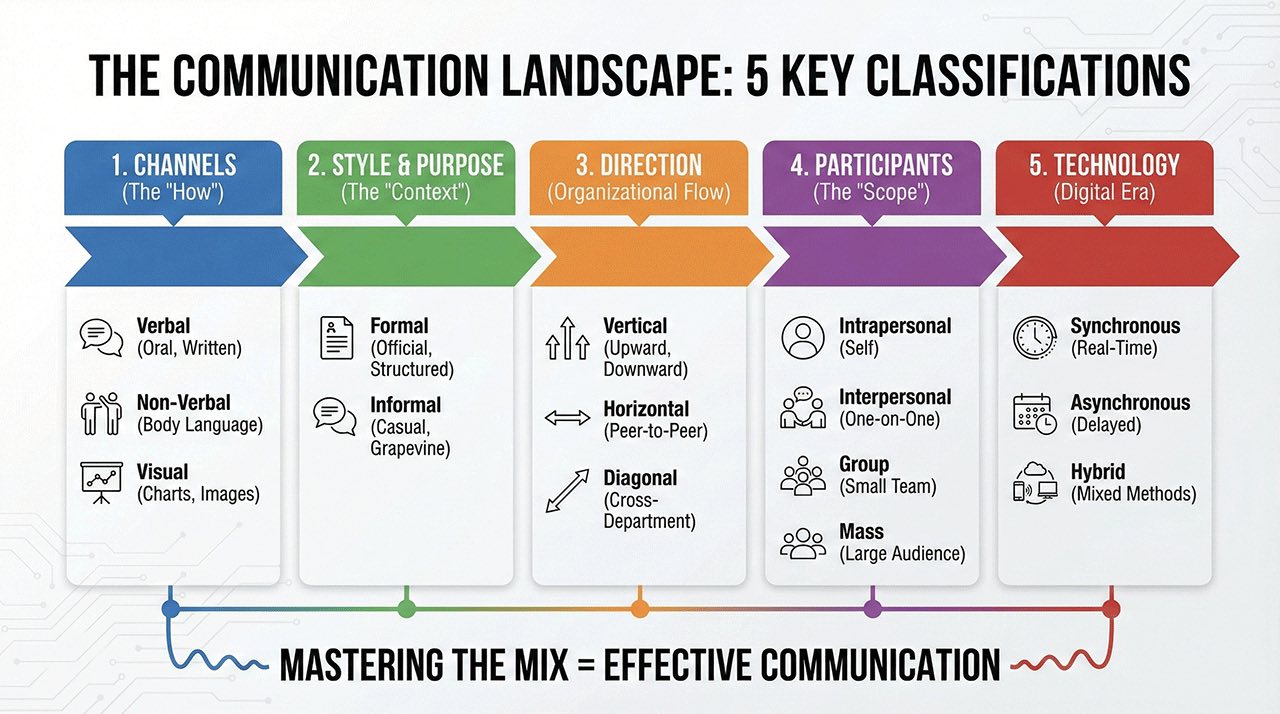
1. Based on Communication Channels (The “How”)
The most common way to classify communication is by the channel we use. This answers the question: “How are we sending the message?”
We usually break this down into three main buckets: Verbal, Non-Verbal, and Visual.
Verbal Communication
This is what most people think of first. Verbal communication uses words to convey a message. It is the bedrock of human interaction.
However, verbal doesn’t just mean “spoken.” It encompasses both oral and written forms.
Oral Communication
This involves spoken words. It includes face-to-face conversations, phone calls, speeches, and video chats.
The biggest advantage here is speed. You get instant feedback. If the other person is confused, you can see it on their face immediately. You can clarify your point right there.
For example, think about a brainstorming session. Ideas fly around the room. People interrupt each other excitedly. That dynamic energy is unique to types of oral communication. It builds relationships faster than any other method.
Written Communication
This involves any message that uses written words. We are talking about emails, reports, memos, and letters.
Unlike speech, written communication is permanent. It creates a record. You can save it. You can refer back to it later.
Imagine you need to send detailed instructions on how to operate a new machine. You wouldn’t just say it. You would write it down. This ensures accuracy. It prevents the “telephone game” effect where the message gets distorted.
To learn more about the specific formats used in business, you can check out our guide on written communication characteristics.
Non-Verbal Communication
Did you know that you are communicating even when you are silent?
Non-verbal communication includes facial expressions, posture, gestures, and eye contact. It is the “silent language” that speaks volumes.
For instance, imagine your boss says, “Good job,” but they are looking at their phone and frowning. Which message do you believe? You believe the frown.
Non-verbal cues often reveal the truth behind the words. They carry the emotional weight of the message. If you want to be a great leader, you must master these kinds of non-verbal communication. They can build trust or destroy it in seconds.
Visual Communication
A picture is worth a thousand words. That is the core of visual communication.
This type uses images, charts, graphs, maps, and logos to convey information.
In business, visuals are crucial for analyzing data. Imagine trying to explain a complex sales trend using only text. It would be boring and confusing.
Instead, you show a colorful bar chart. Suddenly, everyone understands. The trend is obvious. Visuals make complex data digestible. They grab attention and help memory retention.
2. Based on Style and Purpose (The “Context”)
Not all conversations happen in the same setting. Sometimes, we need to be serious. Other times, we can relax.
This brings us to the classification based on style and formality.
Formal Communication
This is the “suit and tie” of communication. It follows strict rules and protocols.
Formal communication usually flows through official channels. It includes board meetings, official letters, performance reviews, and legal notices.
The language here is professional. It is precise. There is no slang. The goal is to be authoritative and clear.
For example, a resignation letter is a formal document. You wouldn’t write it on a sticky note with a smiley face. You would follow a standard format to ensure it is taken seriously.
Informal Communication
Conversely, we have informal communication. This is the “jeans and t-shirt” version.
It is casual. It is spontaneous. It doesn’t follow any organizational chart. We often call this the “Grapevine.”
This includes chatting by the coffee machine, texting a colleague about lunch, or gossiping about office news.
Many managers try to stop informal communication, but that is a mistake. This type of talk builds social bonds. It relieves stress. It makes the workplace feel human. Smart leaders listen to the grapevine to understand the true mood of their team.
3. Based on Direction (The Organizational Flow)
In a company, information flows like water in a pipe system. It moves up, down, and sideways.
Understanding these directions helps you navigate the corporate ladder.
Vertical Communication
This is communication that moves between different levels of the hierarchy. It can go in two directions.
Downward Communication flows from the top to the bottom. Ideally, this is managers giving instructions to employees. It includes policy statements, orders, and feedback.
Upward Communication flows from the bottom to the top. This is employees giving feedback to managers. It includes reports, suggestions, and complaints.
Both are vital. Without downward flow, employees are lost. Without upward flow, managers are blind. To dive deeper into this dynamic, read our article on what is vertical communication.
Horizontal (Lateral) Communication
This happens between people at the same level.
Imagine the Marketing Manager talking to the Finance Manager. Neither is the boss of the other. They are peers.
Horizontal communication is essential for coordination. It breaks down silos. It helps different departments work together towards a common goal.
If the sales team doesn’t talk to the production team, you might sell products you don’t have. That is a disaster. Effective horizontal communication prevents these operational nightmares.
Diagonal (Cross-wise) Communication
This is the wildcard. It cuts across both levels and departments.
For example, a junior software developer talks directly to the VP of Marketing to explain a new feature.
This bypasses the traditional chain of command. In the past, this was frowned upon. Today, however, modern companies encourage it. It speeds things up. It allows experts to talk to decision-makers directly, regardless of their rank.
4. Based on the Number of Participants (The “Scope”)
How many people are involved in the chat? This classification looks at the size of the audience.
Intrapersonal Communication
This is the conversation you have with yourself.
You might think this is crazy, but we all do it. “Did I lock the door?” “I can do this presentation.” “I need to calm down.”
This self-talk is intrapersonal communication. It is critical for self-awareness, planning, and emotional control. Before you can communicate well with others, you must be able to communicate well with yourself.
Interpersonal Communication
This involves two people. It is a one-on-one exchange.
This could be a job interview, a performance review, or a date. It is highly interactive. The sender and receiver swap roles constantly.
This type builds the deepest connections. It allows for vulnerability and detailed understanding.
Group Communication
Here, we have more than two people, but the group is small enough that everyone can interact.
Think of a team meeting or a study group.
The dynamics here are different. You have to manage turn-taking. You have to deal with different personalities. Leadership skills become very important in group settings to ensure everyone is heard.
Mass Communication
Finally, we have communication on a grand scale.
This is one sender reaching a massive, unknown audience. We are talking about television, radio, newspapers, and social media posts.
In mass communication, there is usually little to no immediate feedback. You publish an ad, and thousands see it.
For businesses, this is how you build a brand. You use types of mass media to shape public opinion and reach potential customers far and wide.
5. Based on Modern Technology (Digital Era Updates)
The textbooks of the past didn’t cover this. But in 2025, technology defines how we talk.
We can classify modern communication based on time.
Synchronous Communication
This happens in real-time. “Synchronous” means “at the same time.”
Zoom calls, phone calls, and live face-to-face meetings fall into this category.
It is great for brainstorming, resolving conflicts, and building rapport. You get immediate answers. However, it requires everyone to be available at the same specific moment.
Asynchronous Communication
This happens with a delay. “Asynchronous” means “not at the same time.”
Emails, Slack messages, project management comments, and recorded videos are examples.
I send an email now. You read it three hours later.
This is the backbone of remote work. It allows deep work. You don’t have to interrupt your day to answer every message instantly. It gives you time to think before you respond.
Hybrid Communication
Most modern workplaces use a mix. This is hybrid communication.
We might have a quick Zoom call (synchronous) to kick off a project. Then, we switch to Asana or Trello (asynchronous) to manage the tasks.
Mastering the balance between these two is the key to productivity in the digital age.
How to Choose the Right Type of Communication?
Now you see the menu. There are so many options. So, how do you choose what to order?
You need to consider a few factors.
1. The Urgency
Is the building on fire? Don’t send an email. Yell (Oral/Verbal). Do you need an answer right now? Call them. If it can wait, send a message.
2. The Formality
Are you firing someone? You must do this face-to-face (Oral) followed by a formal letter (Written). Sending a text message would be highly unprofessional and legally risky.
3. The Complexity
Are you explaining a complex architectural blueprint? You need visuals. You need written specs. A phone call won’t cut it.
4. The Sensitivity
Are you discussing a personal health issue? Keep it private (Interpersonal). Do not put it on the company Slack channel.
5. The Documentation
Do you need proof this conversation happened? Use email or a formal memo. As the saying goes, “If it isn’t written down, it didn’t happen.”
Conclusion
Communication is a vast landscape. It is not just one thing.
It is the ink on a contract. It is the smile of a receptionist. It is the chart in a presentation. It is the gossip in the hallway.
We have explored the classifications based on channels, style, direction, participants, and technology.
Understanding these types of communication gives you a toolkit. You are no longer guessing. You can pick the right tool for the right job.
If you need speed, go oral. If you need accuracy, go written. If you need to persuade, use your non-verbal cues.
The best communicators are flexible. They flow between these types effortlessly. They know that the goal is not just to speak, but to be understood.
So, the next time you have a message to send, pause for a second. Ask yourself: “Which type matches my goal?”
That split-second decision can change everything. Happy communicating!
Frequently asked questions
When should I choose written over oral communication in business?
Use written communication when you need a permanent record, must convey complex instructions, or require accuracy. Choose oral when you need immediate feedback, want to build relationships, or the message is straightforward. For sensitive matters like performance reviews or policy changes, written documentation protects both parties and prevents misunderstandings.
Can non-verbal cues contradict what I’m saying without damaging credibility?
No. When non-verbal signals contradict your words, receivers believe the non-verbal message. If you say you’re confident but avoid eye contact, people sense dishonesty. Align your body language, tone, and facial expressions with your message. This consistency builds trust and ensures your intended meaning comes through clearly.
Is it ever appropriate to mix formal and informal communication in one message?
Generally, no. Mixing styles confuses your audience and weakens your message’s impact. A formal email with casual language feels unprofessional. A casual chat with formal jargon feels stiff. Match your style to the context and relationship. If unsure, lean formal—you can always become more casual later.
What’s the best way to present data: charts, written explanation, or both?
Use both. Visual charts grab attention and make trends obvious, but they need context. Pair charts with a brief written explanation that highlights key insights and what action to take. This combination helps different learning styles and ensures your audience understands not just the data, but its business significance.
Should I rely on the grapevine to understand team morale?
Listen to it, but don’t rely solely on it. Informal communication reveals honest feelings and concerns, giving you valuable insight into team dynamics. However, grapevine information can be distorted or incomplete. Use it as a signal to investigate further through direct conversations and formal feedback channels.
3 Comments
Good idea
Originally posted on an earlier version of this article.
Good idea
Originally posted on an earlier version of this article.
Other systems are sensitive,You need to be schooled well,You can disturb protocol?