


Have you ever stared at a blank screen and wondered how to turn a pile of data into a clear message? You are not alone. In the corporate world, the ability to write a solid business report is a superpower. It is the nerve center of an organization that keeps information flowing.
Whether you are a student or a professional, mastering this skill is non-negotiable. Reports are the primary means of communication in organizations. They help managers plan, organize, and control everyday chaos.
In this guide, we will break down everything you need to know about business report writing. We will cover the objectives, the difference between short and long formats, and the step-by-step process to write one.
Let’s dive in!
Why Do We Write Business Reports? (The Objectives)
Before we start typing, we need to ask a simple question. Why are we doing this? A report is not just paperwork. It is a tool for action.

In large-scale organizations, there is no alternative to using reports. Even in small businesses, they play a massive role. Here are the core objectives of writing a business report:
- Transmitting Information: Managers cannot be everywhere at once. They rely on reports to get information from one level to another.
- Making Decisions: A report is a basic management tool for making decisions. It supplies the necessary data to solve complex problems.
- Interpreting Events: Data alone is boring. A report provides interpretation and explanation so readers can actually understand what the numbers mean.
- Communication with External Stakeholders: Shareholders, creditors, and customers need to know what is happening. Without formal reports, these groups would remain in the dark.
- Developing an Information Base: Reports are preserved for future reference. They help develop a sound history for the company.
- Controlling: This is a key function of management. Reports serve as a yardstick to see if actual performance meets the standard.
- Labor-Management Relations: In big companies, reports act as a mechanism to keep both top management and employees informed about each other.
Short Reports vs. Long Reports: Which One Do You Need?
Not all reports are created equal. Sometimes you need a novel, and other times you just need a post-it note.
Understanding the Short Report
Short reports are created for specific purposes and are often viewed as the most useful reports. They are usually informal and deal with routine, recurring problems.
Key Characteristics of Short Reports:
- Little Introduction: They need very little introductory material.
- Direct Start: They often begin with a catchy headline and jump right in.
- Personal Style: The writing is often personal. You can use pronouns like “I” or “you”.
- Routine: They are frequently prepared for sales, production, or maintenance updates.
Understanding the Long Report
On the other hand, long reports are for complex, non-recurring problems.
Key Characteristics of Long Reports:
- Formal Tone: The writing style is impersonal and strictly formal.
- Structured: They require a well-designed coherence plan and introductory elements.
- Distance: A personal relationship between the reader and writer is unlikely to exist.
Comparison Table: Short vs. Long Reports
| Feature | Short Report | Long Report |
| Introductory Material | Little to none needed | Required in sequence |
| Writing Style | Personal and Informal | Formal and Impersonal |
| Problem Type | Routine and recurring | Complex and non-recurring |
| Personal Relationship | Likely exists (e.g., parent-child) | Unlikely to exist |
The Forms of Short Reports
When you decide to write a short report, you generally have two format options. These are the letter form and the memorandum form.
1. Letter Reports
A letter report is written using the format of a standard business letter. It includes a date, inside address, salutation, and signature.
When to use it:
Primarily, you use letter reports to present information to people outside the organization. For example, an outside consultant might write a letter report to a company recommending a solution.
Features:
- Length: Usually three to four pages or less.
- Style: Personal pronouns like I, you, and we are used.
- Order: Use direct order for internal readers, but indirect order for external readers who need more context.
2. Memorandum (Memo) Reports
As the name implies, this is written in memo form. It is the most widely used report in business.
When to use it:
Memo reports are for internal readers. They travel from one person to another within the organization. Employees use them to report to superiors, and department chiefs use them for policy formulation.
Features:
- Formality: This is the most informal form of report.
- Content: Deals with day-to-day routine problems.
- Structure: It usually follows a direct order because there is hardly any need for introductory information.
Guidelines for Writing the Body of a Short Report
Writing a short report sounds easy, right? However, you still need to follow some rules to make it effective.
Here are the top suggestions for writing the body:
- Skip the Title Intro: If your introduction is only one or two short paragraphs, you can usually omit the title “Introduction”.
- Be Impartial: Present all relevant facts accurately and impartially.
- Use Headings: Use headings to guide the reader. Still, write your sentences so they can stand alone even if the headings did not exist.
- Visuals: Include graphs, tables, or pictures whenever they clarify information.
- Writing Principles: Use understandable words. Keep sentences averaging 16 to 20 words.
- Paragraph Length: Keep paragraphs short. The average length should be about seven typewritten lines.
7 Steps to Writing a Business Report
Now, let’s get into the process. Writing a successful report requires a sequence. If you skip a step, you might end up with a mess.
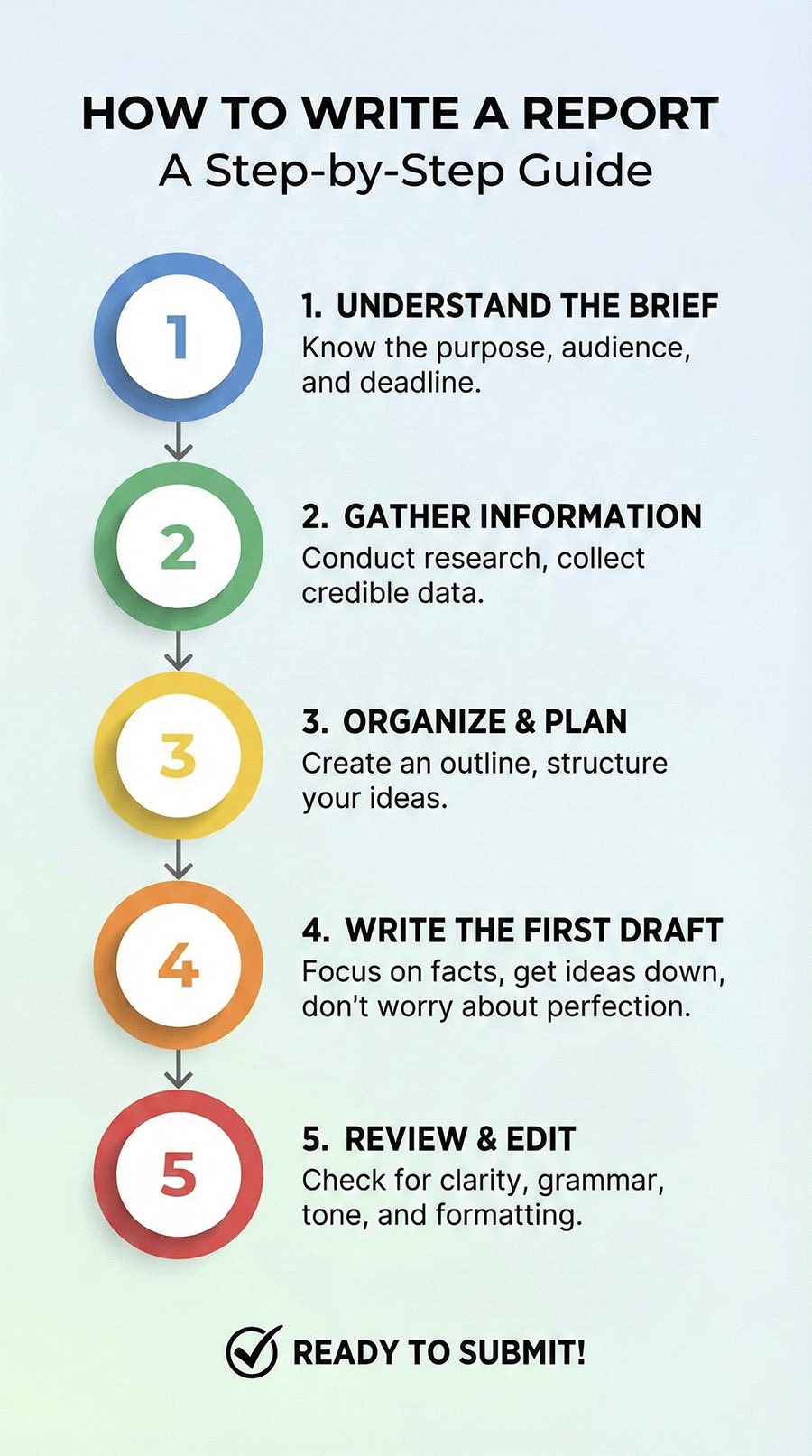
Here is the 7-step formula for writing a business report:
Step 1: Determination of Purpose
First, determine the purpose. What is the goal? Every report deals with a specific problem. You need to answer what, why, and when to write the report.
Step 2: Developing a Working Plan
After defining the problem, you need a plan. This serves as a basis for outlining the report. List down the scope of work to be done in line with the business objective.
Step 3: Collecting Information
Now, go get the data. You can observe and inquire for primary data. Alternatively, you can use journals, newspapers, and books for secondary information.
Step 4: Organizing and Analyzing
This is where you make sense of the mess. Organize the collected info based on the business objective. You might need to reject a lot of data that isn’t relevant. Use statistical techniques for in-depth analysis.
Step 5: Arriving at Conclusions
Based on your analysis, you must arrive at a conclusion. If you fail to draw a correct conclusion, the report will fail to serve its purpose. This is a crucial aspect of the business steps.
Step 6: Selecting the Method of Writing
How will you arrange the info? You have two main choices:
- Inductive Method: Introduction -> Discussion -> Recommendations/Conclusions.
- Deductive Method: Summary/Recommendations -> Introduction -> Discussion.
Step 7: Writing and Submitting
Finally, draft the report. Prepare a rough copy first. Check for grammatical accuracy and writing style. Once edited, prepare the final copy and submit it to the concerned authority.
The Big Picture: What is an Annual Business Report?
We have talked about short reports and the general process. Now, let’s look at the heavyweight champion: The Annual Business Report.
An annual report is prepared and published at the end of an accounting year. All public limited companies are obliged to prepare this for their shareholders.
It is not just numbers. It is a comprehensive look at the funds, performance, and activities of the company.
Contents of an Annual Business Report
While there is no “all acceptable” list, most annual reports contain the following:
- Company Profile: Highlights the mission, vision, goals, and policies.
- Message from the Chairman: A briefing on general affairs, future plans, and the economy. It gives a personal touch from the top.
- Board of Directors: Lists the names and addresses of all directors.
- Shareholding Pattern: Shows if the company is owned by a few directors or by mass people. This is useful for corporate governance.
- Notice of AGM: Informs shareholders about the date and place of the Annual General Meeting.
- Director’s Report: A short statement on company activities drafted by the directors.
- Auditor’s Report: A certificate issued by auditors after checking the balance sheet and profit/loss accounts.
- Audited Financial Statements: The key part. This contains the income statement, balance sheet, and cash flow statement to explain financial health.

Final Thoughts
Writing a business report does not have to be scary. Whether it is a quick memo to your team or a massive annual report for shareholders, the principles remain the same.
You need accuracy, clarity, and a focus on the objective.
By following the steps outlined above, you can turn complex data into clear, actionable insights. Remember, a good report doesn’t just inform; it helps people make the right decisions.
1 Comment
Very nice 👍🙂