


Have you ever played a game of “Chinese Whispers”? You say something to one person, they tell another, and by the time it reaches the last person, the message sounds completely different! Something similar can happen in offices when communication flows up and down through different levels of hierarchy. This, my friend, is where vertical communication comes in.
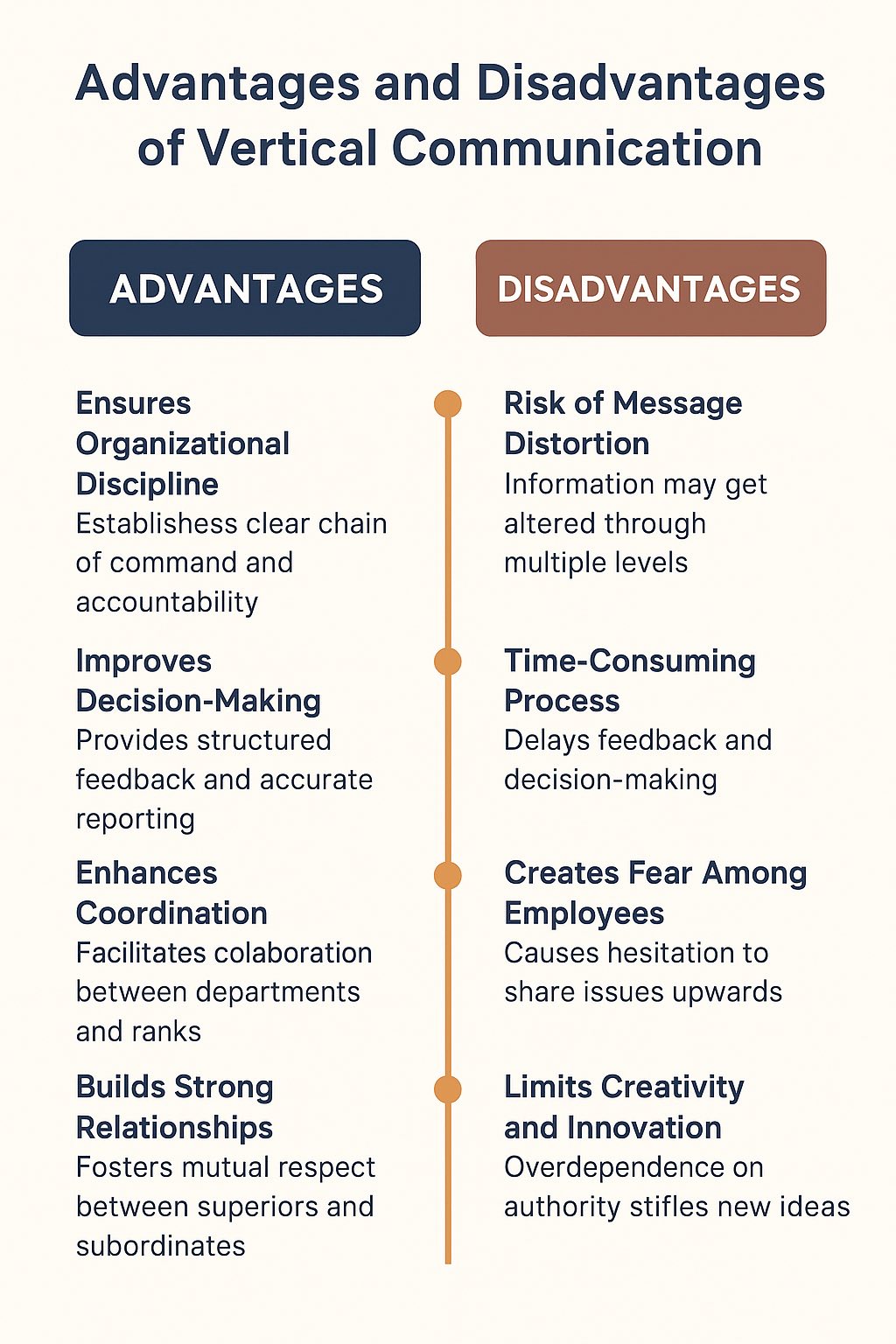
Vertical communication is one of the most common types of communication in any organization. It connects managers, supervisors, and employees in a structured flow of information. It has many advantages, but it also brings a few disadvantages that can slow down communication. Let’s explore both sides in detail.
Advantages of Vertical Communication
Now let’s discuss the bright side. Vertical communication is not only organized but also strengthens teamwork and leadership.
1. Ensures Organizational Discipline
Vertical communication establishes a clear hierarchy. Everyone knows who gives orders and who follows them. This structure keeps activities organized, especially in large companies where confusion can arise easily.
2. Improves Decision-Making
Managers receive accurate information from employees through upward communication. Based on this data, they can make smarter decisions. On the other hand, downward communication ensures that employees know what to do and why.
This back-and-forth system strengthens internal control. Learn how communication supports leadership in Role of Communication in Management.
3. Enhances Coordination
Without communication between management and employees, teamwork would collapse. Vertical communication keeps departments aligned with the company’s goals. Managers share strategies, while employees report outcomes.
4. Builds Mutual Understanding
Good vertical communication reduces misunderstandings. For instance, when employees clearly understand their roles, they perform better. Similarly, when managers listen to workers’ feedback, it builds mutual respect and trust.
5. Simplifies Report Writing and Record-Keeping
Reports are an essential part of organizational communication. Vertical channels make it easier to collect accurate data for writing reports and summaries. For example, in a business meeting, minutes are often based on upward and downward exchanges of information. You can read Guidelines for Writing Short Report in Business for more insights.
6. Increases Efficiency and Productivity
Since information follows a clear path, employees can focus on tasks without confusion. Managers can also monitor performance more easily. This leads to better results and time management.
Disadvantages of Vertical Communication
While vertical communication is vital, it’s not perfect. It can create barriers if not handled properly. Let’s look at some key drawbacks.
1. Risk of Message Distortion
Every time a message passes through multiple levels, the chances of misinterpretation increase. By the time it reaches the final receiver, it may sound completely different. This is one of the biggest challenges in large organizations.
2. Time-Consuming Process
Because information must pass through formal steps, decision-making can become slow. When urgent matters arise, this delay can hurt performance.
To learn how to handle this issue, read Overcome the Communication Barriers in Business.
3. Creates Fear Among Employees
In strict hierarchical systems, employees may feel uncomfortable sharing honest opinions. They fear punishment or disapproval. This prevents upward communication from being fully effective.
4. Limits Creativity and Innovation
When employees are not encouraged to speak up, creative ideas stay hidden. Managers who only focus on downward communication may miss opportunities for innovation. That’s why organizations today try to mix both vertical and horizontal flows.
5. Reduces Cross-Department Collaboration
Vertical systems can create silos where departments work independently instead of together. This reduces teamwork and slows progress. If you want to compare how horizontal systems overcome this, see Advantages and Disadvantages of Horizontal Communication.
6. Information Overload at Higher Levels
Sometimes, managers receive too many reports from different subordinates. Sorting through all that data can be stressful, leading to delays or oversight in important matters.
Comparison: Vertical vs Horizontal Communication
To understand vertical communication better, let’s compare it with horizontal communication.
| Aspect | Vertical Communication | Horizontal Communication |
|---|---|---|
| Direction | Upward and Downward | Between employees at the same level |
| Purpose | Command, control, feedback | Coordination, teamwork |
| Flow | Through hierarchy | Across departments |
| Speed | Slower due to layers | Faster and flexible |
| Example | Manager giving instructions to staff | Marketing manager coordinating with sales manager |
If you’d like a deeper comparison, visit Differences Between Horizontal and Vertical Communication.
How to Overcome the Limitations of Vertical Communication
Even though vertical communication has flaws, they can be managed with the right strategies. Here’s how:
1. Encourage Two-Way Communication
Managers should welcome feedback and ideas from employees. Open discussions create trust and help resolve issues quickly.
2. Simplify Hierarchies
Organizations with too many levels can remove unnecessary layers to make communication faster.
3. Use Modern Communication Tools
Emails, instant messages, and video meetings make vertical communication faster and clearer.
4. Provide Communication Training
Train managers and employees to communicate effectively. Listening skills, clarity, and empathy are key.
5. Promote a Positive Culture
When employees feel respected, they communicate openly. A culture of transparency removes fear and misunderstanding.
These tips not only improve communication but also enhance overall organizational health.
For more techniques to improve communication efficiency, see Two-Way Communication and Its Importance.
Case Example: Real-Life Scenario
Imagine a large retail company with multiple branches. The head office sends new marketing policies to store managers through downward communication. The managers then train sales staff accordingly. After the campaign, sales reports are sent upward for review.
If this flow works properly, the company achieves consistency and clear feedback. However, if one level fails to deliver the message correctly, the entire system can suffer. This is why balancing upward and downward communication is essential for success.
Summary and Key Takeaways
Let’s wrap up what we’ve learned.
Vertical communication helps maintain discipline, coordination, and control within an organization. It ensures that everyone understands their duties and responsibilities. However, it also brings challenges like delays, message distortion, and limited creativity.
To get the best results, companies must combine vertical with horizontal and informal communication. By promoting open feedback, reducing hierarchy, and using modern tools, they can make communication more effective and efficient.
If you’re interested in exploring how different communication styles impact performance, check What is Effective Communication.
Final Thoughts
Vertical communication acts as the backbone of most organizations. It keeps order, provides structure, and ensures messages reach the right people. However, as much as it builds efficiency, it must evolve with time.
Today’s workplaces value speed, openness, and teamwork. Therefore, combining vertical systems with more interactive approaches can help organizations thrive in the modern era.
Frequently asked questions
Should I skip my direct manager and go straight to senior leadership with urgent feedback?
Generally, no. Going around your manager damages trust and violates hierarchy, even in emergencies. Instead, mark your message urgent and request an immediate conversation with your manager. If they’re unavailable, ask their supervisor for guidance on escalation. Most organizations have formal escalation procedures for time-sensitive issues—use those instead.
How can I share a creative idea if my workplace culture discourages speaking up?
Start small. Share ideas in one-on-one meetings with your manager rather than group settings, where fear is often stronger. Frame ideas as questions or suggestions tied to company goals. If your manager remains dismissive, look for informal channels like suggestion boxes or cross-departmental projects where horizontal communication is encouraged.
What if a message gets distorted as it passes through multiple management levels?
Prevent distortion by documenting key messages in writing—emails, memos, or shared documents create a record. For critical information, confirm understanding by asking recipients to summarize back. In large organizations, use multiple channels (email plus meeting notes) so the message doesn’t rely on one person’s interpretation.
Is it better to wait for formal channels or use instant messaging for quick answers from my boss?
Use instant messaging for quick clarifications, but follow up with formal documentation for decisions that affect your work. Instant messages are fast but easy to misinterpret or forget. Reserve formal channels (email, meetings) for anything that needs a record or affects multiple people.
How do I know if my organization has too many management layers slowing decisions?
Watch approval timelines. If routine decisions take weeks or require sign-off from five levels, you likely have too many layers. Compare your approval process to similar companies in your industry. If your organization is slower, suggest removing unnecessary approval steps or creating fast-track processes for urgent matters.
1 Comment
Nice for my to know this wonderful patterns of communication