


When someone asks you to write them a recommendation letter, do you feel honored or slightly nervous? Probably both. After all, this is not just a polite note. A business recommendation letter is a serious piece of professional communication. It can influence careers, open doors, and even shape reputations.
Unlike a business resignation letter, which gracefully closes a chapter, a recommendation letter helps someone start a new one. Done well, it can make the difference between landing a job, winning a scholarship, or securing a new partnership.
In this guide, we will explore everything you need to know about business recommendation letters. You will learn what they are, why they matter, how to structure them, and how to avoid the common mistakes that many writers make. We will also walk through templates and examples so you can confidently write a letter that leaves an impression.
What Is a Business Recommendation Letter?
A business recommendation letter, also known as a business reference, is a formal letter written to endorse someone’s skills, achievements, and character. It can be written by a current or former manager, a colleague, a professor, or even a business partner.
Think of it as a credibility booster. A resume and a business cover letter tell the world what someone thinks about themselves. A recommendation letter shows what others think about them. That makes it powerful, because employers and clients trust third-party opinions.
While an acknowledgement letter simply confirms receipt of documents or goods, a recommendation letter does something more personal. It vouches for someone’s competence, professionalism, and integrity.
Why Are Recommendation Letters Important in Business?
Let’s face it, in business and career growth, your reputation often matters as much as your skills. A well-written recommendation letter helps highlight both.
- It validates professional reputation: A strong endorsement from a trusted voice can elevate someone’s application above the rest.
- It provides evidence of achievements: Instead of just saying “they are great at project management,” the letter can explain how they led a team to complete a project ahead of schedule.
- It opens career opportunities: Many promotions and internships require references, and a good one can tip the balance.
- It builds trust in partnerships: If you are recommending a company or partner, your words can reassure future collaborators.
- It adds a human touch: Unlike a resume packed with bullet points, a recommendation tells a story.
Think about it this way: just as a sales letter persuades customers to buy a product, a recommendation letter persuades others to trust and value a person.
Structure of a Business Recommendation Letter
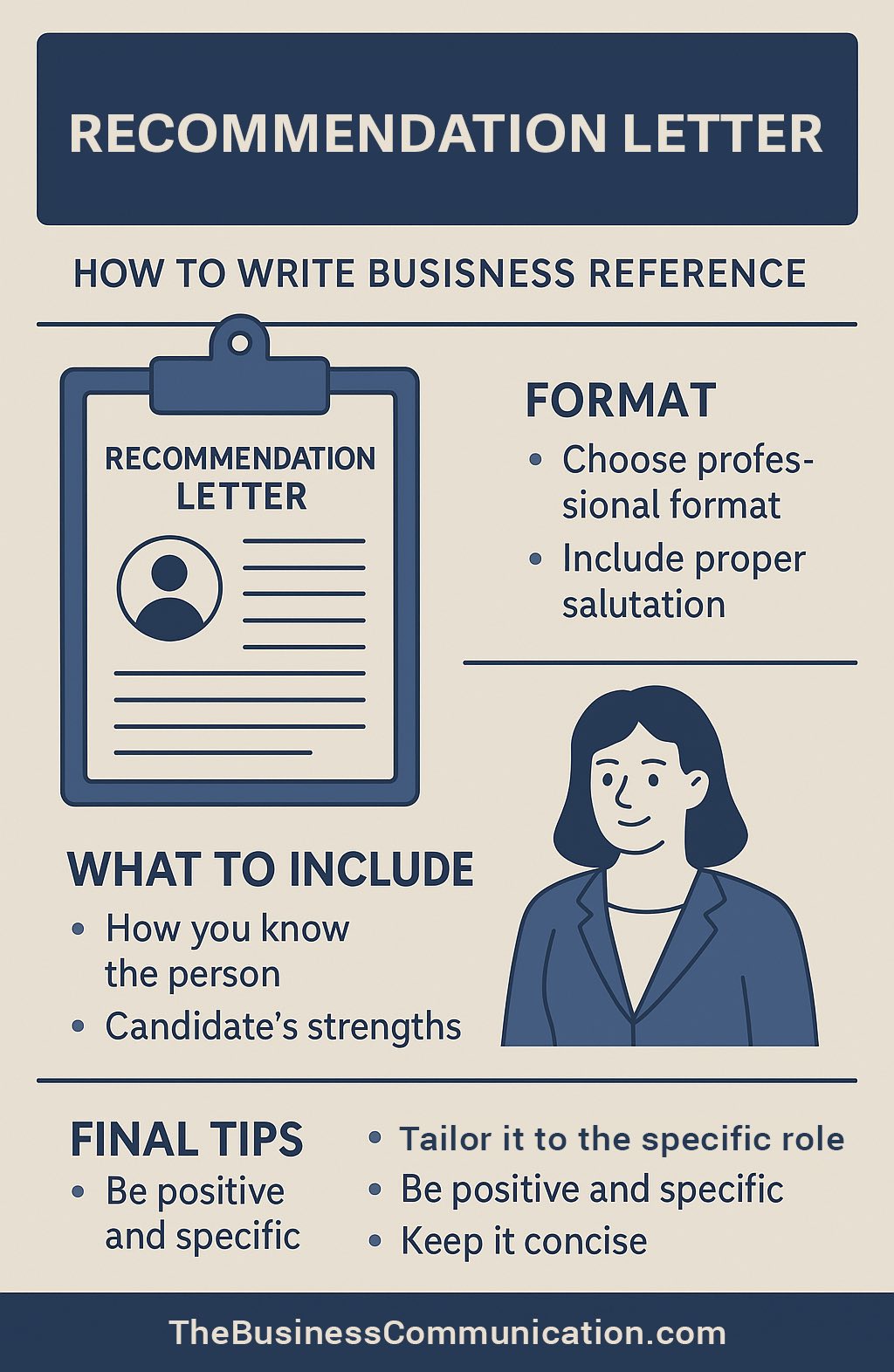
Recommendation letters should follow a professional structure. If you have read about the parts of a business letter, you will recognize the format.
- Sender’s Contact Information: Your full name, job title, company, email, and phone.
- Date: Always include the date of writing.
- Recipient’s Contact Details: The name, position, and organization of the recipient.
- Subject Line: For example, “Recommendation for [Candidate’s Name].”
- Opening Paragraph: Introduce yourself and explain your relationship with the candidate.
- Body Paragraphs: Share specific achievements, skills, and qualities. Use short stories or examples.
- Closing Paragraph: Strongly endorse the candidate and invite the reader to contact you for further details.
- Signature: A polite sign-off with your name and signature.
This structure is easy to follow, ensures clarity, and looks professional. Unlike an inquiry letter, which seeks information, a recommendation letter delivers information with confidence.
Types of Business Recommendation Letters
Not all recommendation letters are the same. The type depends on the purpose.
1. Employment Recommendation Letter
This is the most common type, written by a manager or supervisor to recommend an employee for a job. It emphasizes professional skills, accomplishments, and work ethic.
2. Academic or Internship Recommendation Letter
Usually written by professors, teachers, or internship supervisors. It focuses on academic performance, eagerness to learn, and adaptability.
3. Character Reference Letter
This highlights personal qualities such as honesty, teamwork, and dependability. Often used for general purposes when employers want insight into a candidate’s personality.
4. Business Partnership Recommendation Letter
Written to vouch for the reliability and professionalism of a company, supplier, or partner. Helps in forming new collaborations.
5. Promotion Recommendation Letter
This one is written inside a company to support an employee’s promotion. It highlights contributions, leadership, and loyalty.
Each type follows the same structure but adapts the focus. For instance, a promotion recommendation has similarities with a persuasive order letter because both request something specific, though one asks for goods and the other for recognition.
Key Elements of an Effective Recommendation Letter
A bland letter that says “hardworking and reliable” does not impress anyone. A strong business reference includes the following:
- Clear relationship: State how you know the candidate and for how long.
- Specific achievements: Use numbers, results, or anecdotes to prove the person’s skills.
- Balance of skills and character: Employers want both competence and integrity.
- Professional but warm tone: Be supportive but avoid exaggeration.
- Strong endorsement: Use confident phrases like “I highly recommend” or “Without hesitation, I recommend.”
Unlike a complaint letter, which highlights problems, a recommendation letter highlights solutions: it shows why the person is a valuable asset.
Business Recommendation Letter vs Other Business Letters
To better understand where recommendation letters fit in business communication, let’s compare.
- Cover Letters: Written by applicants to promote themselves. Recommendation letters come from third parties to support them.
- Resignation Letters: Communicate leaving a job. Recommendations often follow, helping with the next step.
- Acknowledgement Letters: Confirm receiving something. Recommendations validate trust and ability.
- Sales Letters: Persuade buyers to invest. Recommendations persuade employers or partners to trust.
Together, these letters form a toolkit for professional communication. Each has its role, tone, and purpose.
Sample Business Recommendation Letter Templates
Here are some templates you can easily adapt.
Template 1: Job Recommendation
Dear [Hiring Manager’s Name],
I am pleased to recommend [Candidate’s Name] for the role of [Job Title] at [Company Name]. I worked with [Candidate] for [X years] at [Your Company], where they consistently demonstrated excellent skills in [specific skill].
One example of their contribution was when they [explain achievement]. Their ability to [mention another skill] made them a valuable part of our team.
I strongly believe [Candidate] will bring the same dedication and success to your organization. Please contact me at [email/phone] if you need more details.
Sincerely,
[Your Name]
Template 2: Internship or Academic Recommendation
Dear [Coordinator’s Name],
It is my pleasure to recommend [Student’s Name] for the internship program at [Company]. As their professor in [Subject], I observed their outstanding academic performance and willingness to go beyond classroom learning.
They demonstrated initiative, teamwork, and problem-solving skills during projects. I am confident they will add great value to your organization.
Sincerely,
[Your Name]
Template 3: Character Reference
Dear [Recipient],
I am writing to recommend [Name], whom I have known for [X years]. They are trustworthy, dependable, and approach every responsibility with sincerity.
Their integrity and collaborative nature make them suitable for opportunities that require responsibility and reliability.
Sincerely,
[Your Name]
Template 4: Business Partnership Recommendation
Dear [Recipient],
I am happy to recommend [Company/Individual] as a reliable business partner. Our collaboration on [describe project] demonstrated their professionalism, timely delivery, and excellent communication.
I am confident that they will be a trustworthy partner for future ventures.
Sincerely,
[Your Name]
Template 5: Promotion Recommendation
Dear [Manager’s Name],
I highly recommend [Employee’s Name] for promotion to [Position]. Over the past [X years], they have shown exceptional leadership, completed projects successfully, and mentored junior staff.
Their dedication and ability to solve complex problems make them the right candidate for this advancement.
Sincerely,
[Your Name]
Common Mistakes to Avoid in Recommendation Letters
Even with good intentions, many recommendation letters fail because of common errors.
- Being too vague: Avoid clichés like “a nice person.” Add details.
- Writing without enough knowledge: Only write if you know the person well.
- Making it too long: Keep it to one page unless absolutely necessary.
- Exaggeration: Stay realistic. Too much praise sounds fake.
- Forgetting contact information: Always include a way to reach you.
These mistakes weaken the impact. A clear, professional letter is more effective than one overloaded with empty praise.
Tips for Writing a Strong Business Recommendation Letter
Here are some final tips to make your recommendation stand out.
- Customize each letter: Tailor it to the specific role or purpose.
- Use action words: Words like “achieved,” “improved,” and “led” add strength.
- Tell a short story: A quick example of success is more memorable than a list.
- Stay positive but realistic: Employers want honesty, not exaggeration.
- Proofread carefully: Typos or grammar errors reduce credibility.
Tone matters here just as much as it does in a formal business letter format. A polished letter reflects professionalism.
Conclusion
A business recommendation letter is not just another document. It is a tool that can shape careers, inspire trust, and strengthen professional relationships. By following the right structure, including specific examples, and keeping the tone professional, you can write a recommendation that truly helps someone.
Think of it as your professional stamp of approval. Just as a complaint letter sample shows how to express concerns tactfully, a recommendation letter shows how to express support effectively. Both are part of the broader art of business communication.
When you are asked to write one, do it with care. It reflects not only on the person you are recommending but also on you as a professional. In the world of business, words matter, and your recommendation may just be the key that unlocks someone’s next big opportunity.
Frequently asked questions
Should I write a recommendation letter if I barely know the candidate?
No. A weak or generic letter damages your credibility and the candidate’s chances. Only write if you can speak to specific achievements and have worked with them long enough to vouch for their abilities. If asked by someone you don’t know well, politely decline and suggest they ask someone with deeper knowledge.
What if the candidate asks me to write a letter but I have concerns about their fit?
Be honest but tactful. You can decline without burning bridges by saying you’re not the best fit to write the letter. If you do write it, focus on genuine strengths rather than exaggerating weaknesses. Never lie to protect someone’s feelings—your reputation is on the line.
Can I send a recommendation letter via email, or should it be printed?
Email is now standard and acceptable. Send it directly to the recipient or the candidate, depending on their request. Use a professional format with your letterhead if possible. Print and sign only if the employer specifically requests a physical copy or formal documentation.
How specific should I be about salary, performance ratings, or past conflicts?
Avoid salary details unless directly asked. Focus on achievements and skills instead. Skip past conflicts entirely unless they demonstrate growth. If performance ratings are relevant, mention them only if they’re strong. Keep the tone forward-looking and positive without being dishonest.
What’s the ideal length for a business recommendation letter?
One page is standard and preferred. Three to four paragraphs with specific examples work best. Hiring managers receive many letters and appreciate concise, impactful writing. Longer letters risk losing attention unless you’re providing exceptional detail that directly supports the candidate.
Should I mention that the candidate asked me to write this letter?
No. It’s understood that the candidate requested it. Simply state your relationship and how long you’ve known them. Mentioning the request sounds awkward and weakens the letter’s credibility. Let your endorsement speak for itself.