


Have you ever wondered why some advertising campaigns go viral instantly while others flop? You might think it is just luck. You might think it is all about having a big budget.
However, the reality is quite different. It is usually about psychology.
Behind every successful media message, there is a framework at work. These frameworks explain how information travels, how people process it, and how it changes their behavior. In the academic world, we call these mass communication theories.
For students and marketers, these are not just dry textbook concepts. They are powerful tools. If you understand the theory, you can predict the result.
We have previously discussed the mechanical side of things in our guide on the [mass communication process]. That post explained how the message moves. Today, we are going to explore why it matters.
We will dive into the psychology of the audience. We will look at seven major theories that have shaped the media landscape. And most importantly, we will see how you can apply them to your business strategy today.
Why Marketers Need to Understand Media Theory
You might be asking a valid question right now. “I am a business student, not a sociologist. Why do I need to know this?”
Here is the deal. Marketing is essentially applied psychology.
When you launch a product, you are trying to change a behavior. You want people to stop buying Brand X and start buying Brand Y. To do that, you need to know what makes them tick.
These theories help you navigate the complex world of [different types of mass media]. They help you decide whether to use a TV ad, an influencer, or a blog post.
Without a theoretical foundation, you are just guessing. You are throwing spaghetti at the wall to see what sticks. With these theories, you become a sniper. You know exactly where to aim your message for maximum impact.
Let’s look at the seven theories that every modern marketer should have in their toolkit.
1. The Magic Bullet Theory (Hypodermic Needle Theory)
Let’s start with one of the oldest concepts. It is often called the Magic Bullet Theory, or sometimes the Hypodermic Needle Theory.
Imagine a doctor injecting medicine directly into a patient’s arm. The effect is immediate. The effect is powerful. And the effect is the same for every patient.
In the early 20th century, theorists believed media worked the same way. They thought if you “injected” a message into the audience via radio or print, everyone would believe it instantly. They viewed the audience as passive zombies.
The Reality Check
We know now that this is not true. People are smart. You cannot just tell them “Buy this soap” and expect everyone to run to the store.
However, many inexperienced marketers still act like this theory is true. They think that “shouting louder” or spamming ads will force people to buy.
Marketing Application
The lesson here is about what not to do. Do not assume your audience is passive.
If you blast a generic message to everyone, it will likely fail. Instead, you need to respect the intelligence of your consumer. You must build trust, not just noise.
2. The Two-Step Flow Theory (The Foundation of Influencer Marketing)
This is perhaps the most valuable theory for the social media age.
The Two-Step Flow Theory argues that mass media does not influence people directly. Instead, the information flows in two distinct steps.
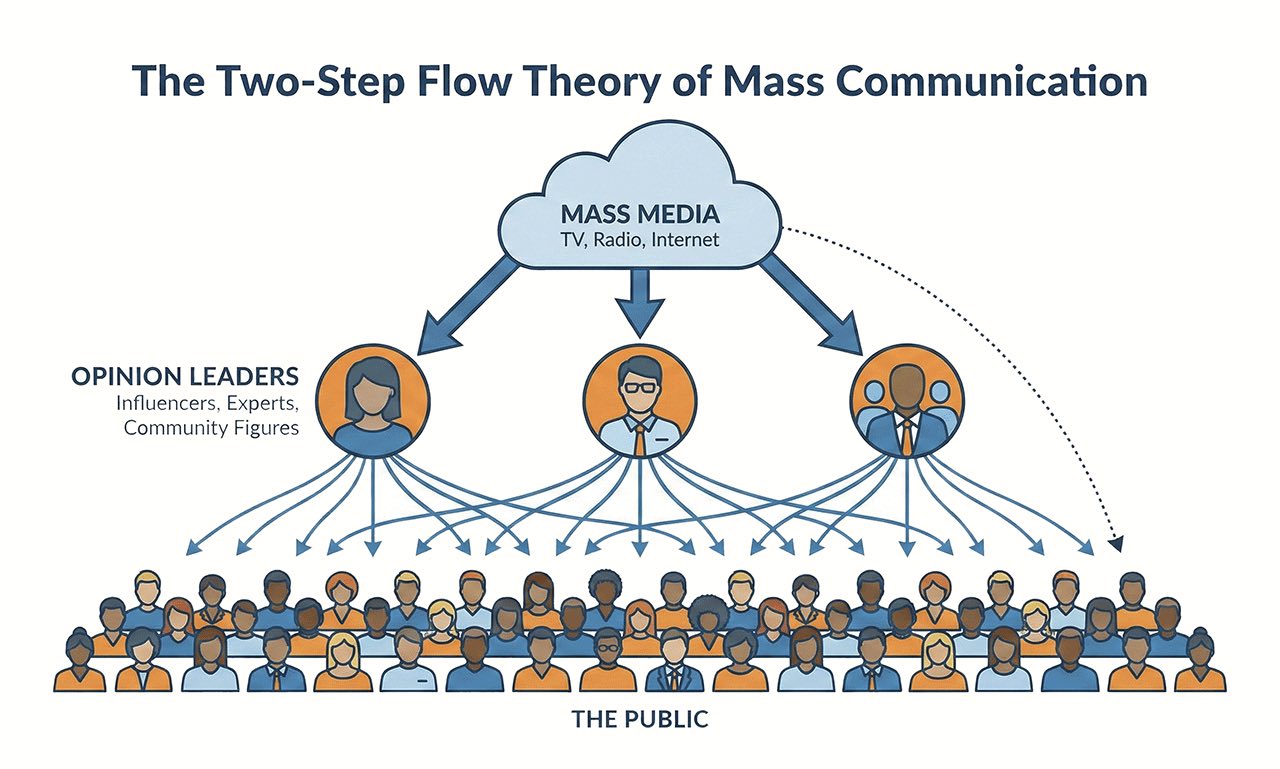
First, the message reaches “Opinion Leaders.” These are the respected individuals in a community. They consume the media, process it, and form an opinion.
Second, these Opinion Leaders pass their interpretation down to the “General Public” (the masses). The public listens to the leader, not the original source.
Marketing Application
Does this sound familiar? It should. This is the scientific basis for Influencer Marketing.
When you want to expand the [scope of mass communication] for your brand, do not just target the masses. Target the leaders.
If you sell tech gadgets, get a popular tech reviewer to talk about it. If you sell makeup, send it to a beauty guru.
Your customers trust these people more than they trust your corporate ads. By winning over the Opinion Leaders, you unlock the trust of their followers.
3. Agenda Setting Theory
Have you ever noticed that everyone seems to be talking about the same news story at the same time?
It is not a coincidence. It is called the Agenda Setting Theory.
This theory suggests that the media acts as a gatekeeper. They select which topics to cover and which to ignore. The core phrase to remember here is: “The media doesn’t tell people what to think, but what to think about.”
If the news covers a recession every day for a month, the public will view the economy as the most important issue. They might have different opinions on it, but the topic itself becomes the priority.
Marketing Application
For business communication, this is all about Public Relations (PR) and Brand Awareness.
You want your brand to be on the agenda. You want people to be thinking about your category.
For example, a cybersecurity company does not just sell antivirus software. They publish reports about “rising hacker threats.” They get the news to talk about hacking.
Once “hacking” is on the public agenda, people naturally start looking for solutions. That is when they find your product. You are setting the stage for the sale before you even pitch the product.
4. Uses and Gratifications Theory (UGT)
Most theories look at what media does to people. This theory flips the script. It looks at what people do with media.
The Uses and Gratifications Theory (UGT) assumes the audience is active. They are not just sitting there waiting for a Magic Bullet. They are actively searching for content to fulfill specific needs.
Generally, people consume media for four main reasons:
- Information: To learn something or stay updated.
- Entertainment: To escape reality or relax.
- Social Interaction: To connect with others.
- Personal Identity: To reinforce their own values.
Marketing Application
This is the backbone of modern Content Marketing and SEO.
When you create content, you must ask yourself: “What need does this fulfill?”
If you are writing for a [digital media platform], you need to know user intent. Are they looking for a quick laugh? Or are they looking for a detailed guide?
If you try to sell a product when the user is looking for entertainment, they will skip your ad. But if you provide a funny video that also showcases your brand, you satisfy their need for entertainment.
Align your content with the user’s gratification, and you will win their loyalty.
5. The Gatekeeping Theory
Information does not flow freely like a river. It flows through gates. And at every gate, there is a guard.
This is the Gatekeeping Theory. It explains that information is filtered before it reaches the audience.
In traditional [broadcast media channels], the gatekeepers were powerful. They were the editors, producers, and station managers. If they did not like your story, it died on the desk. It never reached the public.
Marketing Application
Today, the gatekeepers have changed, but they have not disappeared.
We still have human gatekeepers in PR. You have to pitch your story to journalists. You have to convince them it is worth publishing.
But now, we also have algorithmic gatekeepers. Google, Facebook, and TikTok use algorithms to decide what users see.
If your content does not meet the algorithm’s criteria (engagement, relevance, quality), it gets filtered out. As a digital marketer, your job is to “please the gatekeeper.” You do this by optimizing keywords and creating high-engagement content.
6. Cultivation Theory
Have you ever met someone who watches crime shows all day? They are usually terrified of walking outside at night. They think the world is a dangerous place, even if their neighborhood is perfectly safe.
This is the Cultivation Theory. It suggests that long-term exposure to media shapes our perception of reality.
It is not an immediate effect like the Magic Bullet. It is a slow, gradual process. It is like a stalactite forming in a cave. Drop by drop, the media “cultivates” a specific worldview in the audience.
Marketing Application
This is vital for Branding.
You cannot build a brand overnight. You build it through consistency over years.
Think about a brand like Volvo. For decades, their ads have focused on one thing: Safety. They cultivated the idea that “Volvo equals Safety.”
Now, that is their reality. If you see a Volvo crash, you assume the driver survived.
As a business, you must be consistent with your messaging. If you change your brand voice every month, you break the cultivation process. Stick to your core message, and over time, it will become the customer’s reality.
7. Diffusion of Innovations Theory
Finally, we have a theory that explains how new products spread.
The Diffusion of Innovations Theory divides the population into five groups based on how quickly they adopt new ideas:
- Innovators: The tech geeks who line up at midnight.
- Early Adopters: The opinion leaders who wait for a review.
- Early Majority: The average people who wait until it is “normal.”
- Late Majority: The skeptics who only buy when they have to.
- Laggards: The people who still use flip phones.
Marketing Application
You cannot market to all these groups at the same time.
When you launch a new product, you should target the Innovators and Early Adopters. Use technical language. Focus on novelty.
Once you cross into the mainstream market, you need to change your message. The Early Majority does not care about “new specs.” They care about social proof and reliability.
To effectively grasp the [definition of mass communication] in a business context, you must see it as a timeline. Your message must evolve as your product moves through this diffusion curve.
Which Theory is Best for Your Business?
You have read the list. Now you might be wondering, “Which one should I use?”
The answer is: All of them. Or at least, a mix of them.
There is no single “best” theory. The best marketers mix and match these frameworks depending on their goals.
For example, if you are launching a startup, you might use the Diffusion of Innovations to find your first customers. Simultaneously, you might use the Two-Step Flow by sending free samples to influencers.
Later, as you grow, you will focus on Cultivation Theory to build long-term brand loyalty.
Conclusion
Marketing without theory is like sailing without a map. You might move forward, but you do not know where you are going.
These seven theories give you that map. They explain the invisible forces that drive consumer behavior.
- Magic Bullet: Reminds us not to be arrogant.
- Two-Step Flow: Teaches us the power of influencers.
- Agenda Setting: Shows us the value of PR.
- Uses and Gratifications: Guides our content strategy.
- Gatekeeping: Helps us navigate algorithms and editors.
- Cultivation: emphasizes long-term consistency.
- Diffusion of Innovations: Helps us time our product launches.
By understanding these psychological triggers, you move beyond simple communication. You start mastering the art of persuasion.
Now that you have a grasp on the theories, it is time to see them in action. I recommend reading our guide on the [role of digital media] next. It will show you how these classic theories are being rewritten in the online world.
So, the next time you see an ad that makes you want to click, stop and analyze it. Which theory are they using on you? You might be surprised by the answer.