


Imagine you have moved your office to a new location. Now, you need to inform 500 clients, 50 suppliers, and all your stakeholders about this change. Writing individual emails to everyone would take forever.
So, what is the solution?
The answer is a Circular Letter.
In the world of business communication, efficiency is key. A circular letter allows you to send the same important information to a large number of people at once. It saves time, ensures consistency, and keeps your professional network updated.
In this comprehensive guide, we will cover everything you need to know about circular letters. From the correct format and common mistakes to real-life samples like branch openings and business expansions, we have got it all covered.
What is a Circular Letter?
A circular letter is a formal document sent to a specific group of people to convey the same message. It acts as a mass communication tool. Unlike a personal letter, which is written for one individual, a circular is “circulated” among many.
You might use it internally to inform employees about a new policy. Alternatively, you might use it externally to tell customers about a new product launch.
Key Objectives:
- To Announce: Sharing news about new branches, partners, or address changes.
- To Persuade: Convincing customers to try a new service.
- To Inform: Notifying stakeholders about policy changes.
Circular Letter vs. Memo vs. Notice and Newsletter
Many people get confused between these three documents. However, they serve different purposes.
- Circular Letter: Sent to a large group (internal or external). It is often written in a letter format with a salutation.
- Memo (Memorandum): Strictly for internal communication within an organization. It is usually less formal than a circular.
- Notice: A short announcement usually pinned on a board or shared digitally. It is legally binding in some contexts (like board meetings) but lacks the personal touch of a letter.
People often confuse circular letters with other forms of communication. Here is how they differ:
| Aspect | Circular Letter | Notice | Memo | Newsletter |
|---|---|---|---|---|
| Audience | Many people, internal or external | Mostly internal | Internal (specific team) | Internal or external |
| Tone | Formal but friendly | Strictly formal | Formal | Informative & engaging |
| Length | Short to medium | Very short | Brief | Longer with multiple topics |
| Purpose | Inform, announce, persuade | Inform only | Inform or instruct | Share updates regularly |
Having this table makes it easy to pick the right form of communication.
Types of Circular Letters
Circular letters come in many forms. Here are the most common types with quick examples.
- Business Circular Letters: Announcing new products, partnerships, or company updates.
- Sales or Marketing Circulars: Promoting discounts, special offers, or product launches.
- Policy Change Circulars: Informing employees about new HR rules or work-from-home guidelines.
- Appointment or Promotion Circulars: Announcing new hires or promotions within the company.
- Meeting or Event Circulars: Inviting staff to annual meetings, workshops, or conferences.
- Price List or Discount Circulars: Common in retail businesses to inform customers about new price lists.
- Holiday or Closure Circulars: Announcing office closure for holidays, repairs, or emergencies.
Instead of putting all details for each type here, you can create separate blog posts for each. This not only helps SEO but also allows readers to explore the topic they care about.
The Standard Format of a Circular Letter
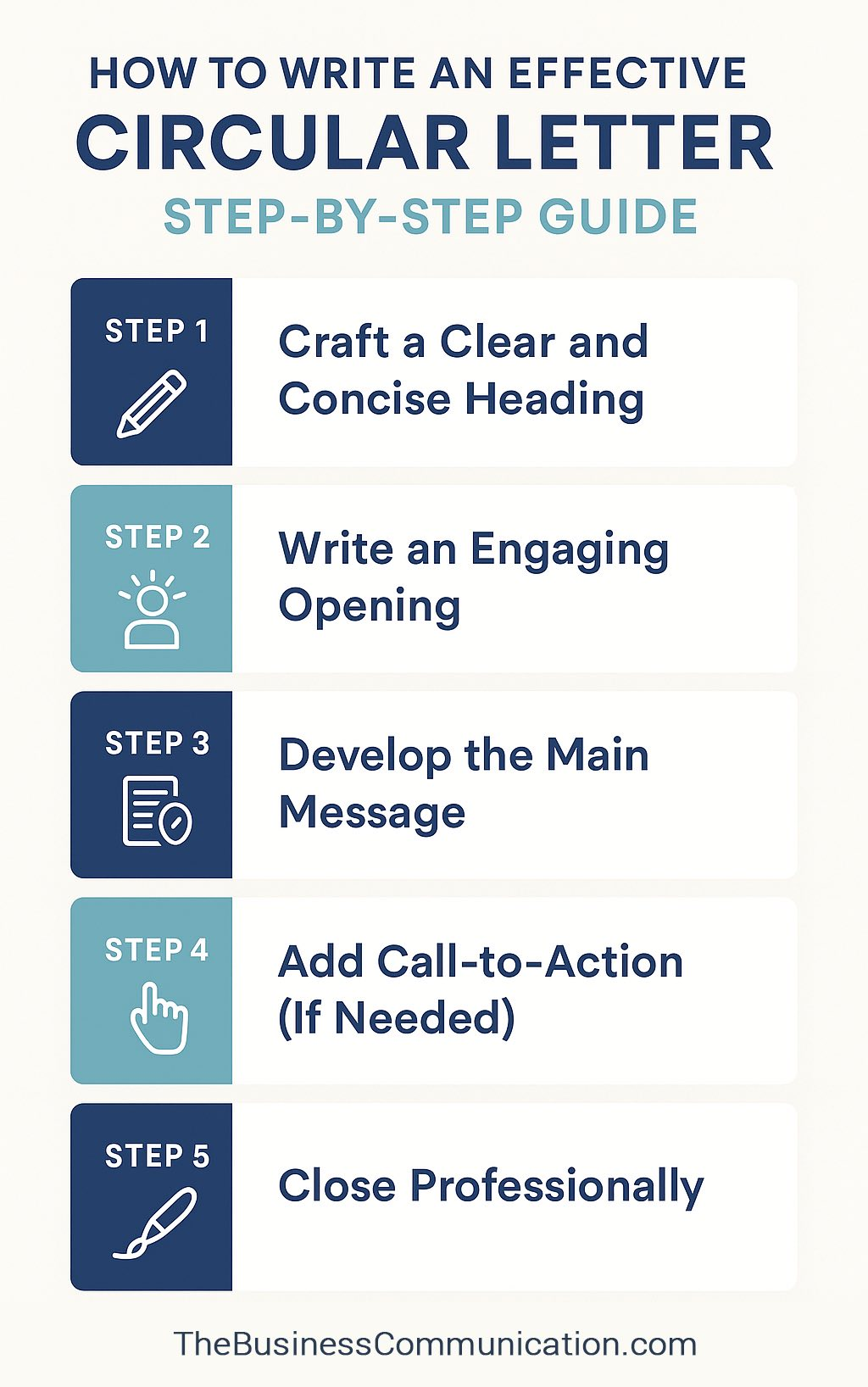
Writing a circular letter is not rocket science. Still, you must follow a professional structure to ensure it is taken seriously.
Here is the standard layout you should follow:
1. Letterhead
Always print your circular on company letterhead. This establishes authority.
2. Reference Number & Date
This is crucial for record-keeping. For example: Ref: DTC/2025/CL-01.
3. Inside Address (Optional)
Since you are sending this to many people, you often skip the specific inside address. Instead, you might use a “To” line.
4. Salutation
Use a generalized but polite greeting.
- Examples: “Dear Valued Customers,” “Dear Team,” or “To Whom It May Concern.”
5. The Body
- Opening: State the purpose immediately.
- Middle: Provide the necessary details (dates, locations, reasons).
- Closing: End with a call to action or a polite thank you.
6. Signature
Your name, designation, and company seal.
Common Mistakes to Avoid
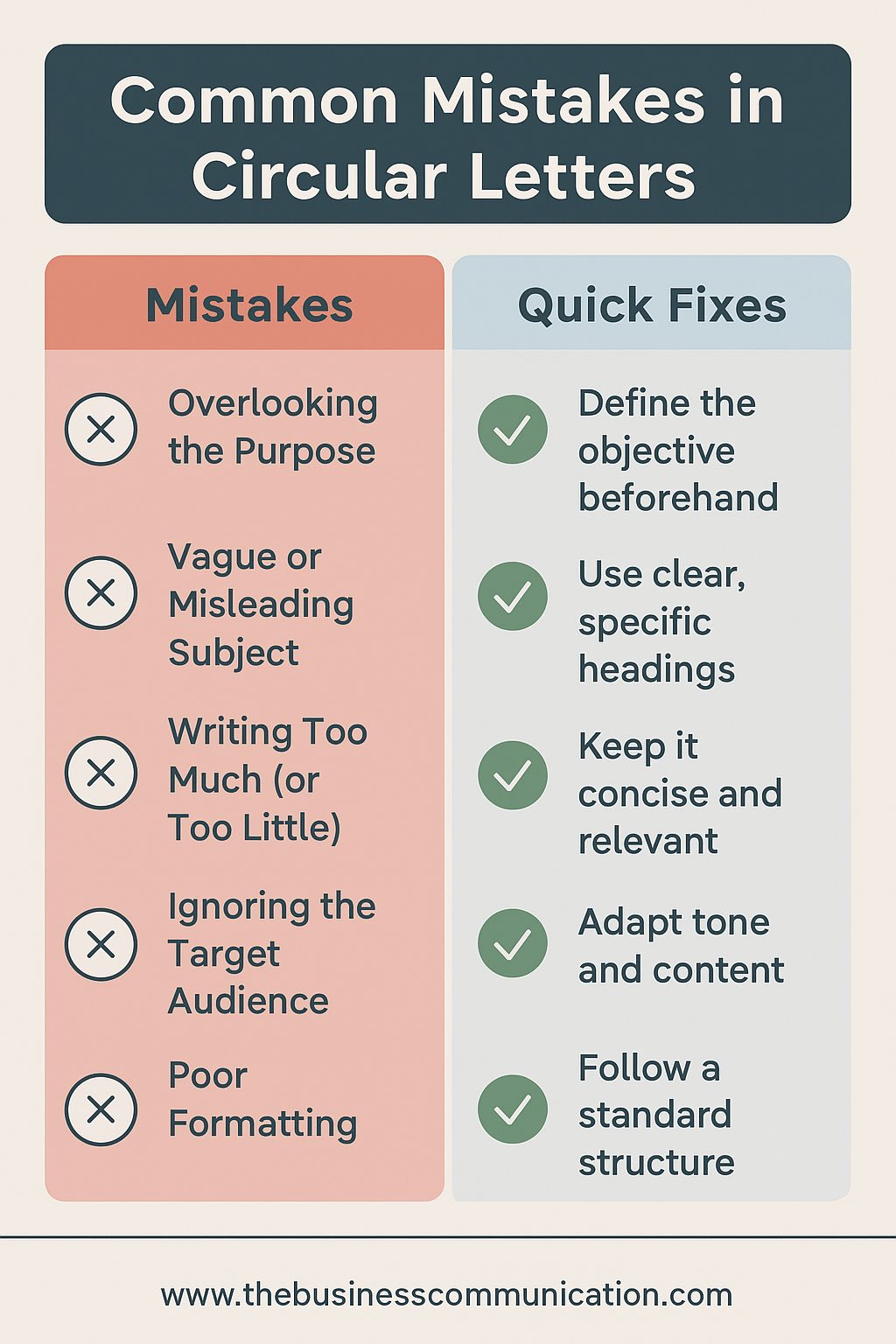
Even experienced professionals make errors when drafting circulars. If you want your message to be effective, avoid these pitfalls.
- Being Too Vague: Your readers are busy. If you do not get to the point, they will stop reading.
- Ignoring the Tone: A circular about a “Price Hike” should be polite and explanatory. Conversely, a circular about a “New Branch” should be enthusiastic. Matching the tone to the message is vital.
- Information Overload: Do not cram too many topics into one letter. Keep it focused on one main announcement.
- Poor Formatting: Huge walls of text are hard to read. Use bullet points and short paragraphs to make it scannable.
Circular Letter Advantages vs Disadvantages
This table makes it easy to understand that the advantages far outweigh the downsides if you write them well.
| Aspect | Advantages | Disadvantages |
|---|---|---|
| Reach | Reaches many people at once | May feel impersonal |
| Clarity | Provides consistent information | Risk of being ignored if too long |
| Professionalism | Adds formal tone and credibility | Can sound stiff if not written well |
| Record Keeping | Creates a communication trail | Requires effort to draft properly |
5 Professional Circular Letter Samples
Here are practical examples you can adapt for your business needs.
Sample 1: Opening of a New Branch
(Use this when your business expands to a new location)
Subject: Announcement of Our New Branch in [City Name]
Dear Valued Customers,
We are thrilled to announce that [Company Name] is expanding!
Thanks to your continuous support and trust in our services, we are opening a new branch in [Location/City]. This expansion will allow us to serve you better and faster.
New Branch Details:
- Address: [Insert Full Address]
- Opening Date: [Insert Date]
- Contact Person: [Manager’s Name]
We invite you to visit our new office. As a token of appreciation, we are offering a 10% discount on all services at the new location for the first month.
Thank you for being part of our journey.
Sincerely,
[Your Name]
[Designation]
Sample 2: Change of Business Address
(Use this to ensure you don’t lose mail or clients during a move)
Subject: Important Notice Regarding Change of Office Address
Dear Clients and Partners,
Please be informed that our head office is moving to a new, larger facility to accommodate our growing team.
Effective from [Date], all our operations will be conducted from the following address:
[New Address Here]
[New Phone Number, if applicable]
Please update your records accordingly. All correspondence should now be sent to this new location. We apologize for any inconvenience this temporary transition may cause.
Best regards,
[Your Name]
[Designation]
Sample 3: Introduction of a New Partner
(Essential for law firms, accounting agencies, or partnerships)
Subject: Welcoming Our New Partner, Mr./Ms. [Name]
Dear Clients,
It gives us immense pleasure to inform you that Mr./Ms. [Name] has joined [Company Name] as a Managing Partner.
Mr./Ms. [Name] brings over 15 years of experience in [Field/Industry]. We are confident that their expertise will add significant value to the services we provide to you.
We look forward to your continued cooperation.
Yours faithfully,
[Your Name]
[Designation]
Sample 4: Price Adjustment Circular
(A delicate topic that needs a polite tone)
Subject: Adjustment in Service Charges
Dear Customer,
At [Company Name], we are committed to providing you with the highest quality products.
Over the last year, the cost of raw materials and logistics has increased significantly. Despite our best efforts to absorb these costs, we find it necessary to slightly adjust our pricing structure.
Effective from [Date], there will be a marginal increase of [Percentage]% across our product line. This change ensures that we can maintain the premium quality you expect from us.
We appreciate your understanding and continued patronage.
Sincerely,
[Your Name]
[Manager]
Sample 5: Business Expansion (General)
Subject: Expanding Our Horizons – New Product Line Launch
Dear Retailers and Distributors,
We are happy to inform you that [Company Name] is expanding its portfolio. After months of research and development, we are launching our new line of [Product Name].
These products are designed to meet the growing demand for [Specific Need]. We believe this addition will be highly profitable for your retail outlets.
Please find the attached catalog and price list. We look forward to receiving your orders soon.
Best regards,
[Your Name]
[Sales Manager]
Download Sample Circular Letters for Business, School, Employees
Why start from scratch every time you need to write a circular letter? To save you time and effort, I have combined all 9 sample circular letters from this post into one neatly formatted, ready-to-edit document.
Inside the file, you will find:
- Business announcement circular sample
- Sales/discount circular letter
- Policy/office order sample
- HR promotion, holiday, and meeting circulars
- School exam, holiday, and parent-teacher meeting circulars
Each sample is properly formatted with headings, salutations, and closings, so you can just fill in your details and use it right away.
Download the Complete Circular Letter Sample Collection (Google Doc)
Pro Tip: Make a copy of this file in your Google Drive, so you can reuse and edit it whenever you need without affecting the original version.
Conclusion
Writing a circular letter is a fundamental skill in business communication. Whether you are announcing a victory like a new branch or delivering news about a price hike, clarity is your best friend.
By following the standard format and avoiding common mistakes, you can ensure your message is received positively.
Next time you need to make a mass announcement, do not start from scratch. Use the templates above to save time and maintain professionalism.
Frequently asked questions
Should I personalize circular letters or keep them completely generic?
Use a generic salutation like “Dear Valued Customers” for true circulars sent to hundreds. However, if your list is smaller (under 50), consider mail-merge to insert names. This adds a personal touch without sacrificing efficiency. The key is matching personalization to your audience size and relationship depth.
What if my circular needs to reach both internal employees and external customers?
Send two separate circulars with tailored messages. Employees need different details and tone than customers. A single generic version risks confusing both groups. Use the same reference number and date to show they’re related announcements, but customize the body, salutation, and call-to-action for each audience.
Is a circular letter still appropriate in 2025, or should I use email instead?
Email works for urgent, informal updates. Use a printed circular letter for formal announcements (policy changes, office moves, price increases) that need a professional record and wider distribution. Circulars carry more weight and credibility. Choose based on formality level and whether you need a physical archive.
How long should a circular letter be to avoid being ignored?
Keep it under one page. Busy readers scan quickly. State your purpose in the first paragraph, provide essential details in 3-4 short paragraphs, then close with a clear call-to-action. Use bullet points for multiple items. If you need more space, you’re likely covering too many topics.
What reference number format should I use for tracking circulars?
Create a system that includes your department initials, year, and sequence number. Example: HR/2025/CL-05 or DTC/2025/CL-01. This helps recipients file and reference the letter accurately. Keep a log of all circulars sent for compliance and record-keeping purposes.
5 Comments
Thanks its helpful for my studyies
You ought to take part in a contest for one
of the greatest sites on the web. I’m going to recommend this website!
sample letter please ?
its so nice
Excellent article. I certainly love this website.
Stick with it!