


In the business world, information is power. Whether you are looking for the price of a new software, checking the status of a job application, or asking a supplier about bulk discounts, you need to ask the right questions to get the right answers.
This is where the Inquiry Letter comes in.
Writing a clear, professional inquiry letter is a fundamental skill. A poorly written inquiry can lead to confusion, delays, or even being ignored completely. On the other hand, a well-crafted letter establishes professionalism and gets you the information you need quickly.
In this comprehensive guide, we will combine everything you need to know about inquiry letters. From formatting and etiquette to real-life samples and common mistakes, consider this your go-to resource.
What is an Inquiry Letter?
An inquiry letter is a formal written request for information. You send it when you want details about a product, service, job opening, course, or even a business partnership.
Think of it as the written version of asking a friend, “Hey, can you tell me more about that?” except you are asking a company, school, or professional contact, and you need to be polite and professional.
Some people call it an enquiry letter, which is more common in British English. Both mean the same thing.
The primary goals are:
- To ask for specific details (price, availability, features).
- To request a catalogue, brochure, or sample.
- To check the status of an order or application.
Types of Inquiry Letters
Not all inquiry letters are the same. Here are some common types:
Business Inquiry Letter
Used when a company wants to know about another company’s product, service, or policy. For example, a retailer might ask a manufacturer for bulk pricing.
Product or Service Inquiry Letter
Individuals or businesses use this to ask about features, availability, or technical specifications. Example: “Do you have this product in blue and what is the delivery time?”
Job or Internship Inquiry Letter
Job seekers send this letter to HR to check if a company has openings. It is a great way to show interest even before jobs are posted.
Educational Inquiry Letter
Students or parents use this to ask about admission requirements, scholarship opportunities, or application deadlines.
General Information Inquiry Letter
Covers everything else. You might write one to ask a government office about procedures, or to an event organizer about participation rules.
Inquiry Letter vs. Request Letter: What’s the Difference?
Many people use these terms interchangeably, but there is a subtle difference.
- Inquiry Letter: Primarily seeks information. You are asking “What,” “When,” or “How much.”
- Example: “Do you have this laptop in stock?”
- Request Letter: Primarily seeks an action or a favor. You are asking someone to “Do” something.
- Example: “Please send me the catalogue.”
While they overlap, an inquiry often leads to a request. For example, you might inquire about a product’s price and then request a demo.
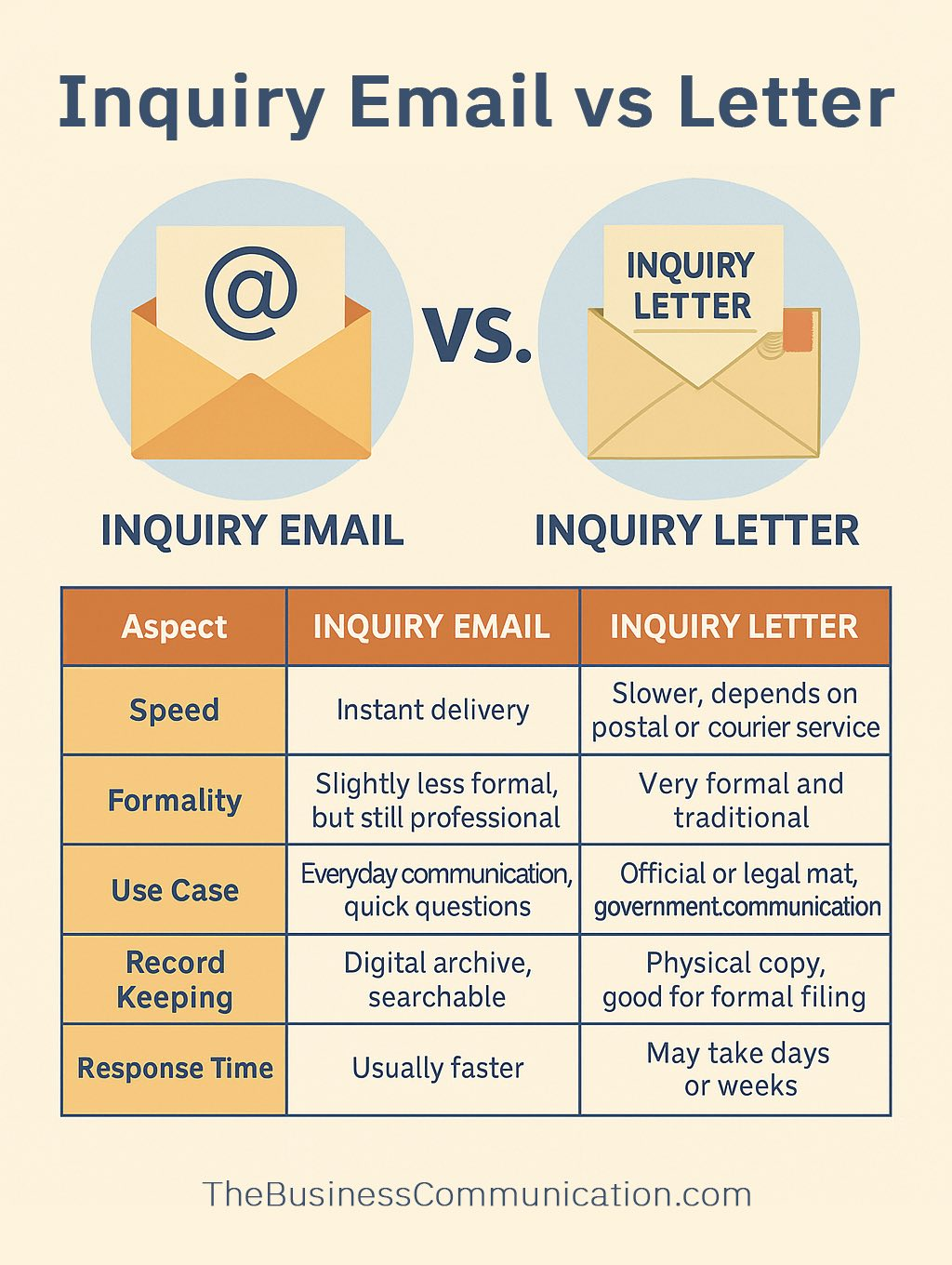
Inquiry Email vs Inquiry Letter: Core Differences
Here’s a quick comparison to make things crystal clear:
| Aspect | Inquiry Email | Inquiry Letter |
|---|---|---|
| Speed | Instant delivery | Slower, depends on postal or courier service |
| Formality | Slightly less formal, but still professional | Very formal and traditional |
| Use Case | Everyday communication, quick questions, job inquiries | Official or legal matters, government communication |
| Record Keeping | Digital archive, searchable | Physical copy, good for formal filing |
| Response Time | Usually faster | May take days or weeks |
Pro Tip: If you are unsure, send an email. It is the standard for modern business communication.
The Standard Inquiry Letter Format
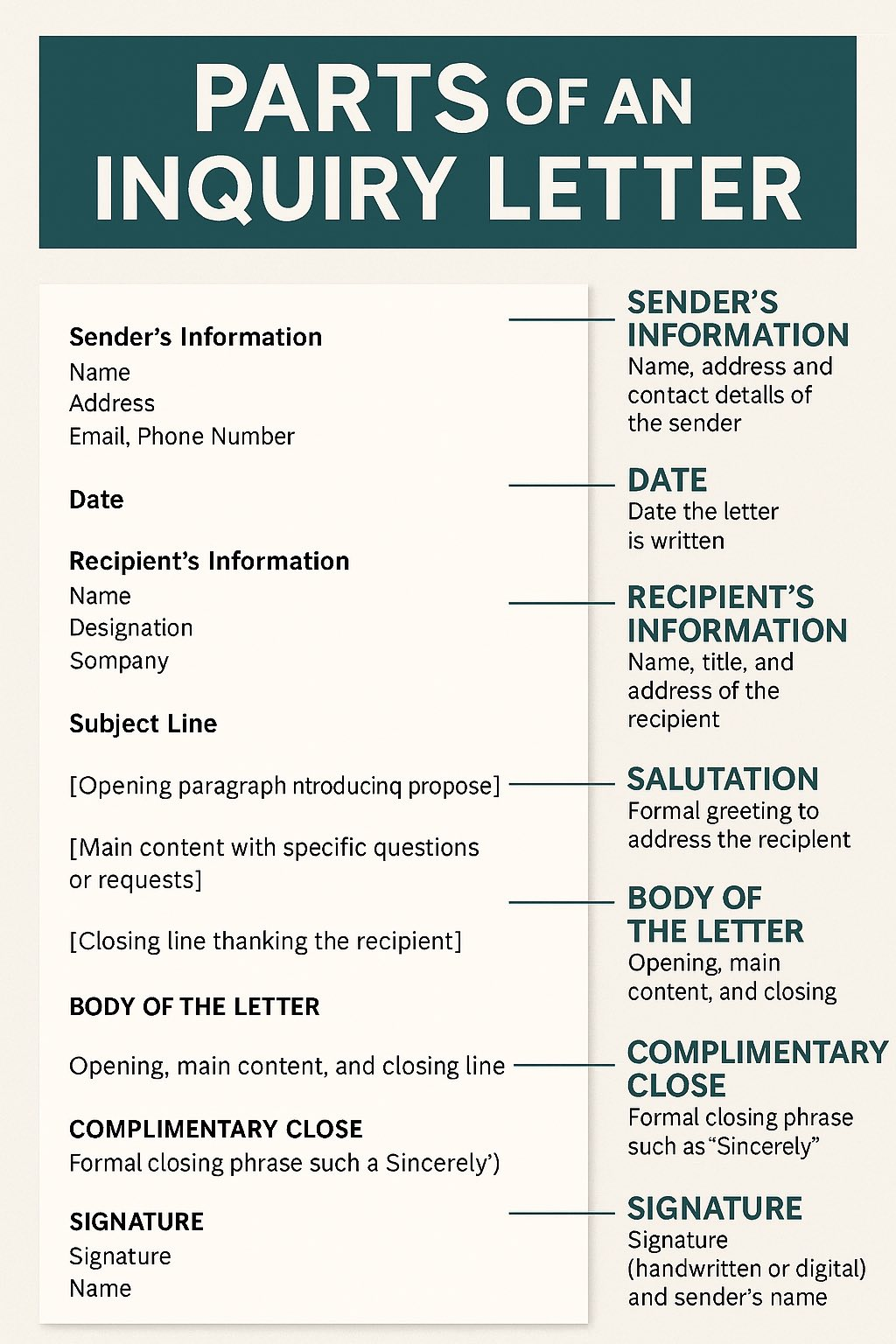
A professional inquiry letter must follow a structured layout. Whether you are typing a letter or sending an email, these elements are essential.
1. The Header (For Letters)
- Your Contact Info: Name, Address, Phone, Email.
- Date: The day you are writing.
- Recipient’s Info: Name, Title, Company Name, Address.
2. The Salutation
Always address a specific person if possible.
- Preferred: “Dear Mr. Khan,” or “Dear Ms. Smith,”
- If unknown: “Dear Hiring Manager,” or “To the Sales Department,”
3. The Opening (The Context)
State clearly who you are and why you are writing. Do not make the reader guess.
- Example: “I am writing to inquire about the bulk pricing for your Model-X Office Chairs.”
4. The Body (The Questions)
This is the core of your letter. Be specific. If you have multiple questions, use bullet points.
- Bad: “Tell me about your services.”
- Good: “Could you please provide details on:
- Your delivery timelines?
- Warranty policies?
- Payment terms?”
5. The Closing (Call to Action)
Politely mention what you expect next.
- Example: “I look forward to receiving this information by Friday.”
6. The Sign-off
Use a professional closing like “Sincerely,” or “Best regards,” followed by your signature.
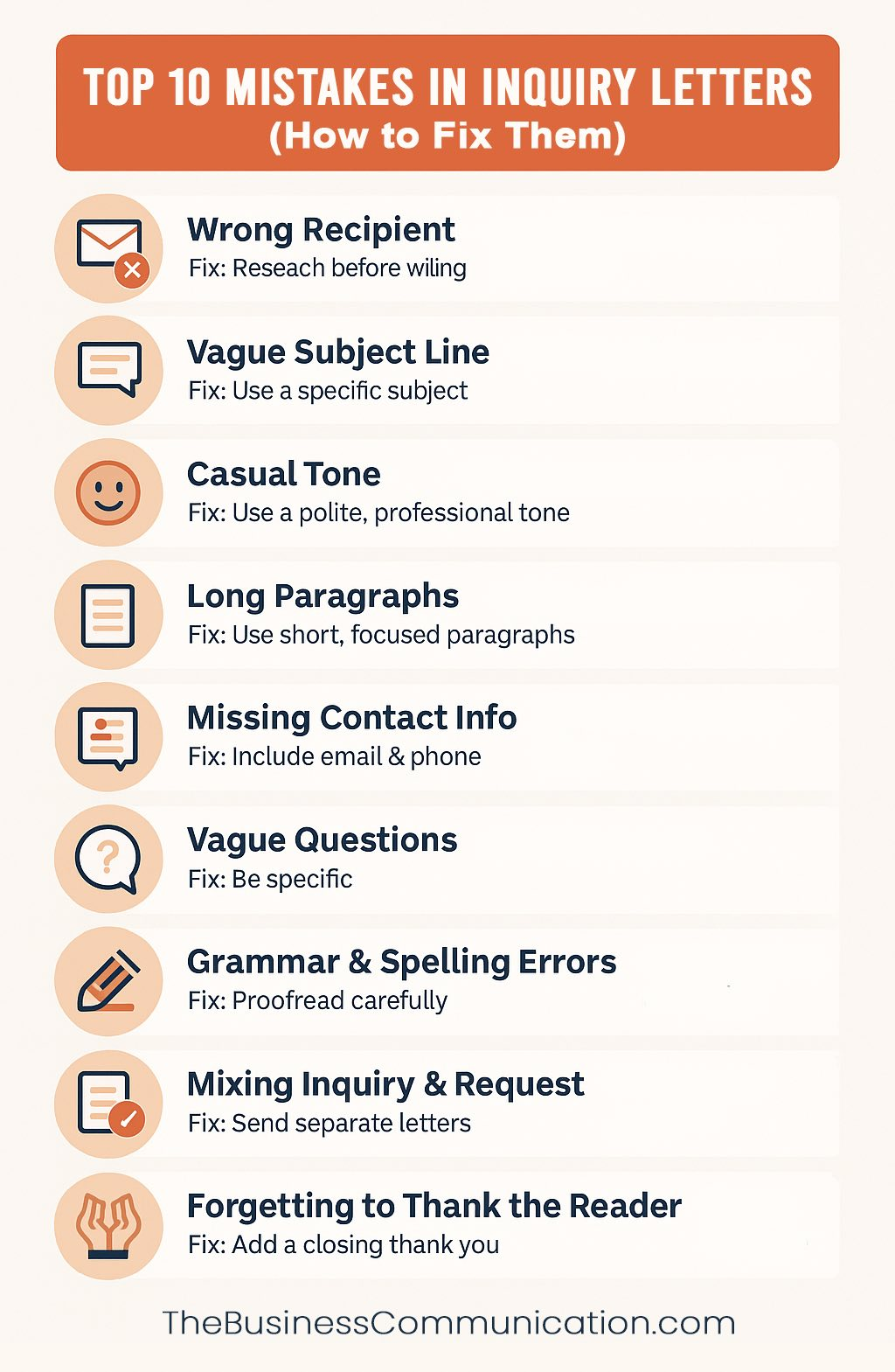
Top 5 Mistakes to Avoid in Inquiry Letters
Even experienced professionals make errors that hurt their chances of getting a reply. Here are the most common pitfalls:
- Vague Subject Lines: Sending an email with the subject “Hello” or “Question” is a recipe for being ignored. Use “Inquiry Regarding Bulk Order #123” instead.
- Information Overload: Don’t write a novel. Keep your letter concise and focused on the specific information you need.
- Aggressive Tone: Avoid demanding language like “Send this immediately.” Use “Could you please share…” instead.
- Forgetting Contact Info: If you want a brochure mailed to you, did you remember to include your mailing address? Always double-check.
- Not Doing Homework: Don’t ask questions that are easily answered on their website’s “About Us” or “FAQ” page. It shows a lack of research.
3 Professional Inquiry Letter Samples
You can copy and adapt these templates for your own use.
Sample 1: Product Price & Availability (Email Format)
Subject: Inquiry Regarding Price and Availability of Dell XPS 15
Dear Sales Team,
I hope this email finds you well.
My name is [Your Name], and I am the Purchasing Manager at [Your Company Name]. We are currently looking to upgrade our office laptops and are interested in the Dell XPS 15 (Model 9500).
Could you please provide the following information?
- Current unit price for orders of 10+ units.
- Availability of stock for immediate delivery.
- Details regarding your corporate warranty packages.
We are looking to finalize our purchase by the end of this week, so a prompt response would be appreciated.
Best regards,
[Your Name]
[Your Phone Number]
[Your LinkedIn Profile/Website]
Sample 2: Inquiry for Job Vacancy (Unsolicited)
Subject: Inquiry Regarding Potential Opportunities – Digital Marketing Team
Dear Mr. Ahmed,
I have been following [Company Name]’s recent campaigns with great interest, especially the “Summer Sale” project. I am writing to inquire if there are any upcoming openings in your Digital Marketing department.
I have over 5 years of experience in SEO and content strategy and believe my skills would align well with your team’s innovative approach.
I have attached my resume for your review. If there are no current vacancies, I would appreciate it if you could keep my profile on file for future opportunities.
Thank you for your time and consideration.
Sincerely,
[Your Name]
[Link to Portfolio]
Sample 3: Business Services Inquiry (Formal Letter Style)
[Your Name]
[Your Address]
[Date]
[Recipient Name]
[Manager, Catering Services]
[Company Name]
[Address]
Ref: Inquiry about Catering Services for Annual Conference
Dear [Recipient Name],
We are organizing our Annual Tech Conference on December 15, 2025, and are looking for a reliable catering partner.
We would like to inquire about your buffet services for approximately 200 guests. Specifically, could you please clarify:
- Do you offer vegetarian and gluten-free menu options?
- What is the cost per head for a premium lunch buffet?
- Is the service staff included in the package?
Please send us your latest brochure and a price list at your earliest convenience.
Sincerely,
[Signature]
[Your Printed Name]
[Designation]
🎁 Bonus: 25 professional inquiry letter templates (free download)
Why copy and paste each template one by one when you can grab them all at once? I have bundled all 25 professional inquiry letter templates into a single, clean, and ready-to-use document.
You can open it in Google Docs for instant editing or download it as a Word file for offline use. Just click the link below and start customizing:
👉 Download All 25 Inquiry Letter Templates Here
This free resource will save you hours of formatting work and help you send professional inquiry letters in minutes. Bookmark it, share it with friends, or save it for future reference.
Conclusion
Writing an inquiry letter is not just about asking questions; it’s about building a bridge between you and the information you need.
By following the standard structure, keeping your tone polite yet professional, and avoiding common mistakes, you ensure that your inquiry gets the attention it deserves.
Next time you need to reach out to a business or institution, don’t just send a quick text. Use these templates to draft a letter that commands respect and guarantees a reply.
Frequently asked questions
Should I send an inquiry as a letter or email?
Send an email. It’s the modern standard for business communication and gets faster responses. Use a formal letter only for official or legal matters, government communication, or when the recipient specifically requests it. Email is searchable, instant, and still professional when formatted correctly.
What if I don’t know the recipient’s name or title?
Use a generic but professional salutation like “Dear Hiring Manager,” “Dear Sales Department,” or “To Whom It May Concern.” Then spend 30 seconds searching LinkedIn or the company website for a specific contact. A named recipient always gets better results than a generic greeting.
How many questions should I ask in one inquiry letter?
Ask 3-5 specific questions maximum. Use bullet points to organize them. Too many questions overwhelm the recipient and reduce response rates. Group related questions together. If you need extensive information, consider a follow-up letter after you receive initial answers.
Why might my inquiry letter be ignored?
Common reasons include vague subject lines (“Hello” instead of “Inquiry Regarding Product Pricing”), unclear purpose, information overload, aggressive tone, or poor formatting. Keep it concise, specific, and professional. Include a clear call to action with a deadline, like “I’d appreciate a response by Friday.”
Is it acceptable to follow up if I don’t get a response?
Yes. Wait 5-7 business days, then send a polite follow-up email referencing your original inquiry. Keep it brief: “I wanted to follow up on my inquiry from [date]. Could you confirm receipt?” A second follow-up after another week is acceptable, but a third is usually too much.
Can I use an inquiry letter template for different types of requests?
Yes, the basic structure works for all inquiry types: header, salutation, context, specific questions, call to action, and sign-off. Adjust the tone and questions based on context. A job inquiry is slightly less formal than a government inquiry, but the framework stays the same.